Results by title
18284 books match the query 'United States' and 3764 start with t
Trumping Religion
The New Christian Right, the Free Speech Clause, and the CourtsSteven P. Brown
University of Alabama Press, 2004
The first scholarly treatment of the strategies employed by the New Christian Right in redefining religious freedom in the courtroom.
Trumping Religion provides a detailed analysis of the five major public-interest law firms that have litigated religion cases in the federal courts between 1980 and 2000. Allied with several highly vocal, evangelical ministries, such as those of Jerry Falwell and Pat Robinson, these legal organizations argue that religious expression is a form of protected speech and thereby gain a greater latitude of interpretation in the courts. The long-term agenda of the New Christian Right as illuminated by this study is to shape church-state jurisprudence in a way that permits free course for the Christian gospel.
Steven P. Brown presents his research and conclusions from a balanced viewpoint. In filling a distinct void in the literature, this book will be of considerable interest to political scientists, legal scholars, law schools and seminaries, and anyone concerned with the intersection of religion and judicial politics.
Trust in the Land
New Directions in Tribal ConservationBeth Rose Middleton
University of Arizona Press, 2011
—Cayuse Chief Young Chief, Walla Walla Council of 1855
America has always been Indian land. Historically and culturally, Native Americans have had a strong appreciation for the land and what it offers. After continually struggling to hold on to their land and losing millions of acres, Native Americans still have a strong and ongoing relationship to their homelands. The land holds spiritual value and offers a way of life through fishing, farming, and hunting. It remains essential—not only for subsistence but also for cultural continuity—that Native Americans regain rights to land they were promised.
Beth Rose Middleton examines new and innovative ideas concerning Native land conservancies, providing advice on land trusts, collaborations, and conservation groups. Increasingly, tribes are working to protect their access to culturally important lands by collaborating with Native and non- Native conservation movements. By using private conservation partnerships to reacquire lost land, tribes can ensure the health and sustainability of vital natural resources. In particular, tribal governments are using conservation easements and land trusts to reclaim rights to lost acreage. Through the use of these and other private conservation tools, tribes are able to protect or in some cases buy back the land that was never sold but rather was taken from them.
Trust in the Land sets into motion a new wave of ideas concerning land conservation. This informative book will appeal to Native and non-Native individuals and organizations interested in protecting the land as well as environmentalists and government agencies.
Trust in the Law
Encouraging Public Cooperation with the Police and CourtsTom R. Tyler
Russell Sage Foundation, 2002
Trust
Representatives and ConstituentsWilliam T. Bianco
University of Michigan Press, 1994
Why do constituents sometimes defer to their representative's judgment, rewarding her for acting as she thinks best, even when she ignores their demands? By making decisions about trust, constituents determine whether their representative is rewarded for implementing their demands or for using her judgment. These decisions shape legislator behavior and, through behavior, policy outcomes. Therefore, any attempt to explain or evaluate representative institutions such as the modern Congress requires an answer to a simple question: When do constituents trust their representative, and what is the basis of that trust?
This book is the first systematic analysis of constituent trust. It assumes that elected officials and ordinary citizens are rational actors. However, the book moves beyond the standard rational choice framework in three ways. It avoids narrow, unrealistic assumptions about motivations and information. It shows that many kinds of behavior not usually thought of as rational choices, such as a voter's desire to be represented by "someone like them," are the product of a systematic, predictable calculus---a calculus aimed at securing favorable policy outcomes. Finally, the book uses interviews with ninety-three members of the U.S. House of Representatives to test its predictions about trust.
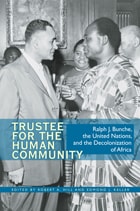
Trustee for the Human Community
Ralph J. Bunche, the United Nations, and the Decolonization of AfricaRobert A. Hill
Ohio University Press, 2010
Ralph J. Bunche (1904–1971), winner of the Nobel Peace Prize in 1950, was a key U.S. diplomat in the planning and creation of the United Nations in 1945. In 1947 he was invited to join the permanent UN Secretariat as director of the new Trusteeship Department. In this position, Bunche played a key role in setting up the trusteeship system that provided important impetus for postwar decolonization ending European control of Africa as well as an international framework for the oversight of the decolonization process after the Second World War.
Trustee for the Human Community is the first volume to examine the totality of Bunche’s unrivalled role in the struggle for African independence both as a key intellectual and an international diplomat and to illuminate it from the broader African American perspective.
These commissioned essays examine the full range of Ralph Bunche’s involvement in Africa. The scholars explore sensitive political issues, such as Bunche’s role in the Congo and his views on the struggle in South Africa. Trustee for the Human Community stands as a monument to the profoundly important role of one of the greatest Americans in one of the greatest political movements in the history of the twentieth century.
Contributors: David Anthony, Ralph A. Austen, Abena P. A. Busia, Neta C. Crawford, Robert R. Edgar, Charles P. Henry, Robert A. Hill, Edmond J. Keller, Martin Kilson, Georges Nzongola-Ntalaja, Jon Olver, Pearl T. Robinson, Elliott P. Skinner, Crawford Young
Trustees of Culture
Power, Wealth, and Status on Elite Arts BoardsFrancie Ostrower
University of Chicago Press, 2002
Her new study demonstrates that members of elite arts boards walk a fine line between maintaining their status and serving the needs of the large-scale organizations they oversee. As class members whose status depends in part on the prestige of the boards on which they serve, trustees seek to perpetuate arts boards as exclusive elite enclaves. But in response to pressures to increase and diversify the audiences for arts institutions, elite board members act in a surprisingly open manner in terms of organizational accessibility and operations.
Written with clarity and grace, Trustees of Culture will contribute significantly to our understanding of organizational governance; the politics of fundraising; elite arts participation and philanthropy; as well as the consequences of wider social policies that continue to emphasize private financial support. Ostrower's study will prove to be indispensable reading for not just sociologists of culture, but anyone interested in how the arts are financially and institutionally supported.
Trusteeship in Change
Toward Tribal Autonomy in Resource ManagementRichmond L. Clow
University Press of Colorado, 2001
This book also includes case studies focused on wildlife management, forest preservation, tribal hunting laws, and other specific concerns in management, preservation and utilization of Native American land. An excellent source for scholars in the fields of Native American and environmental studies, Trusteeship in Change is sure to spark debate and to be an important reference book for years to come.
Truth Be Told
White Nostalgia and Antiracist Queer Resistance in “Post-Truth” AmericaLaura Elliot Tetreault
The Ohio State University Press, 2025
Taking a critical disinformation studies approach, Tetreault analyzes post-truth political messaging in the US after 2016. Using racial rhetorical criticism combined with a queer lens, they focus on how contemporary antiracist, queer, and feminist activists used various forms of cultural production to work against disinformation and its circulation, enacting refusal and insisting on the validity of their own knowledges as a form of community care. Tetreault ultimately argues that it’s not just the truth that academics must advocate for; they must question whose truth and how that truth is mediated and circulated.
Trying Biology
The Scopes Trial, Textbooks, and the Antievolution Movement in American SchoolsAdam R. Shapiro
University of Chicago Press, 2013
Trying Home
The Rise and Fall of an Anarchist Utopia on Puget SoundJustin Wadland
Oregon State University Press, 2014
The true story of an anarchist colony on a remote Puget Sound peninsula, Trying Home traces the history of Home, Washington, from its founding in 1896 to its dissolution amid bitter infighting in 1921.
As a practical experiment in anarchism, Home offered its participants a rare degree of freedom and tolerance in the Gilded Age, but the community also became notorious to the outside world for its open rejection of contemporary values. Using a series of linked narratives, Trying Home reveals the stories of the iconoclastic individuals who lived in Home, among them Lois Waisbrooker, an advocate of women’s rights and free love, who was arrested for her writings after the assassination of President McKinley; Jay Fox, editor of The Agitator, who defended his right to free speech all the way to the Supreme Court; and Donald Vose, a young man who grew up in Home and turned spy for a detective agency.
Justin Wadland weaves his own discovery of Home—and his own reflections on the concept of home—into the story, setting the book apart from a conventional history. After discovering the newspapers published in the colony, Wadland ventures beyond the documents to explore the landscape, travelling by boat along the steamer route most visitors once took to the settlement. He visits Home to talk with people who live there now.
Meticulously researched and engagingly written, Trying Home will fascinate scholars and general readers alike, especially those interested in the history of the Pacific Northwest, utopian communities, and anarchism.
Trying to Get Over
African American Directors after Blaxploitation, 1977-1986By Keith Corson
University of Texas Press, 2016
From 1972 to 1976, Hollywood made an unprecedented number of films targeted at black audiences. But following this era known as “blaxploitation,” the momentum suddenly reversed for black filmmakers, and a large void separates the end of blaxploitation from the black film explosion that followed the arrival of Spike Lee’s She's Gotta Have It in 1986. Illuminating an overlooked era in African American film history, Trying to Get Over is the first in-depth study of black directors working during the decade between 1977 and 1986.
Keith Corson provides a fresh definition of blaxploitation, lays out a concrete reason for its end, and explains the major gap in African American representation during the years that followed. He focuses primarily on the work of eight directors—Michael Schultz, Sidney Poitier, Jamaa Fanaka, Fred Williamson, Gilbert Moses, Stan Lathan, Richard Pryor, and Prince—who were the only black directors making commercially distributed films in the decade following the blaxploitation cycle. Using the careers of each director and the twenty-four films they produced during this time to tell a larger story about Hollywood and the shifting dialogue about race, power, and access, Corson shows how these directors are a key part of the continuum of African American cinema and how they have shaped popular culture over the past quarter century.
Tubby
Raymond O. Barton and the US Army, 1889-1963Stephen A. Bourque
University of North Texas Press, 2024
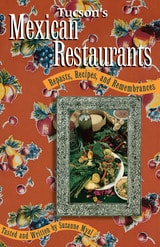
Tucson's Mexican Restaurants
Repasts, Recipes, and RemembrancesSuzanne Myal
University of Arizona Press, 1999
From the traditional restaurants of South Tucson to newer dining spots on the north and east sides, Tucson's Mexican Restaurants is an affectionate look at some of the best places to savor this wonderful cuisine. Suzanne Myal takes readers into the kitchens of many of these establishments to offer insights into the families that run them, the secrets of food preparation, and even the history of some of Tucson's best-loved recipes. Many of those recipes, along with others from prominent Mexican American families, are reproduced in the book, inviting readers to try their hand at red beef tamales, chiles rellenos, and other favorite dishes.
The book is organized by six sections of town, with a locator map for each. The entry for each establishment includes address, hours, price range, and credit card information, and indicates the specialties of the house. Each entry is also coded for features such as level of alcohol service; availability of carryout, delivery, and catering; and whether the menu features heart-healthy or vegetarian options. A separate section lists Mexican bakeries and tortilla factories, and a guide to fiestas helps readers choose beer or tequila—and find menudo when they've overindulged.
From street trucks to historic sites, Mexican restaurants in Tucson offer something for every palate. This book can help visitors and residents alike find their way around them and better enjoy some of the best Mexican food north of the border.
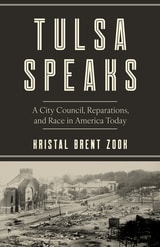
Tulsa Speaks
A City Council, Reparations, and Race in America TodayKristal Brent Zook
Rutgers University Press, 2026
In 2021, the international media descended upon Tulsa, Oklahoma, for the centennial commemoration of the May 31–June 1, 1921, massacre in which a white mob killed more than three hundred African American residents, burned homes and businesses, and decimated a thriving town once referred to as “Black Wall Street.”
Tulsa Speaks is about the ongoing work of the Tulsa City Council, both before the Centennial and afterward, when the cameras were no longer trained on the city. It dives deep into the interpersonal dynamics among the nine councilors, exploring the continuing fight for reparations and racial justice and the long-running efforts of councilor, Vanessa Hall-Harper of District 1, to bring repair to Greenwood.
Tulsa, like many municipal bodies across the country, serves as a hopeful sign of what we might become, as Americans and as a microcosm of race relations in America today.
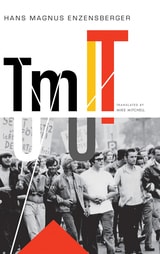
Tumult
Hans Magnus Enzensberger
Seagull Books, 2016
Hans Magnus Enzensberger, widely regarded as Germany’s greatest living poet, was already well known in the 1960s, the tempestuous decade of which Tumult is an autobiographical record. Derived from old papers, notes, jottings, photos, and letters that the poet stumbled upon years later in his attic, the volume is not so much about the man, but rather the many places he visited and people whom he met on his travels through the Soviet Union and Cuba during the 1960s. The book is made up of four long-form pieces written from 1963 to 1970, each episode concluding with a poem and postscript written in 2014. Translated by Mike Mitchell, the book is a lively and deftly written travelogue offering a glimpse into the history of leftist thought. Dedicated to “those who disappeared,” Tumult is a document of that which remains one of humanity’s headiest times.
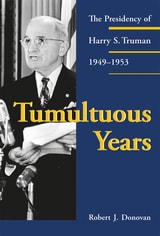
Tumultuous Years
The Presidency of Harry S. Truman, 1949-1953Robert J. Donovan
University of Missouri Press, 1996
Tungsten in Peace and War, 1918–1946
Ronald H. Limbaugh
University of Nevada Press, 2011
Tunnel Visions
The Rise and Fall of the Superconducting Super ColliderMichael Riordan, Lillian Hoddeson, and Adrienne W. Kolb
University of Chicago Press, 2015
Drawing on extensive archival research, contemporaneous press accounts, and over one hundred interviews with scientists, engineers, government officials, and others involved, Tunnel Visions tells the riveting story of the aborted SSC project. The authors examine the complex, interrelated causes for its demise, including problems of large-project management, continuing cost overruns, and lack of foreign contributions. In doing so, they ask whether Big Science has become too large and expensive, including whether academic scientists and their government overseers can effectively manage such an enormous undertaking.
Turbulence Across the Sea
Transatlantic Relations and Strategic CompetitionEdited by Elie Baranets and Andrew Novo
University of Michigan Press, 2024
With a mix of research methodologies applied by scholars from both sides of the Atlantic, Turbulence Across the Sea offers a comprehensive analysis of relations among European and North American actors in the context of strategic competition among the United States, Europe, Russia, and China. In doing so, it demonstrates that a reaffirmation of transatlantic cooperation is necessary to maintain security in the face of aggressive moves by both Russia and China. By analyzing attitudes from the perspective of both the various actors (Britain, France, Germany, and the European Union) and various sectors (intelligence cooperation, foreign direct investments, technology, and the defense industry), this book provides readers with a comprehensive perspective on the challenges and opportunities in the shifting landscape of security in the twenty-first century.
Turf Wars
How Congressional Committees Claim JurisdictionDavid C. King
University of Chicago Press, 1997
Political scientists have long maintained that jurisdictions are relatively static, changing only at times of dramatic reforms. Not so, says King. Combining quantitative evidence with interviews and case studies, he shows how on-going turf wars make jurisdictions fluid.
According to King, jurisdictional change stems both from legislators seeking electoral advantage and from nonpartisan House parliamentarians referring ambiguous bills to committees with the expertise to handle the issues. King brilliantly dissects the politics of turf grabbing and at the same time shows how parliamentarians have become institutional guardians of the legislative process.
Original and insightful, Turf Wars will be valuable to those interested in congressional studies and American politics more generally.
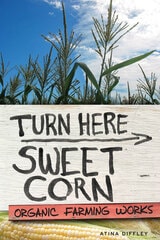
Turn Here Sweet Corn
Organic Farming WorksAtina Diffley
University of Minnesota Press, 2013
When the hail starts to fall, Atina Diffley doesn’t compare it to golf balls. She’s a farmer. It’s “as big as a B-size potato.” As her bombarded land turns white, she and her husband Martin huddle under a blanket and reminisce: the one-hundred-mile-per-hour winds; the eleven-inch rainfall (“that broccoli turned out gorgeous”); the hail disaster of 1977. The romance of farming washed away a long time ago, but the love? Never. In telling her story of working the land, coaxing good food from the fertile soil, Atina Diffley reminds us of an ultimate truth: we live in relationships—with the earth, plants and animals, families and communities.
A memoir of making these essential relationships work in the face of challenges as natural as weather and as unnatural as corporate politics, her book is a firsthand history of getting in at the “ground level” of organic farming. One of the first certified organic produce farms in the Midwest, the Diffleys’ Gardens of Eagan helped to usher in a new kind of green revolution in the heart of America’s farmland, supplying their roadside stand and a growing number of local food co-ops. This is a story of a world transformed—and reclaimed—one square acre at a time.
And yet, after surviving punishing storms and the devastating loss of fifth-generation Diffley family land to suburban development, the Diffleys faced the ultimate challenge: the threat of eminent domain for a crude oil pipeline proposed by one of the largest privately owned companies in the world, notorious polluters Koch Industries. As Atina Diffley tells her David-versus-Goliath tale, she gives readers everything from expert instruction in organic farming to an entrepreneur’s manual on how to grow a business to a legal thriller about battling corporate arrogance to a love story about a single mother falling for a good, big-hearted man.
Turn Out the Lights
Chronicles of Texas during the 80s and 90sBy Gary Cartwright
University of Texas Press, 2000
Whether the subject is Jack Ruby, Willie Nelson, or his own leukemia-stricken son Mark, when it comes to looking at the world through another person's eyes, nobody does it better than Gary Cartwright. For over twenty-five years, readers of Texas Monthly have relied on Cartwright to tell the stories behind the headlines with pull-no-punches honesty and wry humor. His reporting has told us not just what's happened over three decades in Texas, but, more importantly, what we've become as a result.
This book collects seventeen of Cartwright's best Texas Monthly articles from the 1980s and 1990s, along with a new essay, "My Most Unforgettable Year," about the lasting legacy of the Kennedy assassination. He ranges widely in these pieces, from the reasons for his return to Texas after a New Mexican exile to profiles of Kris Kristofferson and Willie Nelson. Along the way, he strolls through San Antonio's historic King William District; attends a Dallas Cowboys old-timers reunion and the Holyfield vs. Foreman fight; visits the front lines of Texas' new range wars; gets inside the heads of murderers, gamblers, and revolutionaries; and debunks Viagra miracles, psychic surgery, and Kennedy conspiracy theories. In Cartwright's words, these pieces all record "the renewal of my Texas-ness, a rediscovery of Texas after returning home."
Turned Inside Out
Reading the Russian Novel in PrisonSteven Shankman
Northwestern University Press, 2017
Turned Inside Out will appeal to readers with interests in the classic novels of Russian literature, in prisons and pedagogy, or in Levinas and phenomenology. At a time when the humanities are struggling to justify the centrality of their mission in today’s colleges and universities, Steven Shankman by example makes an undeniably powerful case for the transformative power of reading great texts.
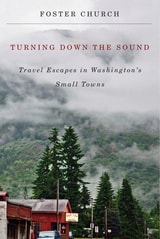
Turning Down the Sound
Travel Escapes in Washington's Small TownsFoster Church
Oregon State University Press, 2014
As in his previous book, Discovering Main Street: Travel Adventures in Small Towns of the Northwest, Church employs the finesse of his Pulitzer-Prize-winning journalism. He also shares his passion for encouraging tourists down less traveled paths—paths that curve beside valleys and wheat fields, travel along orchards and straits, and abut mountains and rivers.
Once inside these small towns, local flavors abound. Church reveals how each community’s unique character informs its hospitality and culture: In Morton, the abandoned Roxy movie theater was re-opened to host lectures and live performances. In the town of Palouse, a once-lonesome farming community in the Washington wheat country is now home to antiques shops and art galleries, and in Pomeroy, a pioneering legacy is celebrated in a lively annual festival.
With maps, photographs, and recommendations for more than thirty-five towns in all corners of the state, Turning Down the Sound vastly expands the resources available for readers and travelers keen on encountering what Church calls American tourism’s last frontier: its small towns.
Turning Points of the American Civil War
Edited by Chris Mackowski and Kristopher D. White, with a foreword by Thomas A. Desjardin
Southern Illinois University Press, 2017
Turning South Again
Re-Thinking Modernism/Re-Reading Booker T.Houston A. Baker Jr.
Duke University Press, 2001
From the holds of slave ships to the peonage of Reconstruction to the contemporary prison system, incarceration has largely defined black life in the United States. Even Washington’s school at Tuskegee, Baker explains, housed and regulated black bodies no longer directly controlled by slave owners. He further implicates Washington by claiming that in enacting his ideas about racial “uplift,” Washington engaged in “mulatto modernism,” a compromised attempt at full citizenship. Combining autobiographical prose, literary criticism, psychoanalytic writing, and, occasionally, blues lyrics and poetry, Baker meditates on the consequences of mulatto modernism for the project of black modernism, which he defines as the achievement of mobile, life-enhancing participation in the public sphere and economic solvency for the majority of African Americans. By including a section about growing up in the South, as well as his recent return to assume a professorship at Duke, Baker contributes further to one of the book’s central concerns: a call to centralize the South in American cultural studies.
Turning the Legislative Thumbscrew
Minority Rights and Procedural Change in Legislative PoliticsDouglas Dion
University of Michigan Press, 2001
Turning the Page
Storytelling as Activism in Queer Film and MediaCoon, David R
Rutgers University Press, 2018
Surprisingly, Hollywood is still clumsily grappling with its representation of sexual minorities, and LGBTQ filmmakers struggle to find a place in the mainstream movie industry. However, organizations outside the mainstream are making a difference, helping to produce and distribute authentic stories that are both by and for LGBTQ people.
Turning the Page introduces readers to three nonprofit organizations that, in very different ways, have each positively transformed the queer media landscape. David R. Coon takes readers inside In the Life Media, whose groundbreaking documentaries on the LGBTQ experience aired for over twenty years on public television stations nationwide. Coon reveals the successes of POWER UP, a nonprofit production company dedicated to mentoring filmmakers who can turn queer stories into fully realized features and short films. Finally, he turns to Three Dollar Bill Cinema, an organization whose film festivals help queer media find an audience and whose filmmaking camps for LGBTQ youth are nurturing the next generation of queer cinema.
Combining a close analysis of specific films and video programs with extensive interviews of industry professionals, Turning the Page demonstrates how queer storytelling in visual media has the potential to empower individuals, strengthen communities, and motivate social justice activism.
Turning the Tide
Making Life Better for Deaf and Hard of Hearing SchoolchildrenGina A. Oliva
Gallaudet University Press, 2014
Turning the Tide presents a qualitative study of deaf and hard of hearing students who attended mainstream schools. The authors conducted three focus groups in different regions in the country, enlisting six to eight participants with diverse backgrounds for each session. They also gathered information from 113 online respondents who answered the same questions used in the focus groups. The respondents discussed many issues, including the difficulties of finding friends and social access, the struggle to establish an identity, the challenges of K-12 interpreting and class placement, and the vast potential of summer and weekend programs for deaf students. Their empowering stories clearly demonstrate that no deaf or hard of hearing student should be educated alone. The authors also elicited comments on other changes that parents, advocates, and other allies could work toward to improve further the educational environment of deaf children.
Turning the Tide
The University of Alabama in the 1960sEarl H. Tilford
University of Alabama Press, 2014
Earl H. Tilford details the origins of the student movement from within the Student Government Association, whose leaders included Ralph Knowles and future governor Don Siegelman, among others; the participation of key members of “The Machine,” the political faction made up of the powerful fraternities and sororities on campus; and the efforts of more radical non-Greek students like Jack Drake, Ed Still, and Sondra Nesmith. Tilford also details the political maneuverings that drove the cause of social change through multiple administrations at the university. Turning the Tide highlights the contributions of university presidents Frank A. Rose and David Mathews, as well as administrators like the dean of men John L. Blackburn, who supported the student leaders but also encouraged them to work within the system rather than against it.
Based on archival research, interviews with many of the principal participants, and the author’s personal experiences, Tilford’s Turning the Tide is a compelling portrait of a university in transition during the turbulence surrounding the civil rights and anti-war movements of the 1960s.
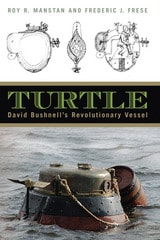
Turtle
David Bushnell's Revolutionary VesselRoy R. Manstan
Westholme Publishing, 2010
The Remarkable History and Reconstruction of the First Operational Submarine
At the onset of the American Revolution, the British expected to quell the rebellion quickly with a show of overwhelming force. In an experiment in asymmetric warfare, David Bushnell created the first submarine vessel designed specifically “for the destruction of vessels of war.” On a quiet September night in 1776, sergeant Ezra Lee maneuvered Bushnell’s strange little craft out from Manhattan and into the midst of the greatest naval fleet ever assembled in the Americas. Lee’s goal was to sink the British flagship HMS Eagle by attaching a powerful explosive to its hull. Although the mission was unsuccessful, Bushnell’s concept of submarine warfare was considered by George Washington to have been “an effort of genius.”
David Bushnell was raised in the town of Saybrook at the mouth of the Connecticut River. More than two centuries later, another Turtle would be launched into the same river within sight of Bushnell’s first forays with his vessel during the summer of 1775. Under the direction of technical arts teacher Frederic J. Frese, students at Old Saybrook High School created a working replica of Bushnell’s submarine, facilitated through an education partnership with the Naval Undersea Warfare Center in Newport, Rhode Island, where Roy R. Manstan was a mechanical engineer and Navy trained diver. With twenty-first century submariners at the helm, the Turtle replica was subjected to a series of operational tests at the Mystic Seaport Museum in Mystic, Connecticut.
In Turtle: David Bushnell’s Revolutionary Vessel, the authors provide new insight into Bushnell’s “engine of devastation,” tracing the history of undersea warfare before Bushnell and the origin of the many innovations Bushnell understood would be necessary for conducting a covert submarine attack. The knowledge gained from testing the Turtle replica enabled the authors to speculate as to what America’s first submariner Ezra Lee experienced that September night and what may have caused the attack to fail.
Tuscaloosa
200 Years in the MakingG. Ward Hubbs
University of Alabama Press, 2019
A lavishly illustrated history of this distinctive city’s origins as a settlement on the banks of the Black Warrior River to its development into a thriving nexus of higher education, sports, and culture
In both its subject and its approach, Tuscaloosa: 200 Years in the Making is an account unlike any other of a city unlike any other—storied, inimitable, and thriving. G. Ward Hubbs has written a lively and enlightening bicentennial history of Tuscaloosa that is by turns enthralling, dramatic, disturbing, and uplifting. Far from a traditional chronicle listing one event after another, the narrative focuses instead on six key turning points that dramatically altered the fabric of the city over the past two centuries.
The selection of this frontier village as the state capital gave rise to a building boom, some extraordinary architecture, and the founding of The University of Alabama. The state’s secession in 1861 brought on a devastating war and the burning of the university by Union cavalry; decades of social adjustments followed, ultimately leading to legalized racial segregation. Meanwhile, town boosters set out to lure various industries, but with varying success.
The decision to adopt new inventions, ranging from electricity to telephones to automobiles, revolutionized the daily lives of Tuscaloosans in only a few short decades. Beginning with radio, and followed by the Second World War and television, the formerly isolated townspeople discovered an entirely different world that would culminate in Mercedes-Benz building its first overseas production plant nearby. At the same time, the world would watch as Tuscaloosa became the center of some pivotal moments in the civil rights movement—and great moments in college football as well.
An impressive amount of research is collected in this accessibly written history of the city and its evolution. Tuscaloosa is a versatile history that will be of interest to a general readership, for scholars to use as a starting point for further research, and for city and county school students to better understand their home locale.
Tutoring Matters
Everything You Always Wanted To Know About How To TutorJerome Rabow
Temple University Press, 1999
Tutoring Matters is the authoritative manual for both the aspiring and seasoned tutor. Using firsthand experiences of over one hundred new and experienced tutors, this long-awaited guide offers chapters on attitudes and anxieties, teaching techniques, and building relationships. It educates the tutor on how to handle and appreciate social and language differences; how to use other adults -- teachers, administrators, parents, employers -- to a student's advantage; and, when your student or circumstances determine that it's time, how to put a positive and supportive end to the tutor-tutee relationship.
Written by experienced tutors and tutoring educators, Tutoring Matters celebrates -- and provides just the right tools for -- an individualized and successful tutoring relationship and shows just how much you can learn -- about the world and yourself -- through teaching others.
Tutoring Matters
Everything You Always Wanted to Know about How to TutorAuthored by Tiffani Chin, Jerome Rabow and Jeimee Estrada
Temple University Press, 2011
Tutoring Matters is the authoritative guide for both the aspiring and seasoned tutor. Using firsthand experiences of over one hundred new and experienced college student tutors, the authors offer techniques for handling tutoring anxieties, teaching strategies, and tips for building relationships.
This new edition has been fully updated to help tutors to engage the interest of their students. In addition, it features practical “tip boxes” that provide quick-reference guidelines on a range of tutoring challenges—from making a connection in your first tutoring session to becoming familiar with your pupil's life and tutoring needs. This new edition also provides practical experience-based tips "from the trenches" about how to tutor math and reading and how to help students develop other academic skills and interests.
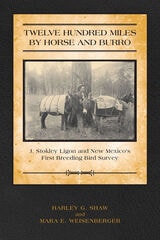
Twelve Hundred Miles by Horse and Burro
J. Stokley Ligon and New Mexico’s First Breeding Bird SurveyHarley G. Shaw and Mara E. Weisenberger
University of Arizona Press, 2011
As it turns out, the trek was Ligon's first job with the US Biological Survey, and it did not go entirely undocumented. The breeding bird population report that eventually resulted from the journey, photographs from glass plate negatives, and—perhaps most enticingly—Ligon's own personal diary from these travels are presented here. Not just a compelling account of the expedition itself, the materials and insights found in this volume also reveal aspects of Ligon's family history, his early interest in wildlife, and the development of the wilderness skills needed to undertake such a survey.
Using his original itinerary and handwritten report, the authors of this book revisited many of the places that Ligon surveyed and in a few cases were even able to locate and repeat Ligon's early photographs. Combined with a discussion of the conditions of birds and other wildlife then and now, this volume serves as a useful tool for understanding how wildlife numbers, distribution, and habitats changed in New Mexico over the course of the twentieth century.
Birding enthusiasts, historians, naturalists, and even armchair adventurers will all find something to love in this chronicle of a young man from a West Texas ranching family with a driving ambition to be a professional naturalist and writer.
Twelve Mormon Homes Revisited
Touring Polygamous Utah with Elizabeth Kane, 1872-1873Lowell C. Bennion
University of Utah Press, 2024
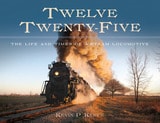
Twelve Twenty-Five
The Life and Times of a Steam LocomotiveKevin P. Keefe
Michigan State University Press, 2016
Pere Marquette 1225 was built in 1941 at the peak of steam locomotive development. The narrative traces the 1225’s regular freight service in Michigan, its unlikely salvation from the scrapyard for preservation at Michigan State University, and the subsequent work to bring it back to steam, first by a student club and later by a railroad museum. Milestones along the way include 1225’s retirement in 1951, its donation to MSU in 1957, its return to steam in 1988, a successful career hauling tens of thousands of excursion riders, and its starring role in the 2004 movie The Polar Express. The massive infrastructure that supported American steam locomotives in their heyday disappeared long ago, forcing 1225’s faithful to make their own spare parts, learn ancient railroad skills, and interpret the entire effort for the public. As such, the continuing career of 1225 is a triumph of historic preservation.

Twelve-Cent Archie
Beaty, Bart
Rutgers University Press, 2015
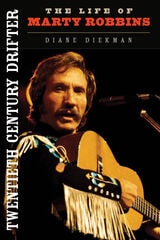
Twentieth Century Drifter
The Life of Marty RobbinsDiane Diekman
University of Illinois Press, 2012
Twentieth Century Drifter: The Life of Marty Robbins is the first biography of this legendary country music artist and NASCAR driver who scored sixteen number-one hits and two Grammy awards. Yet even with fame and fortune, Marty Robbins always yearned for more.
Drawing from personal interviews and in-depth research, biographer Diane Diekman explains how Robbins saw himself as a drifter, a man always searching for self-fulfillment and inner peace. Born Martin David Robinson to a hardworking mother and an abusive alcoholic father, he never fully escaped the insecurities burned into him by a poverty-stricken nomadic childhood in the Arizona desert. In 1947 he got his first gig as a singer and guitar player. Too nervous to talk, the shy young man walked onstage singing. Soon he changed his name to Marty Robbins, cultivated his magnetic stage presence, and established himself as an entertainer, songwriter, and successful NASCAR driver.
For fans of Robbins, NASCAR, and classic country music, Twentieth Century Drifter: The Life of Marty Robbins is a revealing portrait of this well-loved, restless entertainer, a private man who kept those who loved him at a distance.
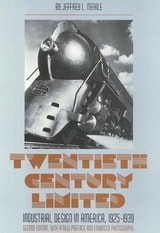
Twentieth Century Limited
Industrial Design In America 1925-1939Jeffrey L. Meikle
Temple University Press, 2001
Commercial artists who answered the call of business -- Walter Dorwin Teague, Norman Bel Geddes, Henry Dreyfuss, and Raymond Loewy the best known among them -- were pioneers who envisioned a coherent machine-age environment in which life would be clean, efficient, and harmonious. Working with new materials -- chrome, stainless steel, Bakelite plastic -- they created a streamlined expressionist style which reflected the desire of the Depression-era public for a frictionless, static society.
Appliances such as Loewy's Coldspot refrigerator "set a new standard" (according to the advertisements), and its usefulness extended to the way it improved the middle-class consumer's taste for sleek new products.
Profusely illustrated with 150 photographs, Twentieth Century Limited pays tribute to the industrial designers and the way they transformed American culture; a generation after its initial publication, this book remains the best introduction to the subject. The new edition will fascinate anyone interested in art, architecture, technology, and American culture of the 1930's.
Twentieth-Century American Success Rhetoric
How to Construct a Suitable SelfJohn Ramage
Southern Illinois University Press, 2005
Self-help authors like Tom Peters and Stephen Covey, who have dominated best-seller lists over the last two decades, have exercised increasing influence on political, governmental, and educational organizations. By contrast, the topic of American success books— texts that promise to help readers succeed by retrofitting their identity to meet workplace demands—has been ignored by scholars since the 1980s. John Ramage challenges the neglect of this hugely popular literature and revives a once-lively conversation among eminent critics about the social phenomenon represented in the work of Bruce Barton, Dale Carnegie, and Norman Vincent Peale, among others.
Using literary texts from Don Quixote to Catch-22 to gloss the discussion, Ramage utilizes Kenneth Burke’s rhetorical theory to understand symbolic acts and social issues and brings together earlier commentaries within a new critical framework. He considers the problematic and paradoxical nature of success and examines its meaning in terms of its traditional dialectic partner, happiness. A synopsis of seventeenth- to nineteenth-century forerunners prefaces this analysis in which Ramage links literary code heroes with the activities of twentieth-century business leaders to determine whether, in the search for authenticity, the heroic individual or the corporation is ultimately served.
This comprehensive study chronicles the legitimation of the success book genre, enumerates rhetorical strategies used to win over readers, and supplies the historical context that renders each book’s message timely. After considering some of the dangers of crossing disciplinary borders, as exemplified by Deborah Tannen’s work, Ramage critiques Stanley Fish’s theoretical strictures against this practice, finally summoning academic critics to action with a strong call to exert greater influence within the popular marketplace.
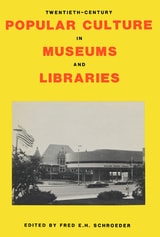
Twentieth-Century Popular Culture in Museums and Libraries
Fred E.H. Schroeder
University of Wisconsin Press, 1981
The essays in this book investigate the reasons for present-day neglect of popular culture materials and chart the various routes by which conscientious and insightful librarians and museum directors can correct this disastrous oversight.
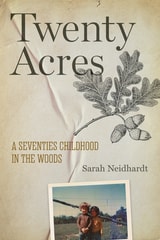
Twenty Acres
A Seventies Childhood in the WoodsSarah Neidhardt
University of Arkansas Press, 2023
"A memoir infused with both empathy and inquiry."
—Wendy J. Fox, Electric Literature
“Twenty Acres is an engaging, thoughtful memoir of growing up in an off-the-grid cabin as part of the 1970s back-to-the-land movement. Sarah Neidhardt captures her subject beautifully and offers a compelling portrait of a highly specific, historically significant time and place.”
—Kate Daloz, author of We Are As Gods: Back to the Land in the 1970s on the Quest for a New America
Sarah Neidhardt grew up in the woods. When she was an infant, her parents left behind comfortable, urbane lives to take part in the back-to-the-land movement. They moved their young family to an isolated piece of land deep in the Arkansas Ozarks where they built a cabin, grew crops, and strove for eight years to live self-sufficiently.
In this vivid memoir Neidhardt explores her childhood in wider familial and social contexts. Drawing upon a trove of family letters and other archival material, she follows her parents’ journey from privilege to food stamps—from their formative youths, to their embrace of pioneer homemaking and rural poverty, to their sudden and wrenching return to conventional society—and explores the back-to-the-land movement of the 1970s as it was, and as she lived it.
A story of strangers in a strange land, of class, marriage, and family in a changing world, Twenty Acres: A Seventies Childhood in the Woods is part childhood idyll, part cautionary tale. Sarah Neidhardt reveals the treasures and tolls of unconventional, pastoral lives, and her insightful reflections offer a fresh perspective on what it means to aspire to pre-industrial lifestyles in a modern world.
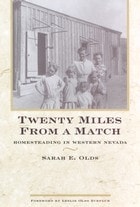
Twenty Miles From A Match
Homesteading In Western NevadaSarah E. Olds
University of Nevada Press, 1978
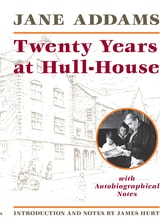
Twenty Years at Hull-House
Jane Addams, with Autobiographical Notes. Introduction and Notes by James Hurt.
University of Illinois Press, 1990
Twenty-First Century Color Lines
Multiracial Change in Contemporary Americaedited by Andrew Grant-Thomas and Gary Orfield, foreword by Christopher Edley, Jr.
Temple University Press, 2008
The result of work initiated by the Harvard Civil Rights Project, this collection provides an excellent overview of the contemporary racial and ethnic terrain in the United States. The well-respected contributors to Twenty-First Century Color Lines combine theoretical and empirical perspectives, answering fundamental questions about the present and future of multiracialism in the United States: How are racial and ethnic identities promoted and defended across a spectrum of social, geopolitical and cultural contexts? What do two generations of demographic and social shifts around issues of race look like “on the ground?” What are the socio-cultural implications of changing demographics in the U.S.? And what do the answers to these questions portend for our multiracial future?
This illuminating book addresses issues of work, education, family life and nationality for different ethnic groups, including Asians and Latinos as well as African Americans and whites. Such diversity, gathered here in one volume, provides new perspectives on ethnicity in a society marked by profound racial transformations.
Contributors: Luis A. Avilés, Juan Carlos Martínez-Cruzado, Nilanjana Dasgupta, Christina Gómez, Gerald Gurin, Patricia Gurin, Anthony Kwame Harrison, Maria-Rosario Jackson, John Matlock, Nancy McArdle, John Mollenkopf, john a. powell, Doris Ramírez, David Roediger, Anayra Santory-Jorge, Jiannbin Lee Shiao, Mia H. Tuan, Katrina Wade-Golden and the editors.

Twenty-First-Century Kids, Twenty-First-Century Librarians
Virginia A. Walter
American Library Association, 2009
Twenty-Three Minutes to Eternity
The Final Voyage of the Escort Carrier USS Liscome BayJames L. Noles
University of Alabama Press, 2004
Twenty-one Texas Short Stories
Edited by William Peery
University of Texas Press, 1954
This is a splendid collection of stories about Texas by Texans—stories that appeared in leading magazines in the first half of the twentieth century.
Authors in this volume:
- Dillon Anderson
- Barry Benefield
- Charles Carver
- Margaret Cousins
- Chester T. Crowell
- Eugene Cunningham
- J. Frank Dobie
- Fred Gipson
- William Goyen
- O. Henry
- Sylvan Karchmer
- Harry Kidd, Jr.
- Mary King O’Donnell
- George Pattullo
- George Sessions Perry
- Katherine Anne Porter
- Winifred Sanford
- John W. Thomason, Jr.
- Thomas Thompson
- John Watson
- John W. Wilson
Twilight of the American State
Pierre Schlag
University of Michigan Press, 2023
Finalist: 2024 Order of the Coif Book Award | March 3, 2025
The sudden emergence of the Trump nation surprised nearly everyone, including journalists, pundits, political consultants, and academics. When Trump won in 2016, his ascendancy was widely viewed as a fluke. Yet time showed it was instead the rise of a movement—angry, militant, revanchist, and unabashedly authoritarian.
How did this happen? Twilight of the American State offers a sweeping exploration of how law and legal institutions helped prepare the grounds for this rebellious movement. The controversial argument is that, viewed as a legal matter, the American state is not just a liberal democracy, as most Americans believe. Rather, the American state is composed of an uneasy and unstable combination of different versions of the state—liberal democratic, administered, neoliberal, and dissociative. Each of these versions arose through its own law and legal institutions. Each emerged at different times historically. Each was prompted by deficits in the prior versions. Each has survived displacement by succeeding versions. All remain active in the contemporary moment—creating the political-legal dysfunction America confronts today.
Pierre Schlag maps out a big picture view of the tribulations of the American state. The book abjures conventional academic frameworks, sets aside prescriptions for quick fixes, dispenses with lamentations about polarization, and bypasses historical celebrations of the American Spirit.