Results by title
4030 books match the query 'Language Arts & Disciplines' and 760 start with t
The Library Quarterly, volume 96 number 2 (April 2026)
The University of Chicago Press
University of Chicago Press Journals, 2026
The Library Quarterly, volume 96 number 3 (July 2026)
The University of Chicago Press
University of Chicago Press Journals, 2026
The Library Quarterly, volume 96 number 4 (October 2026)
The University of Chicago Press
University of Chicago Press Journals, 2026

The Library Security and Safety Guide to Prevention, Planning, and Response
Miriam B. Kahn
American Library Association, 2008
The Library Workplace Idea Book
Proactive Steps for Positive ChangeAmanda H. McLellan
American Library Association, 2020
The Library's Guide to Graphic Novels
John Ballestro
American Library Association, 2020
The circ stats say it all: graphic novels’ popularity among library users keeps growing, with more being published (and acquired by libraries) each year. The unique challenges of developing and managing a graphics novels collection have led the Association of Library Collections and Technical Services (ALCTS) to craft this guide, presented under the expert supervision of editor Ballestro, who has worked with comics for more than 35 years. Examining the ever-changing ways that graphic novels are created, packaged, marketed, and released, this resource gathers a range of voices from the field to explore such topics as
- a cultural history of comics and graphic novels from their World War II origins to today, providing a solid grounding for newbies and fresh insights for all;
- catching up on the Big Two’s reboots: Marvel’s 10 and DC’s 4;
- five questions to ask when evaluating nonfiction graphic novels and 30 picks for a core collection;
- key publishers and cartoonists to consider when adding international titles;
- developing a collection that supports curriculum and faculty outreach to ensure wide usage, with catalogers’ tips for organizing your collection and improving discovery;
- real-world examples of how libraries treat graphic novels, such as an in-depth profile of the development of the Penn Libraries' manga collection;
- how to integrate the emerging field of graphic medicine into the collection; and
- specialized resources like The Cartoonists of Color and Queer Cartoonists databases, the open access scholarly journal Comic Grid, and the No Flying, No Tights website.
The Library's Legal Answer Book
Tomas A. Lipinski
American Library Association, 2003
The Library's Legal Answers for Meeting Rooms and Displays
Mary Minow
American Library Association, 2016
The Library’s Legal Answers for Makerspaces
Mary Minow
American Library Association, 2016
The Linguistic Turn in Contemporary Japanese Literary Studies
Politics, Language, TextualityEdited and with an Introduction by Michael K. Bourdaghs
University of Michigan Press, 2010
The Linguistics of Punctuation
Geoffrey Nunberg
CSLI, 1990
The Little Database
A Poetics of Media FormatsDaniel Scott Snelson
University of Minnesota Press, 2025
A poetics for reading the everyday objects that populate a hard drive
Bespoke online archives like PennSound and Eclipse host an astounding array of “old media” artifacts, posing a handcrafted counterpoint to the immense databases aggregated by digital titans like Google and Facebook. In The Little Database, Daniel Scott Snelson argues for the significance of these comparatively “small” collections, exploring how digital archives dramatically transform the artifacts they host and how they might help us better understand our own private collections in turn.
Examining curated collections such as Textz, UbuWeb, and the Electronic Poetry Center, Snelson explores media-specific works by poets and artists, including William Carlos Williams, Tracie Morris, bill bissett, Nam June Paik, and Vicki Bennett. He develops creative tools and contingent methods for reading cultural data, whether found on the internet or in our own collections of TXT, JPG, MP3, and MOV artifacts, presenting case studies to show how these objects have come to find revised meaning in their digital contexts. Along the way, experimental poetic interludes give readers practical entry points into the creative practice of producing new meanings in any given little database.
Inventive and interdisciplinary, The Little Database grapples with the digitized afterlives of cultural objects, showing how the past is continually reconfigured to shape the present. It invites readers to find playful and personal means for unpacking their own data collections, in the process discovering idiosyncratic ways to explore and connect with digital archives.
Retail e-book files for this title are screen-reader friendly with images accompanied by short alt text and/or extended descriptions.
The Little Magazine in Contemporary America
Edited by Ian Morris and Joanne Diaz
University of Chicago Press, 2015
In this collection, Ian Morris and Joanne Diaz gather the reflections of twenty-three prominent editors whose little magazines have flourished over the past thirty-five years. Highlighting the creativity and innovation driving this diverse and still vital medium, contributors offer insights into how their publications sometimes succeeded, sometimes reluctantly folded, but mostly how they evolved and persevered. Other topics discussed include the role of little magazines in promoting the work and concerns of minority and women writers, the place of universities in supporting and shaping little magazines, and the online and offline future of these publications.
Selected contributors
Betsy Sussler, BOMB; Lee Gutkind, Creative Nonfiction; Bruce Andrews, L=A=N=G=U=A=G=E; Dave Eggers, McSweeney’s; Keith Gessen, n+1; Don Share, Poetry; Jane Friedman, VQR; Amy Hoffman, Women’s Review of Books; and more.

The Living Library
An Intellectual EcosystemDavid Cronrath
Assoc of College & Research Libraries, 2014
The Living Library
An Intellectual EcosystemPatricia Steele
Assoc of College & Research Libraries, 2014
The Logic of Women on Trial
Case Studies of Popular American TrialsJanice Schuetz
Southern Illinois University Press, 1994
Janice Schuetz investigates the felony trials of nine American women from colonial Salem to the present: Rebecca Nurse, tried for witchcraft in 1692; Mary E. Surratt, tried in 1865 for assisting John Wilkes Booth in the assassination of Abraham Lincoln; Lizzie Andrew Borden, tried in 1892 for the ax murder of her father and stepmother; Margaret Sanger, tried in 1915, 1917, and 1929 for her actions in support of birth control; Ethel Rosenberg, tried in 1951 for aiding the disclosure of secrets of the atom bomb to the Soviets; Yvonne Wanrow, tried in 1974 for killing a man who molested her neighbor’s daughter; Patricia Campbell Hearst, tried in 1975 for bank robbery as a member of the Symbionese Liberation Army; Jean Harris, tried in 1982 for killing Herman Tarnower, the Diet Doctor; and Darci Kayleen Pierce, tried in 1988 for kidnapping and brutally murdering a pregnant woman, then removing the baby from the woman’s womb.
In her analysis, Schuetz is careful to define these trials as popular trials. Characteristically, popular trials involve persons, issues, or crimes of social interest that attract extensive public interest and involvement. Such trials make a contribution to the ongoing historical dialogue about the meaning of justice and the legal system, while reflecting the values of the time and place in which they occur.
Schuetz examines the kinds of communication that transpired and the importance of gender in the trials by applying a different current rhetorical theory to each trial text. In every chapter, she explains her chosen interpretive theory, compares that framework with the discourse of the trial, and makes judgments about the meaning of the trial texts based on the interpretive theory.
The Lone Arranger
Succeeding in a Small RepositoryChristina J. Zamon
American Library Association, 2013
The Lost Chance in China and the Rise of Cold War Populism
Stephen J. Hartnett
Michigan State University Press, 2025
The Lyceum and Public Culture in the Nineteenth-Century United States
Angela G. Ray
Michigan State University Press, 2005
Angela Ray provides a refreshing new look at the lyceum lecture system as it developed in the United States from the 1820s to the 1880s. She argues that the lyceum contributed to the creation of an American "public" at a time when the country experienced a rapid change in land area, increasing immigration, and a revolution in transportation, communication technology, and social roles.
The history of the lyceum in the nineteenth century illustrates a process of expansion, diffusion, and eventual commercialization. In the late 1820s, a politically and economically dominant culture—the white Protestant northeastern middle class—institutionalized the practice of public debating and public lecturing for education and moral uplift. In the 1820s and 1830s, the lyceum was characterized by organized groups in cities and towns, particularly in the Northeast and the Old Northwest (now the Midwest). These groups were established to promote debate, to create a setting for study, and to provide a forum for members’ lecturing. By the 1840s and 1850s, however, most lyceums concentrated on the sponsorship of public lectures, presented for institutional profit as well as public instruction and entertainment. Eventually, lyceum lectures became a commercial enterprise and desirable platform for celebrities who wished to expand their incomes from lecturing.
The Madison Women
Gender, Higher Education, and Literacy in Nineteenth-Century AppalachiaAmanda E Hayes
West Virginia University Press, 2024
Incorporating captivating mini-biographies of women who attended Madison College and who went on to change their communities in ways large and small, this book reveals how the lives of its students impart lessons about history, regional culture, and how we can shape the Appalachia's future.
The Makerspace Librarian's Sourcebook
Ellyssa Kroski
American Library Association, 2017
The Making of Shakespeare's First Folio
Emma Smith
Bodleian Library Publishing, 2015
The Making of Shakespeare’s First Folio offers the first comprehensive biography of the earliest collected edition of Shakespeare’s plays. In November 1623, the book arrived in the bookshop of the London publisher Edward Blount at the Black Bear. Long in the making, Master William Shakespeare’s Comedies, Histories, and Tragedies—as the First Folio was then known—appeared seven years after Shakespeare’s death. Nearly one thousand pages in length, the collection comprised thirty-six plays, half of which had never been previously published. Emma Smith tells the story of the First Folio’s origins, locating it within the social and political context of Jacobean London and bringing in the latest scholarship on the seventeenth-century book trade.
Extensively illustrated, The Making of Shakespeare’s First Folio is a landmark addition to the copious literature on Shakespeare. It will shed much-needed light on the birth of the First Folio—of which fewer than 250 copies remain—and the birth of Shakespeare’s towering reputation.
The Managerial Unconscious in the History of Composition Studies
Donna Strickland
Southern Illinois University Press, 2011
The Managerial Unconscious in the History of Composition Studies is the first book to address the history of composition studies as a profession rather than focusing on its pedagogical theories and systems. Strickland questions why writing and the teaching of writing have been the major areas of scholarly inquiry in the field when specialists often work primarily as writing program administrators, not teachers.
Strickland traces the emergence of writing programs in the early twentieth century, the founding of two professional organizations by and for writing program administrators, and the managerial overtones of the “social turn” of the field during the 1990s. She illustrates how these managerial imperatives not only have provided much of the impetus for the growth of composition studies over the past three decades but also have contributed to the stratified workplaces and managed writing practices the field’s pedagogical research often decries.
The Managerial Unconscious in the History of Composition Studies makes the case that administrative work should not be separated from intellectual work, calling attention to the interplay between these two kinds of work in academia at large and to the pronounced hierarchies of contingent faculty and tenure-track administrators endemic to college writing programs. The result is a reasoned plea for an alternative understanding of the very mission of the field itself.
The Managing Creativity
The Innovative Research LibraryRonald Jantz
Assoc of College & Research Libraries, 2016
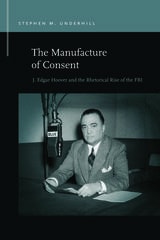
The Manufacture of Consent
J. Edgar Hoover and the Rhetorical Rise of the FBIStephen M. Underhill
Michigan State University Press, 2020

The Many Faces of Agreement
Morphology, Syntax, Semantics, and Discourse Factors in Serbo-Croatian AgreementStephen Wechsler and Larisa Zlatic
CSLI, 2003
With this framework in place, the authors explore a number of factors that affect agreement processes. The theory even explains the striking cross-linguistic generalizations expressed in Corbett's Agreement Hierarchy. Agreement is shown to be a distributed phenomenon, manifesting its many faces among the various components of grammar.
The Mark of Criminality
Rhetoric, Race, and Gangsta Rap in the War-on-Crime EraBryan J. McCann
University of Alabama Press, 2017
In The Mark of Criminality: Rhetoric, Race, and Gangsta Rap in the War-on-Crime Era, Bryan J. McCann argues that gangsta rap should be viewed as more than a damaging reinforcement of an era’s worst racial stereotypes. Rather, he positions the works of key gangsta rap artists, as well as the controversies their work produced, squarely within the law-and-order politics and popular culture of the 1980s and 1990s to reveal a profoundly complex period in American history when the meanings of crime and criminality were incredibly unstable.
At the center of this era—when politicians sought to prove their “tough-on-crime” credentials—was the mark of criminality, a set of discourses that labeled members of predominantly poor, urban, and minority communities as threats to the social order. Through their use of the mark of criminality, public figures implemented extremely harsh penal polices that have helped make the United States the world’s leading jailer of its adult population.
At the same time when politicians like Ronald Reagan, George H. W. Bush, and Bill Clinton and television shows such as COPS and America’s Most Wanted perpetuated images of gang and drug-filled ghettos, gangsta rap burst out of the hip-hop nation, emanating mainly from the predominantly black neighborhoods of South Central Los Angeles. Groups like NWA and solo artists (including Dr. Dre, Snoop Dogg, and Tupac Shakur) became millionaires by marketing the very discourses political and cultural leaders used to justify their war on crime. For these artists, the mark of criminality was a source of power, credibility, and revenue. By understanding gangsta rap as a potent, if deeply imperfect, enactment of the mark of criminality, we can better understand how crime is always a site of struggle over meaning. Furthermore, by underscoring the nimble rhetorical character of criminality, we can learn lessons that may inform efforts to challenge our nation’s failed policies of mass incarceration.
The Marvelous Clouds
Toward a Philosophy of Elemental MediaJohn Durham Peters
University of Chicago Press, 2015
When we speak of clouds these days, it is as likely that we mean data clouds or network clouds as cumulus or stratus. In their sharing of the term, both kinds of clouds reveal an essential truth: that the natural world and the technological world are not so distinct. In The Marvelous Clouds, John Durham Peters argues that though we often think of media as environments, the reverse is just as true—environments are media.
Peters defines media expansively as elements that compose the human world. Drawing from ideas implicit in media philosophy, Peters argues that media are more than carriers of messages: they are the very infrastructures combining nature and culture that allow human life to thrive. Through an encyclopedic array of examples from the oceans to the skies, The Marvelous Clouds reveals the long prehistory of so-called new media. Digital media, Peters argues, are an extension of early practices tied to the establishment of civilization such as mastering fire, building calendars, reading the stars, creating language, and establishing religions. New media do not take us into uncharted waters, but rather confront us with the deepest and oldest questions of society and ecology: how to manage the relations people have with themselves, others, and the natural world.
A wide-ranging meditation on the many means we have employed to cope with the struggles of existence—from navigation to farming, meteorology to Google—The Marvelous Clouds shows how media lie at the very heart of our interactions with the world around us. Peters’s book will not only change how we think about media but provide a new appreciation for the day-to-day foundations of life on earth that we so often take for granted.
The Mathematical Theory of Communication
Claude E. Shannon and Warren Weaver
University of Illinois Press, 1998
The Matrix of Lyric Transformation
Poetic Modes and Self-Presentation in Early Chinese Pentasyllabic PoetryCai Zong-qi
University of Michigan Press, 1997
The Media and Communications Study Skills Student Guide
Doug Specht
University of Westminster Press, 2019
All the tips, ideas and advice given to, and requested by, MA students in Media and Communications, are brought together in an easy-to-use accessible guide to help students study most effectively.
Based upon many years of teaching study skills and hundreds of lecture slides and handouts this introduction covers a range of general and generic skills that the author relates specifically towards media and communications studies. As well as the mechanics of writing and presentations, the book also shows how students can work on and engage with the critical and contemplative elements of their degrees whilst retaining motivation and refining timekeeping skills.
Of course the nuts and bolts of reading, writing, listening, seminars and the dreaded dissertation and essays are covered too. In addition advice on referencing, citation and academic style is offered for those with concerns over English grammar and expression.
Aimed primarily at postgraduate students, there is significant crossover with undergraduate work, so this book will also prove of use to upper level undergraduate readers whether using English as a first or second language.
The Medical Library Association Essential Guide to Becoming an Expert Searcher
Terry Ann Jankowski
American Library Association, 2008
The Medical Library Association Guide to Finding Out about Complementary and Alternative Medicine
The Best Print and Electronic ResourcesAmerican Library Association, 2010
The Medical Library Association Guide to Finding Out about Diabetes
The Best Print and Electronic ResourcesDana L. Ladd
American Library Association, 2013
The Medical Library Association Guide to Finding Out about Heart Disease
The Best Print and Electronic ResourcesJeanette American Library Association
American Library Association, 2013
The Medical Library Association Guide to Managing Health Care Libraries
Rosalind Farnam Dudden
American Library Association, 2011
The Medical Library Association's Master Guide to Authoritative Information Resources in the Health Sciences
American Library Association, 2013
The Memoir and the Memoirist
Reading and Writing Personal NarrativeThomas Larson
Ohio University Press, 2007
The memoir is the most popular and expressive literary form of our time. Writers embrace the memoir and readers devour it, propelling many memoirs by relative unknowns to the top of the best-seller list. Writing programs challenge authors to disclose themselves in personal narrative. Memoir and personal narrative urge writers to face the intimacies of the self and ask what is true.
In The Memoir and the Memoirist, critic and memoirist Thomas Larson explores the craft and purpose of writing this new form. Larson guides the reader from the autobiography and the personal essay to the memoir—a genre focused on a particularly emotional relationship in the author’s past, an intimate story concerned more with who is remembering, and why, than with what is remembered.
The Memoir and the Memoirist touches on the nuances of memory, of finding and telling the truth, and of disclosing one’s deepest self. It explores the craft and purpose of personal narrative by looking in detail at more than a dozen examples by writers such as Mary Karr, Frank McCourt, Dave Eggers, Elizabeth Wurtzel, Mark Doty, Nuala O’Faolain, Rick Bragg, and Joseph Lelyveld to show what they reveal about themselves. Larson also opens up his own writing and that of his students to demonstrate the hidden mechanics of the writing process.
For both the interested reader of memoir and the writer wrestling with the craft, The Memoir and the Memoirist provides guidance and insight into the many facets of this provocative and popular art form.

The Memoir of Ednah Shepard Thomas
Ednah Shepard Thomas
University Press of Colorado, 2017
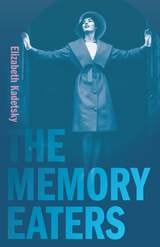
The Memory Eaters
Elizabeth Kadetsky
University of Massachusetts Press, 2020
As her mother loses her grasp on their shared history, Elizabeth Kadetsky sifts through boxes of the snapshots, newspaper clippings, pamphlets, and notebooks that remain, hoping to uncover the memories that her mother is actively losing as her dementia progresses. These remnants offer the false yet beguiling suggestion that the past is easy to reconstruct—easy to hold.
At turns lyrical, poignant, and alluring, The Memory Eaters tells the story of a family's cyclical and intergenerational incidents of trauma, secret-keeping, and forgetting in the context of 1970s and 1980s New York City. Moving from her parents' divorce to her mother's career as a Seventh Avenue fashion model and from her sister's addiction and homelessness to her own experiences with therapy for post-traumatic stress disorder, Kadetsky takes readers on a spiraling trip through memory, consciousness fractured by addiction and dementia, and a compulsion for the past salved by nostalgia.
The Mertiyo Rathors of Merto, Rajasthan
Select Translations Bearing on the History of a Rajput Family, 1462–1660, Volumes 1–2Richard Saran and Norman P. Ziegler, translators and annotators
University of Michigan Press, 2001
The Methodical Memory
Invention in Current-Traditional RhetoricSharon Crowley
Southern Illinois University Press, 1990
In this first sustained critique of current-traditional rhetorical theory, Sharon Crowley uses a postmodern, deconstructive reading to reexamine the historical development of current-traditional rhetoric. She identifies it (as well as the British new rhetoric from which it developed) as a philosophy of language use that posits universal principles of mind and discourse. Crowley argues that these philosophies are not appropriate bases for the construction of rhetorical theories, much less guides for the teaching of composition. She explains that current-traditional rhetoric is not a rhetorical theory, and she argues that its use as such has led to a misrepresentation of invention.
Crowley contends that current-traditional rhetoric continues to prosper because a considerable number of college composition teachers—graduate students, part-time instructors, and teachers of literature—are not involved in the development of the curricula they are asked to teach. As a result, their voices, necessary to create any true representation of the composition teaching experience, are denied access to the scholarly conversations evaluating the soundness of the institutionalized teaching methods derived from the current-traditional approach.
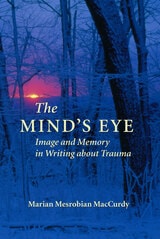
The Mind's Eye
Image and Memory in Writing about TraumaMarian Mesrobian MacCurdy
University of Massachusetts Press, 2007
MacCurdy begins by discussing what trauma is, how traumatic memories are stored and accessed, and how writing affects them. She then focuses on the processes involved in translating traumatic images into narrative form, showing how the same patterns and problems emerge whether the writers are students or professionals. Using examples drawn from the classroom, MacCurdy investigates the beneficial effects of the study of trauma on communities as well as individuals, witnesses as well as writers, and explores the implications of these relationships for the world at large, particularly as they pertain to issues of justice, retribution, and forgiveness.
Throughout the volume the author draws on her own experience as teacher, writer, survivor, and descendant of survivors to explain how one can engage student work on difficult subjects without appropriating the texts or getting lost in the emotions generated by them. She further shows how appropriate safeguards can be put in place to protect both teacher and student writer. The end result of such a pedagogy, MacCurdy demonstrates, is not simply better writers but more integrated people, capable of converting their own losses and griefs into compassion for others.

The Miniaturists
Barbara Browning
Duke University Press, 2022

The Mirror Makers
A History of American Advertising and Its CreatorsStephen Fox
University of Illinois Press, 1997

The Mirror in the Text
Lucien Dällenbach
University of Chicago Press, 1989
In this classic study, Lucien Dällenbach provides the first systematic analysis of this device and its literary and artistic applications from Van Eyck and Velasquez to Gide, Beckett and the French nouveau roman.
Alongside this wealth of examples, Dällenbach constructs his theoretical argument with elegance and clarity, assuming no previous knowledge of arcane and specialized theory, but guiding the reader helpfully through the maze of literary criticism. The result is a new conceptual field, a new grammar of the mise en abyme, and an examination of its function within the work of art and literature.
The highly original study has been acclaimed as one of the most important works of contemporary literary theory. It will be of interest to all students of English and European literature, as well as to students of the visual arts.
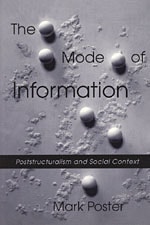
The Mode of Information
Poststructuralism and Social ContextMark Poster
University of Chicago Press, 1990
The difference, Mark Poster argues, is the profound effect electronic mediation exerts on the very way we perceive ourselves and reality. To help decode the linguistic dimensions of our multiple forms of social interaction, he plays upon Marx's theory of the mode of production—the shift to late capitalism has a parallel in the shift from the mode of production to that of information.
Enlisting poststructuralist theory, he links four modes of communication with four poststructuralists: TV ads with Baudrillard, data bases with Foucault, electronic writing with Derrida, and computer science with Lyotard. Mode of Information points the way to a poststructuralist strategy for writing history, a framework well suited to unearthing structures of domination and the means to their disruption.
"An informed, insightful, provocative account of phenomena that have transformed virtually every area of public and private life on our time."—Robert Anchor, American Historical Review
"The importance of Poster's book is unmistakable for he skillfully negotiates between and juxtaposes two wide theoretical domains—electronically mediated communications and poststructuralist theory—about which much has been written, but hardly with the acumen that he brings to bear in a long-awaited critical rapprochement."—Charles J. Stivale, Criticism
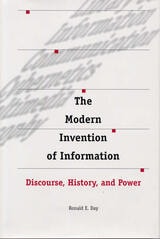
The Modern Invention of Information
Discourse, History, and PowerRonald E. Day
Southern Illinois University Press, 2008
In The Modern Invention of Information: Discourse, History, and Power, Ronald E. Day provides a historically informed critical analysis of the concept and politics of information. Analyzing texts in Europe and the United States, his critical reading method goes beyond traditional historiographical readings of communication and information by engaging specific historical texts in terms of their attempts to construct and reshape history.
After laying the groundwork and justifying his method of close reading for this study, Day examines the texts of two pre–World War II documentalists, Paul Otlet and Suzanne Briet. Through the work of Otlet and Briet, Day shows how documentation and information were associated with concepts of cultural progress. Day also discusses the social expansion of the conduit metaphor in the works of Warren Weaver and Norbert Wiener. He then shows how the work of contemporary French multimedia theorist Pierre Lévy refracts the earlier philosophical writings of Gilles Deleuze and Félix Guattari through the prism of the capitalist understanding of the “virtual society.”
Turning back to the pre–World War II period, Day examines two critics of the information society: Martin Heidegger and Walter Benjamin. He explains Heidegger’s philosophical critique of the information culture’s model of language and truth as well as Benjamin’s aesthetic and historical critique of mass information and communication. Day concludes by contemplating the relation of critical theory and information, particularly in regard to the information culture’s transformation of history, historiography, and historicity into positive categories of assumed and represented knowledge.

The Monkey's Paw
New Chronicles from PeruRobin Kirk
University of Massachusetts Press, 1997
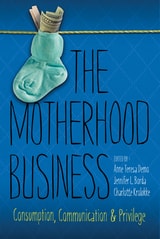
The Motherhood Business
Consumption, Communication, and PrivilegeEdited by Anne Teresa Demo, Jennifer L. Borda, and Charlotte Kroløkke
University of Alabama Press, 2015
Examining how motherhood, consumption, and privilege shape identities in contemporary culture.
The Motherhood Business is a piercing collection of ten original essays that reveal the rhetoric of the motherhood industry. Focusing on the consumer life of mothers and the emerging entrepreneurship associated with motherhood, the collection considers how different forms of privilege (class, race, and nationality) inform discourses about mothering, consumption, mobility, and leisure.
The Motherhood Business follows the harried mother’s path into the anxious maelstrom of intelligent toys, healthy foods and meals, and educational choices. It also traces how some enterprising mothers leverage cultural capital and rhetorical vision to create thriving baby- and child-based businesses of their own, as evidenced by the rise of mommy bloggers and “mompreneurs”over the last decade.
Starting with the rapidly expanding global fertility market, The Motherhood Business explores the intersection of motherhood, consumption, and privilege in the context of fertility tourism, international adoption, and transnational surrogacy. The synergy between motherhood and the marketplace demonstrated across the essays affirms the stronghold of “intensive mothering ideology” in decisions over what mothers buy and how they brand their businesses even as that ideology evolves. Across diverse contexts, the volume also identifies how different forms or privilege shape how mothers construct their identities through their consumption and entrepreneurship.
Although social observers have long commented on the link between motherhood and consumerism, little has been written within the field of rhetoric. Penetrating and interdisciplinary, The Motherhood Business illuminates how consumer culture not only shapes contemporary motherhood but also changes in response to mothers who constitute a driving force of the economy.