Results by title
2817 books match the query 'Nature' and 595 start with t
The Necessary Earth
Nature and Solitude in American LiteratureBy Wilson O. Clough
University of Texas Press, 1964
The Necessary Earth is a study of the degree to which the long American experience with an open frontier has entered into an inherently American literature to distinguish it from that of other lands. Since literature is, in the author’s words, “a compound of time, place, and the individual projection of personal experience and reflection into objective forms,” the American compulsion to communicate their experience and their difference was a virtual guarantee that a native literature would arrive.
The text falls into three major portions. The first considers the “age of wonder,” the impact of New World upon Old World comers to effect profound changes, and to set the new American on the parallel paths of idealism and pragmatism. The second part examines the effort of native-born writers to appropriate this experience for new metaphors and new literary theme. Without this effort, the frontier might have remained no more than a dwindling legend, and the transference to the theme of self-reliance might never have appeared. In the third portion the author turns to the twentieth century, examining here the degree to which the national theme of reliance on experience over tradition has persisted in the work of major authors.
Ranging thus from Jamestown and Plymouth to Wallace Stevens, the book stresses, throughout, the pull of untamed nature on the human spirit, and the echoes of that experience in what is most intrinsic in American literature. Without denying frontier lawlessness or native chauvinism, Clough directs our attention primarily to the problems of the creation of a new language and a new metaphor to meet the new experience, and the persistence of a truly American note into a maturing of both manner and matter.
The New Decentralists
The Back-to-the-Land Movement and the Politics of Localism in Appalachia, 1968-2000Jinny A Turman
West Virginia University Press, 2026
How some “back-to-the-landers” fled alienating urban, bureaucratic places for rural Appalachia in pursuit of self-reliance, liberation, and community, only to later find themselves vulnerable to a rising tide of national conservatism that minted new political elites on the state and local level at odds with their progressive social ideas and environmental values.
The New Madrid Earthquakes, Revised Edition
James Lal Penick, Jr.
University of Missouri Press, 1981
Since its publication in a cloth edition in 1976, Penick’s book has met with enormous regional appeal as well as critical acclaim. For the new paper edition, the author has written a new introduction. New material in the final chapter reports on the scientific inquiries into the New Madrid quakes since 1976.
Critical comments on the cloth edition: “James Penick has put together a well-written account of the quakes and their effects upon people, animals, waterways, and land. Based on the scattered accounts of the times it offers a good insight into the reactions of persons suddenly confronted with the perils of the unknown. The vivid description of the devastation wrought upon the face of the land gives a picture of dramatic change brought about by the upheaval of natural forces. In short, reading Penick’s work one is readily caught up in the total violence of the event.”—American Historical Review
“Penick provides information relevant to present studies of earthquakes in this area.”—Earthquake Information Bulletin
The New Plagues
Pandemics and Poverty in a Globalized WorldStefan Kaufmann
Haus Publishing, 2009
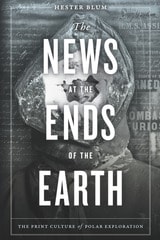
The News at the Ends of the Earth
The Print Culture of Polar ExplorationHester Blum
Duke University Press, 2019
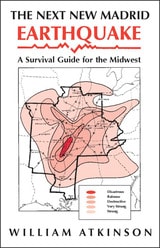
The Next New Madrid Earthquake
A Survival Guide for the MidwestWilliam Atkinson
Southern Illinois University Press, 1989
Scientists who specialize in the study of Mississippi Valley earthquakes say that the region is overdue for a powerful tremor that will cause major damage and undoubtedly some casualties.
The inevitability of a future quake and the lack of preparation by both individuals and communities provided the impetus for this book. Atkinson brings together applicable information from many disciplines: history, geology and seismology, engineering, zoology, politics and community planning, economics, environmental science, sociology, and psychology and mental health to provide the most comprehensive perspective to date of the myriad impacts of a major earthquake on the Mississippi Valley.
Atkinson addresses such basic questions as "What, actually, are earthquakes? How do they occur? Where are they likely to occur? Can they be predicted, perhaps even prevented?" He also addresses those steps that individuals can take to improve their chances for survival both during and after an earthquake.
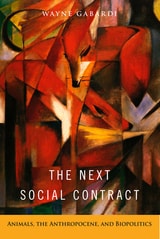
The Next Social Contract
Animals, the Anthropocene, and BiopoliticsWayne Gabardi
Temple University Press, 2017
In his provocative book The Next Social Contract, Wayne Gabardi rigorously considers the fate of animals in the twenty-first century. He claims that if we are to address the challenges raised by the Anthropocene—the period where nonhuman beings tend to be mere extras, often subsumed under the umbrella notion of “nature”—we need to radically rethink our basic ethical outlook and develop a new, “more-than-human” social contract.
Gabardi’s wide-ranging and multidisciplinary analysis focuses on four principal battlegrounds of animal biopolitics in the twenty first century: the extinction of wild animals, the crisis of oceanic animals, industrialized farm animals and the future of industrial agribusiness, and the situation of contact-zone animals moving into human-occupied habitats.
In his recasting of the social contract, Gabardi envisions a culture shift in human-animal relations toward posthumanism that features the ethical and political prioritization of animal life so it is on par with that of human well-being.
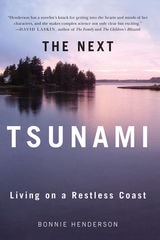
The Next Tsunami
Living on a Restless CoastBonnie Henderson
Oregon State University Press, 2014
More than twenty years passed before geologists discovered that it was neither Seaside’s first nor worst tsunami. In fact, massive tsunamis strike the Pacific coast every few hundred years, triggered not by distant temblors but by huge quakes less than one hundred miles off the Northwest coast. Not until the late 1990s would scientists use evidence like tree rings and centuries-old warehouse records from Japan to fix the date, hour, and magnitude of the Pacific Northwest coast’s last megathrust earthquake: 9 p.m., January 26, 1700, magnitude 9.0—one of the largest quakes the world has known. When the next one strikes—this year or hundreds of years from now—the tsunami it generates is likely to be the most devastating natural disaster in the history of the United States.
In The Next Tsunami, Bonnie Henderson shares the stories of scientists like meteorologist Alfred Wegener, who formulated his theory of continental drift while gazing at ice floes calving from Greenland glaciers, and geologist Brian Atwater, who paddled his dented aluminum canoe up coastal streams looking for layers of peat sandwiched among sand and silt. The story begins and ends with Tom Horning, who grew up to become a geologist and return to his family home at the mouth of the river in Seaside—arguably the Northwest community with the most to lose from what scientist Atwater predicts will be an “apocalyptic” disaster. No one in Seaside understands earthquake science—and the politics and complicated psychology of living in a tsunami zone—better than Horning.
Henderson’s compelling story of how scientists came to understand the Cascadia Subduction Zone—a fault line capable of producing earthquakes even larger than the 2011 Tohoku quake in Japan—and how ordinary people cope with that knowledge is essential reading for anyone interested in the charged intersection of science, human nature, and public policy
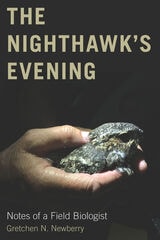
The Nighthawk's Evening
Notes of a Field BiologistGretchen N. Newberry
Oregon State University Press, 2021
This acrobatic, night-flying bird nests on rooftops and flocks in the thousands as it migrates from Alaska to Argentina and back every year. Nighthawks are strange animals, reptiles with feathers, sleepy during the day, but quick, agile, and especially adept at survival. They have the ability to withstand extreme temperatures and adapt to many habitats, but they are struggling for survival in the Anthropocene.
Newberry’s story focuses on the bird itself—its complex conservation status and cultural significance—and the larger, often hidden world of nocturnal animals. Along the way, she gives readers insight into the daily life of a scientist, especially one who works primarily at night. The Nighthawk’s Evening uses one scientist and one species to explore the challenges, disappointments, and successes of scientific research and conservation efforts. An accessible work of science, it will appeal to birders, students, wildlife managers, and anyone who is fascinated by urban wildlife.

The North Carolina Shore and Its Barrier Islands
Restless Ribbons of SandOrrin H. Pilkey, William J. Neal, Stanley R. Riggs, Craig A. Webb, David M. Bush, Deborah F. Pilkey, Jane Bullock, and Brian A. Cowan
Duke University Press, 1998
Evidence that the North Carolina shore is changing is never hard to find, but recently the devastation wrought by Hurricane Fran and the perilous situation of the historic lighthouse at Cape Hatteras have reminded all concerned of the fragility of this coast. Arguing for a policy of intelligent development, one in which residential and commercial structures meet rather than confront the changing nature of the shore, the authors have included practical information on hazards of many kinds—storms, tides, floods, erosion, island migration, and earthquakes. Diagrams and photographs clearly illustrate coastal processes and aid in understanding the impact of hurricanes and northeasters, wave and current dynamics, as well as pollution and other environmental destruction due to overdevelopment. A chapter on estuaries provides related information on the shores of back barrier areas that are growing in popularity for recreational residences. Risk maps focus on the natural hazards of each island and together with construction guidelines provide a basis for informed island management. Lastly, the dynamics of coastal politics and management are reviewed through an analysis of the controversies over the decision to move the Cape Hatteras lighthouse and a proposed effort to stabilize Oregon Inlet.
From the natural and historic perspective of the opening chapters to the regional discussions of individual barrier islands, this book is both a primer on coastal processes for the first time visitor as well as a guide to hazard identification for property owners.
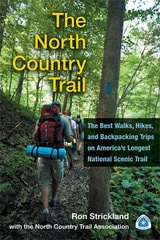
The North Country Trail
The Best Walks, Hikes, and Backpacking Trips on America’s Longest National Scenic TrailRon Strickland with the North Country Trail Association
University of Michigan Press, 2013
The North Country Trail is the longest of America’s eleven congressionally designated National Scenic Trails. Winding through seven states—New York, Pennsylvania, Ohio, Michigan, Wisconsin, Minnesota, and North Dakota—the NCT’s 4,600 miles attract more than one million visitors annually. These hikers are treated to a smorgasbord of Upper Midwest hiking featuring everything from urban strolls to backcountry adventure through mountains, rivers, prairies, and shoreline. This book is the definitive guide for NCT hikers—whether first-timers, seasoned backpackers, or any level in between—who wish to maximize their experience on this splendid trail.
In addition to a full overview of the trail’s tread in each state, the guide describes in detail forty of the NCT’s premier segments, with helpful information including easy-to-read trail descriptions, physical and navigation difficulties, trail highlights, hiking tips, and precise maps incorporating the latest GPS technology.
The Northeast
A Fire SurveyStephen J. Pyne
University of Arizona Press, 2019
The Northeast has its roster of great fires, beginning with dark days in the late 18th century, followed by a chronicle of conflagrations continuing as late as 1903 and 1908, with a shocking after-tremor in 1947. It hosted the nation’s first forestry schools. It organized the first interstate (and international) fire compact. And it was the Northeast that pioneered the transition to the true Big Burn—industrial combustion—as America went from burning living landscapes to burning lithic ones.
In this new book in the To the Last Smoke series, renowned fire expert Stephen J. Pyne narrates this history and explains how fire is returning to a place not usually thought of in America’s fire scene. He examines what changes in climate and land use mean for wildfire, what fire ecology means for cultural landscapes, and what experiments are underway to reintroduce fire to habitats that need it. The region’s great fires have gone; its influence on the national scene has not.
The Northeast: A Fire Survey samples the historic and contemporary significance of the region and explains how it fits into a national cartography and narrative of fire.
Included in this volume:
How the region shaped America’s understanding and policy toward fire
How fire fits into the region today and what that means for the country overall
What changes in climate, land use, and institutions may mean for northeastern fire, both wild and tame
The Northern Rockies
A Fire SurveyStephen J. Pyne
University of Arizona Press, 2016
The Northern Rockies remain one of three major hearths for America’s fire culture. They hold a major fire laboratory, an equipment development center, an aerial fire depot, and a social engagement with fire—even a literature. Missoula is to fire in the big backcountry what Tallahassee is to prescribed burning and what Southern California is to urban-wildland hybrids. On its margins, Boise hosts the National Interagency Fire Center. In this structured collection of essays on the region, Stephen J. Pyne explores what makes the Northern Rockies distinctive and what sets it apart from other regions of the country. Surprisingly, perhaps, the story is equally one of big bureaucracies and of generations that encounter the region’s majestic landscapes through flame.
The Northern Rockies is part of a multivolume series describing the nation’s fire scene region by region. The volumes in To the Last Smoke also cover Florida, the Northern Rockies, the Great Plains, the Southwest, and several other critical fire regions. The series serves as an important punctuation point to Pyne’s 50-year career with wildland fire—both as a firefighter and a fire scholar. These unique surveys of regional pyrogeography are Pyne’s way of “keeping with it to the end,” encompassing the directive from his rookie season to stay with every fire “to the last smoke.”
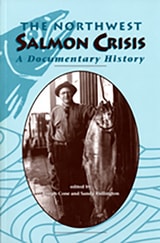
The Northwest Salmon Crisis
A Documentary HistoryJoseph Cone
Oregon State University Press, 1996
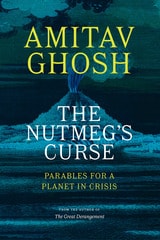
The Nutmeg's Curse
Parables for a Planet in CrisisAmitav Ghosh
University of Chicago Press, 2021
A powerful work of history, essay, testimony, and polemic, Amitav Ghosh’s new book traces our contemporary planetary crisis back to the discovery of the New World and the sea route to the Indian Ocean. The Nutmeg’s Curse argues that the dynamics of climate change today are rooted in a centuries-old geopolitical order constructed by Western colonialism. At the center of Ghosh’s narrative is the now-ubiquitous spice nutmeg. The history of the nutmeg is one of conquest and exploitation—of both human life and the natural environment. In Ghosh’s hands, the story of the nutmeg becomes a parable for our environmental crisis, revealing the ways human history has always been entangled with earthly materials such as spices, tea, sugarcane, opium, and fossil fuels. Our crisis, he shows, is ultimately the result of a mechanistic view of the earth, where nature exists only as a resource for humans to use for our own ends, rather than a force of its own, full of agency and meaning.
Writing against the backdrop of the global pandemic and the Black Lives Matter protests, Ghosh frames these historical stories in a way that connects our shared colonial histories with the deep inequality we see around us today. By interweaving discussions on everything from the global history of the oil trade to the migrant crisis and the animist spirituality of Indigenous communities around the world, The Nutmeg’s Curse offers a sharp critique of Western society and speaks to the profoundly remarkable ways in which human history is shaped by non-human forces.
The Ocean Reader
History, Culture, PoliticsEric Paul Roorda, editor
Duke University Press, 2020
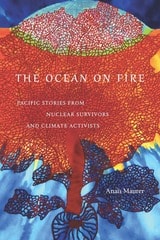
The Ocean on Fire
Pacific Stories from Nuclear Survivors and Climate ActivistsAnaïs Maurer
Duke University Press, 2024
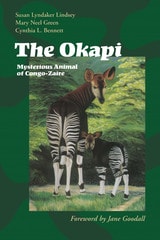
The Okapi
Mysterious Animal of Congo-ZaireBy Susan Lyndaker Lindsey, Mary Neel Green, and Cynthia L. Bennett
University of Texas Press, 1999
Congo-Zaire contains Africa's largest remaining tracts of intact rain forest, making it one of the most important regions for biodiversity conservation. Its Ituri Forest is home to plants and animals native to nowhere else on earth, including the elusive and little-known okapi.
In this popularly written book, three long-time observers of the okapi present a complete, contemporary natural history of this appealing relative of the giraffe. They recount its discovery by European explorers and describe its appearance and life cycle. They also discuss current efforts to preserve the species, both in the wild and at zoos around the world.
Illustrated with charming line drawings, The Okapi will be a valuable resource for conservationists and zoo visitors alike-indeed anyone fascinated by the mysterious animal of Congo-Zaire.
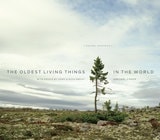
The Oldest Living Things in the World
Rachel Sussman
University of Chicago Press, 2014
Her work is both timeless and timely, and spans disciplines, continents, and millennia. It is underscored by an innate environmentalism and driven by Sussman’s relentless curiosity. She begins at “year zero,” and looks back from there, photographing the past in the present. These ancient individuals live on every continent and range from Greenlandic lichens that grow only one centimeter a century, to unique desert shrubs in Africa and South America, a predatory fungus in Oregon, Caribbean brain coral, to an 80,000-year-old colony of aspen in Utah. Sussman journeyed to Antarctica to photograph 5,500-year-old moss; Australia for stromatolites, primeval organisms tied to the oxygenation of the planet and the beginnings of life on Earth; and to Tasmania to capture a 43,600-year-old self-propagating shrub that’s the last individual of its kind. Her portraits reveal the living history of our planet—and what we stand to lose in the future. These ancient survivors have weathered millennia in some of the world’s most extreme environments, yet climate change and human encroachment have put many of them in danger. Two of her subjects have already met with untimely deaths by human hands.
Alongside the photographs, Sussman relays fascinating – and sometimes harrowing – tales of her global adventures tracking down her subjects and shares insights from the scientists who research them. The oldest living things in the world are a record and celebration of the past, a call to action in the present, and a barometer of our future.
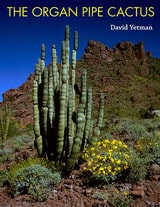
The Organ Pipe Cactus
David Yetman
University of Arizona Press, 2006
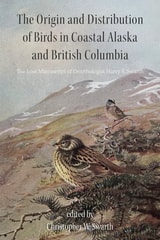
The Origin and Distribution of Birds in Coastal Alaska and British Columbia
The Lost Manuscript of Ornithologist Harry S. SwarthChristopher W. Swarth
Oregon State University Press, 2022
In 2019, Christopher Swarth, Harry’s grandson and a scientist in his own right, discovered the forgotten manuscript. This book includes the original unpublished manuscript, accompanied by contextual essays from contemporary ornithologists who examine the impact and relevance of Swarth’s research on coastal bird diversity, fox sparrow migration, and the systematic puzzle of the timberline sparrow. Expedition maps display field camps and exploration routes, and species checklists illustrate the variety of birds observed at key field sites. To bring additional color and insight, The Origin and Distribution of Birds in Coastal Alaska and British Columbia also includes excerpts from Harry Swarth’s field notes, a comprehensive list of Harry Swarth’s publications, and a glossary with historic and contemporary bird names. Naturalists, ornithologists, birders, and all those who want to learn more about the natural history of the region will delight in the rediscovery of this long-lost treasure.
The Origins of Modern Environmental Thought
J. Edward de Steiguer
University of Arizona Press, 2006
Among others, de Steiguer examines works by Barry Commoner, Paul Ehrlich, Kenneth Boulding, Garrett Hardin, Herman Daly, and Arne Naess. He describes the growth of the environmental movement from 1962 to 1973 and explains a number of factors that led to a decline in environmental interest during the mid-1970s. He then reveals changes in environmental awareness in the 1980s and concludes with commentary on the movement through 2004. Updated and revised from The Age of Environmentalism, this expanded edition includes three new chapters on Stewart Udall, Roderick Nash, and E. F. Schumacher, as well as a new concluding chapter, bibliography, and updated material throughout. This primer on the history and development of environmental consciousness and the many modern scholars who have shaped the movement will be useful to students in all branches of environmental studies and philosophy, as well as biology, economics, and physics.
The Other Jersey Shore
Life on the Delaware RiverMichael Aaron Rockland
Rutgers University Press, 2024
The Other Jersey Shore takes readers on a personal tour of the New Jersey portion of the Delaware River and its surroundings. You will learn about the role that the river played in human history, including Washington’s four crossings of the Delaware during the Revolutionary War. And you will also learn about the ecological history of the river itself, once one of the most polluted waterways in the country and now one of the cleanest, providing drinking water for 17 million people. Michael Aaron Rockland, a long-time New Jersey resident, shows readers his very favorite spots along the Delaware, including the pristine waterfalls and wilderness in the Delaware Water Gap recreation area. Along the way, he shares engrossing stories and surprising facts about the river that literally defines western New Jersey.
The Other Public Lands
Preservation, Extraction, and Politics on the Fifty States' Natural Resource LandsSteven Davis
Temple University Press, 2025
The Other Public Lands looks at both differences and common patterns in state land management, including the structure of natural resource agencies. Davis examines the privatization and commercialization of state parks, and the tensions between recreation, revenue and the preservation of biodiversity and natural landscapes. He also raises issues about equity, access, appropriate development, and ecological health. Chapters review state forests, state wildlife management areas, and school trust lands. In addition, the roles of interest groups, the courts, and agency culture and behavior are compared and analyzed both between states and the federal government and between states with differing approaches to specific issues.
As there has been a demand to transfer at least some federal lands to the states, The Other Public Lands concludes with an appraisal of whether states could handle this transfer and goes on to suggest ways to ensure adequate access in an era of increased demand.
The Owls Are Not What They Seem
Artist as EthologistArnaud Gerspacher
University of Minnesota Press, 2022
Toward a posthumanist art and ethology
The Owls Are Not What They Seem is a selective history of modern and contemporary engagements with animals in the visual arts and how these explorations relate to the evolution of scientific knowledge regarding animals. Arnaud Gerspacher argues that artistic knowledge, with its experimental nature, ability to contain contradictions, and more capacious understanding of truth-claims, presents a valuable supplement to scientific knowledge when it comes to encountering and existing alongside nonhuman animals and life worlds.
Though critical of art works involving animals that are unreflective and exploitative, Gerspacher’s exploration of aesthetic practices by Allora & Calzadilla, Pierre Huyghe, Agnieszka Kurant, Araya Rasdjarmrearnsook, Martin Roth, David Weber-Krebs, and others suggests that, alongside scientific practices, art has much to offer in revealing the otherworldly qualities of animals and forging ecopolitical solidarities with fellow earthlings.
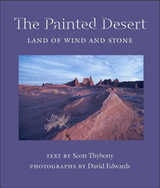
The Painted Desert
Land of Wind and StoneText by Scott Thybony; Photographs by David Edwards
University of Arizona Press, 2006
But this remote pocket of the Arizona desert, sandwiched between the Little Colorado River on one side and bold escarpments on the other, is much more than most tourists ever experience. An ethereal landscape of sculpted rock, wind-fluted cliffs, and elegantly drifting sand, the Painted Desert is a rich storehouse of natural beauty, colorful history, and scientific wonders. Here the strongest winds in Arizona blow across extensive dunefields, where less than ten inches of rain falls each year and only a few desert-savvy Navajo are able to live.
Now, for the first time award-winning writer Scott Thybony and freelance photographer David Edwards offer an intimate look at a place that remains inhospitable and inaccessible to so many. They share insights about the geology, paleontology, anthropology, and human history of the region as well as personal stories that dispel the misconceptions and mysteries that surround this delicate and difficult landscape.
With fifteen stunning photographs gracing the text, this book offers a vibrant portrait of one of the Southwest’s most barren, and most colorful landscapes.
The Painted Forest
Krista Eastman
West Virginia University Press, 2019
Council for Wisconsin Writers, Norbert Blei/August Derleth Nonfiction Book Award winner
In this often-surprising book of essays, Krista Eastman explores the myths we make about who we are and where we’re from. The Painted Forest uncovers strange and little-known “home places”—not only the picturesque hills and valleys of the author’s childhood in rural Wisconsin, but also tourist towns, the “under-imagined and overly caricatured” Midwest, and a far-flung station in Antarctica where the filmmaker Werner Herzog makes an unexpected appearance.
The Painted Forest upends easy narratives of place, embracing tentativeness and erasing boundaries. But it is Eastman’s willingness to play—to follow her curiosity down every odd path, to exude a skeptical wonder—that gives this book depth and distinction. An unlikely array of people, places, and texts meet for close conversation, and tension is diffused with art, imagination, and a strong sense of there being some other way forward. Eastman offers a smart and contemporary take on how we wander and how we belong.
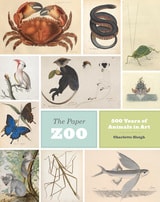
The Paper Zoo
500 Years of Animals in ArtCharlotte Sleigh
University of Chicago Press, 2017
In this stunning book, historian of science Charlotte Sleigh draws on the ultimate bibliophile’s menagerie—the collections of the British Library—to present a lavishly illustrated homage to this historical collaboration between art and science. Gathering together a breathtaking range of nature illustrations from manuscripts, prints, drawings, and rare printed books from across the world, Sleigh brings us face to face (or face to tentacle) with images of butterflies, beetles, and spiders, of shells, fish, and coral polyps. Organized into four themed sections—exotic, native, domestic, and paradoxical—the images introduce us to some of the world’s most renowned natural history illustrators, from John James Audubon to Mark Catesby and Ernst Haeckel, as well as to lesser-known artists. In her accompanying text, Sleigh traces the story of the art of natural history from the Renaissance through the great age of exploration and into the nineteenth century, offering insight into the changing connections between the natural and human worlds.
But the story does not end there. From caterpillars to crabs, langurs to dugongs, stick insects to Old English pigs; from the sinuous tail feathers of birds of paradise to the lime-green wings of New Zealand’s enormous flightless parrot, the kakapo; from the crenellated plates of a tortoise’s shell to imagined likenesses of unicorns, mermaids, and dinosaurs, the story continues in this book. It is a Paper Zoo for all time.
The Passage to Cosmos
Alexander von Humboldt and the Shaping of AmericaLaura Dassow Walls
University of Chicago Press, 2009
Explorer, scientist, writer, and humanist, Alexander von Humboldt was the most famous intellectual of the age that began with Napoleon and ended with Darwin. With Cosmos, the book that crowned his career, Humboldt offered to the world his vision of humans and nature as integrated halves of a single whole. In it, Humboldt espoused the idea that, while the universe of nature exists apart from human purpose, its beauty and order, the very idea of the whole it composes, are human achievements: cosmos comes into being in the dance of world and mind, subject and object, science and poetry.
Humboldt’s science laid the foundations for ecology and inspired the theories of his most important scientific disciple, Charles Darwin. In the United States, his ideas shaped the work of Emerson, Thoreau, Poe, and Whitman. They helped spark the American environmental movement through followers like John Muir and George Perkins Marsh. And they even bolstered efforts to free the slaves and honor the rights of Indians.
Laura Dassow Walls here traces Humboldt’s ideas for Cosmos to his 1799 journey to the Americas, where he first experienced the diversity of nature and of the world’s peoples—and envisioned a new cosmopolitanism that would link ideas, disciplines, and nations into a global web of knowledge and cultures. In reclaiming Humboldt’s transcultural and transdisciplinary project, Walls situates America in a lively and contested field of ideas, actions, and interests, and reaches beyond to a new worldview that integrates the natural and social sciences, the arts, and the humanities.
To the end of his life, Humboldt called himself “half an American,” but ironically his legacy has largely faded in the United States. The Passage to Cosmos will reintroduce this seminal thinker to a new audience and return America to its rightful place in the story of his life, work, and enduring legacy.
The Patagonian Sublime
The Green Economy and Post-Neoliberal PoliticsMendoza, Marcos
Rutgers University Press, 2019
Mendoza explores the fraught intersection of the green economy with the New Left politics of the Néstor Kirchner and Cristina Fernández de Kirchner governments. Mendoza documents the strategies of capitalist development, national representation, and political rule embedded in the “green productivist” agenda pursued by Kirchner and Fernández. Mendoza shows how Andean Patagonian communities have responded to the challenges of community-based conservation, the fashioning of wilderness zones, and the drive to create place-based monopolies that allow ecotourism destinations to compete in the global consumer economy.
The Pathless Way
Michael Cohen
University of Wisconsin Press, 1986
"A tour de force, a remarkable narrative of spiritual and political development. . . . [Cohen's] oft unanswered, and unanswerable, questions, his views of Muir's spiritual, intellectual, and political growth are insightful, challenging, and new. They deserve an audience with scholars and Muir devotees."—Shirley Sargent, Pacific Historian
In this powerful study, Michael Cohen captures as never before the powerful consciousness, vision, and legacy of the pioneering environmentalist John Muir. Ultimately, Cohen stresses, this ecological consciousness would generate an ecological conscience.
It was no longer enough for Muir to individually test and celebrate his enlightenment in the wild. His vision, he now felt, must lead to concrete action, and the result was a protracted campaign that stressed the ecological education of the American public, governmental protection of natural resources, the establishment of the National Parks, and the encouragement of tourism.
Anyone interested in environmental studies, in American history and literature, or in the future of our natural heritage will be drawn by the very bracing flavor of his wilderness odyssey, evoked here by one of his own—a twentieth-century mountaineer and literary craftsman.
The Pecan
A History of America's Native NutBy James McWilliams
University of Texas Press, 2013
What would Thanksgiving be without pecan pie? New Orleans without pecan pralines? Southern cooks would have to hang up their aprons without America’s native nut, whose popularity has spread far beyond the tree’s natural home. But as familiar as the pecan is, most people don’t know the fascinating story of how native pecan trees fed Americans for thousands of years until the nut was “improved” a little more than a century ago—and why that rapid domestication actually threatens the pecan’s long-term future.
In The Pecan, acclaimed writer and historian James McWilliams explores the history of America’s most important commercial nut. He describes how essential the pecan was for Native Americans—by some calculations, an average pecan harvest had the food value of nearly 150,000 bison. McWilliams explains that, because of its natural edibility, abundance, and ease of harvesting, the pecan was left in its natural state longer than any other commercial fruit or nut crop in America. Yet once the process of “improvement” began, it took less than a century for the pecan to be almost totally domesticated. Today, more than 300 million pounds of pecans are produced every year in the United States—and as much as half of that total might be exported to China, which has fallen in love with America’s native nut. McWilliams also warns that, as ubiquitous as the pecan has become, it is vulnerable to a “perfect storm” of economic threats and ecological disasters that could wipe it out within a generation. This lively history suggests why the pecan deserves to be recognized as a true American heirloom.
The Pennsylvania Weather Book
Gelber, Ben
Rutgers University Press, 2002
The weather has always been a favorite topic of conversation. Undoubtedly, someone must have said to Noah, “I thought they said it was supposed to let up on Tuesday.” Over a century ago, American essayist Charles Dudley Warner wrote in the HartfordCourant, “Everybody talks about the weather but nobody does anything about it.” And now with the advent of the 24-hour Weather Channel and high-tech radar and satellite imagery, we have more information about the weather at our disposal than ever before. But what about weather in the past? Is the climate changing? Are the summers hotter now than ever before? Were winters colder when our grandparents were children?
In The Pennsylvania Weather Book, meteorologist Ben Gelber provides the first comprehensive survey of 250 years of recorded weather in this state. He reports on noteworthy weather happenings by category (snowstorms, rainstorms, cold and heat waves, thunderstorms, and tropical storms) and places them in historical context. Throughout the book, Gelber clearly defines meteorological terms and explains what creates weather events. The book features appendices and tables containing useful references for average temperatures, precipitation, snowfall, and climate data. It also provides a brief history of the weather watchers who contributed to the state’s meteorological records since the late eighteenth century. This volume will serve as a valuable resource for weather professionals, amateurs, and local enthusiasts alike.
The People's Forests
Marshall, Robert
University of Iowa Press, 2002
Devoted conservationist, environmentalist, and explorer Robert Marshall (1901-1939) was chief of the Division of Recreation and Lands, U.S. Forest Service, when he died at age thirty-eight. Throughout his short but intense life, Marshall helped catalyze the preservation of millions of wilderness acres in all parts of the U.S., inspired countless wilderness advocates, and was a pioneer in the modern environmental movement: he and seven fellow conservationists founded the Wilderness Society in 1935. First published in 1933, The People's Forests made a passionate case for the public ownership and management of the nation's forests in the face of generations of devastating practices; its republication now is especially timely.
Marshall describes the major values of forests as sources of raw materials, as essential resources for the conservation of soil and water, and as a “precious environment for recreation” and for “the happiness of millions of human beings.” He considers the pros and cons of private and public ownership, deciding that public ownership and large-scale public acquisition are vital in order to save the nation's forests, and sets out ways to intelligently plan for and manage public ownership.
The last words of this book capture Marshall's philosophy perfectly: “The time has come when we must discard the unsocial view that our woods are the lumbermen's and substitute the broader ideal that every acre of woodland in the country is rightly a part of the people's forests.”
The People's Own Landscape
Nature, Tourism, and Dictatorship in East GermanyScott Moranda
University of Michigan Press, 2014
East Germany’s Socialist Unity Party aimed to placate a public well aware of the higher standards of living enjoyed elsewhere by encouraging them to participate in outdoor activities and take vacations in the countryside. Scott Moranda considers East Germany’s rural landscapes from the perspective of both technical experts (landscape architects, biologists, and physicians) who hoped to dictate how vacationers interacted with nature, and the vacationers themselves, whose outdoor experience shaped their understanding of environmental change. As authorities eliminated traditional tourist and nature conservation organizations, dissident conservationists demanded better protection of natural spaces. At the same time, many East Germans shared their government’s expectations for economic development that had real consequences for the land. By the 1980s, environmentalists saw themselves as outsiders struggling against the state and a public that had embraced mainstream ideas about limitless economic growth and material pleasures.
The Peregrine Returns
The Art and Architecture of an Urban Raptor RecoveryMary Hennen with Peggy Macnamara
University of Chicago Press, 2017
In The Peregrine Returns, Mary Hennen gives wings to this extraordinary conservation success story. Drawing on the beautiful watercolors of Field Museum artist-in-residence Peggy Macnamara and photos by Field Museum research assistant Stephanie Ware, as well as her own decades of work with peregrines, Hennen uses a program in Chicago as a case study for the peregrines’ journey from their devastating decline to the discovery of its cause (a thinning of eggshells caused by a by-product of DDT), through to recovery, revealing how the urban landscape has played an essential role in enabling falcons to return to the wild—and how people are now learning to live in close proximity to these captivating raptors.
Both a model for conservation programs across the country and an eye-opening look at the many creatures with which we share our homes, this richly illustrated story is an inspiring example of how urban architecture can serve not only our cities’ human inhabitants, but also their wild ones.
The Perfection of Nature
Animals, Breeding, and Race in the RenaissanceMackenzie Cooley
University of Chicago Press, 2022
The Renaissance is celebrated for the belief that individuals could fashion themselves to greatness, but there is a dark undercurrent to this fêted era of history. The same men and women who offered profound advancements in European understanding of the human condition—and laid the foundations of the Scientific Revolution—were also obsessed with controlling that condition and the wider natural world.
Tracing early modern artisanal practice, Mackenzie Cooley shows how the idea of race and theories of inheritance developed through animal breeding in the shadow of the Spanish Empire. While one strand of the Renaissance celebrated a liberal view of human potential, another limited it by biology, reducing man to beast and prince to stud. “Race,” Cooley explains, first referred to animal stock honed through breeding. To those who invented the concept, race was not inflexible, but the fragile result of reproductive work. As the Spanish empire expanded, the concept of race moved from nonhuman to human animals. Cooley reveals how, as the dangerous idea of controlled reproduction was brought to life again and again, a rich, complex, and ever-shifting language of race and breeding was born.
Adding nuance and historical context to discussions of race and human and animal relations, The Perfection of Nature provides a close reading of undertheorized notions of generation and its discontents in the more-than-human world.
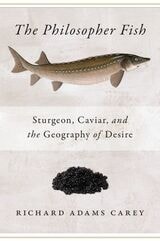
The Philosopher Fish
Sturgeon, Caviar, and the Geography of DesireRichard Adams Carey
Brandeis University Press, 2024
From the acclaimed eco-journalist Rick Carey comes a fascinating chronicle of a fast-disappearing fish—and of the people whose lives and livelihoods depend on it. Since the days of the Persian Empire, caviar has trumpeted status, wealth, prestige, and sex appeal. In this remarkable journey to caviar’s source, Carey immerses himself in the world of the sturgeon, the fish that lays these golden eggs. The sturgeon has a fascinating biological past—and a very uncertain future. Sturgeon populations worldwide have declined seventy percent in the last twenty years. Meanwhile, the beluga sturgeon, producer of the most coveted caviar, has climbed to number four on the World Wildlife Fund’s most-endangered species list. A high-stakes cocktail of business, crime, diplomacy, technology, and the dilemmas of conservation, The Philosopher Fish is the epic story of a 250-million-year-old fish struggling to survive.
This new edition includes new chapters bringing up to date the story of this elusive and mysterious fish, and the people involved with both preserving and exploiting it.
The Philosophy of Nature
Ivor Leclerc
Catholic University of America Press, 2018
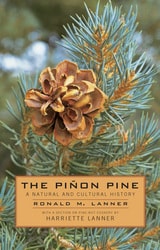
The Pinon Pine
A Natural And Cultural HistoryRonald M. Lanner
University of Nevada Press, 1981
An engaging look at the history of the piñon pine and its ecosystem. Combining natural history and observations of the cultural importance of the tree to both native Indians and European settlers, Lanner provides information on the management of the tree and its interdependence with the birds and animals of the piñon-juniper woodland. Science, cultural history, and ecologicall issues, plus delicious recipes using the piñon pine nuts, make for a concise natural and cultural history of the piñon pine.
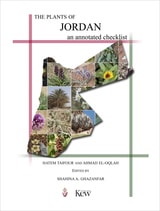
The Plants of Jordan
An Annotated ChecklistHatem Taifour and Ahmad El-Oqlah
Royal Botanic Gardens, Kew, 2017
The Plants of Sudan and South Sudan
An Annotated ChecklistEdited by Iain Darbyshire, Maha Kordofani, Imadeldin Farag, Ruba Candiga, and Helen Pickering
Royal Botanic Gardens, Kew, 2014
The Plants of Sudan and South Sudan is the first comprehensive look at the plants of this region and includes nearly every known species. Each entry includes accepted scientific names, relevant synonymy, and brief habitat notes, as well as both global and regional distribution data. Also featured is a list of globally threatened plant species, their habitats, and their distribution within the region, which offers conservationists, land management agencies, and governmental departments key information on potential conservation priorities. This book will be the baseline reference for all future botanical and conservation work in the Sudan region.

The Poconos
An Illustrated Natural History GuideHalma, Robert
Rutgers University Press, 1988
The Poconos, a rich plateau nestled in northeastern Pennsylvania between the Delaware River and the Moosic Mountains, encompass a variety of alluring features. The perfect reference for amateur naturalists, outdoor enthusiasts, tourists, and others who wish to explore the area, this classic guide clearly explains the unique geographic characteristics, animal habits and habitats, climate, geology, and vegetation of the area.
The authors trace the region from its beginnings millions of years ago as part of a shallow sea, through the reshaping forces of great glaciers, to today’s roadways and turnpikes. This revised and expanded edition also includes brief profiles of individuals who played significant roles in the preservation or understanding of the area’s ecology. Chapters provide a general survey of the area, including its history and places to be explored and observed, information on forest types, wildlife, and aquatic habitats, updated facts and figures on animal populations, as well as new details on invasive species.
Throughout the book, numerous boxes direct readers to observatory points for specific birds, ecosystems, vegetation types, and geological features, while maps, tables, original pen-and-ink illustrations, and a select list of field guides and other references enhance the book’s appeal. An indispensable companion for visitors as well as residents, The Poconos is a must-read for everyone who wants to discover or better understand the beauty and natural history of this unique region.
The Poconos
An Illustrated Natural History GuideCarl S. Oplinger and Robert Halma
Rutgers University Press, 2006
The Poconos, a rich plateau nestled in northeastern Pennsylvania between the Delaware River and the Moosic Mountains, encompass a variety of alluring features. The perfect reference for amateur naturalists, outdoor enthusiasts, tourists, and others who wish to explore the area, this classic guide clearly explains the unique geographic characteristics, animal habits and habitats, climate, geology, and vegetation of the area.
The authors trace the region from its beginnings millions of years ago as part of a shallow sea, through the reshaping forces of great glaciers, to today’s roadways and turnpikes. This revised and expanded edition also includes brief profiles of individuals who played significant roles in the preservation or understanding of the area’s ecology. Chapters provide a general survey of the area, including its history and places to be explored and observed, information on forest types, wildlife, and aquatic habitats, updated facts and figures on animal populations, as well as new details on invasive species.
Throughout the book, numerous boxes direct readers to observatory points for specific birds, ecosystems, vegetation types, and geological features, while maps, tables, original pen-and-ink illustrations, and a select list of field guides and other references enhance the book’s appeal. An indispensable companion for visitors as well as residents, The Poconos is a must-read for everyone who wants to discover or better understand the beauty and natural history of this unique region.
The Poetics of Natural History
Christoph Irmscher
Rutgers University Press, 2019
Early American naturalists assembled dazzling collections of native flora and fauna, from John Bartram’s botanical garden in Philadelphia and the artful display of animals in Charles Willson Peale’s museum to P. T. Barnum’s American Museum, infamously characterized by Henry James as “halls of humbug.” Yet physical collections were only one of the myriad ways that these naturalists captured, catalogued, and commemorated America’s rich biodiversity. They also turned to writing and art, from John Edward Holbrook’s forays into the fascinating world of herpetology to John James Audubon’s masterful portraits of American birds.
In this groundbreaking, now classic book, Christoph Irmscher argues that early American natural historians developed a distinctly poetic sensibility that allowed them to imagine themselves as part of, and not apart from, their environment. He also demonstrates what happens to such inclusiveness in the hands of Harvard scientist-turned Amazonian explorer Louis Agassiz, whose racist pseudoscience appalled his student William James.
This expanded, full-color edition of The Poetics of Natural History features a preface and art from award-winning artist Rosamond Purcell and invites the reader to be fully immersed in an era when the boundaries between literature, art, and science became fluid.
The Poetics of Natural History
From John Bartram to William JamesIrmscher, Christoph
Rutgers University Press, 1999
The Poetics of Natural History is about the “daydreams” of early American naturalists (from 1730 to 1868) and the collections they created around these dreams. Christoph Irmscher explores how, through the acts of organizing physical artifacts and reflecting upon their collections through writings and images, naturalists from John Bartram to Louis Agassiz were making sense of themselves and their world. These collections allowed them, in a way, to collect themselves.
In the first part of his book, Irmscher offers us a guided tour of the actual collections, beginning in Bartram’s disorderly botanical garden in Philadelphia and taking us through the artful display of animals in Charles Wilson Peale’s collections and, finally, to the “halls of humbug” of P. T. Barnum’s American Museum. The second part of the book moves away from the collections, and explores natural history words and images. Irmscher unforgettably describes American collectors’ fascination and horror with the American rattlesnake, and invokes the violent and beautiful world of American birds as described in John James Audubon’s paintings and writings. His book ends with a description of Louis Agassiz’s 1865 expedition to Brazil as seen through the eyes of the young William James, who reluctantly gathered Brazilian fish while his mentor assembled “proof” that some human beings were less human than others.
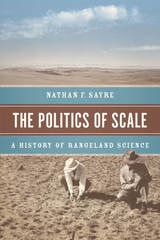
The Politics of Scale
A History of Rangeland ScienceNathan F. Sayre
University of Chicago Press, 2017
During the late 1880s and early 1890s, a variety of forces—from the Homestead Act of 1862 to the extermination of bison, foreign investment, and lack of government regulation—promoted free-for-all access to and development of the western range, with disastrous environmental consequences. To address the crisis, government agencies turned to scientists, but as Nathan F. Sayre shows, range science grew in a politically fraught landscape. Neither the scientists nor the public agencies could escape the influences of bureaucrats and ranchers who demanded results, and the ideas that became scientific orthodoxy—from fire suppression and predator control to fencing and carrying capacities—contained flaws and blind spots that plague public debates about rangelands to this day. Looking at the global history of rangeland science through the Cold War and beyond, The Politics of Scale identifies the sources of past conflicts and mistakes and helps us to see a more promising path forward, one in which rangeland science is guided less by capital and the state and more by communities working in collaboration with scientists.
The Porch
Meditations on the Edge of NatureCharlie Hailey
University of Chicago Press, 2021
Hailey writes from a modest porch on the Homosassa River in Florida. He sleeps there, studies the tides, listens for osprey and manatee, welcomes shipwrecked visitors, watches shadows on its screens, reckons with climate change, and reflects on his own acclimation to his environment. The profound connections he unearths anchor an armchair exploration of past porches and those of the future, moving from ancient Greece to contemporary Sweden, from the White House roof to the Anthropocene home. In his ruminations, he links up with other porch dwellers including environmentalist Rachel Carson, poet Wendell Berry, writers Eudora Welty and Zora Neale Hurston, philosopher John Dewey, architect Louis Kahn, and photographer Paul Strand.
As close as architecture can bring us to nature, the porch is where we can learn to contemplate anew our evolving place in a changing world—a space we need now more than ever. Timeless and timely, Hailey’s book is a dreamy yet deeply passionate meditation on the joy and gravity of sitting on the porch.

The Practical Guide to Michigan Law
Fred S. Steingold
University of Michigan Press, 1983
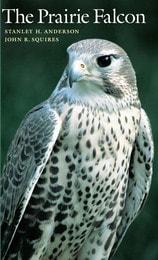
The Prairie Falcon
By Stanley H. Anderson and John R. Squires
University of Texas Press, 1997
Skillful hunters beautiful in flight, Prairie Falcons inhabit the rocky cliffs of the American West. These raptors range from southern Canada and northern North Dakota to Baja California, Arizona, New Mexico, western and northern Texas, and southeastern Coahuila, Mexico.
This is the first book for a wide audience devoted exclusively to the Prairie Falcon. Stanley Anderson and John Squires cover all aspects of the falcon's life history from mating and rearing young to hunting behaviors and the yearly migration cycle. They provide complete descriptive characteristics for identifying Prairie Falcons and also compare them to other raptors, especially the closely related Peregrine Falcon.
In addition, the authors recount the long association of falcons with people, which may extend back as far as 2000 BC. They describe the practice of falconry from the Middle Ages until today. And they assess the threats to Prairie Falcons posed by human activities, from pesticide use and destruction of habitat to disruption of the breeding cycle by careless birdwatchers.