Results by title
2018 books match the query 'Political aspects' and 377 start with t
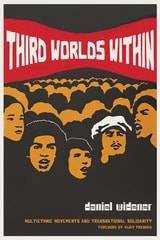
Third Worlds Within
Multiethnic Movements and Transnational SolidarityDaniel Widener
Duke University Press, 2024
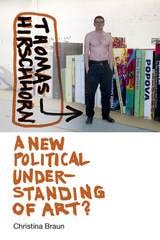
Thomas Hirschhorn
A New Political Understanding of Art?Christina Braun
Dartmouth College Press, 2018
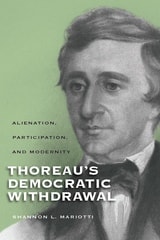
Thoreau’s Democratic Withdrawal
Alienation, Participation, and ModernityShannon L. Mariotti
University of Wisconsin Press, 2009
Separated by time, space, and context, Thoreau and Adorno share a common belief that critical inquiry is essential to democracy but threatened by modern society. While walking, huckleberrying, and picking wild apples, Thoreau tries to recover the capacities for independent perception and thought that are blunted by “Main Street,” conventional society, and the rapidly industrializing world that surrounded him. Adorno’s thoughts on particularity and the microscopic gaze he employs to work against the alienated experience of modernity help us better understand the value of Thoreau’s excursions into nature. Reading Thoreau with Adorno, we see how periodic withdrawals from public spaces are not necessarily apolitical or apathetic but can revitalize our capacity for the critical thought that truly defines democracy.
In graceful, readable prose, Mariotti reintroduces us to a celebrated American thinker, offers new insights on Adorno, and highlights the striking common ground they share. Their provocative and challenging ideas, she shows, still hold lessons on how we can be responsible citizens in a society that often discourages original, critical analysis of public issues.
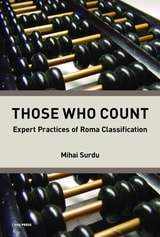
Those Who Count
Expert Practicies of Roma ClassificationMihai Surdu
Central European University Press, 2016
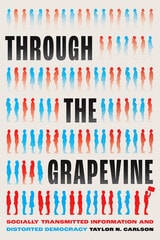
Through the Grapevine
Socially Transmitted Information and Distorted DemocracyTaylor N. Carlson
University of Chicago Press, 2024
An enlightening examination of what it means when Americans rely on family and friends to stay on top of politics.
Accurate information is at the heart of democratic functioning. For decades, researchers interested in how information is disseminated have focused on mass media, but the reality is that many Americans today do not learn about politics from direct engagement with the news. Rather, about one-third of Americans learn chiefly from information shared by their peers in conversation or on social media. How does this socially transmitted information differ from that communicated by traditional media? What are the consequences for political attitudes and behavior?
Drawing on evidence from experiments, surveys, and social media, Taylor N. Carlson finds that, as information flows first from the media then person to person, it becomes sparse, more biased, less accurate, and more mobilizing. The result is what Carlson calls distorted democracy. Although socially transmitted information does not necessarily render democracy dysfunctional, Through the Grapevine shows how it contributes to a public that is at once underinformed, polarized, and engaged.

Tissue Economies
Blood, Organs, and Cell Lines in Late CapitalismCatherine Waldby and Robert Mitchell
Duke University Press, 2006
Waldby and Mitchell pull together a prodigious amount of research—involving policy reports and scientific papers, operating manuals, legal decisions, interviews, journalism, and Congressional testimony—to offer a series of case studies based on particular forms of tissue exchange. They examine the effect of threats of contamination—from HIV and other pathogens—on blood banks’ understandings of the gift/commodity relationship; the growth of autologous economies, in which individuals bank their tissues for their own use; the creation of the United Kingdom’s Stem Cell bank, which facilitates the donation of embryos for stem cell development; and the legal and financial repercussions of designating some tissues “hospital waste.” They also consider the impact of different models of biotechnology patents on tissue economies and the relationship between experimental therapies to regenerate damaged or degenerated tissues and calls for a legal, for-profit market in organs. Ultimately, Waldby and Mitchell conclude that scientific technologies, the globalization of tissue exchange, and recent anthropological, sociological, and legal thinking have blurred any strict line separating donations from the incursion of market values into tissue economies.

Touched Bodies
The Performative Turn in Latin American ArtMara Polgovsky Ezcurra
Rutgers University Press, 2019
Winner of the 2019 Art Journal Prize from the College Art Association
What is the role of pleasure and pain in the politics of art? In Touched Bodies, Mara Polgovsky Ezcurra approaches this question as she examines the flourishing of live and intermedial performance in Latin America during times of authoritarianism and its significance during transitions to democracy. Based on original documents and innovative readings, her book brings politics and ethics to the discussion of artistic developments during the “long 1980s”. She describes the rise of performance art in the context of feminism, HIV-activism, and human right movements, taking a close look at the work of Diamela Eltit and Raúl Zurita from Chile, León Ferrari and Liliana Maresca from Argentina, and Marcos Kurtycz, the No Grupo art collective, and Proceso Pentágono from Mexico. The comparative study of the work of these artists attests to a performative turn in Latin American art during the 1980s that, like photography and film before, recast the artistic field as a whole, changing the ways in which we perceive art and understand its role in society.
Tourism Geopolitics
Assemblages of Infrastructure, Affect, and ImaginationEdited by Mary Mostafanezhad, Matilde Córdoba Azcárate, Roger Norum
University of Arizona Press, 2021
In Tourism Geopolitics, contributors show enacted processes such as labor migration, conservation, securitization, nation building, territorial disputes, ethnic cleansing, heritage revitalization, and global health crisis management, among others. These contended societal processes are deployed through tourism development initiatives that mobilize deeply uneven symbolic and material landscapes. The chapters reveal how a range of experiences are implicated in this process: museum visits, walking tours, architectonical evocations of the past, road construction, militarized island imaginations, gendered cultural texts, and official silences. Collectively, the chapters offer ethnographically rich illustrations from around the world that demonstrate the critical nature of tourism in formal geopolitical practices, as well as the geopolitical nature of everyday tourism encounters. This volume is a vital read for critical geographers, anthropologists, and political scientists, as well as scholars of tourism and cultural studies.
Contributors: Sarah Becklake, M. Bianet Castellanos, Matilde Córdoba Azcárate, Jason Dittmer, Klaus Dodds, Jamie Gillen, Simon Halink, Jordan Hallbauer, James Igoe, Debbie Lisle, Mary Mostafanezhad, Dieter K. Müller, Roger Norum, Alessandro Rippa, Ian Rowen, Robert Saunders, Juan Francisco Salazar, Tani Sebro, Mimi Sheller, Henry Szadziewski, Vernadette Vicuña González, Emma Waterton

Toward an Anti-Capitalist Composition
James Rushing Daniel
Utah State University Press, 2022
Drawing on an array of philosophers, political theorists, and activists, Daniel outlines an anti-capitalist approach informed by the common, a concept theorized by Pierre Dardot and Christian Laval as a solidaristic response to capitalism rooted in inventive political action. Rather than relying upon claims of membership or ownership, the common supports radical, collective acts of remaking that comprehensively reject capitalist logics. Applying this approach to collaborative writing, student debt, working culture, and digital writing, Daniel demonstrates how the writing classroom may be oriented toward capitalist harms and prepare students to critique and resist them. He likewise employs the common to theorize how anti-capitalist interventions beyond the classroom could challenge institutional privatization and oppose the adjunctification of the professoriate.
Arguing that composition scholars have long neglected marketization and corporate power, Toward an Anti-Capitalist Composition extends a case for adopting a resolute anti-capitalist stance in the field and for remaking the university as a site of common work.
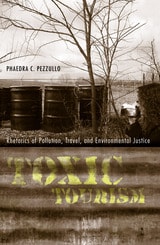
Toxic Tourism
Rhetorics of Pollution, Travel, and Environmental JusticePhaedra C. Pezzullo
University of Alabama Press, 2009
The first book length study of the environmental justice movement, tourism, and the links between race, class, and waste
Tracks on the Trail
Popular Music, Race, and the US PresidencyDana Gorzelany-Mostak
University of Michigan Press, 2023
From Bill Clinton playing his saxophone on The Arsenio Hall Show to Barack Obama referencing Jay-Z’s song “Dirt Off Your Shoulder,” politicians have used music not only to construct their personal presidential identities but to create the broader identity of the American presidency. Through music, candidates can appear relatable, show cultural competency, communicate values and ideas, or connect with a specific constituency. On a less explicit level, episodes such as Clinton’s sax-playing and Obama’s shoulder brush operate as aural and visual articulations of race and racial identity. But why do candidates choose to engage with race in this manner? And why do supporters and detractors on YouTube and the Twittersphere similarly engage with race when they create music videos or remixes in homage to their favorite candidates?
With Barack Obama, Ben Carson, Kamala Harris, and Donald Trump as case studies, Tracks on the Trail: Popular Music, Race, and the US Presidency sheds light on the factors that motivate candidates and constituents alike to articulate race through music on the campaign trail and shows how the racialization of sound intersects with other markers of difference and ultimately shapes the public discourse surrounding candidates, popular music, and the meanings attached to race in the 21st century. Gorzelany-Mostak explores musical engagement broadly, including official music in the form of candidate playlists and launch event setlists, as well as unofficial music in the form of newly composed campaign songs, mashups, parodies, and remixes.
Training for Catastrophe
Fictions of National Security after 9/11Lindsay Thomas
University of Minnesota Press, 2021
A timely, politically savvy examination of how impossible disasters shape the very real possibilities of our world
Why would the normally buttoned-down national security state imagine lurid future scenarios like a zombie apocalypse? In Training for Catastrophe, author Lindsay Thomas shows how our security regime reimagines plausibility to focus on unlikely and even unreal events rather than probable ones. With an in-depth focus on preparedness (a pivotal, emergent national security paradigm since 9/11) she explores how fiction shapes national security.
Thomas finds fiction at work in unexpected settings, from policy documents and workplace training manuals to comics and video games. Through these texts—as well as plenty of science fiction—she examines the philosophy of preparedness, interrogating the roots of why it asks us to treat explicitly fictional events as real. Thomas connects this philosophical underpinning to how preparedness plays out in contemporary politics, emphasizing how it uses aesthetic elements like realism, genre, character, and plot to train people both to regard some disasters as normal and to ignore others.
Training for Catastrophe makes an important case for how these documents elicit consent and compliance. Thomas draws from a huge archive of texts—including a Centers for Disease Control comic about a zombie apocalypse, the work of Audre Lorde, and the political thrillers of former national security advisor Richard Clarke—to ask difficult questions about the uses and values of fiction. A major statement on how national security intrudes into questions of art and life, Training for Catastrophe is a timely intervention into how we confront disasters.
Transformative Justice
Israeli Identity on TrialLeora Bilsky
University of Michigan Press, 2004
Transforming the Personal, Political, Historical and Sacred in Theory and Practice
Personal, Political, Historical, and SacredManfred Halpern
University of Scranton Press, 2009
Transitions
Legal Change, Legal MeaningsAustin Sarat
University of Alabama Press, 2012
Transitions: Legal Change, Legal Meanings illustrates the various intersections, crises, and shifts that continually occur within the law, and how these moments of change interact with and comment on contemporary society.
Akhil Reed Amar / William L. Andreen /
Jack M. Beermann / Heather Elliott / Joshua
Alexander Geltzer / David Gray / Paul
Horwitz / Daniel H. Joyner / Nina
Mendelson / Meredith Render / Austin
Sarat / Ruti Teitel / Lindsey Ohlsson Worth
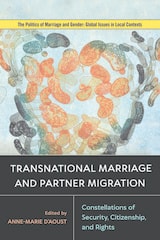
Transnational Marriage and Partner Migration
Constellations of Security, Citizenship, and RightsAnne-Marie D'Aoust
Rutgers University Press, 2022

Transnational Political Islam
Religion, Ideology and PowerEdited by Azza Karam
Pluto Press, 2003
Political Islam, to be distinguished from Islam as a culture or a religion, and from Islamic Fundamentalism, is an increasingly important feature of the western political scene. The ideologies of Political Islam reflect the fact that some of their adherents live and work within a Western socio-political context.
Although Political Islam has been widely written about in Muslim countries, very little has been published the West, and this book attempts to redress that imbalance.
With a range of outstanding contributors that includes academics and human rights advocates this book tackles the diversity of Islamist thinking and practice in various Western countries and explores their transnational connections in both East and West.
The book analyses developments in Islamist thinking and activities, and their connections to the latest global political and economic trends, and discusses future evolutions of the ideology and its manifestations.
Transnational Political Spaces
Agents - Structures - EncountersEdited by Mathias Albert, Gesa Bluhm, Jan Helmig, Andreas Leutzsch, and Jochen W
Campus Verlag, 2009
From a decidedly multidisciplinary perspective, the articles in Transnational Political Spaces address the notion that political space is no longer fully congruent with national borders. Instead there are areas called transnational political spaces—caused by factors such as migration and social transformation—where policy occurs oblivious to national pressure. Organized into three sections—transnational actors, transnational spaces, and critical encounters—this volume explains how these spaces are formed and defined and how they can be traced and conceptualized.

Transplanting the Great Society
Lyndon Johnson and Food for PeaceKristin L. Ahlberg
University of Missouri Press, 2008

Traveler, There Is No Road
Theatre, the Spanish Civil War, and the Decolonial Imagination in the AmericasLisa Jackson-Schebetta
University of Iowa Press, 2017
This book offers a unique perspective on 1930s theatre and performance, encompassing the theatrical work of the Cuban, Puerto Rican, and Spanish diasporas in the United States, as well as the better-known Anglophone communities. Jackson-Schebetta situates well-known figures, such as Langston Hughes and Clifford Odets, alongside lesser-known ones, such as Erasmo Vando, Franca de Armiño, and Manuel Aparicio. The milicianas, female soldiers of the Spanish Republic, stride on stage alongside the male fighters of the Lincoln Brigade. They and many others used the multiple visions of Spain forged during the civil war to foment decolonial practices across the pasts, presents, and futures of the Americas. Traveler conclusively demonstrates that theatre and performance scholars must position US performances within the Americas writ broadly, and in doing so they must recognize the centrality of the hemisphere’s longest-lived colonial power, Spain.
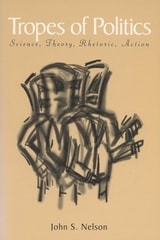
Tropes of Politics
Science, Theory, Rhetoric, ActionJohn S. Nelson
University of Wisconsin Press, 1998
Talk is of central importance to politics of almost every kind—it’s no accident that when the ancient Greeks first attempted to examine politics systematically, they developed the study of rhetoric. In Tropes of Politics, John Nelson applies rhetorical analysis first to political theory, and then to politics in practice. He offers a full and deep critical examination of political science and political theory as fields of study, and then undertakes a series of creative examinations of political rhetoric, including a deconstruction of deliberation and debate by the U.S. Senate prior to the Gulf War.
Using the neglected arts of argument refined by the rhetoric of inquiry, Nelson traces how everyday words like consent and debate construct politics in much the same way that poets such as Mamet and Shakespeare construct plays, and he shows how we are remaking our politics even as we speak. Tropes of Politics explores how politicians take stands and political scientists probe representation, how experts become informed even as citizens become authorities, how students actually reinvent government while professors merely model politics, how senators wage war yet keep comity among themselves.
The action, Nelson shows, is in the tropes: these figures of speech and images of deed can persuade us to turn from ideologies like liberalism toward spectacles about democracy or movements into environmentalism and feminism. His argument is that inventive attention to tropes can mean better participation in politics. And the argument is in the tropes—evidence itself as sights or citations, governments as machines or men, politics as hardball or softball, deliberations as freedoms or constraints, borders as fringes or friends.

Trumpets in the Mountains
Theater and the Politics of National Culture in CubaLaurie A. Frederik
Duke University Press, 2012
Campesinos inhabit some of the island's most isolated areas, including the mountainous regions in central and eastern Cuba where Laurie A. Frederik conducted research among rural communities and professional theater groups. Analyzing the ongoing dialogue of cultural officials, urban and rural artists, and campesinos, Frederik provides an on-the-ground account of how visions of the nation are developed, manipulated, dramatized, and maintained in public consciousness. She shows that cubanía is defined, and redefined, in the interactive movement between intellectual, political, and everyday worlds.
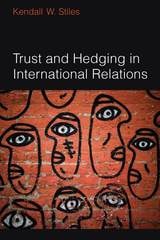
Trust and Hedging in International Relations
Kendall W. Stiles
University of Michigan Press, 2018
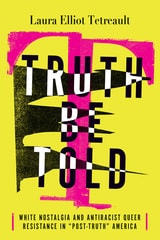
Truth Be Told
White Nostalgia and Antiracist Queer Resistance in “Post-Truth” AmericaLaura Elliot Tetreault
The Ohio State University Press, 2025
Taking a critical disinformation studies approach, Tetreault analyzes post-truth political messaging in the US after 2016. Using racial rhetorical criticism combined with a queer lens, they focus on how contemporary antiracist, queer, and feminist activists used various forms of cultural production to work against disinformation and its circulation, enacting refusal and insisting on the validity of their own knowledges as a form of community care. Tetreault ultimately argues that it’s not just the truth that academics must advocate for; they must question whose truth and how that truth is mediated and circulated.
Tungsten in Peace and War, 1918–1946
Ronald H. Limbaugh
University of Nevada Press, 2011
Tweets and the Streets
Social Media and Contemporary ActivismPaolo Gerbaudo
Pluto Press, 2012
Tweets and the Streets analyses the culture of the new protest movements of the 21st century. From the Arab Spring to the 'indignados' protests in Spain and the Occupy movement, Paolo Gerbaudo examines the relationship between the rise of social media and the emergence of new forms of protest.
Gerbaudo argues that activists' use of Twitter and Facebook does not fit with the image of a 'cyberspace' detached from physical reality. Instead, social media is used as part of a project of re-appropriation of public space, which involves the assembling of different groups around 'occupied' places such as Cairo’s Tahrir Square or New York’s Zuccotti Park.
An exciting and invigorating journey through the new politics of dissent, Tweets and the Streets points both to the creative possibilities and to the risks of political evanescence which new media brings to the contemporary protest experience.
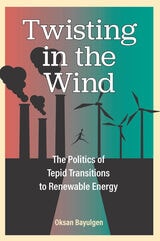
Twisting in the Wind
The Politics of Tepid Transitions to Renewable EnergyOksan Bayulgen
University of Michigan Press, 2022
Why do governments insist on fossil fuels? Why do renewables face uncertain and inconsistent legal and regulatory circumstances that slow their market-share growth against fossil fuels? Oksan Bayulgen studies the political determinants of partial energy reforms that result in tepid energy transitions and shifts the geographical focus from front-runner countries of energy innovation to developing countries, which have become the largest carbon emitters in the world. Her in-depth case study of energy policies in Turkey over the past two decades demonstrates that energy transitions are neither inevitable nor linear and that they are often initiated if and only when promoting renewables is in the interests of governing elites and stall when political dividends associated with energy rents change. This book contributes to the debates on the nature and pace of energy transitions by analyzing the power dynamics and political institutions under which energy reforms are initiated and implemented over time. This timely topic will be of interest to scholars, policymakers, energy investors, and anyone interested in environmental studies.