Results by title
3027 books match the query 'Sociology' and 538 start with t
The Professional Convict's Tale
The Survival of John O'Neill In and Out of PrisonElmer H. Johnson
Southern Illinois University Press, 2007
Challenging the ideology of treatment in the prison world
The Professional Convict’s Tale: The Survival of John O’Neill In and Out of Prison offers a unique, inside view of life behind bars in the 1960s. Elmer H. Johnson, a criminologist who has specialized in prison life for half a century, gave Menard Penitentiary parolee John O’Neill a tape recorder and a set of questions designed to draw out his opinions and observations about the prison world.
This study frames O’Neill’s responses with Johnson’s analysis. O’Neill’s narrative guides readers through the world beyond the prison gate as he shares his strategies for survival and proposes alternatives to rebellion or submission. He discusses the fractionalization between the keepers and the kept and the effects that subterranean communication, threats of inmate predators, and prison riots can have on the psyche of both inmates and staff.
O’Neill’s frustrations and the inadequate responses from the community to which he was paroled illustrate the social costs and impact of parole for the community and for the parolee. Although O’Neill recorded his comments more than forty years ago, they are still relevant today when thousands of convicts are being released from prison each year.

The Professional Thief
Chic Conwell and Edwin Hardin Sutherland
University of Chicago Press, 1988

The Progressive City
Planning and Participation, 1969-1984Clavel, Pierre
Rutgers University Press, 1986
The Projects
Gang and Non-Gang Families in East Los AngelesBy James Diego Vigil
University of Texas Press, 2007
2008 — ALLA Prize for Best Book on Latina/o Anthropology
The Pico Gardens housing development in East Los Angeles has a high percentage of resident families with a history of persistent poverty, gang involvement, and crime. In some families, members of three generations have belonged to gangs. Many other Pico Gardens families, however, have managed to avoid the cycle of gang involvement.
In this work, Vigil adds to the tradition of poverty research and elaborates on the association of family dynamics and gang membership. The main objective of his research was to discover what factors make some families more vulnerable to gang membership, and why gang resistance was evidenced in similarly situated non-gang-involved families. Providing rich, in-depth interviews and observations, Vigil examines the wide variations in income and social capital that exist among the ostensibly poor, mostly Mexican American residents. Vigil documents how families connect and interact with social agencies in greater East Los Angeles to help chart the routines and rhythms of the lives of public housing residents. He presents family life histories to augment and provide texture to the quantitative information.
By studying life in Pico Gardens, Vigil feels we can better understand how human agency interacts with structural factors to produce the reality that families living in all public housing developments must contend with daily.

The Proletarian Gamble
Korean Workers in Interwar JapanKen C. Kawashima
Duke University Press, 2009
Kawashima draws on previously unseen archival materials from interwar Japan as he describes how Korean migrants struggled against various recruitment practices, unfair and discriminatory wages, sudden firings, racist housing practices, and excessive bureaucratic red tape. Demonstrating that there was no single Korean “minority,” he reveals how Koreans exploited fellow Koreans and how the stratification of their communities worked to the advantage of state and capital. However, Kawashima also describes how, when migrant workers did organize—as when they became involved in Rōsō (the largest Korean communist labor union in Japan) and in Zenkyō (the Japanese communist labor union)—their diverse struggles were united toward a common goal. In The Proletarian Gamble, his analysis of the Korean migrant workers' experiences opens into a much broader rethinking of the fundamental nature of capitalist commodity economies and the analytical categories of the proletariat, surplus populations, commodification, and state power.
The Public Infrastructure of Work and Play
Michael A. Pagano
University of Illinois Press, 2018
The latest volume in the Urban Agenda series looks at pressing infrastructure issues discussed at the 2017 UIC Urban Forum. Topics include: competing notions of the infrastructure ideal; what previous large infrastructure programs can teach the Trump Administration; how infrastructure influences city design; the architecture of the cities of tomorrow; who benefits from infrastructure improvements; and evaluations of projects like the Chicago Riverwalk and grassroots efforts to reclaim neighborhood parks from gangs.
Contributors: Philip Ashton, Beverly S. Bunch, Bill Burton, Charles Hoch, Sean Lally, and Sanjeev Vidyarthi
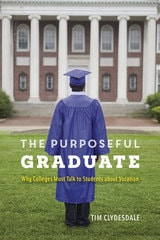
The Purposeful Graduate
Why Colleges Must Talk to Students about VocationTim Clydesdale
University of Chicago Press, 2015
The key, he argues, is simple: direct, systematic, and creative programs that engage undergraduates on the question of purpose. Backing up his argument with rich data from a Lilly Endowment grant that funded such programs on eighty-eight different campuses, he shows that thoughtful engagement of the notion of vocational calling by students, faculty, and staff can bring rich rewards for all those involved: greater intellectual development, more robust community involvement, and a more proactive approach to lifelong goals. Nearly every institution he examines—from internationally acclaimed research universities to small liberal arts colleges—is a success story, each designing and implementing its own program, that provides students with deep resources that help them to launch flourishing lives.
Flying in the face of the pessimistic forecast of higher education’s emaciated future, Clydesdale offers a profoundly rich alternative, one that can be achieved if we simply muster the courage to talk with students about who they are and what they are meant to do.
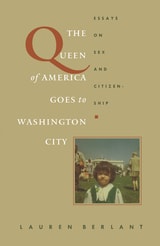
The Queen of America Goes to Washington City
Essays on Sex and CitizenshipLauren Berlant
Duke University Press, 1997
As Berlant traces the guiding images of U.S. citizenship through the process of privatization, she discusses the ideas of intimacy that have come to define national culture. From the fantasy of the American dream to the lessons of Forrest Gump, Lisa Simpson to Queer Nation, the reactionary culture of imperilled privilege to the testimony of Anita Hill, Berlant charts the landscape of American politics and culture. She examines the consequences of a shrinking and privatized concept of citizenship on increasing class, racial, sexual, and gender animosity and explores the contradictions of a conservative politics that maintains the sacredness of privacy, the virtue of the free market, and the immorality of state overregulation—except when it comes to issues of intimacy.
Drawing on literature, the law, and popular media, The Queen of America Goes to Washington City is a stunning and major statement about the nation and its citizens in an age of mass mediation. As it opens a critical space for new theory of agency, its narratives and gallery of images will challenge readers to rethink what it means to be American and to seek salvation in its promise.
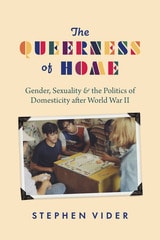
The Queerness of Home
Gender, Sexuality, and the Politics of Domesticity after World War IIStephen Vider
University of Chicago Press, 2021
From the Stonewall riots to the protests of ACT UP, histories of queer and trans politics have almost exclusively centered on public activism. In The Queerness of Home, Stephen Vider turns the focus inward, showing that the intimacy of domestic space has been equally crucial to the history of postwar LGBTQ life.
Beginning in the 1940s, LGBTQ activists looked increasingly to the home as a site of connection, care, and cultural inclusion. They struggled against the conventions of marriage, challenged the gendered codes of everyday labor, reimagined domestic architecture, and contested the racial and class boundaries of kinship and belonging. Retelling LGBTQ history from the inside out, Vider reveals the surprising ways that the home became, and remains, a charged space in battles for social and economic justice, making it clear that LGBTQ people not only realized new forms of community and culture for themselves—they remade the possibilities of home life for everyone.

The Racial Order
Mustafa Emirbayer and Matthew Desmond
University of Chicago Press, 2015
In the end, this project is not merely about race; it is a theoretical reconsideration of the fundamental problems of order, agency, power, and social justice. The Racial Order is a challenging work of social theory, institutional and cultural analysis, and normative inquiry.
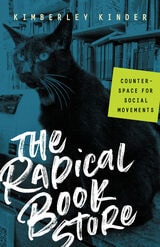
The Radical Bookstore
Counterspace for Social MovementsKimberley Kinder
University of Minnesota Press, 2021
Examines how radical bookstores and similar spaces serve as launching pads for social movements
How does social change happen? It requires an identified problem, an impassioned and committed group, a catalyst, and a plan. In this deeply researched consideration of seventy-seven stores and establishments, Kimberley Kinder argues that activists also need autonomous space for organizing, and that these spaces are made, not found. She explores the remarkably enduring presence of radical bookstores in America and how they provide infrastructure for organizing—gathering places, retail offerings that draw new people into what she calls “counterspaces.”
Kinder focuses on brick-and-mortar venues where owners approach their businesses primarily as social movement tools. These may be bookstores, infoshops, libraries, knowledge cafes, community centers, publishing collectives, thrift stores, or art installations. They are run by activist-entrepreneurs who create centers for organizing and selling books to pay the rent. These spaces allow radical and contentious ideas to be explored and percolate through to actual social movements, and serve as crucibles for activists to challenge capitalism, imperialism, white privilege, patriarchy, and homophobia. They also exist within a central paradox: participating in the marketplace creates tensions, contradictions, and shortfalls. Activist retail does not end capitalism; collective ownership does not enable a retreat from civic requirements like zoning; and donations, no matter how generous, do not offset the enormous power of corporations and governments.
In this timely and relevant book, Kinder presents a necessary, novel, and apt analysis of the role these retail spaces play in radical organizing, one that demonstrates how such durable hubs manage to persist, often for decades, between the spikes of public protest.
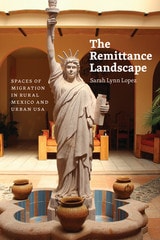
The Remittance Landscape
Spaces of Migration in Rural Mexico and Urban USASarah Lynn Lopez
University of Chicago Press, 2014
Lopez not only identifies a clear correspondence between the flow of remittances and the recent building boom in rural Mexico but also proposes that this construction boom itself motivates migration and changes social and cultural life for migrants and their families. At the same time, migrants are changing the landscapes of cities in the United States: for example, Chicago and Los Angeles are home to buildings explicitly created as headquarters for Mexican workers from several Mexican states such as Jalisco, Michoacán, and Zacatecas. Through careful ethnographic and architectural analysis, and fieldwork on both sides of the border, Lopez brings migrant hometowns to life and positions them within the larger debates about immigration.
The Return of the Neighborhood as an Urban Strategy
Edited by Michael A. Pagano
University of Illinois Press, 2015
The topics focus on sustainable capital and societal investments in people and firms at the neighborhood level. Proposed solutions cover a range of possibilities for enhancing the quality of life for individuals, households, and neighborhoods. These include everything from microenterprises to factories; from social spaces for collective and social action to private facilities; from affordable housing and safety to gated communities; and from neighborhood public education to cooperative, charter, and private schools.
Contributors: Andy Clarno, Teresa Córdova, Nilda Flores-González, Pedro A. Noguera, Alice O'Connor, Mary Pattillo, Janet Smith, Nik Theodore, Elizabeth S. Todd-Breland, Stephanie Truchan, and Rachel Weber.
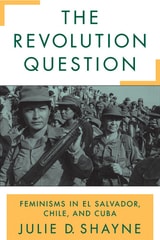
The Revolution Question
Feminisms in El Salvador, Chile, and CubaShayne, Julie D.
Rutgers University Press, 2004
The Rhetoric of Social Research
Understood and BelievedEdited by Albert Hunter
Rutgers University Press, 1990

The Rights of the Defenseless
Protecting Animals and Children in Gilded Age AmericaSusan J. Pearson
University of Chicago Press, 2011
In 1877, the American Humane Society was formed as the national organization for animal and child protection. Thirty years later, there were 354 anticruelty organizations chartered in the United States, nearly 200 of which were similarly invested in the welfare of both humans and animals. In The Rights of the Defenseless, Susan J. Pearson seeks to understand the institutional, cultural, legal, and political significance of the perceived bond between these two kinds of helpless creatures, and the attempts made to protect them.
Unlike many of today’s humane organizations, those Pearson follows were delegated police powers to make arrests and bring cases of cruelty to animals and children before local magistrates. Those whom they prosecuted were subject to fines, jail time, and the removal of either animal or child from their possession. Pearson explores the limits of and motivation behind this power and argues that while these reformers claimed nothing more than sympathy with the helpless and a desire to protect their rights, they turned “cruelty” into a social problem, stretched government resources, and expanded the state through private associations. The first book to explore these dual organizations and their storied history, The Rights of the Defenseless will appeal broadly to reform-minded historians and social theorists alike.
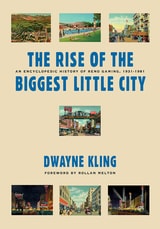
The Rise Of The Biggest Little City
An Encyclopedic History Of Reno Gaming, 1931-1981Dwayne Kling
University of Nevada Press, 2010
The history of Reno during the first half century is to a great degree the history of Reno’s gaming industry. Between 1931 and 1981, the economy, skyline, and lifestyle of “the Biggest Little City in the World” were strongly influenced by the city’s casinos and the people who created and operated them. In The Rise of the Biggest Little City, longtime Reno gaming executive Dwayne Kling records the fruits of his fourteen years of research into the history of Reno’s casinos, from the backroom (and often illegal) dives of the industry’s beginnings to the elegant casino-hotels of today. Arranged in encyclopedic form with historic photographs (many never before published), the book offers the stories of such famous establishments as Harolds Club, the Cal-Neva, the Sands, and Harrah’s, as well as defunct clubs like the Cedars, the Silver Spur, and the Bank Club. We also find the stories of the men and women who created Reno’s gaming industry—such as James McKay and Bill Graham, who came from the rough-and-tumble saloons of boom-town Tonopah and developed a chain of illegal gambling clubs and brothels into Reno’s first major casino, the Bank Club; the Smith family—Raymond I. “Pappy,” Harold Sr., Raymond A., and Harold Jr.—whose Harolds Club was a prime downtown attraction for over fifty years and brought Reno national fame as a destination for fun and gambling; Bill Bailey, an African-American whose Harlem Club—one of the first integrated casinos in Reno—attracted such show-business luminaries as Louis Armstrong and Pearl Bailey (his cousin) for late-night jam sessions; William Harrah, who parleyed a string of small bingo parlors into a major gaming empire; and Jack Douglass, a slot-route operator in the early days of legal gaming who became a major figure in Reno’s modern casino industry. There are more. Kling records the stories of hundreds of gaming establishments, most of them long forgotten, stretching geographically from the Mount Rose Highway to the north end of town, from Verdi to Sparks; and of dozens of men and women who shaped the industry, for better and for worse. We learn from that Reno was the true pioneer of the gambling industry. It was here that big-name entertainment was first offered in a casino setting; that elegant hotel rooms and fine dining were first offered as amenities of the casino experience; that a casino corporation first traded its stock on the New York Stock Exchange; that ethnic minorities first owned and operated casinos, and first integrated them. The Rise of the Biggest Little City will engage readers with its authoritative account of the rise of modern Reno and of the colorful history that lies beneath today’s neon and glitz.
The Rise of Chicago's Black Metropolis, 1920-1929
Christopher Robert Reed
University of Illinois Press, 2014
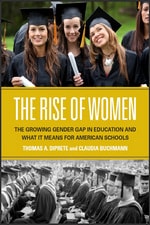
The Rise of Women
The Growing Gender Gap in Education and What it Means for American SchoolsThomas A. DiPrete
Russell Sage Foundation, 2013
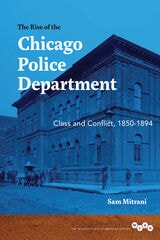
The Rise of the Chicago Police Department
Class and Conflict, 1850-1894Sam Mitrani
University of Illinois Press, 2013
In this book, Sam Mitrani cogently examines the making of the police department in Chicago, which by the late 1800s had grown into the most violent, turbulent city in America. Chicago was roiling with political and economic conflict, much of it rooted in class tensions, and the city's lawmakers and business elite fostered the growth of a professional municipal police force to protect capitalism, its assets, and their own positions in society. Together with city policymakers, the business elite united behind an ideology of order that would simultaneously justify the police force's existence and dictate its functions.
Tracing the Chicago police department's growth through events such as the 1855 Lager Beer riot, the Civil War, the May Day strikes, the 1877 railroad workers strike and riot, and the Haymarket violence in 1886, Mitrani demonstrates that this ideology of order both succeeded and failed in its aims. Recasting late nineteenth-century Chicago in terms of the struggle over order, this insightful history uncovers the modern police department's role in reconciling democracy with industrial capitalism.
The Rise of the Masses
Spontaneous Mobilization and Contentious PoliticsBenjamin Abrams
University of Chicago Press, 2023
Between 15 and 26 million Americans participated in protests surrounding the murders of George Floyd, Ahmaud Arbery, Breonna Taylor, and others as part of the Black Lives Matter protests in 2020, which is only one of the most recent examples of an immense mobilization of citizens around a cause. In The Rise of the Masses, sociologist Benjamin Abrams addresses why and how people spontaneously protest, riot, and revolt en masse. While most uprisings of such a scale require tremendous resources and organizing, this book focuses on cases where people with no connection to organized movements take to the streets, largely of their own accord. Looking to the Arab Spring, Occupy Wall Street, and the Black Lives Uprising, as well as the historical case of the French Revolution, Abrams lays out a theory of how and why massive mobilizations arise without the large-scale planning that usually goes into staging protests.
Analyzing a breadth of historical and regional cases that provide insight into mass collective behavior, Abrams draws on first-person interviews and archival sources to argue that people organically mobilize when a movement speaks to their pre-existing dispositions and when structural and social conditions make it easier to get involved—what Abrams terms affinity-convergence theory. Shedding a light on the drivers behind large spontaneous protests, The Rise of the Masses offers a significant theory that could help predict movements to come.
The Risk Society Revisited
Social Theory and Risk GovernanceEugene Rosa
Temple University Press, 2015
Risk is a part of life. How we handle uncertainty and deal with potential threats influence decision making throughout our lives. In The Risk Society Revisited, Eugene A. Rosa, Ortwin Renn, and Aaron M. McCright offer the first book to present an integrated theory of risk and governance.
The authors examine our sociological understanding of risk and how we reconcile modern human conditions with our handling of risk in our quest for improved quality of life. They build a new framework for understanding risk—one that provides an innovative connection between social theory and the governance of technological and environmental risks and the sociopolitical challenges they pose for a sustainable future.
Showing how our consciousness affects risk in the decisions we make—as individuals and as members of a democratic society—The Risk Society Revisited makes an important contribution to the literature of risk research.

The Road to Rebellion
Class Formation and Kansas Populism, 1865-1900Scott G. McNall
University of Chicago Press, 1988
McNall rejects the traditional view that blames the failure of the Alliance on a turn to mass-based electoral politics, but rather sees the move into national politics by the Farmer's Alliance as part of a rational strategy to better wage their fight for economic justice. The Kansas populists failed, he argues, because of their inability to embrace a broad, working-class base, to provide an effective alternative vision, and ultimately to create a distinct class organization. Debates about how classes come into being, or how democracy is to be realized, cannot be settled in the abstract. McNall's recreation of this heroic struggle is a model in the analysis of class formation. At the same time, The Road to Rebellion is dynamic social history, which holds vital lessons for structuring and realizing alternative political agendas today.
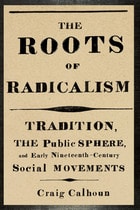
The Roots of Radicalism
Tradition, the Public Sphere, and Early Nineteenth-Century Social MovementsCraig Calhoun
University of Chicago Press, 2012
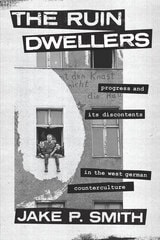
The Ruin Dwellers
Progress and Its Discontents in the West German CountercultureJake P. Smith
University of Chicago Press, 2025
The Ruin Dwellers takes readers into the urban spaces of youth revolts during the 1970s and ’80s in West Germany and elsewhere in western and central Europe. Whereas earlier generations of leftist activists were primarily oriented toward the utopian future, participants in the youth movements of the 1970s and ’80s developed a more complex set of temporal practices that sought to scramble the borders between the past, present, and future.
Examining a rich corpus of radical texts and practices, historian Jake P. Smith shows that squatters and their leftist allies in this period engaged in social, cultural, and aesthetic experiments with modes of autonomous living. Smith brings to life the real and imagined landscapes conjured in squatted houses and street protests; in art, dress, music, graffiti, and film; and in philosophical, poetic, and political texts. In so doing, he offers an eye-opening look at anarchic world-making practices that found new ways of imagining an emancipated future through inhabiting the fractured past.
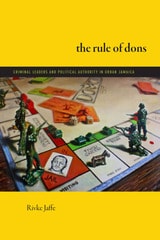
The Rule of Dons
Criminal Leaders and Political Authority in Urban JamaicaRivke Jaffe
Duke University Press, 2024
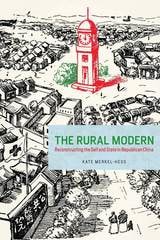
The Rural Modern
Reconstructing the Self and State in Republican ChinaKate Merkel-Hess
University of Chicago Press, 2016
In The Rural Modern, Merkel-Hess shows that Chinese reformers and intellectuals created an idea of modernity that was not simply about what was foreign and new, as in Shanghai and other cities, but instead captured the Chinese people’s desire for social and political change rooted in rural traditions and institutions. She traces efforts to remake village education, economics, and politics, analyzing how these efforts contributed to a new, inclusive vision of rural Chinese life. Merkel-Hess argues that as China sought to redefine itself, such rural reform efforts played a major role, and tensions that emerged between rural and urban ways deeply informed social relations, government policies, and subsequent efforts to create a modern nation during the communist period.
The Script of Life in Modern Society
Entry into Adulthood in a Changing WorldMarlis Buchmann
University of Chicago Press, 1989
The Selected Papers of Edward Shils, Volume 3
The Calling of Sociology and Other Essays on the Pursuit of LearningEdward Shils
University of Chicago Press, 1980
The Servant Class City
Urban Revitalization versus the Working Poor in San DiegoDavid J. Karjanen
University of Minnesota Press, 2016
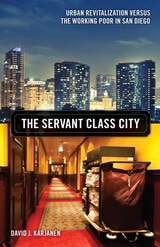
San Diego, California, is frequently viewed as a model for American urban revitalization. It looks like a success story, with blight and poverty replaced by high-rises and jobs. But David J. Karjanen shows that the much-touted job opportunities for poor people have been concentrated in low-paying service work as the cost of living in San Diego has soared. The Servant Class City documents how, over a period of three decades, San Diego’s urban transformation actually eroded the economic standing of the city’s working poor.
Karjanen demonstrates that urban policy in San Diego, which has been devoted to increasing tourism, has fostered the creation of jobs that do not actually provide either livable wages or paths to upward mobility. Marshaling a wealth of heretofore uncollected data, he challenges the presumption that decades-long stagnation of job mobility in the united states is a result of insufficient worker training or a “skills mismatch,” or is attributable to various personal qualities of the urban poor.
Karjanen interweaves profiles of people with a compelling presentation of data. Each chapter addresses a significant topic: hospitality industry jobs, retail work, informal employment, “fringe banking,” and economic barriers to mobility. In revealing the true story of the “poverty traps” that are associated with low-wage jobs in the service economy, The Servant Class City complicates the rosy picture of life in an American tourist boomtown.
The Sexual Organization of the City
Edited by Edward O. Laumann, Stephen Ellingson, Jenna Mahay, Anthony Paik, and Y
University of Chicago Press, 2004
But in The Sexual Organization of the City, Edward Laumann and company argue that this idea is a myth. Drawing on extensive surveys and interviews with Chicago adults, they show that the city is—to the contrary—a place where sexual choices and options are constrained. From Wicker Park and Boys Town to the South Side and Pilsen, they observe that sexual behavior and partnering are significantly limited by such factors as which neighborhood you live in, your ethnicity, what your sexual preference might be, or the circle of friends to which you belong. In other words, the social and institutional networks that city dwellers occupy potentially limit their sexual options by making different types of sexual activities, relationships, or meeting places less accessible.
To explain this idea of sex in the city, the editors of this work develop a theory of sexual marketplaces—the places where people look for sexual partners. They then use this theory to consider a variety of questions about sexuality: Why do sexual partnerships rarely cross racial and ethnic lines, even in neighborhoods where relatively few same-ethnicity partners are available? Why do gay men and lesbians have few public meeting spots in some neighborhoods, but a wide variety in others? Why are African Americans less likely to marry than whites? Does having a lot of friends make you less likely to get a sexually transmitted disease? And why do public health campaigns promoting safe sex seem to change the behaviors of some, but not others?
Considering vital questions such as these, and shedding new light on the city of Chicago, this work will profoundly recast our ideas about human sexual behavior.

The Shadow of the Wall
Violence and Migration on the U.S.-Mexico BorderEdited by Jeremy Slack, Daniel E. Martínez, and Scott Whiteford; Foreword by Josiah Heyman; Photographs by Murphy Woodhouse
University of Arizona Press, 2018
The authors analyze data from the Migrant Border Crossing Study (MBCS), a mixed-methods, binational research project that offers socially relevant, rigorous social science about migration, immigration enforcement, and violence on the border. Using information gathered from more than 1,600 post-deportation surveys, this volume examines the different faces of violence and migration along the Arizona-Sonora border and shows that deportees are highly connected to the United States and will stop at nothing to return to their families. The Shadow of the Wall underscores the unintended social consequences of increased border enforcement, immigrant criminalization, and deportation along the U.S.-Mexico border.
Contributors
Howard Campbell
Josiah Heyman
Alison Elizabeth Lee
Daniel E. Martínez
Ricardo Martínez-Schuldt
Emily Peiffer
Jeremy Slack
Prescott L. Vandervoet
Matthew Ward
Scott Whiteford
Murphy Woodhouse
The Sign of the Burger
Mcdonald'S And The Culture Of PowerJoe Kincheloe
Temple University Press, 2002
"I didn't want to remain a hick from the mountains... In my cultural naivete I saw McDonald's as a place somehow where modern culture capital could be dispensed. Keeping these memories in mind as years later I monitored scores of conversations about the Golden Arches in the late 1990's, it became apparent that McDonald's is still considered a marker of a modern identity."
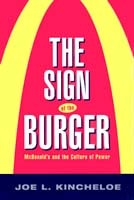
So begins a complicated journey into the power of one of the most recognizable signs of American capitalism: The Golden Arches. The Sign of the Burger examines how McDonald's captures our imagination: as a shorthand for explaining the power of American culture; as a symbol of the strength of consumerism; as a bellwether for the condition of labor in a globalized economy; and often, for better or worse, a powerful educational tool that often defines the nature of culture for hundreds of millions the world over.
While many books have offered simple complaints of the power of McDonald's, Joe Kincheloe explores the real ways McDonald's affects us. We see him as a young boy in Appalachia, watching the Golden Arches going up as the—hopeful—arrival of the modern into his rural world. And we travel with him around the world to see how this approach of the modern affects other people, either through excitement or through attempts at resisting McDonald's power, often in unfortunate ways. Through it all, Kincheloe makes clear, with lucidity and depth, the fact that McDonald's growth will in many ways determine both the nature of accepting and protesting its ever-expanding presence in our global world.
postamble();
The Silent War
Imperialism and the Changing Perception of RaceFrank Furedi
Pluto Press, 1998
The Single Life
Unpatriarchal Manhoods in English Renaissance LiteratureJordan Windholz
University of Alabama Press, 2025
Exploring the Varied Roles of Bachelors during the Renaissance
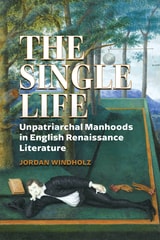
What if the Renaissance bachelor wasn’t just a social outlier but a literary lens through which early modern masculinity reveals its cracks? In The Single Life: Unpatriarchal Manhoods in English Renaissance Literature, Jordan Windholz examines the overlooked and often subversive roles played by never-married men in shaping gender, sexuality, and social order.
Windholz challenges conventional views on gender and sexuality, identifying five archetypes of bachelorhood that complicate our understanding of patriarchal success: the chaste youth, the journeyman bachelor, the true gallant, the incel scholar, and the unmarried eunuch. These figures don’t conform to ideals of marriage, legacy, or economic productivity, but they also weren’t merely left behind. Instead, they served to define what early modern society valued by embodying what it resisted. Windholz shows how Renaissance texts constructed, contained, and occasionally celebrated these “unpatriarchal manhoods.”
By examining the intersections of sexuality, labor, gentility, emotion, and gender, the book provides a nuanced understanding of how single men both upheld and resisted patriarchal norms. Each chapter offers a detailed analysis of literary texts, blending historical and literary analysis with feminist and queer theory. The first study of its kind, Windholz’s work is essential reading for anyone interested in Renaissance literature, gender studies, or those looking to understand the margins of masculinity and the meanings of singledom—then and now.
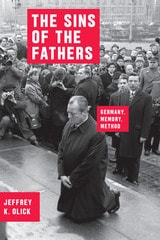
The Sins of the Fathers
Germany, Memory, MethodJeffrey K. Olick
University of Chicago Press, 2016
Nowhere has this precarious balance been more potent, or important, than in the Federal Republic of Germany, where the devastation and atrocities of two world wars have weighed heavily in virtually every moment and aspect of political life. The Sins of the Fathers confronts that difficulty head-on, exploring the variety of ways that Germany’s leaders since 1949 have attempted to meet this challenge, with a particular focus on how those approaches have changed over time. Jeffrey K. Olick asserts that other nations are looking to Germany as an example of how a society can confront a dark past—casting Germany as our model of difficult collective memory.

The Small City and Town
A Conference on Community RelationsRoland Vaile
University of Minnesota Press, 1930
The Social Citizen
Peer Networks and Political BehaviorBetsy Sinclair
University of Chicago Press, 2012
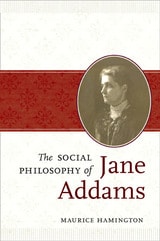
The Social Philosophy of Jane Addams
Maurice Hamington
University of Illinois Press, 2009
Although there has been a resurgence of scholarly interest in Jane Addams, much of the recent literature has dwelt more on her extraordinary and pioneering life than on the philosophical contribution of her twelve books and hundreds of published articles. This study is the first book-length work to focus entirely on Addams as a philosopher, a moral and political theorist who was steeped in the classic American Pragmatist tradition but who transcended that tradition to emphasize the significance of gender, race, and class.
Exploring Addams's contribution to epistemology, ethics, and feminist theory, Maurice Hamington sets the intellectual framework for Addams's social philosophy by discussing her influences, her particular brand of feminism, and finally her unique analytical perspective, which she described as "sympathetic knowledge." The book also investigates how Addams applied her social philosophy to issues of politics, women's rights, prostitution, business ethics, education, and religion.
Addams's philosophical work remains relevant to current feminist ethical discourse, and The Social Philosophy of Jane Addams leads to an understanding of a cosmopolitan theorist who eschewed ideological stances in favor of intermediary steps toward social progress.
The Social Production of Urban Space
By M. Gottdiener
University of Texas Press, 1994
From reviews of the first edition:
"This is perhaps the best theoretically oriented book by a United States urban sociologist since the work of Firey, Hawley, and Sjoberg in the 1940s and 1950s.... Gottdiener is on the cutting edge of urban theoretical work today." —Joe R. Feagin, Contemporary Sociology
Since its first publication in 1985, The Social Production of Urban Space has become a landmark work in urban studies. In this second edition, M. Gottdiener assesses important new theoretical models of urban space—and their shortcomings—including the global perspective, the flexible accumulation school, postmodernism, the new international division of labor, and the "growth machine" perspective.
Going beyond the limitations of these and older theories, Gottdiener proposes a model of urban growth that accounts for the deconcentration away from the central city that began in the United States in the 1920s and continues today. Sociologists, political scientists, economists, geographers, and urban planners will find his interdisciplinary approach to urban science invaluable, as it is currently the most comprehensive treatment of European and American work in these related fields.
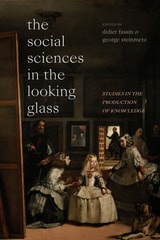
The Social Sciences in the Looking Glass
Studies in the Production of KnowledgeDidier Fassin and George Steinmetz, editors
Duke University Press, 2023
Contributors. Chitralekha, Jean-Louis Fabiani, Didier Fassin, Johan Heilbron, Miriam Kingsberg Kadia, Kristoffer Kropp, Nicolas Langlitz, John Lardas Modern, Álvaro Morcillo Laiz, Amín Pérez, Carel Smith, George Steinmetz, Peter D. Thomas, Bregje van Eekelen, Agata Zysiak
The Social Thought of Ortega y Gasset
A Systematic Synthesis in Postmodernism and InterdisciplinarityJohn T. Graham
University of Missouri Press, 2001
The Social Thought of Ortega y Gasset is the third and final volume of John T. Graham's massive investigation of the thought of Ortega, the renowned twentieth-century Spanish essayist and philosopher. This volume concludes the synthetic trilogy on Ortega's thought as a whole, after previous studies of his philosophy of life and his theory of history.
As the last thing on which he labored, Ortega's social theory completed what he called a "system of life" in three dimensions—a unity in the plurality of philosophy, history, and sociology as three fundamental disciplines that enter into and overlap each other and other humanities. In this volume, Graham investigates Ortega's social thought as expressed in his central work, Man and People, and in several pragmatic fields (politics, culture, education, and religion), interpreting it all in terms of comprehensive categories of postmodernism and interdisciplinarity. While others have studied Ortega's social thought and recently his postmodernity, no one has done so in the context of his thought as a whole or by such a variety of methods.
The "unity in plurality" of Ortega's system is evident in the broad and varied structure of his sociology, which he intended to serve for postmodern times. His own postmodernism was rooted in Nietzsche but also in the pragmatism—from James, Peirce, and Dewey—that informs all parts of this trilogy.
Ortega was the first educator with an interdisciplinary theory and practice—another aspect of the "unity in plurality" of his system. He found inspiration in both ancient and modern precedents for what he saw as a postmodern method of investigating themes and problems that are common to all the human sciences. Innovations at his Institute of Humanities were early postmodern precedents for a new interdisciplinary social method for use by specialists in a variety of fields. All of those interested in Ortega can utilize such methods to elucidate his thought as a whole as well as to pursue their own collaborative work.

The Social World of Batavia
Europeans and Eurasians in Colonial IndonesiaJean Gelman Taylor
University of Wisconsin Press, 2009
Original in its focus on gender and use of varied sources—travelers’ accounts, newspapers, legal codes, genealogical data, photograph albums, paintings, and ceramics—The Social World of Batavia, first published in 1983, forged new paths in the study of colonial society. In this second edition, Gelman offers a new preface as well as an additional chapter tracing the development of these themes by a new generation of scholars.
The Society of the Selfie
Social Media and the Crisis of Liberal DemocracyJeremiah Morelock and Felipe Ziotti Narita
University of Westminster Press, 2021
The Sociology of Culture
Raymond Williams
University of Chicago Press, 1995
"A historical analysis of the social organization of culture in terms of its institutions and formations. Insisting that the term sociology of culture implies a convergence of interests and methods, Williams draws from a broad range of examples: Greek drama, Celtic bards, the Pre-Raphaelites, Bloomsbury and modern copyright laws, among others."—Library Journal
Raymond Williams (1921-87) was professor of drama at Cambridge University. His many books include Marxism and Literature, Keywords, Country and the City, and Culture and Society.
The Sociology of Housing
How Homes Shape Our Social LivesEdited by Brian J. McCabe and Eva Rosen
University of Chicago Press, 2023
In 1947, the president of the American Sociological Association, Louis Wirth, argued for the importance of housing as a field of sociological research. Now, seventy-five years later, the sociology of housing has still not developed as a distinct subfield, leaving efforts to understand housing’s place in society to other disciplines, such as economics and urban planning. With this volume, the editors and contributors solidify the importance of housing studies within the discipline of sociology by tackling topics like racial segregation, housing instability, the supply of affordable housing, and the process of eviction. In doing so, they showcase the very best traditions of sociology: they draw on diverse methodologies, present unique field sites and data sources, and foreground a range of theoretical approaches to elucidate the relationships between contemporary housing, public policy, and key social outcomes.
The Sociology of Housing is a landmark volume that will be used by researchers and students alike to define this growing subfield, map continued directions for research, and center sociologists in interdisciplinary conversations about housing.
The Sociology of Howard S. Becker
Theory with a Wide HorizonAlain Pessin
University of Chicago Press, 2017
French fame has brought French analysis, including The Sociology of Howard S. Becker, written by Alain Pessin and translated into English by Steven Rendall. The book is an exploration of Becker’s major works as expressions of the freedom of possibility within a world of collaborators. Pessin reads Becker’s work as descriptions and ideas that show how society can embody the possibilities of change, of doing things differently, of taking advantage of opportunities for free action. The book is itself a kind of collaboration—Pessin and Becker in dialogue. The Sociology of Howard S. Becker is a meeting of two cultures via two great sociological minds in conversation.

The Sociology of Science
Theoretical and Empirical InvestigationsRobert K. Merton
University of Chicago Press, 1979
"The novelty of the approach, the erudition and elegance, and the unusual breadth of vision make this volume one of the most important contributions to sociology in general and to the sociology of science in particular. . . . Merton's Sociology of Science is a magisterial summary of the field."—Yehuda Elkana, American Journal of Sociology
"Merton's work provides a rich feast for any scientist concerned for a genuine understanding of his own professional self. And Merton's industry, integrity, and humility are permanent witnesses to that ethos which he has done so much to define and support."—J. R. Ravetz, American Scientist
"The essays not only exhibit a diverse and penetrating analysis and a deal of historical and contemporary examples, with concrete numerical data, but also make genuinely good reading because of the wit, the liveliness and the rich learning with which Merton writes."—Philip Morrison, Scientific American
"Merton's impact on sociology as a whole has been large, and his impact on the sociology of science has been so momentous that the title of the book is apt, because Merton's writings represent modern sociology of science more than any other single writer."—Richard McClintock, Contemporary Sociology
The Sociology of Work
Theodore Caplow
University of Minnesota Press, 1954
The Sociology of Work was first published in 1954. Minnesota Archive Editions uses digital technology to make long-unavailable books once again accessible, and are published unaltered from the original University of Minnesota Press editions.
What are the effects of working conditions, rewards, and habits upon the institution of the family? What are the typical forms of occupational segregation, and what are the effects of such segregation upon the general society? How are the social roles appropriate to each occupation created and sustained? What social processes determine the evolution of occupational groupings and the distribution of population among them?
This work, a basic study in occupational sociology, throws light on such questions as these. Professor Caplow describes the occupational system with reference to specialization, occupational status, the formation of professions, mobility, the patterning of individual careers, the occupations of women, and the prospects for continued improvement of working conditions. He draws upon hundreds of empirical studies for his discussions.
The book has been warmly received by reviewers and readers. Robert Dublin commented in the American Journal of Sociology: "This volume will long stand as a sourcebook of hypotheses and thesis topics for students of industrial sociology." Writing in the American Sociological Review, George Caspar Homans called it "a wide-ranging and hard-headed study of American jobs, their place and nature." Robert C. Stone said in Social Forces: "The work is a major contribution to the study of social structure."
The many specialist workers who are concerned with occupational problems—industrial and applied psychologists, personnel and guidance workers, wage economists, labor relations experts, and others—will find this a valuable reference work. It is, of course, pertinent to the interests of general sociologists and anthropologists, and is used as a text in a number of courses in occupational sociology.
The Sociology of the Economy
Frank Dobbin
Russell Sage Foundation, 2004