Results by title
28250 books match the query 'History' and 6388 start with t
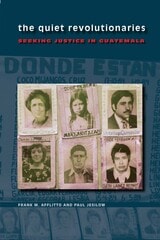
The Quiet Revolutionaries
Seeking Justice in GuatemalaBy Frank M. Afflitto and Paul Jesilow
University of Texas Press, 2007
The last three decades of the twentieth century brought relentless waves of death squads, political kidnappings, and other traumas to the people of Guatemala. Many people fled the country to escape the violence. Yet, at the same moment, a popular movement for justice brought together unlikely bands of behind-the-scenes heroes, blurring ethnic, geographic, and even class lines.
The Quiet Revolutionaries is drawn from interviews conducted by Frank Afflitto in the early 1990s with more than eighty survivors of the state-sanctioned violence. Gathered under frequently life-threatening circumstances, the observations and recollections of these inspiring men and women form a unique perspective on collective efforts to produce change in politics, law, and public consciousness. Examined from a variety of perspectives, from sociological to historical, their stories form a rich ethnography. While it is still too soon to tell whether stable, long-term democracy will prevail in Guatemala, the successes of these fascinating individuals provide a unique understanding of revolutionary resistance.
The Quiet Season
Remembering Country WintersJerry Apps
Wisconsin Historical Society Press, 2025
“As I think back to the days of my childhood, the frost-covered windows in my bedroom, the frigid walks to the country school, the excitement of a blizzard, and a hundred other memories, I realize that these experiences left an indelible mark on me and made me who I am today.”—From the Introduction
Jerry Apps recalls winters growing up on a farm in central Wisconsin during the latter years of the Depression and through World War II. Before electricity came to this part of Waushara County, farmers milked cows by hand with the light of a kerosene lantern, woodstoves heated the drafty farm homes, and “making wood” was a major part of every winter’s work. The children in Jerry’s rural community walked to a country school that was heated with a woodstove and had no indoor plumbing. Wisconsin winters then were a time of reflection, of planning for next year, and of families drawing together. Jerry describes how winter influenced farm families and suggests that those of us who grow up with harsh northern winters are profoundly affected in ways we often are not aware.

The Quiet Season
Remembering Country WintersJerry Apps
Wisconsin Historical Society Press, 2025
“As I think back to the days of my childhood, the frost-covered windows in my bedroom, the frigid walks to the country school, the excitement of a blizzard, and a hundred other memories, I realize that these experiences left an indelible mark on me and made me who I am today.”—From the Introduction
Jerry Apps recalls winters growing up on a farm in central Wisconsin during the latter years of the Depression and through World War II. Before electricity came to this part of Waushara County, farmers milked cows by hand with the light of a kerosene lantern, woodstoves heated the drafty farm homes, and “making wood” was a major part of every winter’s work. The children in Jerry’s rural community walked to a country school that was heated with a woodstove and had no indoor plumbing. Wisconsin winters then were a time of reflection, of planning for next year, and of families drawing together. Jerry describes how winter influenced farm families and suggests that those of us who grow up with harsh northern winters are profoundly affected in ways we often are not aware.
The Quiet Voices
Southern Rabbis and Black Civil Rights, 1880s to 1990sMark K. Bauman
University of Alabama Press, 1997
These wide-ranging essays reveal the various roles played by southern rabbis in the struggle for black civil rights since Reconstruction
The study of black-Jewish relations has become a hotbed of controversy, especially with regard to the role played by Jewish leaders during the Civil Rights movement. Did these leaders play a pivotal role, or did many of them, especially in the South, succumb to societal pressure and strive to be accepted rather than risk being persecuted? If some of these leaders did choose a quieter path, were their reasons valid? And were their methods successful?
Individually, each essay offers a glimpse into both the private and public difficulties these rabbis faced in their struggle to achieve good. Collectively, the essays provide an unparalleled picture of Jewish leadership during the civil rights era.
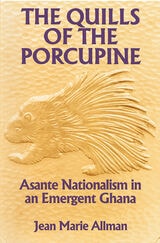
The Quills of the Porcupine
Asante Nationalism in an Emergent GhanaJean Marie Allman
University of Wisconsin Press, 1993
Bearing the historic symbol of the Asante nation, the porcupine, the National Liberation Movement (NLM) stormed onto the Gold Coast’s political stage in 1954, mounting one of the first and most significant campaigns to decentralize political power in decolonizing Africa.
Ghana (formerly the Gold Coast) was the first colony in sub-Saharan Africa to secure political independence from Britain. The struggle for full self-government was led by Kwame Nkrumah, the leading advocate of African nationalism and Pan-African unity in the post-World War II era. The NLM threatened the stability of Nkrumah’s preindependence government and destroyed prospects for a smooth transition to full self-rule. Though NLM demands for Asante autonomy mobilized thousands of members, marchers, and voters, the NLM was unable to forestall plans for a unitary government in a new nation. Under Nkrumah, Ghana became independent in 1957.
Marginalized politically by 1958, the NLM has at times been marginalized by scholars as well. Cast into the shadows of academic inquiry where history’s losers often dwell, the NLM came to be characterized as a tribalist ghost of the past whose foreordained defeat was worthy of some attention, but whose spectacular rise was not.
Today, when it is far harder to dismiss decentralizing movements and alternative nationalisms as things of the past, Jean Marie Allman’s brilliant The Quills of the Porcupine recovers the history of the NLM as a popular movement whose achievements and defeats were rooted in Asante’s history and in the social conflicts of the period. Allman draws skillfully on her extensive interviews with NLM activists, on a variety of published and archival sources in Ghana, and on British colonial records—many of them recently declassified—to provide rich narrative detail.
Sophisticated in its analysis of the NLM’s ideology and of the appeals of the movement to various strata within Asante society, The Quills of the Porcupine is a pioneering case study in the social history of African politics. An exciting story firmly situated within the context of the large theoretical and historical literature on class, ethnicity, and nationalism, its significance reaches far past the borders of Asante, and of Ghana.
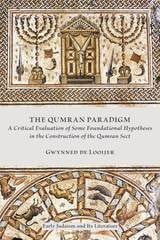
The Qumran Paradigm
Critical Evaluation of Some Foundational Hypotheses in the Construction of the QGwynned de Looijer
SBL Press, 2015
A fundamentally revisionist approach that leaves behind the constructed social reality of a “sectarian” paradigm
Gwynned de Looijer reexamines the key hypotheses that have driven scholars’ understandings of the Dead Sea Scrolls, the archaeological site of Khirbet Qumran, and the textual descriptions of the Essenes. She demonstrates that foundational hypotheses regarding a sect at Qumran have heavily influenced the way the texts found in the surrounding caves are interpreted. De Looijer’s approach abandon’s those assumptions to illustrate that the Dead Sea Scrolls reflect a wider range of backgrounds reflecting the many diverse forms of Judaism that existed in the Second Temple period.
Features:
- In depth analysis of 4QMMT
- Reevaluation of the concept of dualism as it has been applied to Qumran texts
- Charts and tables illustrate complex theories, concepts, and connections
The Quotable Saint Jerome
Jerome Saint Jerome
Catholic University of America Press, 2020
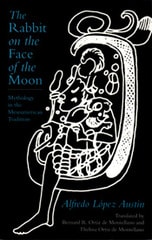
The Rabbit on the Face of the Moon
Mythology in the Mesoamerican TraditionAlfredo Lopez Austin
University of Utah Press, 1996
Eighteen essays provide an accessible, entertaining look into a system of millennia-old legends and beliefs.
Mythology is one of the great creations of humankind. It forms the core of sacred books and reflects the deepest preoccupations of human beings, their most intimate secrets, their glories, and their infamies.
In 1990, Alfredo López Austin, one of the foremost scholars of ancient Mesoamerican thought, began a series of essays about mythology in the Mesoamerican tradition, published in México Indígena. Although his articles were written for general readers, they were also intended to engage specialists. They span a divers subject matter: myths and names, eclipses, stars, left and right, Méxican origins, Aztec incantations, animals, and the incorporation of Christian elements into the living mythologies of Mexico. The title essay relates the Mesoamerican myth explaining why there is a rabbit o the moon’s face to a Buddhist image and suggests the importance of the profound mythical concepts presented by each image.
The eighteen essays in this volume are unified by their basis in Mesoamerican tradition and provide an accessible, entertaining look into a system of millennia-old legends and beliefs.
The Rabbula Corpus
Comprising the Life of Rabbula, His Correspondence, a Homily Delivered in ConstanRobert R. Phenix Jr.
SBL Press, 2017
A significant new study of Rabbula and Christianity in Edessa
This volume makes available for the first time both the Syriac text and an English translation of every available original composition by Rabbula, the controversial bishop of Edessa (ca. 411–435 CE). It includes a new edition of the Life of Rabbula and other biographical traditions about him, including his conversion from paganism to Christianity. The texts collected in the volume are a valuable source for studying the reception history of biblical themes. In addition, the corpus offers insights into the beginnings of ecclesiastical legislation in the East, charitable work, pilgrimage, ascetic ideals, and church administration. Horn and Phenix examine Rabbula’s contribution to the Christological controversies of the fifth and sixth centuries, including his influence on Cyril of Alexandria in his debate with Theodoret of Cyrrhus and Theodore of Mopsuestia.
Features
- A critical study of the theological, cultural, and historical development of Syriac Christianity
- Thorough historical, theological, and socio-cultural analysis provided for each text
- A previously unidentified Christian Palestinian Aramaic fragment
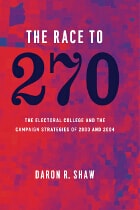
The Race to 270
The Electoral College and the Campaign Strategies of 2000 and 2004Daron R. Shaw
University of Chicago Press, 2006
The Electoral College has played an important role in presidential politics since our nation’s founding, but surprisingly little information exists about precisely how it affects campaign strategy. Daron R. Shaw, a scholar who also worked as a strategist in both Bush-Cheney campaigns, has written the first book to go inside the past two presidential elections and reveal how the race to 270 was won—and lost.
Shaw’s nonpartisan study lays out how both the Democrats and the Republicans developed strategies to win decisive electoral votes by targeting specific states and media markets. Drawing on his own experience with Republican battle plans, candidate schedules, and advertising purchases—plus key contacts in the Gore and Kerry camps—Shaw goes on to show that both sides used information on weekly shifts in candidate support to reallocate media buys and schedule appearances. Most importantly, he uses strikingly original research to prove that these carefully constructed plans significantly affected voters’ preferences and opinions—not in huge numbers, but enough to shift critical votes in key battlegrounds.
Bridging the gap between those who study campaigns and those who conduct them, The Race to 270 will provide political scientists and practitioners alike with fresh insights about the new strategies that stem from one of our oldest institutions.
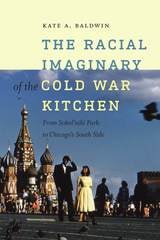
The Racial Imaginary of the Cold War Kitchen
From Sokol’niki Park to Chicago’s South SideKate A. Baldwin
Dartmouth College Press, 2016
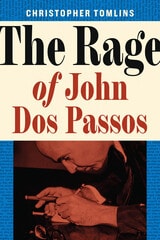
The Rage of John Dos Passos
Christopher Tomlins
University of Chicago Press, 2027
A close look at the emotional and intellectual world of writer John Dos Passos, who was at one time America’s leading modernist, that reveals the political and cultural rhythms of the twentieth century.
John Dos Passos (1896–1970) was a prolific writer—at once compulsive and enigmatic—who became famous in the 1930s as America’s leading literary modernist, only to be eclipsed in the second half of his life because of his own political and aesthetic choices. The Rage of John Dos Passos adopts a psychoanalytic perspective to comprehend the curious career of a man whom Jean-Paul Sartre described in 1938 as “the greatest writer of our time.”
As a young man after World War I, Dos Passos wrote books that won him notoriety as an intemperate critic of American society. His Three Soldiers (1921) was called an insult to the army in which he had been enlisted. His impressionistic novel of New York City, Manhattan Transfer (1925), was dismissed as “spattered filth.” Then in the 1930s, three wildly creative and politically engaged novels written under the collective title U.S.A. truly made his name. Yet Dos Passos then abandoned his youthful radicalism to embrace strident anticommunism and the second Red Scare.
The Rage of John Dos Passos examines the central strands of the author’s life, from infancy until death, and the full range of his writing, including his often-scorned late novels. Christopher Tomlins aims to fuse history, biography, and literary analysis in understanding Dos Passos and his times—and our own.
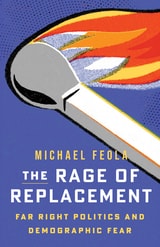
The Rage of Replacement
Far Right Politics and Demographic FearMichael Feola
University of Minnesota Press, 2024
Tracing how the “Great Replacement” narrative has shaped far-right extremism and propelled its dangerous political projects and acts of violence
The “Great Replacement” narrative, which imagines that historic white majorities are being intentionally replaced through immigration policies crafted by global elites, has effectively mobilized racist, nationalist, and nativist movements in the United States and Europe. The Rage of Replacement tracks how this narrative has shaped the politics and worldview of the far right, binding its various camps into a community of rage obsessed with nostalgia for a white-supremacist past.
Showing how the replacement narrative has found significant purchase in recent mainstream discourse through the rise of Trumpism, right-wing media figures like Tucker Carlson, and events such as 2017’s “Unite the Right” rally in Charlottesville, Virginia, Michael Feola diagnoses the dangers this racist theory poses as it shapes the far-right imagination, expands through civil society, and deforms political culture. In particular, he tracks how the replacement narrative has given rise to malignant political strategies designed to “take back” the nation from its perceived enemies—by force if deemed necessary.
Identifying the Great Replacement narrative as a central force behind the rise and expansion of far-right extremism, Feola shows how it has motivated a variety of dangerous political projects in pursuit of illiberal, antidemocratic futures. From calls for the creation of segregated white ethnostates to extremist violence such as the mass shootings in Christchurch, El Paso, and Buffalo, The Rage of Replacement makes clear that replacement theory poses a dire threat to democracy and safety.
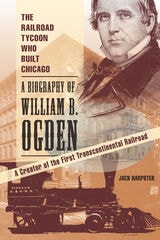
The Railroad Tycoon Who Built Chicago
A Biography of William B. OgdenJack Harpster
Southern Illinois University Press, 2009
William Butler Ogden was a pioneer railroad magnate, one of the earliest founders and developers of the city of Chicago, and an important influence on U.S. westward expansion. His career as a businessman stretched from the streets of Chicago to the wilds of the Wisconsin lumber forests, from the iron mines of Pennsylvania to the financial capitals in New York and beyond. Jack Harpster’s The Railroad Tycoon Who Built Chicago: A Biography of William B. Ogden is the first chronicle of one of the most notable figures in nineteenth-century America.
Harpster traces the life of Ogden from his early experiences as a boy and young businessman in upstate New York to his migration to Chicago, where he invested in land, canal construction, and steamboat companies. He became Chicago’s first mayor, built the city’s first railway system, and suffered through the Great Chicago Fire. His diverse business interests included real estate, land development, city planning, urban transportation, manufacturing, beer brewing, mining, and banking, to name a few. Harpster, however, does not simply focus on Ogden’s role as business mogul; he delves into the heart and soul of the man himself.
The Railroad Tycoon Who Built Chicago is a meticulously researched and nuanced biography set against the backdrop of the historical and societal themes of the nineteenth century. It is a sweeping story about one man’s impact on the birth of commerce in America. Ogden’s private life proves to be as varied and interesting as his public persona, and Harpster weaves the two into a colorful tapestry of a life well and usefully lived.
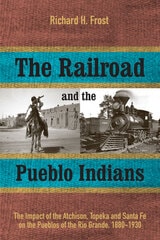
The Railroad and the Pueblo Indians
The Impact of the Atchison, Topeka and Santa Fe on the Pueblos of the Rio Grande, 1880-1930Richard H. Frost
University of Utah Press, 2015
The Pueblo communities responded variously, though mostly conservatively to sustain their traditional communities. This book spotlights two very different responses. Santo Domingo's reaction was hostile, but Laguna chose accommodation. These reactions reveal previously overlooked aspects of these pueblos’ histories that provide compelling reasons behind their varying responses. The book also analyzes the self-contradictory nature of Pueblo constitutional law from 1876 to 1913 and describes conflicted Bureau of Indian Affairs treatment of the Pueblos in the late nineteenth and early twentieth centuries. Each in turn had fateful consequences.
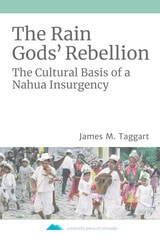
The Rain Gods' Rebellion
The Cultural Basis of a Nahua InsurgencyJames M. Taggart
University Press of Colorado, 2019
The Rain Gods’ Rebellion examines Nahua oral narratives to illuminate the cultural basis of the 1977–1984 rebellion against the local Hispanic elite in Huitzilan de Serdán, Mexico. Drawing from forty years of fieldwork in the region, James M. Taggart traces the sociopolitical role of Nahua rain gods—who took both human and divine forms—back hundreds of years and sheds new light on the connections between social experiences and the Nahua understanding of water and weather in stories. As Taggart shows, Nahua tales of the rain gods’ rebellion anticipated the actual 1977 land invasion in Huitzilan, in which some 200–300 Nahua were killed.
The Rain Gods’ Rebellion reveals how local culture evolves from the expression of unrest to organized insurgency and then into collective memory. Taggart records a tradition of storytelling in which Nahuas radicalized themselves through recounting the rain gods’ stories—stories of the gods organizing and striking with bolts of lightning the companion spirits of autocratic local leaders who worked closely with mestizos. The tales are part of a tradition of resisting the friars’ efforts to convert the Nahuas, Totonacs, Otomi, and Tepehua to Christianity and inspiring nativistic movements against invading settlers.Providing a rare longitudinal look at the cultural basis of this grassroots insurgency, The Rain Gods’ Rebellion offers rare insight into the significance of oral history in forming Nahua collective memory and, by extension, culture. It will be of significance to scholars of Indigenous studies, anthropology, oral history, and violence studies, as well as linguistic anthropologists and sociolinguists.
The Rain's Falling Up
Luca Rastello
Seagull Books, 2022
What was it really like to be a teenager growing up in Italy in the 1970s, during a time it has become all too easy to file away under “years of lead,” as the fathers’ betrayed ideals came face to face with the sons’ and daughters’ rebellions? What was happening in schools, in assemblies, social centers, and occupied factories as the postwar “economic miracle” was being dismantled from within? What moved the foremost French intellectuals of the time to sign an appeal against the repression of the student and workers’ movement in Italy? What did the bullets and heroin bring to a halt, and where did they come from? How does it feel when strategies of terror and police brutality become as ordinary as a TV dinner and as eerie as the plots of the science fiction novels you are plagiarizing to impress a girl? How are metropolitan geographies alchemized in the muscles of a young body crossing the shady lines between ages and sexes?
Luca Rastello raises these and other questions in an astonishing novel that splices chunks of plot and historical reconstruction into the free flow of memory and dream. Rain’s Falling Up tracks the trajectory of a generation while refusing to romanticize its protagonists or resolve the tensions that powered its volatile energy.
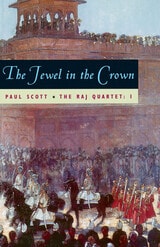
The Raj Quartet, Volume 1
The Jewel in the CrownPaul Scott
University of Chicago Press, 1976
No set of novels so richly recreates the last days of India under British rule—"two nations locked in an imperial embrace"—as Paul Scott's historical tour de force, The Raj Quartet. The Jewel in the Crown opens in 1942 as the British fear both Japanese invasion and Indian demands for independence. On the night after the Indian Congress Party votes to support Ghandi, riots break out and an ambitious police sergeant arrests a young Indian for the alleged rape of the woman they both love.
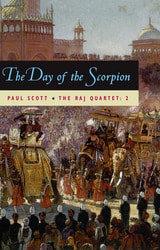
The Raj Quartet, Volume 2
The Day of the ScorpionPaul Scott
University of Chicago Press, 1998
In The Day of the Scorpion, Scott draws us deeper in to his epic of India at the close of World War II. With force and subtlety, he recreates both private ambition and perversity, and the politics of an entire subcontinent at a turning point in history.
As the scorpion, encircled by a ring of fire, will sting itself to death, so does the British raj hasten its own destruction when threatened by the flames of Indian independence. Brutal repression and imprisonment of India's leaders cannot still the cry for home rule. And in the midst of chaos, the English Laytons withdraw from a world they no longer know to seek solace in denial, drink, and madness.
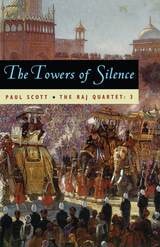
The Raj Quartet, Volume 3
The Towers of SilencePaul Scott
University of Chicago Press, 1998
India, 1943: In a regimental hill station, the ladies of Pankot struggle to preserve the genteel façade of British society amid the debris of a vanishing empire and World War II. A retired missionary, Barbara Batchelor, bears witness to the connections between many human dramas; the love between Daphne Manner and Hari Kumar; the desperate grief an old teacher feels for an India she cannot rescue; and the cruelty of Captain Ronald Merrick, Susan Layton's future husband.
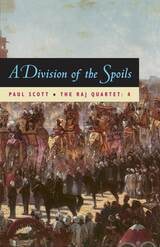
The Raj Quartet, Volume 4
A Division of SpoilsPaul Scott
University of Chicago Press, 1998
After exploiting India's divisions for years, the British depart in such haste that no one is prepared for the Hindu-Muslim riots of 1947. The twilight of the raj turns bloody. Against the backdrop of the violent partition of India and Pakistan, A Division of the Spoils illuminates one last bittersweet romance, revealing the divided loyalties of the British as they flee, retreat from, or cling to India.
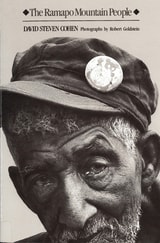
The Ramapo Mountain People
Cohen, David Steven
Rutgers University Press, 1986
In a study combining tee disciplines of anthropology, sociology, folklore, and history, David Cohen found that the old stories about these people were legends, not history.
He found no reliable evidence that their ancestors were Tuscarora Indians, Hessian deserters from the British army, escaped slaves, and British and West Indian prostitutes imported by a sea captain named Jackson for the pleasure of British soldiers occupying Manhattan during the War for Independence.
David Cohen lived among the Ramapo Mountain People for a year, conducting genealogical research into church records, deeds, wills, and inventories in county courthouses and libraries. He established that their ancestors included free black landowners in New York City and mulattoes with some Dutch ancestry who were among the first pioneers to settle in the Hackensack River Valley of New Jersey.
In describing his findings and his experiences, Professor Cohen shows how their racially mixed ancestry, their special family and kinship system, and their intergroup attitudes and folkways distinguish and socially isolate these people as a separate racial group today, despite modern communications and transportation and their proximity to New York City.
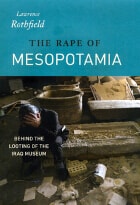
The Rape of Mesopotamia
Behind the Looting of the Iraq MuseumLawrence Rothfield
University of Chicago Press, 2009
On April 10, 2003, as the world watched a statue of Saddam Hussein come crashing down in the heart of Baghdad, a mob of looters attacked the Iraq National Museum. Despite the presence of an American tank unit, the pillaging went unchecked, and more than 15,000 artifacts—some of the oldest evidence of human culture—disappeared into the shadowy worldwide market in illicit antiquities. In the five years since that day, the losses have only mounted, with gangs digging up roughly half a million artifacts that had previously been unexcavated; the loss to our shared human heritage is incalculable.
With The Rape of Mesopotamia, Lawrence Rothfield answers the complicated question of how this wholesale thievery was allowed to occur. Drawing on extensive interviews with soldiers, bureaucrats, war planners, archaeologists, and collectors, Rothfield reconstructs the planning failures—originating at the highest levels of the U.S. government—that led to the invading forces’ utter indifference to the protection of Iraq’s cultural heritage from looters. Widespread incompetence and miscommunication on the part of the Pentagon, unchecked by the disappointingly weak advocacy efforts of worldwide preservation advocates, enabled a tragedy that continues even today, despite widespread public outrage.
Bringing his story up to the present, Rothfield argues forcefully that the international community has yet to learn the lessons of Iraq—and that what happened there is liable to be repeated in future conflicts. A powerful, infuriating chronicle of the disastrous conjunction of military adventure and cultural destruction, The Rape of Mesopotamia is essential reading for all concerned with the future of our past.
The Rational Public
Fifty Years of Trends in Americans' Policy PreferencesBenjamin I. Page and Robert Y. Shapiro
University of Chicago Press, 1992
The authors unequivocally demonstrate that, notwithstanding fluctuations in the opinions of individuals, collective public opinion is remarkably coherent: it reflects a stable system of values shared by the majority of Americans and it responds sensitively to new events, arguments, and information reported in the mass media. While documenting some alarming case of manipulation, Page and Shapiro solidly establish the soundness and value of collective political opinion. The Rational Public provides a wealth of information about what we as a nation have wanted from government, how we have changed our minds over the years, and why.
For anyone interested in the short- and long-term trends in Americans' policy preferences, or eager to learn what Americans have thought about issues ranging from racial equality to the MX missile, welfare to abortion, this book offers by far the most sophisticated and detailed treatment available.

The Razorbacks
A Story of Arkansas FootballOrville Henry
University of Arkansas Press, 1996

The Reader's Repentance
Women Preachers, Women Writers, and Nineteenth-Century Social DiscourseChristine L. Krueger
University of Chicago Press, 1992
Christine L. Krueger persuasively argues that Evangelical Christianity, by assuming the spiritual equality of women and men and the moral superiority of middle-class women, opened a space for the linguistic empowerment of women and fostered the emergence of women orators and writers who, in complex and contradictory ways, became powerful public figures. In the light of unpublished or long out-of-print writing by eighteenth- and nineteenth-century women preachers, Krueger shows how these women drew on religious language to critique forms of male domination, promote female political power, establish communities of women, and, most significantly, feminize social discourse. She traces the legacy of these preachers through the work of writers as diverse as Hannah More, Charlotte Elizabeth Tonna, Elizabeth Gaskell, and George Eliot—women who, despite political differences, shared an evangelical strategy for placing women's concerns on the social agenda of their time.
Documenting and analyzing the tradition of women's preaching as a powerful and distinctly feminist force in the development of nineteenth-century social fiction, The Reader's Repentance reconstitutes a significant chapter in the history of women and culture. This original work will be of interest to students of women's history, literature, and eighteenth- and nineteenth-century society.

The Reagan Range
The Nostalgic Myth in American PoliticsJames Combs
University of Wisconsin Press, 1993
This book is an attempt to make sense out of Ronald Reagan by linking him to various grassroots dimensions of American popular mythology and mind. It attempts to utilize a variety of sources from American and popular culture studies, works on Reagan, and popular materials such as movies to offer an interpretation of reagan as an exemplar of the political relevance and power of popular culture.
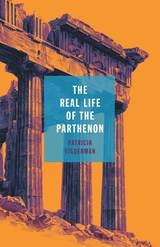
The Real Life of the Parthenon
Patricia Vigderman
The Ohio State University Press, 2018
Ownership battles over the marbles removed from the Parthenon by Lord Elgin have been rumbling into invective, pleading, and counterclaims for two centuries. The emotional temperature around them is high, and steering across the vast past to safe anchor in a brilliant heritage is tricky. The stories around antiquities become distorted by the pull of ownership, and it is these stories that urge Patricia Vigderman into her own exploration of their inspiring legacy in her compelling extended essay, The Real Life of the Parthenon.
Vigderman’s own journey began at the Parthenon, but curiosity edged her further onto the sea between antiquity and the present. She set out to seek the broken temples and amphorae, the mysterious smiles of archaic sculpture, and the finely hammered gold of a funeral wreath among the jumbled streets of modern Athens, the fertile fields of Sicily, the mozzarella buffalo of Paestum. Guided along the way toward the enduring landscapes and fractured history by archeologists, classicists, historians, and artists—and by the desire they inspire—she was caught by ongoing, contemporary local life among the ruins. Gathering present meaning and resonance for the once and future remains of vanished glory, The Real Life of the Parthenon illuminates an important but shadowy element of our common cultural life: the living dynamic between loss and delight.
The Real Philadelphia Book
Jazz Bridge
Temple University Press, 2022
The Real Philadelphia Book, compiled by Jazz Bridge and editors David Dzubinski and Suzanne Cloud, is a collection of more than 200 original jazz and blues compositions. Arranged alphabetically by song title, the sheet music showcases work by generations of Philadelphia musicians. This volume, which is “what every aspiring jazz musician needs to know,” features tunes from Grammy Award-winners Jimmy Heath, Grover Washington, Jr., and Christian McBride, as well as legends such as Joey DeFrancesco, Ray Bryant, and Robin and Duane Eubanks. Also included are rare compositions by jazz greats Bobby Timmons, Hank Mobley, and Lee Morgan, in addition to music by local luminaries, Rhenda Fearrington, Monnette Sudler, and Kaylé Brecher.
The aim of The Real Philadelphia Book is to help the jazz community make deeper, stronger connections while also formally documenting much of the important music created in the Philadelphia metro area by both well- and lesser-known musicians.
Including an index of composers, The Real Philadelphia Bookwill enhance and add to the rich Philadelphia jazz and blues tradition and make the Philly jazz catalogue more easily available to musicians, jazz students and educators around the world.

The Real Real Thing
The Model in the Mirror of ArtWendy Steiner
University of Chicago Press, 2010
Our era is defined by the model. From Victoria’s Secret and America’s Next Top Model to the snapshots we post on Facebook and Twitter, our culture is fixated on the pose, the state of existing simultaneously as artifice and the real thing.
In this bold view of contemporary culture, Wendy Steiner shows us the very meaning of the arts in the process of transformation. Her story begins at the turn of the last century, as the arts abandoned the representation of the world for a heady embrace of the abstract, the surreal, and the self-referential. Today though, this “separate sphere of the aesthetic” is indistinguishable from normal life. Media and images overwhelm us: we gingerly negotiate a real-virtual divide that we suspect no longer exists, craving contact with what J. M. Coetzee has called “the real real thing.” As the World Wide Web renders the lower-case world in ever-higher definition, the reality-based genres of memoir and documentary are displacing fiction, and novels and films are depicting the contemporary condition through model-protagonists who are half-human, half-image. Steiner shows the arts searching out a new ethical potential through this figure: by stressing the independent existence of the model, they welcome in the audience in all its unpredictability, redefining aesthetic experience as a real-world interaction with the promise of empathy, reciprocity, and egalitarian connection.
A masterly performance by a penetrating, inquisitive mind, The Real Real Thing is that rarest of books, one whose provocations and inspirations will inspire readers to take a new—and nuanced—look at the world around them.

The Real Venezuela
Making Socialism in the 21st CenturyIain Bruce
Pluto Press, 2008
Venezuela has become a huge source of hope and inspiration for the Left throughout the world. Some see it as a shining example of how to begin building a successful socialist state, but Western leaders see it as a dangerous enemy and accuse Chávez of being a dictator. This book reveals the truth by examining the country from the ground up.
Iain Bruce explores the political changes underway in Venezuela at the level of the lives of ordinary people. Through grassroots investigations and extended interviews, he explores a series of key transformations in Venezuela: a new social economy around a network of co-operatives; workplace democracy; popular education; radical agrarian reform; participatory budgets and community planning. The result is a clear picture of everyday life in Venezuela.
No other book on the country has this level of detail; it will be a key text for students of Latin American politics and social movements and of interest to anyone following the fortunes of the Bolivarian Revolution.
The Real and the Sacred
Picturing Jesus in Nineteenth-Century FictionJefferson J. A. Gatrall
University of Michigan Press, 2014
The Real, the True, and the Told
Postmodern Historical Narrative and the Ethics of RepresentationEric L. Berlatsky
The Ohio State University Press, 2011
The Realm Of Prester John
Robert Silverberg
Ohio University Press, 1996
In this modern account of the genesis of a great medieval myth, celebrated science fiction author Robert Silverberg’s explores the mysterious origins of Prester John, the astonishing Christian potentate of the East.
Prester John was a legendary figure who cast a powerful spell over Latin Christendom for almost five centuries. Rumors of the warrior-king-prelate’s fabulous realms first reached Europe in the eleventh century and quickly assumed an exalted status alongside such fabled wonders as El Dorado, The Fountain of Youth, and the Holy Grail.
The defeat of a Moslem Turkish tribe by a Buddhist Chinese warlord seems to have been the unlikely historical nugget around which the Prester John myth grew, but contributions to this strange saga have also been traced all around the globe to the Apostle Thomas' apocryphal preaching in India, to the actual existence of small colonies of Nestorian schismatics in central Asia, and even to Genghis Khan.
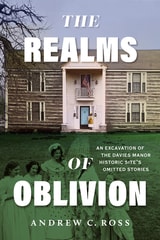
The Realms of Oblivion
An Excavation of the Davies Manor Historic Site's Omitted StoriesAndrew C. Ross
Vanderbilt University Press, 2024
Winner of the Tennessee History Book Award (Tennessee Historical Society and Tennessee Historical Commission), 2024
The Realms of Oblivion explores the complexities involved in reconciling competing versions of history, channeled through Davies Manor, a historic site near Memphis that once centered a wealthy slave-owning family’s sprawling cotton plantation. Interrogating the forces of memorialization that often go unquestioned in the stories we believe about ourselves and our communities, this book simultaneously tells an informative and engrossing bottom-up history—of the Davies family, of the Black families they enslaved and exploited across generations, and of Memphis and Shelby County—while challenging readers to consider just what upholds the survival of that history into the present day.
Written in an engaging and critical style, The Realms of Oblivion is grounded in a rich source base, ranging from nineteenth-century legal records to the personal papers of the Davies family to twentieth-century African American oral histories. Author Andrew C. Ross uses these sources to unearth the stark contrast between the version of Davies Manor’s history that was built out of nostalgia, and the version that records have proven to actually be true. As a result, Ross illuminates the ongoing need for a deep and honest reckoning with the history of the South and of the United States, on the part of both individuals and community institutions such as local historic sites and small museums.
The Reappeared
Argentine Former Political PrisonersPark, Rebekah
Rutgers University Press, 2014
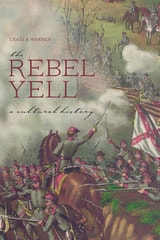
The Rebel Yell
A Cultural HistoryCraig A. Warren
University of Alabama Press, 2014
The first comprehensive history of the fabled Confederate battle cry from its origins and myths through its use in American popular culture.
No aspect of Civil War military lore has received less scholarly attention than the battle cry of the Southern soldier. In The Rebel Yell, Craig A. Warren brings together soldiers' memoirs, little-known articles, and recordings to create a fascinating and exhaustive exploration of the facts and myths about the “Southern screech.”
Through close readings of numerous accounts, Warren demonstrates that the Rebel yell was not a single, unchanging call, but rather it varied from place to place, evolved over time, and expressed nuanced shades of emotion. A multifunctional act, the flexible Rebel yell was immediately recognizable to friends and foes but acquired new forms and purposes as the epic struggle wore on. A Confederate regiment might deliver the yell in harrowing unison to taunt Union troops across the empty spaces of a battlefield. At other times, individual soldiers would call out solo or in call-and-response fashion to communicate with or secure the perimeters of their camps.
The Rebel yell could embody unity and valor, but could also become the voice of racism and hatred. Perhaps most surprising, The Rebel Yell reveals that from Reconstruction through the first half of the twentieth century, the Rebel yell—even more than the Confederate battle flag—served as the most prominent and potent symbol of white Southern defiance of Federal authority. With regard to the late-twentieth and early twenty-first centuries, Warren shows that the yell has served the needs of people the world over: soldiers and civilians, politicians and musicians, re-enactors and humorists, artists and businessmen. Warren dismantles popular assumptions about the Rebel yell as well as the notion that the yell was ever “lost to history.”
Both scholarly and accessible, The Rebel Yell contributes to our knowledge of Civil War history and public memory. It shows the centrality of voice and sound to any reckoning of Southern culture.
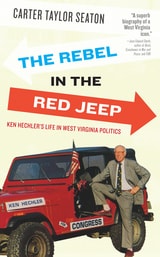
The Rebel in the Red Jeep
Ken Hechler's Life in West Virginia PoliticsCarter Taylor Seaton
West Virginia University Press, 2017
This biography recounts a century of accomplishments, from Hechler’s introduction of innovative teaching methods at major universities, to his work as a speechwriter and researcher for President Harry Truman, and finally to his time representing West Virginia in the US House of Representatives and as the secretary of state.
In West Virginia, where he resisted mainstream political ideology, Hechler was the principal architect behind the Federal Coal Mine Health and Safety Act of 1969 and constantly battled big coal, strip-mining, and fellow politicians alike. He and his signature red jeep remain a fixture in West Virginia. Since 2004, Hechler has campaigned against mountaintop removal mining. He was arrested for trespassing during a protest in 2009 at the age of 94.
The Rebirth of Classical Political Rationalism
An Introduction to the Thought of Leo StraussLeo Strauss
University of Chicago Press, 1989
"[These essays] display the incomparable insight and remarkable range of knowledge that set Strauss's works apart from any other twentieth-century philosopher's."—Charles R. Kesler, National Review
The Reception of Pragmatism in France and the Rise of Roman Catholic Modernism, 1890-1914
David G. Schultenover
Catholic University of America Press, 2009
The Reckless Decade
America in the 1890sH.W. Brands
University of Chicago Press, 2002
Just as we do today, Americans of the 1890s faced changes in economics, politics, society, and technology that led to wrenching and sometimes violent tensions between rich and poor, capital and labor, white and black, East and West. In The Reckless Decade, H. W. Brands demonstrates that we can learn a lot about the contradictions that lie at the heart of America today by looking at them through the lens of the 1890s.
The 1890s saw the closing of the American frontier and a shift toward imperialist ambitions. Populists and muckrakers grappled with robber barons and gold-bugs. Americans addressed the unfinished business of Reconstruction by separating blacks and whites. Booker T. Washington, W. E. B. Du Bois, and other black leaders clashed over the proper response to continuing racial inequality. Those on top of the economic heap—Rockefeller, Carnegie, and Morgan—created vast empires of wealth, while those at the bottom worked for dimes a day. Brands brings all this to life in a vivid narrative filled with larger-than-life characters facing momentous challenges as they worked toward an uncertain future.
The Reckoning of Jeanne d'Antietam
PoemsMatthew Moore
University of Nevada Press, 2023
The collection of poems in The Reckoning of Jeanne d’Antietam circles the U.S. Civil War and the failed revolution of Reconstruction, and Matthew Moore makes incursions into the histories and beliefs of the era through architectures of sound, but also via ancillary histories and histories stacked upon histories—densely and visibly scrawled—like Anselm Kiefer's sculptures of lead books, melted and dripping with the texts of illegible songs. His poems include the figure of Joan of Arc (Jeanne d'Arc) and her voices; the explosion of the U.S. prison system and racial legal fictions amid the groundswell of mass terror in the wake of the U.S. Civil War; the politically poisoned poetic lineage that moves from Modernism, to New Criticism, and dead-ends in Southern Agrarianism; and the destructive colonial histories of the sugar and cotton industries.
The Reckoning of Jeanne d’Antietam stands imbricated with the spell of language-the-testament; language as hard rhyme and difficult music, evanescence and violence; and the invocation of names and events at their meeting places in history. Moore’s poems stand against sentiment and pity, and against the consolation of that which cannot be consoled.
The Reckoning
The Murder of Christopher MarloweCharles Nicholl
University of Chicago Press, 1995
Here, in a tour de force of scholarship and ingenuity, Charles Nicholl penetrates four centuries of obscurity to reveal not only a complex and unsettling story of entrapment and betrayal, chimerical plot and sordid felonies, but also a fascinating vision of the underside of the Elizabethan world.
"Provides the sheer enjoyment of fiction, and might just be true."—Michael Kenney, Boston Globe
"Mr. Nicholl's glittering reconstruction of Marlowe's murder is only one of the many fascinating aspects of this book. Indeed, The Reckoning is equally compelling for its masterly evocation of a vanished world, a world of Elizabethan scholars, poets, con men, alchemists and spies, a world of Machiavellian malice, intrigue and dissent."—Michiko Kakutani, New York Times
"The rich substance of the book is his detail, the thick texture of betrayal and evasion which was Marlowe's life."—Thomas Flanagan, Washington Post Book World
Winner of the Crime Writer's Gold Dagger Award for Nonfiction Thriller

The Recombinant University
Genetic Engineering and the Emergence of Stanford BiotechnologyDoogab Yi
University of Chicago Press, 2015
Bay Area scientists, university administrators, and government officials were fascinated by and increasingly engaged in the economic and political opportunities associated with the privatization of academic research. Yi uncovers how the attempts made by Stanford scientists and administrators to demonstrate the relevance of academic research were increasingly mediated by capitalistic conceptions of knowledge, medical innovation, and the public interest. Their interventions resulted in legal shifts and moral realignments that encouraged the privatization of academic research for public benefit. The Recombinant University brings to life the hybrid origin story of biotechnology and the ways the academic culture of science has changed in tandem with the early commercialization of recombinant DNA technology.
The Reconstruction Amendments
The Essential Documents, Volume 1Edited by Kurt T. Lash
University of Chicago Press, 2021
Volume I outlines a broad historical context for the Reconstruction Amendments and contains materials related to the Thirteenth Amendment, which abolished slavery, while Volume 2 covers the Fourteenth and Fifteenth Amendments on the rights of citizenship and enfranchisement. The documents in this collection encompass a sweeping range of primary sources, from congressional debates to court cases, public speeches to newspaper articles. As a whole, the volumes meticulously depict a significant period of legal change even as they illuminate the ways in which people across the land grappled with the process of constitutional reconstruction. Filling a major gap in the literature on the era, The Reconstruction Amendments will be indispensable for readers in politics, history, and law, as well as anyone seeking a better understanding of the post–Civil War basis of American constitutional democracy.
The Reconstruction Amendments
The Essential Documents, Volume 2Edited by Kurt T. Lash
University of Chicago Press, 2021
Volume I outlines a broad historical context for the Reconstruction Amendments along with materials related to the Thirteenth Amendment, which abolished slavery, while Volume II covers the Fourteenth and Fifteenth Amendments on the rights of citizenship and enfranchisement. The documents in this collection encompass a sweeping range of primary sources, from congressional talks to court cases, public speeches to newspaper articles. As a whole, the volumes meticulously depict a significant period of legal change even as they illuminate the ways in which people across the land grappled with the process of constitutional reconstruction. Filling a major gap in the literature on the era, The Reconstruction Amendments will be indispensable for readers in politics, history, and law, as well as anyone seeking a better understanding of the post–Civil War basis of American constitutional democracy.
The Reconstruction Desegregation Debate
The Policies of Equality and the Rhetoric of Place, 1870-1875Kirt H. Wilson
Michigan State University Press, 2002
In the decade that followed the Civil War, two questions dominated political debate: To what degree were African Americans now “equal” to white Americans, and how should this equality be implemented in law? Although Republicans entertained multiple, even contradictory, answers to these questions, the party committed itself to several civil rights initiatives. When Congress passed the Thirteenth Amendment, the 1866 Civil Rights Act, the Fourteenth Amendment, and the Fifteenth Amendment, it justified these decisions with a broad egalitarian rhetoric. This rhetoric altered congressional culture, instituting new norms that made equality not merely an ideal,but rather a pragmatic aim for political judgments.
Kirt Wilson examines Reconstruction’s desegregation debate to explain how it represented an important movement in the evolution of U.S. race relations. He outlines how Congress fought to control the scope of black civil rights by contesting the definition of black equality, and the expediency and constitutionality of desegregation. Wilson explores how the debate over desegregation altered public memory about slavery and the Civil War, while simultaneously shaping a political culture that established the trajectory of race relations into the next century.

The Reconstruction of Georgia
Alan Conway
University of Minnesota Press, 1966
The Reconstruction of Georgia was first published in 1966. Minnesota Archive Editions uses digital technology to make long-unavailable books once again accessible, and are published unaltered from the original University of Minnesota Press editions.
In this study of the reconstruction period in Georgia following the Civil War, a British historian provides a dispassionate account of a highly controversial subject. A revisionist reappraisal, Dr. Conway's study is the first substantial history of the period to be published in fifty years. The sources include considerable material that has become available since the publication of the last major work on the subject in 1915.
The author gives close attention to the last days of the Civil War and its aftermath in Georgia, the early attempts at political reconstruction in 1865, the work of the Freedmen's Bureau, the economic problems involved in reshaping the state's economy, the development of the state-cropping and crop-lien systems, the imposition of Congressional reconstruction on Georgia under military supervision, the political maneuverings and economic ventures of such prominent figures as Joseph E. Brown, Benjamin Hill, and Hannibal I. Kimball, the efforts of the Ku-Klux Klan to nullify Negro voting rights and re-establish "white supremacy" concepts, and, finally, the investigations by the Democratic party of Republication misgovernment during the administration of Governor Rufus B. Bullock.
Dr. Conway, who did the research for the book in Georgia, has made considerable use of primary manuscripts, travelers' accounts, state and federal reports, and contemporary newspaper material to arrive at an account which judiciously assesses the claims and counter-claims of violently opposed groups which were vitally concerned with the place of the Negro in Southern society after emancipation and with the return of Georgia to the Union.
The Recurrence of Fate
Theatre and Memory in Twentieth-Century RussiaSpencer Jay Golub
University of Iowa Press, 1994
How, why, and according to whose definitions and requirements does a culture self-consciously create memory and project its fate? In this remarkable book—the first in English to treat Russian history as theatre and cultural performance—Spencer Golub reveals the performative nature of Russian history in the twentieth century and the romantic imprisonment/self-imprisonment of the creative intelligentsia within this scenario.
The Red Atlantis
J. Hoberman
Temple University Press, 2000
The Red Atlantis argues that Communism produced a complex culture with a dialectical relation to both modernism and itself. Offering examples ranging from the Stalinist show trial to Franz Kafka's posthumous career as a dissident writer and the work of filmmakers, painters, and writers, which can be understood only as criticism of existing socialism made from within, The Red Atlantis suggests that Communism was an aesthetic project -- perhaps the aesthetic project of the twentieth century.
Considering the meaning of Communist culture in its absence, these essays sift through the wrecking age of Marxist fantasy to exhibit exhumed fossils (Socialist Realist canvases), vanished monuments (the Berlin Wall), imaginary territories (the Jewish state, Birobidzhan), and ideological memories (the Crime of the Century). The Cold War notwithstanding, the greatest of these exotic artifacts and obsolete scenarios is the lost Communist utopia, which, in fact, never existed.