Results by title
3576 books match the query 'American' and 770 start with t

The Novels of Theodore Dreiser
A Critical StudyDonald Pizer
University of Minnesota Press, 1976
The Novels of Theodore Dreiser was first published in 1976. Minnesota Archive Editions uses digital technology to make long-unavailable books once again accessible, and are published unaltered from the original University of Minnesota Press editions.
Relying heavily on the manuscripts and letters in the Dreiser Collection of the University of Pennsylvania Library, Professor Pizer seeks to establish the facts of the sources and composition of each of Dreiser's eight novels and to study the themes and form of the completed works. In this study he relates what can be discovered about the factual reality of a novel to its imaginative reality. His interpretation of the novels avoids the suggestion that there is a single overriding theme or direction in Dreiser's work and emphasizes that Dreiser deserves examination primarily on the basis of the individuality and worth of each of his novels. A separate chapter is devoted to each of the novels: Sister Carrie, Jennie Gerhardt, The "Genius," The Financier, The Titan, An American Tragedy, The Bulwark, and The Stoic.
The Obligation Toward the Difficult Whole
Postmodernist Long PoemsBrian McHale
University of Alabama Press, 2003
Addressing subjects as wide-ranging as angelology, the court masque, pop art, caricature, the cult of the ruin, hip-hop, Spense’'s Irish policy, and the aesthetics of silence, Brian McHale pulls varied threads together to identify a repertoire of postmodernist elements characteristic of the long poems he examines.
As critic Jed Rasula explains, “McHale is wonderfully resourceful in changing the subject from chapter to chapter to fit the poems discussed, and while his approach adheres to the conventions of textual exegesis, the chapters really shine as orchestrations of issues. For instance, James Merrill’s The Changing Light at Sandover works unexpectedly well in raising the subject of found poetry and procedural composition; Melvin Tolso’'s Harlem Gallery and Edward Dorn's Gunslinger are effectively paired to demonstrate the period flavor of pastiche; Geoffrey Hill’s Mercian Hymns and Armand Schwerner’s The Tablets explode the modernist fixation with depth; John Ashbery’s work is given a nuanced reading as proto-theory; Letter to an Imaginary Friend by Thomas McGrath provides a lucid backdrop to raise the question of political efficacy in approaching language poet Bruce Andrews; and Susan Howe's The Europe of Trusts is explored for its intertextual tapestry.”
McHale shows how elements from these long poems overlap, interfere, pull in different directions, jar against, and even contradict each other; and he demonstrates how they also echo, amplify, and reinforce each other. They do not slot smoothly together like pieces in a jigsaw puzzle, but they do form (what else?) a difficult whole.
The Occasions of Poetry
Essays in Criticism and AutobiographyThom Gunn
University of Michigan Press, 1999
Thom Gunn is well-known as a poet, and increasingly as a literary critic. The Occasions of Poetry includes insightful critical pieces on writers ranging from William Carlos Williams and Gary Snyder to Thomas Hardy and Robert Duncan. "The occasion in all cases," writes Gunn, "is the starting point, only, of a poem, but it should be a starting point to which the poet must in some sense stay true." The first loyalty of a writer who is "true to his occasions," he writes, must be to the facts of experience.
The book includes five autobiographical essays, which combine to form an engaging account of the author's development as a poet and to chronicle some of the most significant literary currents of recent decades, both in England and America.
Thom Gunn, born in England in 1929, has lived in America since 1954. His books include Shelf Life: Essays, Memoirs, and an Interview; The Man with Night Sweats; Collected Poems; and The Passages of Joy. The Occasions of Poetry was originally published by Faber and Faber.
The Offbeat
Eschew ObfuscationTheresa Mlinarcik
Michigan State University Press, 2003
The Offbeat literary collection series is devoted to publishing a diverse selection of voices and to promoting contact and discussion among writers. The Offbeat is run entirely by Michigan State University students, with the goal of providing an alternative literary outlet for Michigan writers.
This edition features an interview with noted author, W. S. Penn, plus a selection of original fiction, prose, and poetry from a variety of authors, including Daniel Klass, Timothy Carmody, Joshua Moon, Robert Brady, Mark Geralds, Andrew Hungerford, Jeremy Campbell, Gavin Craig, Ashley Honeysett, Andy McGashen, Colleen Farrow, Crystal Passmore, Jogn Garcia, De'Juan McDuell, Gregory Wright, Bailey Follette, and Brandon Connell.
The Offbeat
I Have Been Sometimes True to NothingTheresa Mlinarcik
Michigan State University Press, 2003
The Offbeat is an independent literary series devoted to publishing a diverse collection of voices, and to promoting contact and discussion among Michigan writers. The Offbeat is run entirely by Michigan State University undergraduates, and is centered in East Lansing. Student editors encourage contributions by all individuals with a Michigan connection, past and present, visitor and resident, urban and rural, student and non-student alike. The Offbeat' goal is to provide an alternative literary outlet for all Michigan writers. The Offbeat presents, encourages, and explores creative works in fiction, poetry, drama, essay, criticism, image, and that which defies categorization. Its purpose is to call attention to voices both emerging and established, including those that have been previously overlooked.
The Offbeat
Noise from Typewriter KeysGoldie Currie
Michigan State University Press, 2010
Noise from Typewriter Keys is the tenth volume in the independent literary series, The Offbeat, devoted to publishing a diverse collection of voices, and to promoting contact and discussion among writers. The Offbeat is run entirely by Michigan State Undergraduates, and is centered in East Lansing. The mission of The Offbeat is to provide an alternative literary outlet for writers from Michigan and beyond, and to call attention to voices both emerging and established.
The Offbeat: Noise from Typewriter Keys is an ensemble of voices and eruptions heard from the inside and out. This volume includes a wide variety of writers and focuses on the ambition of new creation. This part of the series seeks to capture movement of a writer while exploring the varied sounds that come from imagination.
The Offbeat
The Silver LiningChelsea Beck
Michigan State University Press, 2013
The One Voice of James Dickey
His Letters and Life, 1942-1969Edited & Commentary by Gordon Van Ness
University of Missouri Press, 2003
The One Voice of James Dickey
His Letters and Life, 1970-1997Edited & Commentary by Gordon Van Ness
University of Missouri Press, 2005
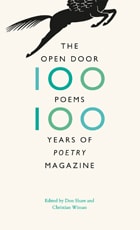
The Open Door
One Hundred Poems, One Hundred Years of "Poetry" MagazineEdited by Don Share and Christian Wiman
University of Chicago Press, 2012
When Harriet Monroe founded Poetry magazine in Chicago in 1912, she began with an image: the Open Door. “May the great poet we are looking for never find it shut, or half-shut, against his ample genius!” For a century, the most important and enduring poets have walked through that door—William Carlos Williams and Wallace Stevens in its first years, Rae Armantrout and Kay Ryan in 2011. And at the same time, Poetry continues to discover the new voices who will be read a century from now.
Poetry’s archives are incomparable, and to celebrate the magazine’s centennial, editors Don Share and Christian Wiman combed them to create a new kind of anthology, energized by the self-imposed limitation to one hundred poems. Rather than attempting to be exhaustive or definitive—or even to offer the most familiar works—they have assembled a collection of poems that, in their juxtaposition, echo across a century of poetry. Adrienne Rich appears alongside Charles Bukowski; poems by Isaac Rosenberg and Randall Jarrell on the two world wars flank a devastating Vietnam War poem by the lesser-known George Starbuck; August Kleinzahler’s “The Hereafter” precedes “Prufrock,” casting Eliot’s masterpiece in a new light. Short extracts from Poetry’s letters and criticism punctuate the verse selections, hinting at themes and threads and serving as guides, interlocutors, or dissenting voices.
The resulting volume is an anthology like no other, a celebration of idiosyncrasy and invention, a vital monument to an institution that refuses to be static, and, most of all, a book that lovers of poetry will devour, debate, and keep close at hand.
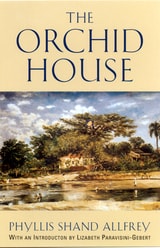
The Orchid House
Allfrey, Phyllis Shand
Rutgers University Press, 1996
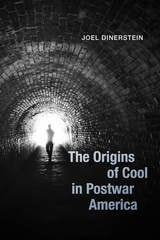
The Origins of Cool in Postwar America
Joel Dinerstein
University of Chicago Press, 2017
Through eye-opening portraits of iconic figures, Dinerstein illuminates the cultural connections and artistic innovations among Lester Young, Humphrey Bogart, Robert Mitchum, Billie Holiday, Frank Sinatra, Jack Kerouac, Albert Camus, Marlon Brando, and James Dean, among others. We eavesdrop on conversations among Jean-Paul Sartre, Simone de Beauvoir, and Miles Davis, and on a forgotten debate between Lorraine Hansberry and Norman Mailer over the "white Negro" and black cool. We come to understand how the cool worlds of Beat writers and Method actors emerged from the intersections of film noir, jazz, and existentialism. Out of this mix, Dinerstein sketches nuanced definitions of cool that unite concepts from African-American and Euro-American culture: the stylish stoicism of the ethical rebel loner; the relaxed intensity of the improvising jazz musician; the effortless, physical grace of the Method actor. To be cool is not to be hip and to be hot is definitely not to be cool.
This is the first work to trace the history of cool during the Cold War by exploring the intersections of film noir, jazz, existential literature, Method acting, blues, and rock and roll. Dinerstein reveals that they came together to create something completely new—and that something is cool.

The Orwell Mystique
A Study in Male IdeologyDaphne Patai
University of Massachusetts Press, 1984
The Orwell Mystique: A Study in Male Ideology is a pioneering work of feminist literary criticism that subjects the life and writing of George Orwell (1903–1950) to a sustained and rigorous feminist analysis. Published in 1984—the same year as the famous date in Orwell's most celebrated dystopian novel—the book examines all of Orwell's major novels, essays, and journalism and argues that his widely celebrated reputation for moral authority and plain-speaking democratic decency is fundamentally undercut by a pervasive and condescending attitude toward women.
Author Daphne Patai contends that Orwell's work is saturated with a male ideology so deeply embedded as to be largely invisible to mainstream criticism, which had long treated Orwell as an exemplar of intellectual honesty and political courage while overlooking the gender assumptions that structure his writing. Drawing on feminist theory and close textual analysis, Patai systematically traces the ways in which Orwell's androcentrism—his tendency to place men and male experience at the center of human life—shapes not only his fiction but also his essays, autobiographical writings, and political commentary.
The book is organized around a series of thematic and textual investigations. An introductory chapter establishes what Patai calls “the Orwell myth”—the cultural phenomenon by which Orwell's personal authority as a moral and political guide has been constructed and sustained. Subsequent chapters examine specific dimensions of Orwell's work and biography, including his experience of empire and the masculine codes embedded in his writings about colonialism; his treatments of vagabondage, manual labor, and working-class masculinity (notably in works such as Down and Out in Paris and London and The Road to Wigan Pier); and the androcentrism running through Nineteen Eighty-Four, in which Patai argues that the novel's treatment of women, sexuality, and the body reflects deeply patriarchal assumptions. The book also addresses Orwell's essays and journalism, situating his gender ideology within the broader context of mid-twentieth-century British patriarchal culture.
At the time of its publication, The Orwell Mystique was one of the first book-length feminist examinations of Orwell, and it generated significant scholarly debate. It remains an important and frequently cited work in both Orwell studies and feminist literary criticism.
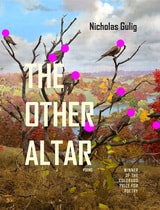
The Other Altar
Nicholas Gulig
University Press of Colorado, 2024
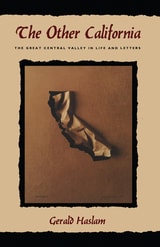
The Other California
The Great Central Valley In Life And LettersGerald W. Haslam
University of Nevada Press, 1993
Oildale native, Gerald Haslam, doesn’t like it when folks dismiss the Central Valley as boring and flat. In this collection of essays, he argues that it is California’s heartland and economic hub. In addition, the valley has produced a crop of gifted writers. These nineteen essays range from reminiscences of childhood and adolescence to a portrait of Mexican-Americans and their position in the Valley’s society to a moving essay about having the author’s aging father come to live with the family. Even if you have never lived in the Valley, reading this book will give you an entirely new perspective the next time you drive into it.
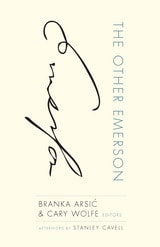
The Other Emerson
Branka Arsic
University of Minnesota Press, 2010
Considering Emerson first and foremost as a daring and original thinker, The Other Emerson focuses on three Emersonian subjects-subjectivity, the political, and the nature of philosophy-and range in topic from Emerson's relationships to slavery and mourning to his place in the development of Romanticism as reread by contemporary systems theory. It is Emerson's appreciation of truth's instability that link him to the European philosophical tradition.
Contributors: Eduardo Cadava, Princeton U; Sharon Cameron, Johns Hopkins U; Russell B. Goodman, U of New Mexico; Paul Grimstad, Yale U; Eric Keenaghan, U at Albany, SUNY; Gregg Lambert, Syracuse U; Sandra Laugier, Université de Picardie Jules Verne; Donald Pease, Dartmouth College.
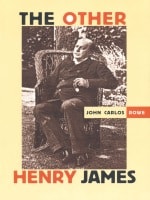
The Other Henry James
John Carlos Rowe
Duke University Press, 1998
Rowe traces a particular development in James’s work, showing how in his early writings James criticized women’s rights, same-sex relations, and other social and political trends now identified with modern culture; how he ambivalently explored these aspects of modernity in his writings of the 1880s; and, later, how he increasingly identified with such modernity in his heretofore largely ignored or marginally treated fiction of the 1890s. Building on recent scholarship that has shown James to be more anxious about gender roles, more conflicted, and more marginal a figure than previously thought, Rowe argues that James—through his treatment of women, children, and gays—indicts the values and conventions of the bourgeoisie. He shows how James confronts social changes in gender roles, sexual preferences, national affiliations, and racial and ethnic identifications in such important novels as The American, The Tragic Muse, What Maisie Knew, and In the Cage, and in such neglected short fiction as “The Last of the Valerii,” “The Death of the Lion,” and “The Middle Years.”
Positioning James’s work within an interpretive context that pits the social and political anxieties of his day against the imperatives of an aesthetic ideology, The Other Henry James will engage scholars, students, and teachers of American literature and culture, gay literature, and queer theory.
The Other Journey
Poems New and SelectedKatherine Chapin
University of Minnesota Press, 1959
The Other Lover
Bruce Smith
University of Chicago Press, 2000
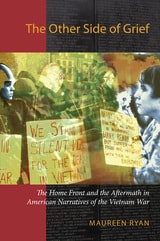
The Other Side of Grief
The Home Front and the Aftermath in American Narratives of the Vietnam WarMaureen Ryan
University of Massachusetts Press, 2008
The lingering aftereffects of the Vietnam War resonate to this day throughout American society: in foreign policy, in attitudes about the military and war generally, and in the contemporary lives of members of the so-called baby boom generation who came of age during the 1960s and early 1970s. While the best-known personal accounts of the war tend to center on the experience of combat, Maureen Ryan's The Other Side of Grief examines the often overlooked narratives—novels, short stories, memoirs, and films—that document the war's impact on the home front.
In analyzing the accounts of Vietnam veterans, women as well as men, Ryan focuses on the process of readjustment, on how the war continued to insinuate itself into their lives, their families, and their communities long after they returned home. She looks at the writings of women whose husbands, lovers, brothers, and sons served in Vietnam and whose own lives were transformed as a result. She also appraises the experiences of the POWs who came to be embraced as the war's only heroes; the ordeal of Vietnamese refugees who fled their “American War” to new lives in the United States; and the influential movement created by those who committed themselves to protesting the war.
The end result of Ryan's investigations is a cogent synthesis of the vast narrative literature generated by the Vietnam War and its aftermath. Together those stories powerfully demonstrate how deeply the legacies of the war penetrated American culture and continue to reverberate still.
The Oval Hour
Kathleen Peirce
University of Iowa Press, 1999

The Oven
An Anti-LectureIlan Stavans
University of Massachusetts Press, 2018
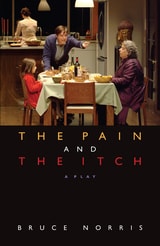
The Pain and the Itch
A PlayBruce Norris
Northwestern University Press, 2008
In this brief but staggering two-act, playwright Norris demonstrates his skill at drawing out the dark truth that lurks beneath the surface of the “perfect” family. His crackling satire takes dead aim at the self-satisfied, left-leaning American upper-middle class and its many self-delusions.
On a winter afternoon, Kelly and Clay—an attractive, prosperous, seemingly happy couple with a four-year-old daughter and a newborn baby—must explain to a visitor the events of the previous Thanksgiving, on which, so it seems, someone or something had been gnawing at the avocados on their kitchen table. In the course of this holiday gathering—attended by Clay’s mother, a well-meaning but clueless first-grade teacher who spouts pointless liberal bromides; his brother, a plastic surgeon with a nihilistic streak and a taste for martinis; and his brother's girlfriend, a sexy Balkan immigrant with a love for all things American (racism included)—the recent past is unearthed along with revelations of failed marriages, fraternal hatred, infidelity and venereal disease, in the form of their daughter’s nasty genital infection. And it’s a comedy. As the story is gradually unfolded to their visitor, a Muslim cab driver, his relationship to the events becomes increasingly clear, as does the emptiness of the family’s supposed benevolence and sensitivity.
With its crashing emotion and cutting humor, this vicious dissection of the comfortable progressive life lays bare the lies that people use to feel righteous even as they veer off a genuinely ethical path.

The Palace of Bones
Allison Eir Jenks
Ohio University Press, 2002
The Palace of Bones by Allison Eir Jenks is an often stark and startling vision of the way we live, the places we inhabit, and the relics we make to comfort ourselves.
Haunted by a quiet, unquenchable longing, Jenks expertly and calmly guides the reader through a vivid dreamscape in this first full-length collection of poems.
The Palace of Bones was selected by final judge and Pulitzer Prize winner Carolyn Kizer. At once dark in its vision and light in its tone, this remarkable book is its author’s self-confident invitation for us to join her in a world she knows intimately and has made almost familiar if not entirely safe.
The Palace of Bones is a stunning debut.
The Paper Wasp
Teresa Cader
Northwestern University Press, 1998
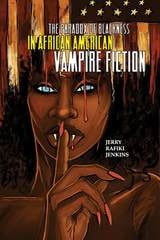
The Paradox of Blackness in African American Vampire Fiction
Jerry Rafiki Jenkins
The Ohio State University Press, 2019
The Part and the Whole in Early American Literature, Print Culture, and Art
Matthew Pethers
Bucknell University Press, 2024
The essays in this pathbreaking collection consider the significance of varied early American fragmentary genres and practices—from diaries and poetry, to almanacs and commonplace books, to sermons and lists, to Indigenous ruins and other material shards and fragments—often overlooked by critics in a scholarly privileging of the “whole.” Contributors from literary studies, book history, and visual culture discuss a host of canonical and non-canonical figures, from Edward Taylor and Washington Irving to Mary Rowlandson and Sarah Kemble Knight, offering insight into the many intellectual, ideological, and material variations of “form” that populated the early American cultural landscape. As these essays reveal, the casting of the fragmentary as aesthetically eccentric or incomplete was a way of reckoning with concerns about the related fragmentation of nation, society, and self. For a contemporary audience, they offer new ways to think about the inevitable gaps and absences in our cultural and historical archive.
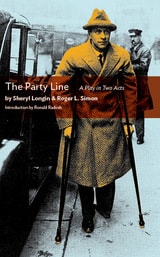
The Party Line
A Full-Length PlayRoger L Simon
St. Augustine's Press, 2013
The Past as Present in the Drama of August Wilson
Harry J. Elam, Jr.
University of Michigan Press, 2004
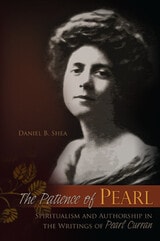
The Patience of Pearl
Spiritualism and Authorship in the Writings of Pearl CurranDaniel B. Shea
University of Missouri Press, 2012
The Pattern More Complicated
New and Selected PoemsAlan Williamson
University of Chicago Press, 2004
The Pattern More Complicated assembles Williamson's most important, representative poems, marking the trajectory of poetic development and the recurrence of themes across the span of four previous collections to present a survey of a major American poet in a single volume.
The Perfect Murder
A Study in DetectionDavid Lehman
University of Michigan Press, 2000
As Lehman shows, the detective story draws deeply from ancient storytelling traditions. The mystery's conventions--the locked room, the clue "hidden" in plain sight, the diabolical double, the villainous least likely subject--work on us as childhood fairy tales do; they prey upon our darkest fears, taking us to the brink of the unbearable before restoring a comforting sense of order. The myth of Oedipus, for example, contains the essential elements of a whodunit, with the twist that the murderer the detective pursues is himself.
With their wisecracking gumshoe heroes, Dashiell Hammett and Raymond Chandler fashioned an existential romance out of the detective novel. More recent writers such as Ross MacDonald, P. D. James, and Ruth Rendell have raised the genre to a new level of psychological sophistication. Yet the form evolves still, and Lehman guides us to the epistemological riddles of Jorge Luis Borges and Umberto Eco, who challenge the notion of a knowable truth. Originally published in 1989, this new edition features an additional chapter on the mystery novels of the 1990s.
"A lively study of the development and varieties of the detective story since Poe, its relations with other forms high and low, and the latter-day appropriation of its techniques by such writers as Borges and Eco. . . . A thoroughly intelligent and readable book." --Richard Wilbur, Pulitzer-Prize winning poet
David Lehman is the series editor of both the The Best American Poetry, published by Scribner, and the Poets on Poetry series published by the University of Michigan Press. He is a former Guggenheim Fellow in poetry, a vice president of the National Book Critics Circle, and the author of several books of criticism and collections of poems.
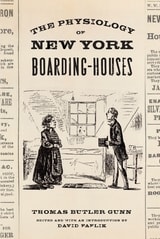
The Physiology of New York Boarding-Houses
Faflik, David
Rutgers University Press, 2008
In his introduction, David Faflik considers what made Gunn's book a compelling read in the past and how today it can elucidate our understanding of the formation and evolution of urban American life and letters.

The Pleasant Profession of Robert A. Heinlein
A Critical Study of His Work (Second Edition)By Farah Mendlesohn
Lever Press, 2027
Robert A. Heinlein began publishing in the 1940s at the dawn of the Golden Age of science fiction. Today he is considered one of the genre's “big three” alongside Arthur C. Clarke and Isaac Asimov. His short stories were instrumental in developing the genre’s structure and rhetoric, while novels such as Stranger in a Strange Land and Starship Troopers demonstrated that such writing could be a vehicle for political argument.
While Heinlein’s influence remains strong, his legacy is fiercely contested. His vision of the future was sometimes radical, sometimes deeply conservative, and arguments have flared up recently about which faction has the most significant claim on his ideas. In this major critical study, Hugo Award-winner Farah Mendlesohn carries out a close reading of Heinlein's work, including unpublished stories, essays, and speeches. The Pleasant Profession of Robert A. Heinlein sets out not to interpret a single book, but to examine Heinlein’s arguments about the nature of science fiction, American politics, and himself.

The Pluralistic Philosophy of Stephen Crane
Patrick K. Dooley
University of Illinois Press, 1993
formally trained in the discipline of philosophical inquiry. Dooley shows how
Crane's philosophical pluralism, which represents his response to the acute moral
uncertainties resulting from the decline of late nineteenth-century religious
authority, allies him with the contextualism of such contemporary philosophers
as William James, C. S. Peirce, and Josiah Royce."
-- James B. Colvert, author of Stephen Crane
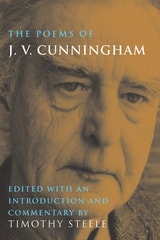
The Poems of J. V. Cunningham
Timothy Steele
Ohio University Press, 1997
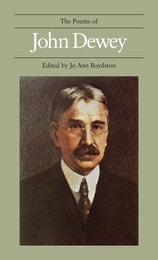
The Poems of John Dewey
Edited by Jo Ann Boydston
Southern Illinois University Press, 1977
A literary discovery of considerable magnitude, these 98 previously unpublished poems by John Dewey, written principally in the 1910–18 period, illuminate an emotive aspect in his intellectual life often not manifest in the prose works.
Rumors of the existence of the poems have circulated among students of Dewey’s life and writings since 1957,when Mrs. Roberta Dewey gained possession of them from the Columbia University Columbiana collection. But except for the few persons who saw copies made by the French scholar Deladelle five years after Dewey’s death, the poems have remained inaccessible until now.
None of the poems has hitherto been published. Mrs. Roberta Dewey and Dewey’s children from his first marriage seem not to have known of Dewey’s experiments in verse during his lifetime. And, as evidence presented here now shows, only two or three acquaintances knew of actual poems written by Dewey, one of them the Polish-American novelist Anzia Yezierska, who had a brief emotional involvement with Dewey in the 1917–18 period. The factual, rather than inferential, evidence of Dewey’s relationship with Anzia Yezierska appears in the poems, which, taken as a whole, provide revealing insights into Dewey’s feelings and illuminate not only aspects of his emotions but of his thought as well.
The fact that Dewey did not publish the poetry himself, together with the circumstances of its discovery and unusual history, has led to the exceptionally careful editorial treatment of the poems given here. Scholars will find all the evidence for the authorship of the manuscripts clearly presented and all the changes and alterations carefully recorded. This edition has received the Modern Language Association of America Center for Editions of American Authors Seal as an “approved text.”
The Poems of Renata Ferreira
Frank X. Gaspar
Tagus Press, 2020
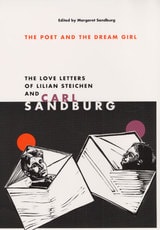
The Poet and Dream Girl
The Love Letters of Lilian Steichen and Carl SandburgEdited by Margaret Sandburg
University of Illinois Press, 1987
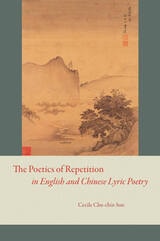
The Poetics of Repetition in English and Chinese Lyric Poetry
Cecile Chu-chin Sun
University of Chicago Press, 2010
For more than half a century, Chinese-Western comparative literature has been recognized as a formal academic discipline, but critics and scholars in the field have done little to develop a viable, common basis for comparison between these disparate literatures. In this pioneering book, Cecile Chu-chin Sun establishes repetition as the ideal perspective from which to compare the poetry and poetics from these two traditions.
Sun contends that repetition is at the heart of all that defines the lyric as a unique art form and, by closely examining its use in Chinese and Western poetry, she demonstrates howone can identify important points of convergence and divergence. Through a representative sampling of poems from both traditions, she illustrates how the irreducible generic nature of the lyric transcends linguistic and cultural barriers but also reveals the fundamental distinctions between the traditions. Most crucially, she dissects the two radically different conceptualizations of reality—mimesis and xing—that serve as underlying principles for the poetic practices of each tradition.
Skillfully integrating theory and practice, The Poetics of Repetition in English and Chinese Lyric Poetryprovides a much-needed model for future study of Chinese and English poetry as well as lucid, succinct interpretations of individual poems.
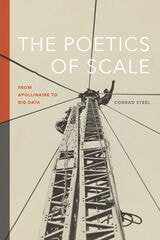
The Poetics of Scale
From Apollinaire to Big DataConrad Steel
University of Iowa Press, 2024
The Poetics of Scale takes us back to the years before the First World War in Paris, where the poet Guillaume Apollinaire claimed to have invented a new mode of poetry large enough to take on the challenges of the coming twentieth century. This history follows Apollinaire’s ideas across the Atlantic and examines how and why his work became such a vital source of inspiration for American poets through the era of intensive American economic expansion and up to the present day. Threading together Apollinaire’s work in the 1910s with three of his American successors—Louis Zukofsky in the 1930s, Allen Ginsberg in the 1950s, and Alice Notley from the 1970s onward—it shows how poetry as a cultural technique became the crucial test case for the scale of our collective imagination.
The Poetics of Transition
Emerson, Pragmatism, and American Literary ModernismJonathan Levin
Duke University Press, 1999
Levin draws on the pragmatist and neopragmatist writings of William James, John Dewey, George Santayana, Richard Rorty, and Cornel West to illuminate the work of modernist literature. In turn, he illuminates the poetic imperatives of pragmatism by tracing the ways in which Henry James, Gertrude Stein, and Wallace Stevens capture the moment of transition—a paradoxical moment that, once it is represented in language or art, requires its own perpetual overcoming. Throughout, he explores how modernist writers, who are masters at recording such “illegible” moments of transition in their poetry and prose, significantly contribute to an expanded understanding of pragmatism and its underlying aesthetics. By linking Emerson with the progressive philosophy of turn-of-the-century pragmatism and the experimentation of American literary modernism, Levin offers new insight into Emerson’s lasting influence on later American philosophers, novelists, and poets.
The Poetics of Transition will interest scholars and students in the fields of literary criticism, neopragmatism, literary modernism, and American literature.
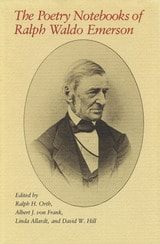
The Poetry Notebooks of Ralph Waldo Emerson
Ralph Waldo Emerson; Edited by Ralph H. Orth, Albert J. von Frank, Linda Allardt, & David W. Hill
University of Missouri Press, 1986
Published here in full are Ralph Waldo Emerson's nine poetry notebooks, the single greatest source of information about his creative habits in poetry. Emerson kept rough drafts, revised versions, and fair copies of hundreds of poems in these notebooks, so that the genesis and development of poems both famous and obscure can be traced closely. The notebooks have been remarkably little consulted, primarily because their unedited textual condition makes them difficult to use. This edition makes them accessible to scholars by presenting a faithful transcription of each notebook, a detailed analysis of the history of each poem, an introduction, and a cross-referenced index.
For this edition, the editors have followed the high standards of textual practice developed for Harvard University Press's edition of The Journals and Miscellaneous Notebooks of Ralph Waldo Emerson. That editorial approach makes possible a logical, clear presentation of material that Emerson often jotted down in segments or with multiple erasures and insertions.
Because it will allow scholars to examine as never before the many facets of Emerson the poet, The Poetry Notebooks of Ralph Waldo Emerson will be a major impetus to study of the man considered by many to be America's greates thinker.
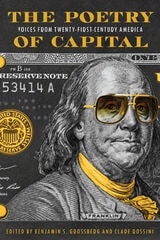
The Poetry of Capital
Voices from Twenty-First-Century AmericaEdited by Benjamin S. Grossberg and Clare Rossini
University of Wisconsin Press, 2021
Editors Benjamin S. Grossberg and Clare Rossini selected poems to reflect broad themes of labor, history and economic forces, social equity, and the environment. In addition, they asked each poet to provide a brief prose comment to introduce their work. Some give broad statements on the nature of wealth in America today; others are intimate, offering insight into how life experiences inform their writing; still others reflect on the art of poetry itself and its unique power to speak to economic pressures of the moment.
Contributors include Mary Jo Bang, Xochiquetzal Candelaria, Alan Chazaro, Mark Doty, Denise Duhamel, Tony Hoagland, Yusef Komunyakaa, Dorianne Laux, Kimiko Hahn, Sharon Olds, George Perreault, Robert Pinsky, Minnie Bruce Pratt, Afaa Michael Weaver, David Wojahn, and others.
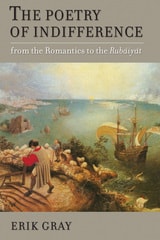
The Poetry of Indifference
From the Romantics to the RubaiyatErik Irving Gray
University of Massachusetts Press, 2005
of poetic indifference began to emerge.
The Poetry of Indifference analyzes nineteenth-century works by Wordsworth, Keats, Byron, Tennyson, Robert Browning, and Edward FitzGerald, among others—works that do not merely declare themselves to be indifferent but formally enact the indifference they describe. Each poem consciously disregards some aspect of poetry that is usually considered to be crucial or definitive, even at the risk of seeming "indifferent" in the sense of "mediocre." Such gestures discourage critical attention, since the poetry of indifference refuses to make claims for itself.
This is particularly true of FitzGerald's Rubáiyát, one of the most popular poems of the nineteenth century, but one that recent critics have almost entirely ignored. In concentrating on this underexplored mode of poetry, Gray not only traces a major shift in recent literary history, from a Romantic poetics of sympathy to a Modernist poetics of alienation, but also considers how this literature can help us understand the sometimes embarrassing but unavoidable presence of indifference in our lives.
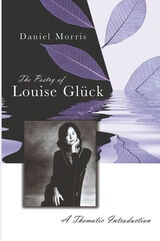
The Poetry of Louise Glück
A Thematic IntroductionDaniel Morris
University of Missouri Press, 2021

The Political Arrays of American Indian Literary History
James H. Cox
University of Minnesota Press, 2019
Bringing fresh insight to a century of writing by Native Americans
The Political Arrays of American Indian Literary History challenges conventional views of the past one hundred years of Native American writing, bringing Native American Renaissance and post-Renaissance writers into conversation with their predecessors. Addressing the political positions such writers have adopted, explored, and debated in their work, James H. Cox counters what he considers a “flattening” of the politics of American Indian literary expression and sets forth a new method of reading Native literature in a vexingly politicized context.
Examining both canonical and lesser-known writers, Cox proposes that scholars approach these texts as “political arrays”: confounding but also generative collisions of conservative, moderate, and progressive ideas that together constitute the rich political landscape of American Indian literary history. Reviewing a broad range of genres including journalism, short fiction, drama, screenplays, personal letters, and detective fiction—by Lynn Riggs, Will Rogers, Sherman Alexie, Thomas King, Leslie Marmon Silko, Louise Erdrich, Winona LaDuke, Carole laFavor, and N. Scott Momaday—he demonstrates that Native texts resist efforts to be read as advocating a particular set of politics
Meticulously researched, The Political Arrays of American Indian Literary History represents a compelling case for reconceptualizing the Native American Renaissance as a literary–historical constellation. By focusing on post-1968 Native writers and texts, argues Cox, critics have often missed how earlier writers were similarly entangled, hopeful, frustrated, contradictory, and unpredictable in their political engagements.
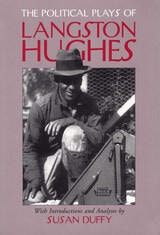
The Political Plays of Langston Hughes
Introductions and Analyses by Susan Duffy
Southern Illinois University Press, 2000
Among the most influential poets of the Harlem Renaissance, Langston Hughes is perhaps best remembered for the innovative use of jazz rhythms in his writing. While his poetry and essays received much public acclaim and scholarly attention, Hughes’ dramas are relatively unknown. Only five of the sixty-three plays Hughes scripted alone or collaboratively have been published (in 1963).
Published here, for the first time, are four of Hughes’ most poignant, poetic, and political dramas, Scottsboro Limited, Harvest (also known as Blood on the Fields), Angelo Herndon Jones, and De Organizer. Each play reflects Hughes’ remarkable professionalism as a playwright as well as his desire to dramatize the social history of the African American experience, especially in the context of the labor movements of the 1930s and their attempts to attract African American workers. Hughes himself counted prominent members of these leftist groups among his close friends and patrons; he formed a theater group with Whittaker Chambers, prompting an FBI investigation of Hughes and his writing in the 1930s. These plays, while easily read as idealistic propaganda pieces for the left, are nonetheless reflective of Hughes’ other more influential and studied works.
The first scholar to offer a systematic study of Hughes’ plays, Susan Duffy provides an informed introduction as well as a detailed analysis of each of the four plays. Duffy also establishes that De Organizer, a collaboration with noted jazz pianist and composer James P. Johnson (who also wrote its score) was indeed performed by the Labor Stage.
By making these forgotten texts available, and by presenting them within a scholarly discussion of 1930s leftist political movements, Duffy seeks to spark a renewed interest in Langston Hughes as an American playwright and political figure.
The Politics of Urban Beauty
New York and Its Art CommissionMichele H. Bogart
University of Chicago Press, 2006
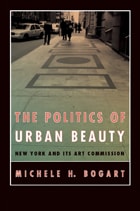
Since its founding in 1898, the Art Commission of the City of New York (ACNY) has served as the city’s aesthetic gatekeeper, evaluating all works of art intended for display on city property. And over the years, the commission’s domain has expanded dramatically to include everything from parks and courthouses to trash cans and sidewalks. In ThePolitics of Urban Beauty, Michele H. Bogart argues that this unprecedented authority has made the commission host to some complex negotiations—involving artists, architects, business leaders, activists, and politicians—about not only the role of art in urban design, but also the shape and meaning of the city and its public spaces.
A former vice president of the ACNY, Bogart tells its story here from an insider’s perspective, tracing the commission’s history from its origins as an outgrowth of progressive reform to its role in New York’s reconstruction after 9/11. Drawing on archival correspondence, drawings, and photographs from commission collections, Bogart presents bracing examples of works—ranging from New Deal murals to Louis Kahn’s unbuilt Memorial to Six Million Jewish Martyrs—that illuminate the ACNY’s subtle yet powerful role in shaping New York’s identity.
The Politics of Urban Beauty is thus a fascinating history of a New York art world that paralleled—and sometimes unpredictably intersected with—the more familiar realm of prominent architects, painters, galleries, and museums. Bogart’s fresh view adds a critical dimension to our understanding of “the city beautiful” and makes an important and lively contribution to the study of art history, urban design, and New York City itself.
The Postal Confessions
Max Garland
University of Massachusetts Press, 1995
These poems wrestle with the inherited myths of their particular time and place. Often set in a small corner of western Kentucky, they explore moments when an individual life becomes implicated in a larger scheme—the realm of Cold War politics, the mysteries of religious faith, the codes and rituals of romantic love. Max Garland shows a lyrical determination to deal with history through the lives, minds, and emotions of ordinary people “stricken with time.”
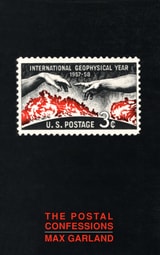
In poems about baptism, bowling, Greek goddesses, and the hydrogen bomb, Garland seems to say that knowledge and even revelation might come from anywhere. The book ends with the image of the empty space Michelangelo left between the hands of Adam and God on the ceiling of the Sistine Chapel; that tension between what lasts and what passes away, comprises the territory of these poems.