Results by title
1832 books match the query 'Essays' and 450 start with t
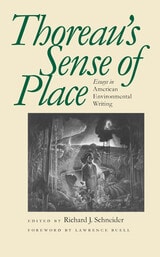
Thoreaus Sense of Place
Essays in American Environmental WritingRichard J. Schneider
University of Iowa Press, 2000
The contributors to this stimulating collection address the ways in which Thoreau and his successors attempt to cope with the basic epistemological split between perceiver and place inherent in writing about nature; related discussions involve the kinds of discourse most effective for writing about place. They focus on the impact on Thoreau and his successors of culturally constructed assumptions deriving from science, politics, race, gender, history, and literary conventions. Finally, they explore the implications surrounding a writer's appropriation or even exploitation of places and objects.
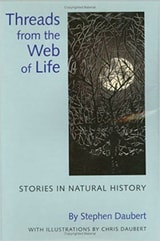
Threads from the Web of Life
Stories in Natural HistoryStephen Daubert
Vanderbilt University Press, 2006
In sixteen stories Steve Daubert pulls the reader into the mystery and immediacy of ecological processes spanning a range from microscopic to tectonic, from microscopic to cosmic forces. Each tale brings the reader into the moment to witness an episode of survival in the wild first-hand. The material is presented on a level of intimacy and detail not usually encountered in other styles of natural history writing.
These creative non-fiction stories provide not just a bird's eye view (though that's true for the owls, warblers, condors, and hummingbirds in the book), but a wasp's eye view, a mouse's, a sea turtle's, a squid's. Sometimes the focus is as small as the detritus on the forest floor, or a single beat of the wing of a gull. Other stories range across evolutionary time. From whales and dinosaurs to creatures invisible to the naked eye, author and illustrator bring to life the dynamic interplay of living, evolving creatures and the natural forces that have shaped their worlds.
The book includes chapter notes that document the scientific basis for each story and describe the controversies still surrounding some of them -- a splendid resource for families to read and share.
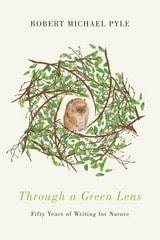
Through a Green Lens
Fifty Years of Writing for NatureRobert Michael Pyle
Oregon State University Press, 2016
Thus began a life path devoted to natural history, nature conservation, and the language, and how they all meet in the literature of the land. Working in a succession of far-flung jobs in biological conservation, teaching, and field research, Pyle eventually threw in a regular paycheck in favor of a freelance existence devoted to his mutual passions for nature study and writing.
All along, he wrote, and wrote: to date, twenty books and hundreds of essays, stories, papers, and poems. But it is the occasional prose--the deeply personal essays that explored and indulged his immediate fascinations--that make up this selection of never-before-collected testimonies. Beginning with that 1965 cri de coeur written on mountain motel stationery, Through a Green Lens ranges across broad territory of topic, vehicle, geography, populace, and politics, concluding with powerful forewords for two 2015 books, Earth and Eros and Nerves and Numbers. Pyle's half-century long view, acute and uncommonly attuned to the physical world, gives readers a remarkable window on the natural setting of our life and times.
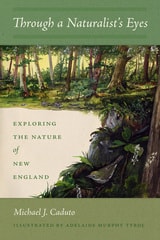
Through a Naturalist's Eyes
Exploring the Nature of New EnglandMichael J. Caduto
University Press of New England, 2016
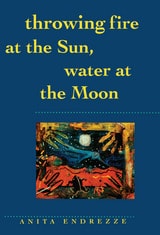
Throwing Fire at the Sun, Water at the Moon
Anita Endrezze
University of Arizona Press, 2000
Throwing Fire at the Sun, Water at the Moon is a blend of ancient myths, poetry, journal extracts, short stories, and essays that tell her people's story from the early 1500s to the present, and her family's story over the past five generations. Reproductions of Endrezze's paintings add an additional dimension to her story and illuminate it with striking visual imagery. Endrezze has combed history and legend to gather stories of her immediate family and her mythical ancient family, the two converging in the spirit of storytelling. She tells Aztec and Yaqui creation stories, tales of witches and seductresses, with recurring motifs from both Yaqui and Chicano culture. She shows how Christianity has deeply infused Yaqui beliefs, sharing poems about the Flood and stories of a Yaqui Jesus. She re-creates the coming of the Spaniards through the works of such historical personages as Andrés Pérez de Ribas. And finally she tells of those individuals who carry the Yaqui spirit into the present day. People like the Esperanza sisters, her grandmothers, and others balance characters like Coyote Woman and the Virgin of Guadalupe to show that Yaqui women are especially important as carriers of their culture.
Greater than the sum of its parts, Endrezze's work is a new kind of family history that features a startling use of language to invoke a people and their past--a time capsule with a female soul. Written to enable her to understand more about her ancestors and to pass this understanding on to her own children, Throwing Fire at the Sun, Water at the Moon helps us gain insight not only into Yaqui culture but into ourselves as well.
Till the Light Leaps
Essays on Playing AttentionD. Graham Burnett
University of Chicago Press, 2027
A ranging, erudite, and intimate examination of the nature of knowledge, by a thinker and creator who defies categorization.
Attention is in short supply and high demand. But when we bring our minds and time and senses to something—an idea, an object, another person—we tap into a human capacity for observation, patience, candor, and presence. Look long enough, and we can reliably catch a bright flash, a shift in the light, even a dawning.
In Till the Light Leaps, historian of science D. Graham Burnett explores the questions that have been major drivers of his intellectual life: How do we know what we know? And how are we changed by that effort? Written during a period of radical, collective, and creative experimentation with attention, the twenty-six essays collected here span topics like technology, science, art, and religion. Together, they comprise a sustained reflection on the relationship between empirical matters and the shiver-work of the human spirit. A brief history of spectroscopy offers an occasion to consider the solemn power of fire, as well as the righteous lessons of a childhood science experiment gone wrong. Skywriting invokes military might, but also the expressionistic bravura of a solo aeronaut, Art Smith. The Greek ritual of throwing plant matter in celebration is a thread connecting animal sacrifice, confetti production, and capitalist excess. In the final, previously unpublished essay, Galway Kinnell’s 1980 poem “Saint Francis and the Sow” becomes a heroic call to love and an allegory of attention in its richest sense.
Till the Light Leaps, a reference to the writings of Simone Weil, advises us to look at something “until the light leaps,” whether it yields a wink or an illumination. Burnett models the work—and the pleasure—of staying present with the world, and his essays test what science can offer, even as they feel for what it cannot.
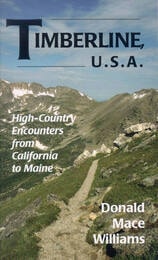
Timberline U.S.A.
High-Country Encounters from California to MaineDonald Mace Williams
Utah State University Press, 2003
As a youth in Denver, Donald Mace Williams developed an affection for high mountain country. After a journalistic career spent mostly on flat lands, he set out to rediscover what was special about country above timberline. He hiked the high alpine in four of America's major ranges-the Rockies, Sierra Nevada, Cascades, and northern Appalachians-and in his narrative of his travels, he tells us what he saw and learned and who he met. Having visited some of these areas when younger, Williams compares his psychological and physical responses as an older man and how his ideas about how to treat the environment have evolved. A recurring theme is the compromises that people such as he make between the pull of mountains and freedom and the responsibilities of making a living in the lowlands. Mainly, he observes and experiences what is distinctive about the timberline environment.
Throughout his book, Williams gently informs readers regarding timberline history, nature, weather, and archaeology; high altitude physiology; and environmental concerns. Frequently, he recounts encounters with interesting and varied people he meets on the trails: a young British hiking companion who has come back to Colorado to repeat a climb on which, a year previously, his two fellow climbers died; a pilot who climbs isolated peaks in the Sierra Nevada in search of bouillon-can scrolls signed by famous early mountaineers; a "Literate Farmer" who pauses on a mountain trail in Vermont to discuss Robert Frost.
Donald Mace Williams is a retired journalist who has worked for such newspapers as The Wichita Eagle, Newsday, and the Fort Worth Star-Telegram. He has a Ph.D. in English from the University of Texas, has published one previous book (Interlude in Umbarger: Italian POWs and a Texas Church); poems in Western Humanities Review, Iron Horse Literary Review, and South Dakota Review; and a short story in Southwest Review. He now lives in Texas.
To Be At Music
Essays & TalksNorma Cole
Omnidawn, 2010
To Go Into the Words
Norman Finkelstein
University of Michigan Press, 2023
To Go Into the Words is the latest book of critical prose from renowned poet and scholar of Jewish literature Norman Finkelstein. Through a rigorous examination of poets such as William Bronk, Helen Adam, and Nathaniel Mackey, the book engages the contemporary poetic fascination with transcendence through the radical delight with language. By opening up a given poem, Finkelstein seeks the “gnosis” or insight of what it contains so that other readers can understand and appreciate the works even more.
Pulling from Finkelstein’s experience of writing thirteen books of poetry and six books of literary criticism, To Go Into the Words consistently rewards the reader with insights as transformative as they are well-considered and deftly mapped out. This volume opens the world of poetry to poets, scholars, and readers by showcasing “the gnosis that is to be found in modern poetry.”
To Know God and the Soul
Essays on the Thought of Saint AugustineRoland J. Teske
Catholic University of America Press, 2008
To Make a Prairie
Essays on Poets, Poetry, and Country LivingMaxine Kumin
University of Michigan Press, 1980
To Taste
On Cooking and the Good LifeScott Samuelson
University of Chicago Press, 2026
A philosopher-chef’s moving meditation on the pleasures of our shared humanity and how it can be most fully experienced in making and sharing food.
Our daily rhythms and most meaningful relationships center on the dining table, and so nothing is more essential to a good life than satisfying meals with friends and family. In To Taste, philosopher and sous-chef Scott Samuelson invites us into his kitchen, where he blends moving personal stories with insights from some of the world’s greatest thinkers into a rich but simple argument: our daily labor, in making food or otherwise, should connect us with other people.
For Samuelson, the pleasures of excellent cooking illuminate this value in particularly compelling ways. When we embrace the work required to prepare and share a good meal, we learn to honor tradition, practice hospitality, respect nature, cherish festivity, and nurture skill—all ethics that resist our increasingly dehumanized world. Ultimately, Samuelson argues that cooking, especially the elusive decision to season a dish “to taste,” contains the full mystery of human life.
Whether you’re a professional chef or your best culinary feat involves a can opener, To Taste can help you cook up a life that elicits a glorious mmm.
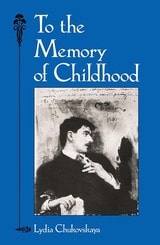
To the Memory of Childhood
Lydia Chukovskaya
Northwestern University Press, 1988
Her father is a household name in Russia because of his tales in verse for children. But his literary accomplishments ranged far beyond bedtime stories. As a critic he wrote controversial articles and lively profiles of cultural figures; as a translator he introduced Whitman, Twain, Kipling, and Wilde to Russian readers. When his children's literature was attacked in the 1920s and 1930s, he turned to editing, scholarship, and articles on translation. A man of boundless energy, he played a vital role in his country's cultural life until his death in 1969. "I am not writing Kornei Ivanovich's biography," Chukovskaya says, "but he was the author of my childhood."
Tomorrow the Manifold
Essays on Foucault, Anarchy, and the Singularization to ComeReiner Schürmann
Diaphanes, 2018
Taken together, these pivotal essays introduce the reader to Schürmann’s most urgent concerns and assemble the conceptual tools that go on to lay the groundwork for his final work, Broken Hegemonies, which offers a subversive re-reading of the history of Western metaphysics outside of Foucault’s genealogical approach. To the reader unfamiliar with Schürmann’s work, these texts establish him as one of the most radical thinkers of the late 20th century, whose work might eventually become legible in our present.
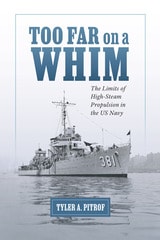
Too Far on a Whim
The Limits of High-Steam Propulsion in the US NavyTyler A. Pitrof
University of Alabama Press, 2024
WINNER OF THE LYMAN BOOK AWARD FOR MARITIME AND NAVAL SCIENCE, TECHNOLOGY, AND ENVIRONMENT
Argues that the US Navy’s commitment to high-steam propulsion for its World War II fleet was a tactical, technological, and bureaucratic failure
In Too Far on a Whim, Tyler A. Pitrof presents a high-spirited revision of the US Navy’s commitment to high-steam propulsion systems, the mainstay of its World War II fleets. Pitrof’s research persuasively demonstrates that in its war against the Imperial Japanese Navy, the US Navy succeeded despite its high-steam propulsion systems rather than because of them.
War with an aggressive Japan and a resurgent Germany loomed in the dark days of the late 1930s. Rear Admiral Harold G. Bowen Sr., head of the US Navy’s Bureau of Engineering, advanced a radical vision: a new fleet based on high-steam propulsion, a novel technology that promised high speeds with smaller engines and better fuel efficiency. High-steam engines had drawbacks—smaller operational ranges and maintenance issues. Nevertheless, trusting its engineers to resolve these issues, the US Navy put high-steam propulsion at the heart of its warship design from 1938 to 1945.
The official record of high-steam technology’s subsequent performance has relied heavily on Bowen’s own memoir, in which he painted high-steam innovation in heroic colors. Pitrof’s empirical review of primary sources such as ship’s maintenance records, however, illuminates the opposite—that the heroism lay in the ability of American seamen to improvise solutions to keep these difficult engines running.
Pitrof artfully explains engineering concepts in layman’s terms and provides an account that extends far beyond technology and into matters of naval hierarchies and bureaucracy, strategic theory, and ego. He offers a cautionary tale—as relevant to any endeavor as it is to military undertakings—about how failures arise when technical experts lack managers who understand their work. Admiral Bowen wielded excessive power because no one else in the US Navy knew enough to countermand him.
Compulsively readable, Too Far on a Whim is a landmark for those interested in naval history and technology but also for readers interested in the interplay between innovation, decision-making, and engineering.
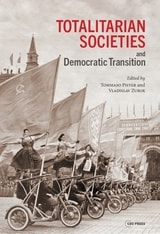
Totalitarian Societies and Democratic Transition
Essays in Memory of Victor ZaslavskyRiccardo James Vargiu
Central European University Press, 2017
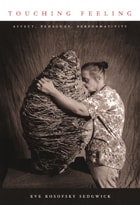
Touching Feeling
Affect, Pedagogy, PerformativityEve Kosofsky Sedgwick
Duke University Press, 2003
In prose sometimes somber, often high-spirited, and always accessible and moving, Touching Feeling interrogates—through virtuoso readings of works by Henry James, J. L. Austin, Judith Butler, the psychologist Silvan Tomkins and others—emotion in many forms. What links the work of teaching to the experience of illness? How can shame become an engine for queer politics, performance, and pleasure? Is sexuality more like an affect or a drive? Is paranoia the only realistic epistemology for modern intellectuals? Ultimately, Sedgwick's unfashionable commitment to the truth of happiness propels a book as open-hearted as it is intellectually daring.
Towards a New Universalism
Boris Groys
University of Minnesota Press, 2026
A dynamic contemporary examination of universalism
Gathering a selection of essays by influential theorist Boris Groys, Towards a New Universalism articulates his sustained engagement with the problem of universality under contemporary conditions shaped by globalization, institutional fragmentation, and digital mediation. Rather than defending classical universalism or abandoning it in favor of cultural particularism, Groys approaches universality as something produced within shared historical, institutional, and technological frameworks.
These essays address topics spanning from identity politics to migration, museums, media, and artificial intelligence, examining how universal claims make their way into social and cultural contexts. Distinct from recent philosophical treatments of universalism, Towards a New Universalism situates the question within aesthetics, media theory, and institutional critique, offering an indispensable collection for anyone interested in the intersections of politics and art.
Distributed for e-flux.
Toxic Loves, Impossible Futures
Feminist Living as ResistanceIrmgard Emmelhainz
Vanderbilt University Press, 2021
These reflections and dialogues are an urgent attempt to resist the present in the company of the voices of women like bell hooks, Sara Ahmed, Leslie Jamison, Lina Meruane, Leanne Betasamosake Simpson, Chris Kraus, Alaíde Foppa, Lorena Wolffer, Sayak Valencia, Pip Day, Veronica Gonzalez Peña, Eimear McBride, Simone de Beauvoir, Elena Poniatowska, Susan Sontag, Margaret Randall, Simone Weil, Arundhati Roy, Marta Lamas, Paul B. Preciado, Dawn Marie Paley, Raquel Gutiérrez, Sara Eliassen, and Silvia Gruner. Toxic Loves, Impossible Futures continues the discussion on how to undo misogyny and dismantle heteropatriarchy's sublimating and denigrating tricks against women, which are intrinsically linked to colonialism and violence against the Earth.
Tragic Thoughts at the End of Philosophy
Language, Literature, and Ethical TheoryGerald L. Bruns
Northwestern University Press, 1999

Trajectories
Crossing the Map of PoetryCarolyne Wright
University of Michigan Press, 2027
In Trajectories, poet, translator, human rights advocate, and world traveler Carolyne Wright maps her poetic path in the crossing of cultural, linguistic, and national boundaries. From her origins in Seattle and the Pacific Northwest through Latin America (Chile, Brazil) and South Asia (India, Bangladesh) through languages spoken in these regions (Spanish, Portuguese, and Bengali), Wright recalls and relives the poetic trajectory as well as the seeming tangents that one poet’s relatively uncommon life has taken. She pays tribute to poetic mentors of the “Northwest School,” to Bengali and Chilean women poets, to the poetry and music of Brazil, and to poets such as Elizabeth Bishop, Ted Hughes, and Sylvia Plath.
Throughout her essays and interviews and across a wide range of literary interests, Wright explores connections between family and national history, intersections of personal and public spheres, and the poetics of the era in which she moves. She connects lyricism to social engagement, witnessing contemporary and historical issues while remaining committed to the heightened, musical language of lyric poetry. Both personal and political, a compelling story and a work of criticism, Trajectories seeks essential insights into poetry as a path of discovery across the cartography of the human heart. Wright offers these experiences and insights as a map for readers who wish to share the journey.
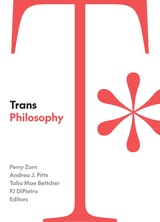
Trans Philosophy
Perry Zurn
University of Minnesota Press, 2024
Establishing trans philosophy as a unique field of inquiry, offering tools for our quest toward a more just and equitable world
Trans Philosophy defines this burgeoning and polymorphous discipline as philosophical work that is accountable to and illuminative of cross-cultural and global trans experiences, histories, and cultural productions. Across language and politics, feminism and phenomenology, and decolonial theory, it addresses trans worldmaking in all its beauty and mundanity.
Critically, the editors center the contributions of trans and gender-nonconforming philosophers from around the globe. Showcasing work from a range of emerging and established voices, Trans Philosophy addresses discrimination, embodiment, identity, language, and law, utilizing diverse philosophical methods to attend to significant intersections between trans experience and class, disability, race, nationality, and sexuality.
At a time when trans-exclusionary views are gaining traction in politics as well as philosophy, this volume urgently redraws the contours of trans discourse, centering the wisdom already generated in trans and other gender-disruptive communities.
Contributors: Megan Burke, Sonoma State U; Robin Dembroff, Yale U; Marie Draz, San Diego State U; Che Gossett, U of Pennsylvania; Ryan Gustafsson, U of Melbourne; Stephanie Kapusta, Dalhousie U; Tamsin Kimoto, Washington U, St. Louis; Hil Malatino, Pennsylvania State U and Rock Ethics Institute; Amy Marvin, Lafayette U; Marlene Wayar.
Retail e-book files for this title are screen-reader friendly.
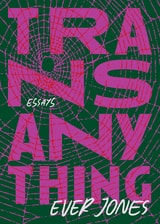
Transanything
EssaysEver Jones
Northwestern University Press, 2025
Transanything reveals a world in metamorphosis. A hermit crab retires its shell, lovers drift apart, and seasons churn, all amid Ever Jones’s own narrative of midlife gender transition.
Jones takes up a tradition of writing—about the American landscape, solitude, wilderness, and the West—long intertwined with colonialism and heteropatriarchy, and makes it wholly their own. A self-proclaimed “nature essay” misbehaves, wandering away from the hummingbird outside Jones’s window. In their chronicle of a week in Yellowstone, Jones navigates trails frequented by grizzlies and a campground where their identity is regarded as equally dangerous. Elk, bison, and bark spiders roam this book’s pages, but it is the gray wolf—the embattled apex predator of the American West, narrow survivor of settler colonial violence, and vessel for American myths of independence—who emerges as Jones’s shapeshifting coprotagonist.
Taking on a global web of colonial systems that seek to divide us, Jones disrupts loneliness and forges space for queerness and transness to be aliveness—to be transanything.
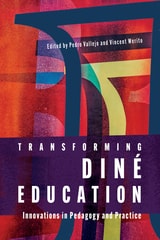
Transforming Diné Education
Innovations in Pedagogy and PracticeEdited by Pedro Vallejo and Vincent Werito
University of Arizona Press, 2022
Bringing together decades of teaching experience, contributors offer perspectives from school- and community-based programs, as well as the tribal, district, and university level. They address special education, language revitalization, wellness, self-determination and sovereignty, and university-tribal-community partnerships. These contributions foreground Diné ways of knowing both as an educational philosophy and as an active practice applied in the innovative programs the book highlights. The contributors deepen our understanding of the state of Navajo education by sharing their perspectives about effective teaching practices and the development of programs that advance educational opportunities for Navajo youth.
This work provides stories of Diné resilience, resistance, and survival. It articulates a Diné-centered pedagogy that will benefit educators and learners for generations to come. Transforming Diné Education fills a need in the larger literature of curricular and programmatic development and provides tools for academic success for all American Indian students.
Contributors
Berlinda Begay
Lorenda Belone
Michael “Mikki” Carroll
Quintina “Tina” Deschenie
Henry Fowler
Richard Fulton
Davis E. Henderson
Kelsey Dayle John
Lyla June Johnston
Tracia Keri Jojola
Tiffany S. Lee
Shawn Secatero
Michael Thompson
Pedro “Pete” Vallejo
Christine B. Vining
Vincent Werito
Duane “Chili” Yazzie
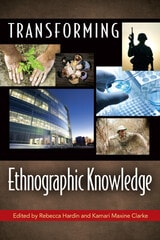
Transforming Ethnographic Knowledge
Edited by Rebecca Hardin and Kamari Maxine Clarke
University of Wisconsin Press, 2012
The ethnographic methods that anthropologists first developed to study other cultures—fieldwork, participant observation, dialogue—are now being adapted for a broad array of applications, such as business, conflict resolution and demobilization, wildlife conservation, education, and biomedicine. In Transforming Ethnographic Knowledge, anthropologists trace the changes they have seen in ethnography as a method and as an intellectual approach, and they offer examples of ethnography’s role in social change and its capacity to transform its practitioners.
Senior scholars Mary Catherine Bateson, Sidney Mintz, and J. Lorand Matory look back at how thinking ethnographically shaped both their work and their lives, and George Marcus suggests that the methods for teaching and training anthropologists need rethinking and updating. The second part of the volume features anthropologists working in sectors where ethnography is finding or claiming new relevance: Kamari Maxine Clarke looks at ethnographers’ involvement (or non-involvement) in military conflict, Csilla Kalocsai employs ethnographic tools to understand the dynamics of corporate management, Rebecca Hardin and Melissa Remis take their own anthropological training into rainforests where wildlife conservation and research meet changing subsistence practices and gendered politics of social difference, and Marcia Inhorn shows how the interests in mobility and diasporic connection that characterize a new generation of ethnographic work also apply to medical technologies, as those mediate fertility and relate to social status in the Middle East.
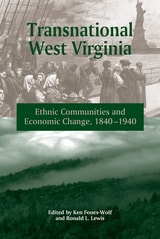
Transnational West Virginia
Ethnic Communities and Economic Change, 1840 - 1940KEN FONES-WOLF
West Virginia University Press, 2002
West Virginia is one of the most homogeneous states in the nation, with among the lowest ratios of foreign-born and minority populations among the states. But as this collection of historical studies demonstrates, this state was built by successive waves of immigrant labors, from the antebellum railroad builders to the twentieth-century coal miners. Transnational West Virginia offers a new understanding of how laborers and their communities shape a region's history. Transnational West Virginia includes essays and studies on immigrant networks, such as Irish workers along the B&O Railroad, Wheeling Germans in the Civil War era, Swiss immigration to West Virginia, and European Jews in Southern West Virginia. This work also covers Belgian glassworkers in West Virginia, black migration to Southern West Virginia, Italians in the Upper Kanawha Valley, Italian immigration to Marion County, Wheeling Iron and the Welsh, West Virginia and immigrant labor to 1920, Monongalia miners between the World Wars, and West Virginia rubber workers in Akron. Transnational West Virginia is the first volume in the West Virginia and Appalachia series, which is under the general editorship of West Virginia University Stuart and Joyce Robbins Chair of History Ronald L. Lewis. Kenneth Fones-Wolf, Associate Professor of History at WVU, also helped edit this collection of essays by ten distinguished scholars.
Transversal Rationality and Intercultural Texts
Essays in Phenomenology and Comparative PhilosophyHwa Yol Jung
Ohio University Press, 2011
Transversality is the keyword that permeates the spirit of these thirteen essays spanning almost half a century, from 1965 to 2009. The essays are exploratory and experimental in nature and are meant to be a transversal linkage between phenomenology and East Asian philosophy.
Transversality is the concept that dispels all ethnocentrisms, including Eurocentrism. In the globalizing world of multiculturalism, Eurocentric universalism falls far short of being universal but simply parochial at the expense of the non-Western world. Transversality is intercultural, interspecific, interdisciplinary, and intersensorial. Transversal Rationality and Intercultural Texts means to transform the very way of philosophizing itself by infusing or hybridizing multiple traditions in the history of the world.
Like no other scholar, Jung bridges the gap between Asian and Western cultures. By engaging Western philosophers as diverse as Bacon, Descartes, Heidegger, Hegel, Merleau-Ponty, Derrida, Glissant, Barthes, Fenollosa, McLuhan, and Eastern philosophers such as Wang Yang-ming, Nishida Kitaro, Nishitani Keiji, Watsuji Tetsuro, Nhat Hanh, and Suzuki Daisetz Teitaro, this book marks an unparalleled contribution to comparative philosophy and the study of philosophy itself.

Traslados/Translations
Essays on Latin America in Honour of Jason WilsonEdited by Claire Lindsay
University of London Press, 2012

Travelers, Immigrants, Inmates
Essays in EstrangementFrances Bartkowski
University of Minnesota Press, 1995
Travelers, Immigrants, Inmates was first published in 1995. Minnesota Archive Editions uses digital technology to make long-unavailable books once again accessible, and are published unaltered from the original University of Minnesota Press editions.
Identities are always mistaken; yet they are as necessary as air to sustain life in and among communities. Frances Bartkowski uses travel writings, U.S. immigrant autobiographies, and concentration camp memoirs to illustrate how tales of dislocation present readers with a picture of the complex issues surrounding mistaken identities. In turn, we learn much about the intimate relation between language and power.
Combining psychoanalytic and political modes of analysis, Bartkowski explores the intertwining of place and the construction of identities. The numerous writings she considers include André Gide's Voyage to the Congo, Eva Hoffman's Lost in Translation, Sandra Cisneros's House on Mango Street, Zora Neale Hurston's Dust Tracks on a Road and Tell My Horse, and Primo Levi's Survival in Auschwitz.
Elegantly written and incisive, Travelers, Immigrants, Inmates stands at the crossroads of contemporary discussions about ethnicity, race, gender, nationalism, and the politics and poetics of identity. It has much to offer readers interested in questions of identity and cultural differences.
Frances Bartkowski is associate professor of English and director of women's studies at Rutgers University in Newark. She is the author of Feminist Utopias (1989).
Traveling Freely
EssaysRoberto Carlos Garcia
Northwestern University Press, 2025
A poet’s debut essay collection exploring American faults through the eyes of a Dominican American
In Traveling Freely: Essays, Roberto Carlos Garcia explores intersecting topics such as race, identity, American socioeconomic inequality, police violence, our inability to partake in our culture as innocents, and our complicity as Americans in all that’s wrong with the United States from the author’s specific vantage point as a Black Dominican American man. The voice in these essays is both clear and nuanced, and as readers move through the collection, the various themes cohere into a multilayered investigation of institutional racism and the inherent exploitations of capitalism.
In essays that are uniquely straightforward and accessible, Garcia insists that in order to resist state-sanctioned violence against marginalized bodies and populations, we must understand our shared history of oppression—so that we can rise against it effectively and find new paths forward.
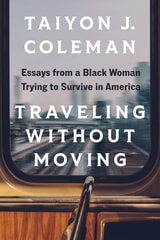
Traveling without Moving
Essays from a Black Woman Trying to Survive in AmericaTaiyon J. Coleman
University of Minnesota Press, 2024
A stunning lyrical commentary on the constructions of race, gender, and class in the fraught nexus of a Black woman’s personal experience and cultural history
The Fair Housing Act passed in 1968, and more than fifty years later, yours seems to be the only Black family on your block in Minneapolis. You and your Black African husband, both college graduates, make less money than some White people with a felony record and no high school diploma. You’re the only Black student in your graduate program. You just aren’t working hard enough. You’re too sensitive. Sandra Bland? George Floyd? Don't take everything so personally. Amid the White smiles of Minnesota Nice and the Minnesota Paradox—the insidious racism of an ostensibly inclusive place to live—what do you do? If you’re Taiyon J. Coleman, you write.
In Traveling without Moving, Coleman shares intimate essays from her life: her childhood in Chicago—growing up in poverty with four siblings and a single mother—and the empowering decision to leave her first marriage. She writes about being the only Black student in a prestigious and predominantly White creative writing program, about institutional racism and implicit bias in writing instruction, about the violent legacies of racism in the U.S. housing market, about the maternal health disparities seen across the country and their implication in her own miscarriage. She explores what it means to write her story and that of her family—an act at once a responsibility and a privilege—bringing forth the inherent contradictions between American ideals and Black reality.
Using a powerful blend of perspectives that move between a first-person lens of lived experience and a wider-ranging critique of U.S. culture, policy, and academia, Coleman’s writing evinces how a Black woman in America is always on the run, always Harriet Tubman, traveling with her babies in tow, seeking safety, desperate to survive, thrive, and finally find freedom.
Retail e-book files for this title are screen-reader friendly.
Travels in a Tree House
Essays on Life and Other JoysJohn Workman
University of Arkansas Press, 2001
Tree Lines
Valerie P Cohen
University of Nevada Press, 2017
The drawings are black-and-white, pen-and-ink representations of high alpine ecosystems. The prose is stripped bare, abbreviated in an epigrammatic style that is poetic and spontaneous. Trees represented here are the Western Juniper or Sierra Juniper, the Limber, and the Bristlecone Pine—three species of long-lived, slow-growing conifers that grow across the Great Basin. While they represent only a small portion of the vegetative culture high in the western mountains, the Cohens use representation as abstraction as is utilized by writers and artists to convey a unique kind of microcosm of our natural environment. This book compares to such classics as Leopold’s A Sand County Almanac, and Berger’s Ways of Seeing, which open up lines of observation, analysis, and art for a new generation of readers.
Treehab
Tales from My Natural, Wild LifeBob Smith
University of Wisconsin Press, 2016
In Treehab—named after a retreat cabin in rural Ontario—Smith muses how he has “always sought the path less traveled.” He rebuffs his diagnosis of ALS as only an unflappable stand-up comic could (“Lou Gehrig’s Disease? But I don’t even like baseball!”) and explores his complex, fulfilling experience of fatherhood, both before and after the onset of the disease.
Stories of his writing and performing life—punctuated by hilariously cutting jokes that comedians tell only to each other—are interspersed with tales of Smith’s enduring relationship with nature: boyhood sojourns in the woods of upstate New York and adult explorations of the remote Alaskan wilderness; snakes and turtles, rocks and minerals; open sky and forest canopy; God and friendship—all recurring touchstones that inspire him to fight for his survival and for the future of his two children.
Aiming his potent, unflinching wit at global warming, equal rights, sex, dogs, Thoreau, and more, Smith demonstrates here the inimitable insight that has made him a beloved voice of a generation. He reminds us that life is perplexing, beautiful, strange, and entirely worth celebrating.
Tribal Water Rights
Essays in Contemporary Law, Policy, and EconomicsEdited by John E. Thorson, Sarah Britton, and Bonnie G. Colby
University of Arizona Press, 2006
Tributes to Iowa Teachers
William L. Sherman
University of Iowa Press, 1996
Trillin on Texas
By Calvin Trillin
University of Texas Press, 2011
A remarkably perceptive portrait of the Lone Star State, this collection of pieces from the New Yorker, the Nation, and other publications presents highlights of bestselling author Calvin Trillin’s classic writing on Texas subjects.
"Yes, I do have a Texas connection, but, as we say in the Midwest, where I grew up, not so's you'd know it." So Calvin Trillin introduces this collection of articles and poems about a place that turns up surprisingly often when he's ostensibly writing about something else. Whether reporting on the American scene for the New Yorker, penning comic verse and political commentary for the Nation, or writing his memoirs, Trillin has bumped into Texas again and again. He insists that "this has not been by design . . . there has simply been a lot going on in Texas." Astute readers will note, however, that Trillin's family immigrated to the United States through the port of Galveston, and, after reading this book, many will believe that the Lone Star State has somehow imprinted itself in the family's imagination.
Trillin on Texas gathers some of Trillin's best writing on subjects near to his heart—politics, true crime, food, and rare books, among them—which also have a Texas connection. Indulging his penchant for making "snide and underhanded jokes about respectable public officials," he offers his signature sardonic take on the Bush dynasty and their tendency toward fractured syntax; a faux, but quite believable, LBJ speech; and wry portraits of assorted Texas county judges, small town sheriffs, and Houston immigration lawyers. Trillin takes us on a mouthwatering pilgrimage to the barbecue joint that Texas Monthly proclaimed the best in Texas and describes scouting for books with Larry McMurtry—who rejects all of his "sleepers." He tells the stories of two teenagers who dug up half a million dollars in an ice chest on a South Texas ranch and of rare book dealer Johnny Jenkins, who was found floating in the Colorado River with a bullet wound in the back of his head. And he recounts how redneck movie reviewer "Joe Bob Briggs" fueled a war between Dallas's daily newspapers and pays tribute to two courageous Texas women who spoke truth to power—Molly Ivins and Sissy Farenthold.
Sure to entertain Texans and other folks alike, Trillin on Texas proves once again that Calvin Trillin is one of America's shrewdest observers and wittiest writers.
Troubled Bodies
Critical Perspectives on Postmodernism, Medical Ethics, and the BodyPaul A. Komesaroff
Duke University Press, 1995
These essays examine the ways in which the consideration of ethical questions is shaped by the structures of knowledge and communication at work in clinical practice, by current assumptions regarding the concept of the body, and by the social and political implications of both. Representing various perspectives including medicine, nursing, philosophy, and sociology, these essays look anew at issues of abortion, reproductive technologies, the doctor-patient relationship, the social construction of illness, the cultural assumptions and consequences of medicine, and the theoretical presuppositions underlying modern psychiatry. Diverging from the tenets of mainstream bioethics, Troubled Bodies suggests that, rather than searching for the correct "coherent perspective" from which to draw ethical principles, we must apprehend the complexity and diversity of the discursive systems within which we dwell.
Truck
On Rebuilding a Worn-Out Pickup and Other Post-Technological AdventuresJohn Jerome
University Press of New England, 1996
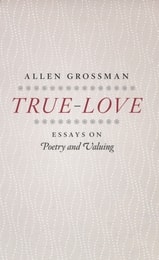
True-Love
Essays on Poetry and ValuingAllen Grossman
University of Chicago Press, 2009
True-Love is the fulfillment of revered poet-critic Allen Grossman’s long service to poetry in the interests of humanity. Poetry’s singular mission is to bind love and truth together—love that desires the beloved’s continued life, knotted with the truth of life’s contingency—to help make us more present to each other.
In the spirit of Blake’s vow of “mental fight,” Grossman contends with challenges to the validity of the poetic imagination, from Adorno’s maxim “No poetry after Auschwitz,” to the claims of religious authority upon truth, and the ultimate challenge posed by the fact of death itself. To these challenges he responds with eloquent and rigorous arguments, drawing on wide resources of learning and his experience as master-poet and teacher. Grossman’s readings of Wordsworth, Hart Crane, Paul Celan, and others focus on poems that interrogate the real or enact the hard bargains that literary representation demands. True-Love is destined to become an essential book wherever poetry and criticism sustain one another.
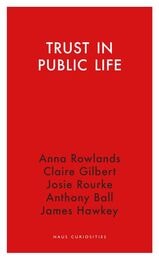
Trust in Public Life
James Hawkey, Anthony Ball, Anna Rowlands, and Josie Rourke
Haus Publishing, 2023
Trust in Public Life is a collection of essays addressing the importance of trust in public life and how public servants can engender and sustain it. In “The Roots of Trust,” Anna Rowlands argues that our loss of trust is a feature of modernity that can only be solved through encounters with real people. In “Trust in Oneself,” Claire Gilbert makes the case that leaders need to have self-trust and confidence to rule. In “Trust in Institutions,” Anthony Ball offers a guide to rebuilding trust in institutions through four virtues: honesty, humility, compassion, and competence. Finally, in “Trust in People,” James Hawkey argues that trust between groups is a choice, not something that can be injected like a vaccine. Together, the essays offer valuable reflections on trust in public life, agreeing that it must be engendered, and offer guidance on how this might be achieved.

Truth Matters
Essays in Honor of Jacques Maritain (American Maritain Association Publications)John G. Trapani Jr.
Catholic University of America Press, 2004

Truth and Lies in Literature
Essays and ReviewsStephen Vizinczey
University of Chicago Press, 1988
"If a critic's job is to puncture pomposity, deflate over-hyped reputations and ferret out true value, then Vizinczey is master of the art."—Publishers Weekly
"Stephen Vizinczey comes on like a pistol-packing stranger here to root out corruption and remind us of our ideals. He carries the role off with inspired gusto. His boldness and pugnacity are bracing and can be very funny."—Ray Sawhill, Newsweek
"Every piece in the book is good, and many are so good that, after dipping into the middle, I stayed up half of the night, reading with growing amazement and admiration."—Bruce Bebb, Los Angeles Reader
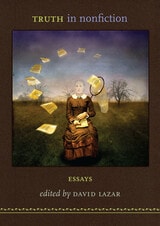
Truth in Nonfiction
EssaysDavid Lazar
University of Iowa Press, 2008
The past and the truth are slippery things, and the art of nonfiction writing requires the writer to shape as well as explore. In personal essays, meditations on the nature of memory, considerations of the genres of memoir, prose poetry, essay, fiction, and film, the contributors to this provocative collection attempt to find answers to the question of what truth in nonfiction means.
Contributors: John D’Agata, Mark Doty, Su Friedrich, Joanna Frueh, Ray González, Vivian Gornick, Barbara Hammer, Kathryn Harrison, Marianne Hirsch, Wayne Koestenbaum, Leonard Kriegel, David Lazar, Alphonso Lingis, Paul Lisicky, Nancy Mairs, Nancy K. Miller, Judith Ortiz Cofer, Phyllis Rose, Oliver Sacks, David Shields, and Leo Spitzer
Truth in Public Life
Vernon White, Stephen Lamport, and Claire Foster-Gilbert
Haus Publishing, 2020
Turn Out the Lights
Chronicles of Texas during the 80s and 90sBy Gary Cartwright
University of Texas Press, 2000
Whether the subject is Jack Ruby, Willie Nelson, or his own leukemia-stricken son Mark, when it comes to looking at the world through another person's eyes, nobody does it better than Gary Cartwright. For over twenty-five years, readers of Texas Monthly have relied on Cartwright to tell the stories behind the headlines with pull-no-punches honesty and wry humor. His reporting has told us not just what's happened over three decades in Texas, but, more importantly, what we've become as a result.
This book collects seventeen of Cartwright's best Texas Monthly articles from the 1980s and 1990s, along with a new essay, "My Most Unforgettable Year," about the lasting legacy of the Kennedy assassination. He ranges widely in these pieces, from the reasons for his return to Texas after a New Mexican exile to profiles of Kris Kristofferson and Willie Nelson. Along the way, he strolls through San Antonio's historic King William District; attends a Dallas Cowboys old-timers reunion and the Holyfield vs. Foreman fight; visits the front lines of Texas' new range wars; gets inside the heads of murderers, gamblers, and revolutionaries; and debunks Viagra miracles, psychic surgery, and Kennedy conspiracy theories. In Cartwright's words, these pieces all record "the renewal of my Texas-ness, a rediscovery of Texas after returning home."
Turning Points of the American Civil War
Edited by Chris Mackowski and Kristopher D. White, with a foreword by Thomas A. Desjardin
Southern Illinois University Press, 2017
Twenty Square Feet of Skin
Megan Baxter
The Ohio State University Press, 2023
Twin Cities Sports
Games for All SeasonsSheldon Anderson
University of Arkansas Press, 2020
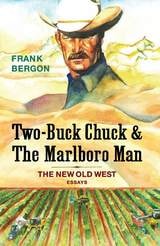
Two-Buck Chuck & The Marlboro Man
The New Old WestFrank Bergon
University of Nevada Press, 2019
Bergon presents a powerful array of rural and small-town Westerners who often see themselves as part of a region and a way of life most Americans aren’t aware of or don’t understand, their voices unheard, their stories untold. In these essays, Westerners from the diverse heritage of the San Joaquin Valley include California’s legendary Fred Franzia, the maker of the world’s best-selling Charles Shaw wines dubbed “Two-Buck Chuck,” and Darrell Winfield, a Dust Bowl migrant and lifelong working cowboy who for more than thirty years reigned as the iconic Marlboro Man. Their voices help us understand the complexities of today’s rural West, where Old West values intersect with New West realities. This is the West (and America today)—a region in conflict with itself.