Results by title
28250 books match the query 'History' and 6388 start with t

The Royal Observatory, Greenwich, 1881–1939
Astronomy, Astronomers and Heritage in a Changing WorldLee T. Macdonald
University College London, 2026
The first detailed history of the Royal Observatory at Greenwich covering the period after the retirement of George Airy, seventh Astronomer Royal, in 1881.
This book charts an under-researched period in the long history of the Royal Observatory at Greenwich. It covers both the scientific and social-political history of the Royal Observatory, focusing on its significance within the history of astronomy and UK history more generally. Using a wealth of archival material—much of which was previously unpublished—Lee T. Macdonald's narrative brings the day-to-day operations of the Observatory to life and reveals how its mission in positional astronomy, combined with its cutting-edge research in photographic mapping and the study of solar eclipses, continues to expand the frontiers of astronomical research.
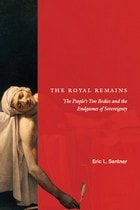
The Royal Remains
The People's Two Bodies and the Endgames of SovereigntyEric L. Santner
University of Chicago Press, 2011
"The king is dead. Long live the king!" In early modern Europe, the king's body was literally sovereign—and the right to rule was immediately transferrable to the next monarch in line upon the king's death. In The Royal Remains, Eric L. Santner argues that the "carnal" dimension of the structures and dynamics of sovereignty hasn't disappeared from politics. Instead, it migrated to a new location—the life of the people—where something royal continues to linger in the way we obsessively track and measure the vicissitudes of our flesh.
Santner demonstrates the ways in which democratic societies have continued many of the rituals and practices associated with kingship in displaced, distorted, and usually, unrecognizable forms. He proposes that those strange mental activities Freud first lumped under the category of the unconscious—which often manifest themselves in peculiar physical ways—are really the uncanny second life of these "royal remains," now animated in the body politic of modern neurotic subjects. Pairing Freud with Kafka, Carl Schmitt with Hugo von Hofmannsthal,and Ernst Kantorowicz with Rainer Maria Rilke, Santner generates brilliant readings of multiple texts and traditions of thought en route to reconsidering the sovereign imaginary. Ultimately, The Royal Remains locates much of modernity—from biopolitical controversies to modernist literary experiments—in this transition from subjecthood to secular citizenship.
This major new work will make a bold and original contribution to discussions of politics, psychoanalysis, and modern art and literature.

The Royal Treasuries of the Spanish Empire in America
Vol. 1: PeruJohn J. Tepaske and Herbert S. Klein, editors
Duke University Press, 1982
The Royal Treasuries of the Spanish Empire in America
Vol. 2: Upper Peru (Bolivia)John J. Tepaske and Herbert S. Klein, editors
Duke University Press, 1982
The Royal Treasuries of the Spanish Empire in America
Vol. 3: Chile and Rio de la PlataJohn J. Tepaske and Herbert S. Klein, editors
Duke University Press, 1982
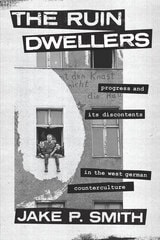
The Ruin Dwellers
Progress and Its Discontents in the West German CountercultureJake P. Smith
University of Chicago Press, 2025
The Ruin Dwellers takes readers into the urban spaces of youth revolts during the 1970s and ’80s in West Germany and elsewhere in western and central Europe. Whereas earlier generations of leftist activists were primarily oriented toward the utopian future, participants in the youth movements of the 1970s and ’80s developed a more complex set of temporal practices that sought to scramble the borders between the past, present, and future.
Examining a rich corpus of radical texts and practices, historian Jake P. Smith shows that squatters and their leftist allies in this period engaged in social, cultural, and aesthetic experiments with modes of autonomous living. Smith brings to life the real and imagined landscapes conjured in squatted houses and street protests; in art, dress, music, graffiti, and film; and in philosophical, poetic, and political texts. In so doing, he offers an eye-opening look at anarchic world-making practices that found new ways of imagining an emancipated future through inhabiting the fractured past.
The Ruin of Souls
A Religious History of Italian Catholic Immigrants in the United States (1853-1921)Massimo Di Gioacchino
Bridwell Press, 2025
Strengthened by largely unknown archival documentation and an original historiographic methodology, the work reveals a new political dimension in the religious history of Italian immigrants in the United States and their relationship with the Catholic religious canon. By integrating the analysis of the ecclesial practices of the Italian communities into a far-reaching epistemological reflection, the work also contributes to the continuing discussion of how we study and examine the religious practices of Catholic communities in the modern era.
The Ruined Anthracite
Historical Trauma in Coal-Mining CommunitiesPaul A. Shackel
University of Illinois Press, 2023
Insightful and dramatic, The Ruined Anthracite combines archaeology, documentary research, and oral history to render the ongoing human cost of environmental devastation and unchecked capitalism.
The Ruins Lesson
Meaning and Material in Western CultureSusan Stewart
University of Chicago Press, 2019
Stewart takes us on a sweeping journey through founding legends of broken covenants and original sin, the Christian appropriation of the classical past, and images of decay in early modern allegory. Stewart looks in depth at the works of Goethe, Piranesi, Blake, and Wordsworth, each of whom found in ruins a means of reinventing his art. Lively and engaging, The Ruins Lesson ultimately asks what can resist ruination—and finds in the self-transforming, ever-fleeting practices of language and thought a clue to what might truly endure.
The Ruins of Allegory
Paradise Lost and the Metamorphosis of Epic ConventionCatherine Gimelli Martin
Duke University Press, 1998
Martin shows how Paradise Lost, written at the threshold of the enormous imaginative shift that accompanied the Protestant, scientific, and political revolutions of the seventeenth century, conforms to a prophetic baroque model of allegory similar to that outlined by Walter Benjamin. As she demonstrates, Milton’s experimentation with baroque forms radically reformulates classical epic, medieval romance, and Spenserian allegory to allow for both a naturalistic, empirically responsible understanding of the universe and for an infinite and incomprehensible God. In this way, the resulting poetic world of Paradise Lost is like Milton’s God, an allegorical “ruin” in which the divine is preserved but at the price of a loss of certainty. Also, as Martin suggests, the poem affirmatively anticipates modernity by placing the chief hope of human progress in the fully self-authored subject.
Maintaining a dialogue with a critical tradition that extends from Johnson and Coleridge to the best contemporary Milton scholarship, Martin sets Paradise Lost in both the early modern and the postmodern worlds. Ruins of Allegory will greatly interest all Milton scholars, as well as students of literary criticism and early modern studies.
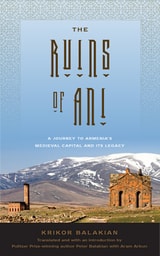
The Ruins of Ani
A Journey to Armenia's Medieval Capital and its LegacyKrikor Balakian
Rutgers University Press, 2019
From the tenth to the thirteenth centuries, the city of Ani was the jewel of the Armenian kingdom, renowned far and wide for its magnificent buildings. Known as the city of 1001 churches, Ani was a center for artistic innovation, and its architecture is a potential missing link between Byzantine and Gothic styles. By the fifteenth century, Ani was virtually abandoned, its stunning buildings left to crumble. Yet its ruins have remained a symbol of cultural accomplishment that looms large in the Armenian imagination.
The Ruins of Ani is a unique combination of history, art criticism, and travel memoir that takes readers on a thousand-year journey in search of past splendors. Today, Ani is a popular tourist site in Turkey, but the city has been falsified in its presentation by the Turkish government in order to erase Armenian history in the wake of the Armenian Genocide. This timely publication also raises questions about the preservation of major historic monuments in the face of post atrocity campaigns of cultural erasure.
Originally written by young priest Krikor Balakian in 1910, just a few years before the Armenian genocide, this book offers a powerful and poignant counterpart to Balakian’s acclaimed genocide memoir Armenian Golgotha. This new translation by the author’s great-nephew, Pulitzer Prize-winning poet Peter Balakian, eloquently renders the book’s vivid descriptions and lyrical prose into English. Including a new introduction that explores Ani’s continued relevance in the twenty-first century, The Ruins of Ani will give readers a new appreciation for this lost city’s status as a pinnacle of both Armenian civilization and human achievement.
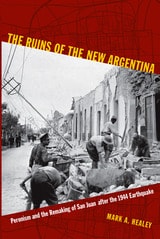
The Ruins of the New Argentina
Peronism and the Remaking of San Juan after the 1944 EarthquakeMark A. Healey
Duke University Press, 2011
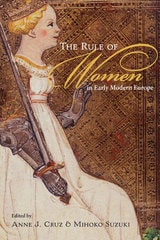
The Rule of Women in Early Modern Europe
Edited by Anne J. Cruz and Mihoko Suzuki
University of Illinois Press, 2008
Drawing on early modern literature and historical documents, this study investigates the various political, discursive, and symbolic measures employed to negotiate and support female sovereignty by both early modern writers and the rulers themselves. The detailed analysis of the women's responses--or inability to respond--to these strictures underscores the relationship between early modern authors and sovereigns and the complex and vexed situation of European women rulers.
Contributors are Tracy Adams, Anne J. Cruz, Éva Deák, Mary C. Ekman, Catherine L. Howey, Elizabeth Ketner, Carole Levin, Sandra Logan, Magdalena S. Sánchez, Mihoko Suzuki, and Barbara F. Weissberger.
The Ruling Passion
British Colonial Allegory and the Paradox of Homosexual DesireChristopher Lane
Duke University Press, 1995
Through attentive readings of sexual and political allegory in the work of Kipling, Forster, James, Beerbohm, Firbank, and others—and deft use of psychoanalytic theory—The Ruling Passion interprets turbulent scenes of masculine identification and pleasure, power and mastery, intimacy and antagonism. By foregrounding the shattering effects of male homosexuality and interracial desire, and by insisting on the centrality of unconscious fantasy and the death drive, The Ruling Passion examines the startling recurrence of colonial failure in narratives of symbolic doubt and ontological crisis. Lane argues compellingly that Britain can progress culturally and politically only when it has relinquished its residual fantasies of global mastery.

The Rumble in the Jungle
Muhammad Ali and George Foreman on the Global StageLewis A. Erenberg
University of Chicago Press, 2019
TheRumble in the Jungle orbits around Ali and Foreman, placing them at the convergence of the American Civil Rights movement and the Great Society, the rise of Islamic and African liberation efforts, and the ongoing quest to cast off the shackles of colonialism. With his far-reaching take on sports, music, marketing, and mass communications, Erenberg shows how one boxing match became nothing less than a turning point in 1970s culture.
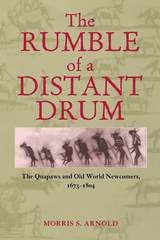
The Rumble of a Distant Drum
The Quapaws and Old World Newcomers, 1673–1804Morris Arnold
University of Arkansas Press, 2007
Winner of the 2001 Booker Worthen Literary Prize
Winner of the 2002 S. G. Ragsdale Award for Arkansas History
The Rumble of a Distant Drum opens in 1673 when Marquette and Jolliet sailed down the Mississippi River and found the Quapaw living in the area where the Arkansas River flowed into the Mississippi. In 1686 Henri de Tonti would found Arkansas Post in this same location. It was the first European settlement in this part of the country, established thirty years before New Orleans and eighty before St. Louis.
Morris S. Arnold draws on his many years of archival research and writing on colonial Arkansas to produce this elegant account of the cultural intersections of the French and Spanish with the native American peoples. He demonstrates that the Quapaws and Frenchmen created a highly symbiotic society in which the two disparate peoples became connected in complex and subtle ways—through intermarriage, trade, religious practice, and political/military alliances.
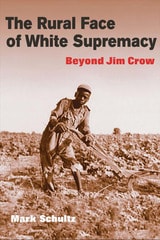
The Rural Face of White Supremacy
BEYOND JIM CROWMark Schultz
University of Illinois Press, 2007
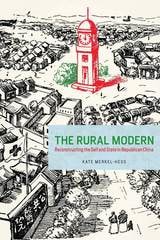
The Rural Modern
Reconstructing the Self and State in Republican ChinaKate Merkel-Hess
University of Chicago Press, 2016
In The Rural Modern, Merkel-Hess shows that Chinese reformers and intellectuals created an idea of modernity that was not simply about what was foreign and new, as in Shanghai and other cities, but instead captured the Chinese people’s desire for social and political change rooted in rural traditions and institutions. She traces efforts to remake village education, economics, and politics, analyzing how these efforts contributed to a new, inclusive vision of rural Chinese life. Merkel-Hess argues that as China sought to redefine itself, such rural reform efforts played a major role, and tensions that emerged between rural and urban ways deeply informed social relations, government policies, and subsequent efforts to create a modern nation during the communist period.
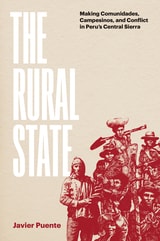
The Rural State
Making Comunidades, Campesinos, and Conflict in Peru's Central SierraJavier Puente
University of Texas Press, 2022
2023 Marysa Navarro Best Book Prize, New England Council of Latin American Studies (NECLAS)
A study of the intersection of rural populations, state formation, and the origins of political conflict in Peru.
On the eve of the twentieth century, Peru seemed like a profitable and yet fairly unexploited country. Both foreign capitalists and local state makers envisioned how remote highland areas were essential to a sustainable national economy. Mobilizing Andean populations lay at the core of this endeavor. In his groundbreaking book, The Rural State, Javier Puente uncovers the surprising and overlooked ways that Peru’s rural communities formed the political nation-state that still exists today.
Puente documents how people living in the Peruvian central sierra in the twentieth century confronted emerging and consolidating powers of state and capital and engaged in an ongoing struggle over increasingly elusive subsistence and autonomies. Over the years, policy, politics, and social turmoil shaped the rural, mountainous regions of Peru until violent unrest, perpetrated by the Shining Path and other revolutionary groups, unveiled the extent, limits, and fractures of a century-long process of rural state formation. Examining the conflicts between one rural community and the many iterations of statehood in the central sierra of Peru, The Rural State offers a fresh perspective on how the Andes became la sierra, how pueblos became comunidades, and how indígenas became campesinos.
The Ruse of Repair
US Neoliberal Empire and the Turn from CritiquePatricia Stuelke
Duke University Press, 2021
The Russia Reader
History, Culture, PoliticsAdele Barker and Bruce Grant, eds.
Duke University Press, 2010
Illustrated with maps, paintings, photographs, posters, and cartoons, The Russia Reader incorporates song lyrics, jokes, anecdotes, and folktales, as well as poems, essays, and fiction by writers including Akhmatova, Dostoyevsky, Pushkin, and Tolstoi. Transcripts from the show trials of major Party figures and an account of how staff at the Lenin Library in Moscow were instructed to interact with foreigners are among the many selections based on personal memoirs and archival materials only recently made available to the public. From a tenth-century emissary’s description of his encounters in Kyivan Rus’, to a scientist’s recollections of her life in a new research city built from scratch in Siberia during the 1950s, to a novelist’s depiction of the decadence of the “New Russians” in the 2000s, The Russia Reader is an extraordinary introduction to a vast and varied country.
The Russia That We Have Lost
Pavel Khazanov
University of Wisconsin Press, 2023
Khazanov’s careful untangling of this discourse in the late Soviet period reveals a process that involved figures of all political stripes, from staunch conservatives to avowed intelligentsia liberals. Further, Khazanov shows that this process occurred not outside of or in opposition to Soviet guidance and censorship, but in mainstream Soviet culture that commanded wide audiences, especially among the Soviet middle class. Excavating the cultural logic of this newly foundational, mythic memory of a “lost Russia,” Khazanov reveals why, despite the apparently liberal achievement of the collapse of the Soviet Union in 1991, Boris Yeltsin (and later, Vladamir Putin) successfully steered Russia into oligarchy and increasing autocracy. The anti-Soviet memory of the pre-Soviet past, ironically constructed during the late socialist period, became and remains a politically salient narrative, a point of consensus that surprisingly attracts both contemporary regime loyalists and their would-be liberal opposition.

The Russian Archipelago at War Against Ukraine
Culture and Contexts 2022–2025Tomáš Glanc
Karolinum Press, 2026
The first sustained cultural analysis of Russia at war that reveals how art, artists, and institutions become actors in conflict.
This book was conceived in wartime, and war stands at its center. It proceeds through an analysis of cultural phenomena and processes that, in one way or another, originated in Russia and bear on the present situation—regardless of where their actors may now reside.
Through a series of case studies, The Russian Archipelago at War Against Ukraine traces how war has entered the realm of art—literature, the visual arts, theater, film, and beyond—and examines the ways in which culture itself becomes a participant in war. What emerges are narratives of resistance and protest, of persecution and prohibition, and emergent forms of underground, but also postures of indifference, resignation, and compliance, including overt loyalty to and support for the ideology and practice of war, its perpetrators, and its objectives.
Underlying this content is a more unsettling question: what aesthetic, cultural-political, moral, and intellectual challenges, consequences, and perhaps even fragile hopes does the horror of war contain?
The Russian Memoir
History and LiteratureBeth Holmgren
Northwestern University Press, 2007
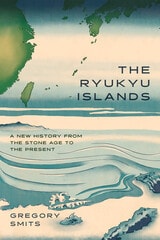
The Ryukyu Islands
A New History from the Stone Age to the PresentGregory Smits
University of Chicago Press, 2025
The Ryukyu Islands between Japan and Taiwan consist of around 160 islands and are home to about 1.5 million inhabitants. Across the islands’ history, sea-lanes and trade patterns have connected them to the East China Sea region, giving them a unique vantage point on the region’s changes and making them a useful lens through which to view and understand those transformations. In this book, Gregory Smits marshals his expertise to canvass the environmental, political, and social history of this fascinating area, emphasizing the diversity of influences from China, Japan, and Korea that have shaped it. Smits begins by tracing the islands’ early history from the time of the oldest extant human remains, through massive inflows of settlers from Japan, until the emergence of a centralized state in the sixteenth century. He then traces the development of the Ryukyu Kingdom from the fifteenth to the nineteenth century, examining its major cultural formations and the interplay of local and external influences driving its evolution. Finally, Smits ushers readers to the modern era, from the end of the Ryukyu Kingdom in 1879 through World War II, the era of American military control, and on to the present. He concludes with their present-day status as a tourist destination affected by ongoing geopolitical, economic, and environmental challenges. Synthesizing decades of research, this book is an indispensable, comprehensive guide to the islands’ history for scholars and nonspecialists alike.
The SBL Handbook of Style
SBL Press, 2014
The definitive source for how to write and publish in the field of biblical studies
The long-awaited second edition of the essential style manual for writing and publishing in biblical studies and related fields includes key style changes, updated and expanded abbreviation and spelling-sample lists, a list of archaeological site names, material on qur’anic sources, detailed information on citing electronic sources, and expanded guidelines for the transliteration and transcription of seventeen ancient languages.
Features:
- Expanded lists of abbreviations for use in ancient Near Eastern, biblical, and early Christian studies
- Information for transliterating seventeen ancient languages
- Exhaustive examples for citing print and electronic sources

The SPHAS
The Life and Times of Basketball's Greatest Jewish TeamAuthored by Doug Stark
Temple University Press, 2011
Founded in 1918, the South Philadelphia Hebrew Association's basketball team, known as the SPHAS, was a top squad in the American Basketball League-capturing seven championships in thirteen seasons-until it disbanded in 1959. In The SPHAS, the first book to chronicle the history of this team and its numerous achievements, Douglas Stark uses rare and noteworthy images of players and memorabilia as well as interviews and anecdotes to recall how players like Inky Lautman, Cy Kaselman, and Shikey Gotthoffer fought racial stereotypes of weakness and inferiority while spreading the game's popularity. Team owner Eddie Gottlieb and Temple University coach Harry Litwack, among others profiled here, began their remarkable careers with the SPHAS.
Stark explores the significance of basketball to the Jewish community during the game's early years, when Jewish players dominated the sport and a distinct American Jewish identity was on the rise. At a time when basketball teams were split along ethnic lines, the SPHAS represented the Philadelphia Jewish community. The SPHAS is an inspiring and heartfelt tale of the team on and off the court.
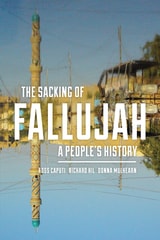
The Sacking of Fallujah
A People's HistoryRoss Caputi
University of Massachusetts Press, 2019
The Iraqi city of Fallujah has become an epicenter of geopolitical conflict, where foreign powers and non-state actors have repeatedly waged war in residential neighborhoods with staggering humanitarian consequences. The Sacking of Fallujah is the first comprehensive study of the three recent sieges of this city, including those by the United States in 2004 and the Iraqi-led operation to defeat ISIS in 2016.
Unlike dominant military accounts that focus on American soldiers and U.S. leaders and perpetuate the myth that the United States “liberated” the city, this book argues that Fallujah was destroyed by coalition forces, leaving public health crises, political destabilization, and mass civilian casualties in their wake. This meticulously researched account cuts through the propaganda to uncover the lived experiences of Fallujans under siege and occupation, and contextualizes these events within a broader history of U.S. policy in the Middle East. Relying on testimony from Iraqi civilians, the work of independent journalists, and documentation from human rights organizations, Ross Caputi, Richard Hil, and Donna Mulhearn place the experiences of Fallujah's residents at the center of this city's recent history.
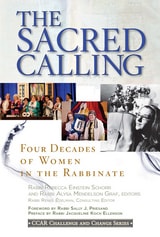
The Sacred Calling
Four Decades of Women in the RabbinateRabbi Rebecca Einstein Schorr and Rabbi Alysa Mendelson Graf
Central Conference of American Rabbis, 2016
Winner of the 2016 National Jewish Book Award in Women's Studies, this pioneering anthology paints an illuminating and necessary picture of the past while laying the groundwork for important work yet to be done.
Women have been rabbis for over forty years. No longer are women rabbis a unique phenomenon, rather they are part of the fabric of Jewish life. In this anthology, rabbis and scholars from across the Jewish world reflect back on the historic significance of women in the rabbinate and explore issues related to both the professional and personal lives of female rabbis. This collection examines the ways in which the reality of women in the rabbinate has impacted all aspects of Jewish life, including congregational culture, liturgical development, life cycle ritual, the Jewish healing movement, spirituality, theology, and more.
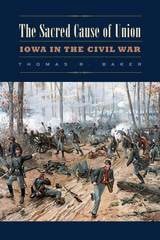
The Sacred Cause of Union
Iowa in the Civil WarThomas R. Baker
University of Iowa Press, 2016
To shed light on how individual Iowans experienced the war, the book profiles six state residents. Three were well-known. Annie Wittenmyer, a divorced woman with roots in Virginia, led the state’s efforts to ship clothing and food to the soldiers. Alexander Clark, a Muscatine businessman and the son of former slaves, eloquently championed the rights of African Americans. Cyrus Carpenter, a Pennsylvania-born land surveyor anxious to make his fortune, served in the army and then headed the state’s Radical Republican faction after the war, ultimately being elected governor.
Three never became famous. Ben Stevens, a young, unemployed carpenter, fought in an Iowa regiment at Shiloh, and then transferred to a Louisiana African American regiment so that he could lead the former slaves into battle. Farm boy Abner Dunham defended the Sunken Road at the Battle of Shiloh, before spending seven grim months in Confederate prison camps. The young Charles Musser faced pressure from his neighbors to enlist and from his parents to remain at home to work on the farm. Soon after he signed on to serve the Union, he discovered that his older brother had joined the Confederate Army. Through the letters and lives of these six Iowans, Thomas Baker shows how the Civil War transformed the state at the same time that Iowans transformed the nation.
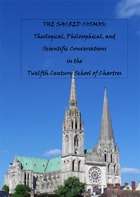
The Sacred Cosmos
Theological, Philosophical, and Scientific Conversations in the Twelfth Century School of ChartresPeter Ellard
University of Scranton Press, 2007
The School of Chartres was a bold intellectual movement of the twelfth century that introduced the World Soul and the Chartrian cosmology to Christendom. In his controversial book, The Sacred Cosmos, theologian Peter Ellard analyzes the most radical aspects of Chartrian thought and traces their relation to classical and late-antique philosophers such as Boethius and Plato. In addition, Ellard investigates the Cathedral of Chartres as an important proof and example of Chartrian theology in this essential volume for anyone interested in the intersection of spirituality and philosophy.
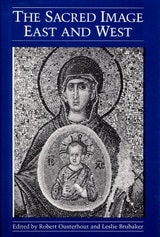
The Sacred Image East and West
Edited by Robert Ousterhout and Leslie Brubaker
University of Illinois Press, 1995
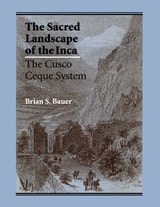
The Sacred Landscape of the Inca
The Cusco Ceque SystemBy Brian S. Bauer
University of Texas Press, 1998
The ceque system of Cusco, the ancient capital of the Inca empire, was perhaps the most complex indigenous ritual system in the pre-Columbian Americas. From a center known as the Coricancha (Golden Enclosure) or the Temple of the Sun, a system of 328 huacas (shrines) arranged along 42 ceques (lines) radiated out toward the mountains surrounding the city. This elaborate network, maintained by ayllus (kin groups) that made offerings to the shrines in their area, organized the city both temporally and spiritually.
From 1990 to 1995, Brian Bauer directed a major project to document the ceque system of Cusco. In this book, he synthesizes extensive archaeological survey work with archival research into the Inca social groups of the Cusco region, their land holdings, and the positions of the shrines to offer a comprehensive, empirical description of the ceque system. Moving well beyond previous interpretations, Bauer constructs a convincing model of the system's physical form and its relation to the social, political, and territorial organization of Cusco.
The Sacred Meadows
A Structural Analysis of Religious Symbolism in an East African TownAbdul Hamid M. el Zein
Northwestern University Press, 1974

The Sacred Remains
Myth, History, and Polity in BelauRichard J. Parmentier
University of Chicago Press, 1987
Richard J. Parmentier employs semiotic methods to analyze both linguistic and nonlinguistic signs representing Belauan history, showing that these signs also organize social and political structures. He identifies four pervasive semiotic patterns that appear rhetorically in myths, chants, and historical narratives and graphically in the arrangement of certain classes of stones, including village boundary markers, burial platforms, exchange valuables, and monoliths found at abandoned sites in the islands.
While not neglecting historical evidence from Western sources, Parmentier contends that the history of Belau cannot be understood without taking into full account indigenous categories of space, time, and transformation and without recognizing the importance of Belauan social actions that construct, interpret, and transmit historical knowledge. Supporting his analysis of Belauan history with concrete ethnographic demonstration, Parmentier presents a work of central importance for Austronesianists, anthropologists, and historians.
The Sacrifice of Socrates
Athens, Plato, GirardWm. Blake Tyrrell
Michigan State University Press, 2012
When Athenians suffered the shame of having lost a war from their own greed and foolishness, around 404 BCE the public’s blame was directed at Socrates, a man whose unique appearance and behavior, as well as his disapproval of the democracy, made him a ready target. Socrates was subsequently put on trial and sentenced to death. However, as René Girard has pointed out, no individual can be held responsible for a communal crisis. Plato’s Apology depicts Socrates as both the bane and the cure of Greek society, while his Crito shows a sacrificial Socrates, what some might consider a pharmakos figure, the human drug through whom Plato can dispense his philosophical remedies. With tremendous insight and satisfying complexity, this book analyzes classical texts through the lens of Girard’s mimetic mechanism.
The Safford Valley Grids
Prehistoric Cultivation in the Southern Arizona DesertWilliam E. Doolittle
University of Arizona Press, 2004
Between A.D. 750 and 1385, people gathered rocks from the tops of the terraces and rearranged them in grids of varying size and shape, averaging about 4 meters to 5 meters square. The grids captured rainfall and water accumulated under the rocks forming the grids. Agave was planted among the rocks, providing a dietary supplement to the maize and beans that were irrigated on the nearby bottom land, a survival crop when the staple crops failed, and possibly a trade commodity when yields were high. Stunning photographs by Adriel Heisey convey the vastness of the grids across the landscape.
The Saga of Lucien L. Nunn and Deep Springs College
L. Jackson Newell
University of Utah Press, 2025
In 1891, Nunn, working with Tesla and Westinghouse, pioneered the world’s first commercial production of high-tension alternating current (AC) for long-distance transmission—something Thomas Edison deemed dangerous and irresponsible. After creating the Telluride Power Company, Nunn constructed the state-of-the-art Olmsted Power Plant in Provo Canyon and the Ontario Power Works at Niagara Falls. To support this new technology, he developed an imaginative model of industrial training that became so compelling that he ultimately abandoned his entrepreneurial career to devote his wealth and talents to experimenting with a new model of liberal education. In 1917, Nunn founded Deep Springs College in eastern California. The school remains one of the most daring, progressive, and selective institutions of higher learning in America. Newell examines how Nunn’s radical educational ideas have survived internal and external challenges for nearly a century and explores their relevance today.
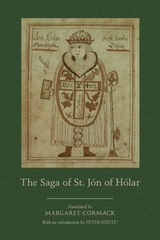
The Saga of St. Jón of Hólar
Translated by Margaret Cormack, With an Introduction byPeter Foote
Arizona Center for Medieval and Renaissance Studies, 2020
This volume contains a translation of the version of the Saga of St. Jón of Hólar that is probably closest to the first Latin vita. It is only the second saga of an Icelandic episcopal saint to appear in a modern translation in the present century. The volume consists of two parts, the first comprising a general introduction and a translation by Margaret Cormack. The second part provides a detailed scholarly analysis of the manuscripts, contents, style, and literary connections of the saga by the late Peter Foote, one of the foremost scholars of Old Norse and Icelandic literature.
The Jóns saga was written in the early thirteenth century, nearly a century after the death of its protagonist, the first bishop of the diocese of Hólar in Northern Iceland. The author of the saga combined Latin learning with native folklore to produce a readable narrative that is contemporary with the earliest family and contemporary sagas. This text provides valuable insight into the religious life of ordinary Icelanders in the thirteenth century, and the introduction corrects common misconceptions about ecclesiastical history and the cult of saints in Iceland. It will be of value to scholars of medieval Icelandic literature, hagiography, and history.
The Saga of the Jomsvikings
Translated from the Old Icelandic by Lee M. Hollander
University of Texas Press, 1955
In A.D. 986, Earl Hákon, ruler of most of Norway, won a triumphant victory over an invading fleet of Danes in the great naval battle of Hjórunga Bay. Sailing under his banner were no fewer than five Icelandic skalds, the poet-historians of the Old Norse world. Two centuries later their accounts of the battle became the basis for one of the liveliest of the Icelandic sagas, with special emphasis on the doings of the Jómsvikings, the famed members of a warrior community that feared no one and dared all. In Lee M. Hollander's faithful translation, all of the unknown twelfth-century author's narrative genius and flair for dramatic situation and pungent characterization is preserved.
The Sagebrush Ocean, Tenth Anniversary Edition
A Natural History Of The Great BasinStephen Trimble
University of Nevada Press, 1999
This is the best general introduction to the ecology and spirit of the Great Basin, a place where "the desert almost seems to mirror the sky in size," where mountains hold "ravens, bristlecone pines, winter stillness—and unseen, but satisfying, the possibility of bighorn sheep." Trimble's photographs come from the backcountry of this rugged land, from months of exploring and hiking the Great Basin wilderness in all seasons; and his well-chosen words come from a rare intimacy with the West.
The Sagebrush Ocean
35th Anniversary EditionStephen Trimble
University of Nevada Press, 2026
The Sagebrush Ocean, the essential introduction to the ecology and spirit of the Great Basin Desert, returns in this richly updated 35th anniversary edition. Winner of the Ansel Adams Award for Photography and Conservation, Stephen Trimble’s authoritative voice and evocative photographs illuminate this landscape of sun-struck playas, surprising wetlands, remote canyons, and wind-swept tundra.
Today, the once-vast “sagebrush ocean” is an endangered sea, as environmental changes and human development have diminished it by half. This heartbreaking decline drives Trimble’s updated text, but he blends loss with reverence for what remains—and urgent insight into what’s at stake. Striking color photographs, many newly added, illuminate some of the continent’s most spectacular but little known scenery. For anyone curious about the Great Basin or concerned for its future, this timely edition is indispensable.
The Sagebrush State, 3d Edition
Nevada's History, Government, and PoliticsMichael W. Bowers
University of Nevada Press, 2006
The Sagebrush State, 4th Ed
Nevada’s History, Government, and PoliticsMichael W. Bowers
University of Nevada Press, 2013
The Sagebrush State, 5th Edition
Nevada's History, Government, and PoliticsMichael W. Bowers
University of Nevada Press, 2018
This comprehensive and insightful explanation discusses how Nevada’s history has shaped its political culture, and how its government operates today. The Sagebrush State serves as a highly readable and accessible text for the study of Nevada’s political history and constitution, which is a graduation requirement at the state’s colleges and universities. The fifth edition is updated through 2017 and includes the full text of the state constitution with extensive annotations of all amendments to the original 1864 document.
The Sagebrush State, 6th Edition
Nevada's History, Government, and PoliticsMichael W. Bowers
University of Nevada Press, 2021
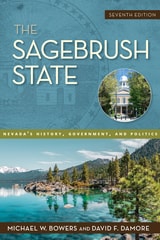
The Sagebrush State, 7th Edition
Nevada's History, Government, and PoliticsMichael W. Bowers
University of Nevada Press, 2025
A dynamic study of Nevada’s government and politics from the state’s inception to the present day.
Starting with Michael W. Bowers’s first edition published in 1996, this concise volume explains the unique dynamics of Nevada’s formation and its political and economic development. David F. Damore continues this legacy in the book’s seventh edition by describing how even today, Nevada is unlike the other states in its politics and culture: economically conservative and averse to strong state government, yet socially libertarian and home to widespread gaming anchored by a 24/7 industry. Nevada has the highest percentage of federally owned lands and one of the highest rates of urbanization in the United States, yet it has often been dominated by rural legislators.
This comprehensive and insightful volume examines how Nevada’s history and founding have shaped its political culture and how its government operates today. The Sagebrush State serves as a highly readable and accessible text for the study of Nevada’s political history and constitution. The seventh edition is updated through 2023 and includes the results of the 2022 elections, policies advanced during the 2023 legislative session, and Nevada’s continuing recovery from the impacts of the COVID-19 recession. The full text of the state constitution with extensive annotations of all amendments to the original 1864 document is provided as an appendix.
The Sagebrush Trail
Western Movies and Twentieth-Century AmericaRichard Aquila
University of Arizona Press, 2015
The book is divided into three parts. Part 1 traces the birth and growth of Westerns from 1900 through the end of World War II. Part 2 focuses on a transitional period in Western movie history during the two decades following World War II. Finally, part 3 shows how Western movies reflected the rapid political, social, and cultural changes that transformed America in the 1960s and the last decades of the twentieth century.
The Sagebrush Trail explains how Westerns evolved throughout the twentieth century in response to changing times, and it provides new evidence and fresh interpretations about both Westerns and American history. These films offer perspectives on the past that historians might otherwise miss. They reveal how Americans reacted to political and social movements, war, and cultural change. The result is the definitive story of Western movies, which contributes to our understanding of not just movie history but also the mythic West and American history. Because of its subject matter and unique approach that blends movies and history, The Sagebrush Trail should appeal to anyone interested in Western movies, pop culture, the American West, and recent American history and culture.
The mythic West beckons but eludes. Yet glimpses of its utopian potential can always be found, even if just for a few hours in the realm of Western movies. There on the silver screen, the mythic West continues to ride tall in the saddle along a “sagebrush trail” that reveals valuable clues about American life and thought.
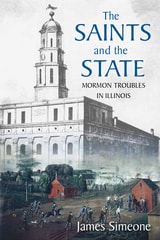
The Saints and the State
The Mormon Troubles in IllinoisJames Simeone
Ohio University Press, 2021
A compelling history of the 1846 Mormon expulsion from Illinois that exemplifies the limits of American democracy and religious tolerance.
When members of the Church of Jesus Christ of Latter-day Saints (known as Mormons) settled in Illinois in 1839, they had been persecuted for their beliefs from Ohio to Missouri. Illinoisans viewed themselves as religiously tolerant egalitarians and initially welcomed the Mormons to their state. However, non-Mormon locals who valued competitive individualism perceived the saints‘ western Illinois settlement, Nauvoo, as a theocracy with too much political power. Amid escalating tensions in 1844, anti-Mormon vigilantes assassinated church founder Joseph Smith and his brother Hyrum. Two years later, the state expelled the saints. Illinois rejected the Mormons not for their religion, but rather for their effort to create a self-governing state in Nauvoo.
Mormons put the essential aspirations of American liberal democracy to the test in Illinois. The saints’ inward group focus and their decision to live together in Nauvoo highlight the challenges strong group consciousness and attachment pose to democratic governance. The Saints and the State narrates this tragic story as an epic failure of governance and shows how the conflicting demands of fairness to the Mormons and accountability to Illinois’s majority became incompatible.
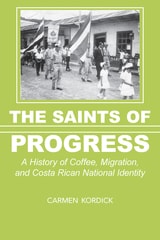
The Saints of Progress
A History of Coffee, Migration, and Costa Rican National IdentityCarmen Kordick
University of Alabama Press, 2019
The Saints of Progress: A History of Coffee, Migration, and Costa Rican National Identity chronicles the development of the Tarrazú Valley, a historically remote—although internationally celebrated—coffee-growing region. Carmen Kordick’s work traces the development of this region from the early nineteenth century to the first decades of the twenty-first century to consider the nation-building process from the margins, while also questioning traditional scholarly works that have reproduced, rather than deconstructed, Costa Rica’s exceptionalist national mythology, which hail Costa Rica as Central America’s “white,” democratic, nonviolent, and egalitarian republic.
In this compelling political, economic, and lived history, Kordick suggests that Costa Rica’s exceptionalist and egalitarian mythology emerged during the Cold War, as revolution, civil war, military dictatorship, and state violence plagued much of Central America. From the vantage point of Costa Rica’s premier coffee-producing region, she examines local, national, and transnational processes. This deeply textured narrative details the inauguration of coffee capitalism, which heightened existing class divisions; a successful armed revolt against the national government, which forged the current political regime; and the onset of massive out-migration to the United States.
Kordick’s research incorporates more than one hundred oral histories and thousands of archival sources gathered in both Costa Rica and the United States to produce a human history of Costa Rica’s past. Her work on the recent past profiles the experiences of migrants in the United States, mostly in New Jersey, where many undocumented Costa Ricans find low-paid work in the restaurant and landscaping sectors. The result is a fine-grained examination of Tarrazú’s development from the 1820s to the present that reshapes traditional understandings of Costa Rica and its national past.