Results by title
11 books match the query 'Borges'

Borges and Europe Revisited
Edited by Evelyn Fishburn
University of London Press, 1998
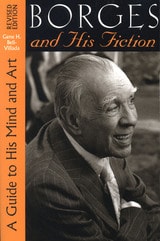
Borges and His Fiction
A Guide to His Mind and ArtBy Gene H. Bell-Villada
University of Texas Press, 2000
From reviews of the first edition:
"A compulsively readable account of the life and works of our greatest...writer of fantasy. With a keen appreciation of Borges himself and a pleasant disregard for the critical clichés, Bell-Villada tells us all we really want to know about the modern master-from pronouncing his name to understanding the stories." —New York Daily News
"Of the scores of Borges studies by now published in English, Bell-Villada's excellent book stands out as one of the freshest and most generally helpful.... Lay readers and specialists alike will find his book a valuable and highly readable companion to Ficciones and El Aleph." —Choice
Since its first publication in 1981, Borges and His Fiction has introduced the life and works of this Argentinian master-writer to an entire generation of students, high school and college teachers, and general readers. Responding to a steady demand for an updated edition, Gene H. Bell-Villada has significantly revised and expanded the book to incorporate new information that has become available since Borges' death in 1986. In particular, he offers a more complete look at Borges and Peronism and Borges' personal experiences of love and mysticism, as well as revised interpretations of some of Borges' stories. As before, the book is divided into three sections that examine Borges' life, his stories in Ficciones and El Aleph, and his place in world literature.
Borges and Kafka, Bolaño and Bloom
Latin American Authors and the Western CanonJuan E. De Castro
Vanderbilt University Press, 2022
Borges and Kafka, Bolaño and Bloom is a parsing not simply of these authors' reactions to a canon, but of the notion of canon writ large and the inequities and erasures therein. It concludes with a look at the testimonial and autobiographical writings of Rigoberta Menchú and Lurgio Gavilán, who arguably represent the trajectory of Indigenous testimonial and autobiographical writing during the last forty years, noting how their texts represent alternative ways of relating to national and, on occasion, Western cultures. This study is a new attempt to map writers' diverse ways of thinking about locality and universality from within and without what is known as the canon.
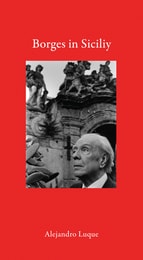
Borges in Sicily
Journey with a Blind GuideAlejandro Luque
Haus Publishing, 2017
This winding journey features literati both past and present, indigenous and foreign. These characters live alongside Luque’s own comments and observations in a narrative that is rich in historical and personal detail. The writer who inspired this great journey, Borges himself, becomes a character in this narrative that is infused with extracts and reflections from his essays and poetry. Borges in Sicily acts as a travel diary, a guide to the most fascinating places in Sicily, a recounting of Borges’s journey around the island, and a deeply poetic story of Luque’s own adventures. The book also includes twenty-three photographs from the renowned Magnum photographer Ferdinando Scianna, and it won the 1st Premio International del Libros de Viajes.
Borges
An IntroductionJulio Premat
Vanderbilt University Press, 2021
Originally published in French by an Argentine ex-pat living in Paris, Borges includes the Argentine specificities of Borges’s work—specificities that are often unrecognized or glossed over in Anglophone readings.
This book is a boon for university students of philosophy and literature, teachers and researchers in these fields who are looking to better understand this complex author, and anyone interested in the advanced study of literature. Somewhere between a guidebook and an exhaustive work of advanced research, Borges is the ultimate stepping-stone into the deeper Borgesian world.
Fiction Refracts Science
Modernist Writers from Proust to BorgesAllen Thiher
University of Missouri Press, 2005
Gombrowicz, Borges, and the Fictional Cosmos
Max Ubelaker Andrade
Bucknell University Press, 2027
Polish author Witold Gombrowicz’s famously chaotic masterpiece, Cosmos, was profoundly influenced by Jorge Luis Borges—particularly by three key stories from Ficciones. Drawing on evidence that Gombrowicz read Ficciones in 1960, as well as handwritten marginalia in Gombrowicz’s copy of Adolfo Bioy Casares’s La invención de Morel, this groundbreaking study argues that Cosmos responded to Borges’s literary transformations of cartography, mathematical combinatorics, and Miguel de Cervantes’s Don Quijote. Along the way, it introduces the concept of “immaterial bibliography” to analyze imaginary texts appearing in literary works. Finally, it examines the tension between Borges’s explicit racism and the ethical and aesthetic vision suggested by his fiction, revealing how rumor, rebellion, and literary inheritance shaped Gombrowicz’s reading of Borges, which in turn influenced the composition of his prizewinning last novel.
Published by Bucknell University Press. Distributed worldwide by Rutgers University Press.
Invisible Work
Borges and TranslationEfrain Kristal
Vanderbilt University Press, 2002
Between the age of ten, when he translated Oscar Wilde, and the end of his life, when he prepared a Spanish version of the Prose Edda , Borges transformed the work of Poe, Kafka, Hesse, Kipling, Melville, Gide, Faulkner, Whitman, Woolf, Chesterton, and many others. In a multitude of essays, lectures, and interviews Borges analyzed the versions of others and developed an engaging view about translation. He held that a translation can improve an original, that contradictory renderings of the same work can be equally valid, and that an original can be unfaithful to a translation.
Borges's bold habits as translator and his views on translation had a decisive impact on his creative process. Translation is also a recurrent motif in Borges's stories. In "The Immortal," for example, a character who has lived for many centuries regains knowledge of poems he had authored, and almost forgotten, by way of modern translations. Many of Borges's fictions include actual or imagined translations, and some of his most important characters are translators. In "Pierre Menard, author of the Quixote," Borges's character is a respected Symbolist poet, but also a translator, and the narrator insists that Menard's masterpiece-his "invisible work"-adds unsuspected layers of meaning to Cervantes's Don Quixote. George Steiner cites this short story as "the most acute, most concentrated commentary anyone has offered on the business of translation."
In an age where many discussions of translation revolve around the dichotomy faithful/unfaithful, this book will surprise and delight even Borges's closest readers and critics.
Out of Context
Historical Reference and the Representation of Reality in BorgesDaniel Balderston
Duke University Press, 1993
Through a detailed examination of seven stories, Daniel Balderston shows how Borges's historical and political references, so often misread as part of a literary game, actually open up a much more complex reality than the one made explicit to the reader. Working in tension with the fantastic aspects of Borges' work, these precise references to realities outside the text illuminate relations between literature and history as well as the author's particular understanding of both. In Borges's perspective as it is revealed here, history emerges as an "other" only partially recoverable in narrative form. From what can be recovered, Balderston is able to clarify Borges's position on historical episodes and trends such as colonialism, the Peronist movement, "Western culture," militarism, and the Spanish invasion of the Americas.
Informed by a wide reading of history, a sympathetic use of critical theory, and a deep understanding of Borges's work, this iconoclastic study provides a radical new approach to one of the most celebrated and—until now—hermetic authors of our time.
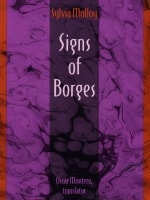
Signs of Borges
Sylvia Molloy
Duke University Press, 1994
Borges's sustained practice of the uncanny gives rise in his texts to endless tensions between illusion and meaning, and to the competing desires for fragmentation, dispersal, and stability. Molloy traces the movement of Borges's own writing by repeatedly spanning the boundaries of genre and cutting across the conventional separations of narrative, lyric and essay, fact and fiction. Rather than seeking to resolve the tensions and conflicts, she preserves and develops them, thereby maintaining the potential of these texts to disturb. At the site of these tensions, Molloy locates the play between meaning and meaninglessness that occurs in Borges's texts. From this vantage point his strategies of deception, recourse to simulacra, inquisitorial urge to unsettle binarism, and distrust of the permanent--all that makes Borges Borges--are examined with unmatched skill and acuity.
Elegantly written and translated, Signs of Borges presents a remarkable and dynamic view of one of the most international and compelling writers of this century. It will be of great interest to all students of twentieth-century literature, particularly to students of Latin American literature.
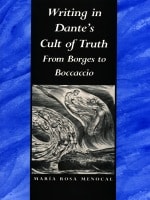
Writing in Dante's Cult of Truth
From Borges to BocaccioMaría Rosa Menocal
Duke University Press, 1991
Beginning with a reading of La vita nuova and the Commedia, this literary history of poetic literary histories explores the Dantean poetic experience as it has been limited and rewritten by later poets, particularly Petrarch, Boccaccio, Borges, Pound, Eliot, and the all but forgotten Silvio Pellico, author of Le mie prigioni. By blending discussions of Dante’s own marriage of literature and literary history with those investigations into the imitative qualities of later works, Writing in Dante’s Cult of Truth presents an intertextual literary history, one which seeks to maintain the uncanniness of literature, while imagining history to be neither linear nor clearly distinguishable from literature itself.