Results by title
28167 books match the query 'History' and 6372 start with t
The Seeds of Triumph
Church and State in Gomulka's PolandHannah Diskin
Central European University Press, 2001
The Roman Catholic Church has played a unique role in the history of Poland in the twentieth century: the people and the Church drew closer and closer together during Nazi rule, the Stalinist period and the somewhat milder, though strongly anti-religious and repressive Gomulka regime (1956-1970). The power struggle between the Church and the communist government did in fact play a role in shaping world politics, the Polish Church having been the force behind the opposition movement in Poland. Against this background, a Polish pope appeared and made a major contribution to the collapse of communism.
The Seeds of Triumph, the most comprehensive recent book on the opposition of Church and State in post-war Poland, compares the characteristics and consequences of this relationship during three different periods: the first and second periods of Gomulka's rule, and the Stalinist era between the two Gomulka periods. It examines the balance of power, studying to what degree the Church and other factors in the political environment influenced governmental policy-making. The author disproves the common stereotype, held at the time, that domestic conditions played only a marginal role. In examining the regime's policies, she covers the legal background, the general policy characteristics, the specific policies implemented during the period, and the role of the individual actors, most notably the pivotal role of the two main protagonists, Cardinal Wyszynski and Wladislaw Gomulka.
In her landmark study, Diskin makes a significant contribution to the study of authoritarian systems and greatly enhances our understanding of the centrality of the Church in recent Polish history.

The Selden Map of China
A New Understanding of the Ming DynastyHongping Annie Nie
Bodleian Library Publishing, 2019
Exploring the commercial aims of the Ming Dynasty, the port city of Quanzhou and its connections with the voyages of the early traveler Zheng He, this book describes the historical background of the era in which the map was used. It also includes an analysis of the skills and techniques involved in Chinese map-making and the significance of the compass bearings, scale, and ratios found on the map, all of which combine to represent a breakthrough in cartographic techniques.
The enthralling story revealed by this extraordinary artifact sheds light on the long history of China’s relationship with the sea and with the wider world.

The Selected Papers of Elizabeth Cady Stanton and Susan B. Anthony
Against an Aristocracy of Sex, 1866 to 1873Gordon, Ann D
Rutgers University Press, 2000
The second volume picks up the story of Stanton and Anthony at the end of 1866, when they launched their drive to make universal suffrage the priority of Reconstruction. Through letters, speeches, articles, and diaries, this volume recounts their years as editor and publisher of the weekly paper the Revolution, their extensive travels, and their lobbying with Congress. It touches on the bitter division that occurred among suffragists over such controversial topics as marriage and divorce, and a national debate over the citizenship of women under the Fourteenth and Fifteenth Amendments. By the summer of 1873, when this volume ends, Anthony stood convicted of the federal crime of illegal citizenship of women under the Fourteenth and Fifteenth Amendments. By the summer of 1873, when this volume ends, Anthony stood convicted of the federal crime of illegal voting. An irate Stanton warned, "I felt afresh the mockery of this boasted chivalry of man towards woman."

The Selected Papers of Elizabeth Cady Stanton and Susan B. Anthony
An Awful Hush, 1895 to 1906Gordon, Ann D
Rutgers University Press, 2012
The “hush” of the title comes suddenly, when first Elizabeth Cady Stanton dies on October 26, 1902, and three years later Susan B. Anthony dies on March 13, 1906. It is sudden because Stanton, despite near blindness and immobility, wrote so intently right to the end that editors had supplies of her articles on hand to publish several months after her death. It is sudden because Anthony, at the age of eighty-five, set off for one more transcontinental trip, telling a friend on the Pacific Coast, “it will be just as well if I come to the end on the cars, or anywhere, as to be at home.”
Volume VI of this extraordinary series of selected papers is inescapably about endings, death, and silence. But death happens here to women still in the fight. An Awful Hush is about reformers trained “in the school of anti-slavery” trying to practice their craft in the age of Jim Crow and a new American Empire. It recounts new challenges to “an aristocracy of sex,” whether among the bishops of the Episcopal church, the voters of California, or the trustees of the University of Rochester. And it sends last messages about woman suffrage. As Stanton wrote to Theodore Roosevelt on the day before she died, “Surely there is no greater monopoly than that of all men, in denying to all women a voice in the laws they are compelled to obey.”
With the publication of Volume VI, this series is now complete.

The Selected Papers of Elizabeth Cady Stanton and Susan B. Anthony
In the School of Anti-Slavery, 1840 to 1866Gordon, Ann D
Rutgers University Press, 1997
In the School of Anti-Slavery, 1840-1866 is the first of six volumes of The Selected Papers of Elizabeth Cady Stanton and Susan B. Anthony. The collection documents the lives and accomplishments of two of America's most important social and political reformers. Though neither Stanton nor Anthony lived to see the passage of the Nineteenth Amendment in 1920, each of them devoted fifty-five years to the cause. Their names were synonymous with woman suffrage in the United States and around the world as they mobilized thousands of women to fight for the right to a political voice.
Opening when Stanton was twenty-five and Anthony was twenty, and ending when Congress sent the Fourteenth Amendment to the states for ratification, this volume recounts a quarter of a century of staunch commitment to political change. Readers will enjoy an extraordinary collection of letters, speeches, articles, and diaries that tells a story-both personal and public-about abolition, temperance, and woman suffrage.
When all six volumes are complete, the Selected Papers of Stanton and Anthony will contain over 2,000 texts transcribed from their originals, the authenticity of each confirmed or explained, with notes to allow for intelligent reading. The papers will provide an invaluable resource for examining the formative years of women's political participation in the United States. No library or scholar of women's history should be without this original and important collection.

The Selected Papers of Elizabeth Cady Stanton and Susan B. Anthony
National Protection for National Citizens, 1873 to 1880Gordon, Ann D
Rutgers University Press, 2003
National Protection for National Citizens, 1873 to 1880 is the third of six planned volumes of TheSelected Papers of Elizabeth Cady Stanton and Susan B. Anthony. The entire collection documents the friendship and accomplishments of two of America's most important social and political reformers. Though neither Stanton nor Anthony lived to see passage of the Nineteenth Amendment in 1920, each of them devoted fifty-five years to the cause of woman suffrage.
The third volume of the Selected Papers of Elizabeth Cady Stanton and Susan B. Anthony opens while woman suffragists await the decision of the U.S. Supreme Court in cases testing whether the Constitution recognized women as voters within the terms of the Fourteenth and Fifteenth Amendments. At its close they are pursuing their own amendment to the Constitution and pressing the presidential candidates of 1880 to speak in its favor. Through their letters, speeches, articles, and diaries, the volume recounts the national careers of Elizabeth Cady Stanton and Susan B. Anthony as popular lecturers, their work with members of Congress to expand women's rights, their protests during the Centennial Year of 1876, and the launch that same year of their campaign for a Sixteenth Amendment.

The Selected Papers of Elizabeth Cady Stanton and Susan B. Anthony
Their Place Inside the Body-Politic, 1887 to 1895Gordon, Ann D
Rutgers University Press, 2009
At the beginning, Stanton and Anthony focus their attention on organizing the International Council of Women in 1888. Late in 1887, Lucy Stone’s American Woman Suffrage Association announced its desire to merge with the national association led by Stanton and Anthony. Two years of fractious negotiations preceded the 1890 merger, and years of sharp disagreements followed. Stanton made her last trip to Washington in 1892 to deliver her famous speech “Solitude of Self.” Two states enfranchised women—Wyoming in 1890 and Colorado in 1893—but failures were numerous. Anthony returned to grueling fieldwork in South Dakota in 1890 and Kansas and New York in 1894. From the campaigns of 1894, Stanton emerged as an advocate of educated suffrage and staunchly defended her new position.

The Selected Papers of Elizabeth Cady Stanton and Susan B. Anthony
When Clowns Make Laws for Queens, 1880-1887Gordon, Ann D
Rutgers University Press, 2006
At the opening of the fourth volume, suffragists hoped to speed passage of a sixteenth amendment to the Constitution through the creation of Select Committees on Woman Suffrage in Congress. Congress did not vote on the amendment until January 1887. Then, in a matter of a week, suffragists were dealt two major blows: the Senate defeated the amendment and the Senate and House reached agreement on the Edmunds-Tucker Act, disenfranchising all women in the Territory of Utah.
As evidenced in this volume's selection of letters, articles, speeches, and diary entries, these were years of frustration. Suffragists not only lost federal and state campaigns for partial and full voting rights, but also endured an invigorated opposition. In spite of these challenges, Stanton and Anthony continued to pursue their life's work. In 1880 both women retired from lecturing to devote attention to their monumental History of Woman Suffrage. They also opened a new transatlantic dialogue about woman's rights during a trip to Europe in 1883.

The Selected Papers of Jane Addams, Volume 4
Moving Beyond Hull-House, 1901-1907Jane Addams; Edited by Stacy Lynn with Cathy Moran Hajo and Victoria Sciancalepore
University of Illinois Press, 2026
The fourth volume in the series follows Addams’s increasingly busy life. Her activities included greater participation in the women’s suffrage movement and speaking tours of twenty-five states and the District of Columbia to discuss child labor, settlement work, and women’s issues. At the same time, she maintained relationships with an intimate circle of female friends, her extended family, the Hull-House community, and most importantly her companion Mary Rozet Smith. The editors provide an extensive collection of documents on this side of Addams’s life while rooting her in the unique time and place of an era of fast and far-reaching change.

The Selected Papers of Jane Addams
Vol. 2: Venturing into UsefulnessEdited by Mary Lynn McCree Bryan, Barbara Bair, and Maree de Angury; with the assistance of Elizabeth Stevens, Stewart Burns, and Ellen Skerrett
University of Illinois Press, 2009
Artfully annotated, The Selected Papers of Jane Addams offers an evocative choice of correspondence, photographs, and other primary documents, presenting a multi-layered narrative of Addams's personal and emerging professional life. Themes inaugurated in the previous volume are expanded here, including dilemmas of family relations and gender roles; the history of education; the dynamics of female friendship; religious belief and ethical development; changes in opportunities for women; and the evolution of philanthropy, social welfare, and reform ideas.

The Selected Papers of Jane Addams
Vol. 3: Creating Hull-House and an International Presence, 1889-1900Jane Addams Edited by Mary Lynn McCree Bryan, Maree de Angury, and Ellen Skerrett: with the assistance of Richard R. Seidel,
University of Illinois Press, 2019
The third volume in this acclaimed series documents Addams’s creation of Hull-House and her rise to worldwide fame as the acknowledged female leader of progressive reform. It also provides evidence of her growing commitment to pacifism. Here we see Addams, a force of thought, action, and commitment, forming lasting relationships with her Hull-House neighbors and the Chicago community of civic, political, and social leaders, even as she matured as an organizer, leader, and fund-raiser, and as a sought-after speaker, and writer. The papers reveal her positions on reform challenges while illuminating her strategies, successes, and responses to failures. At the same time, the collection brings to light Addams’s private life. Letters and other documents trace how many of her Hull-House and reform alliances evolved into deep, lasting friendships and also explore the challenges she faced as her role in her own family life became more complex.
Fully annotated and packed with illustrations, The Selected Papers of Jane Addams, Volume 3 is a portrait of a woman as she changed—and as she changed history.

The Selected Papers of Jane Addams
vol. 1: Preparing to Lead, 1860-81Edited by Mary Lynn McCree Bryan, Barbara Bair, and Maree de Angury
University of Illinois Press, 2002

The Selected Papers of Margaret Sanger, Volume 1
The Woman Rebel, 1900-1928Margaret Sanger, Edited by Esther Katz
University of Illinois Press, 2002

The Selected Papers of Margaret Sanger, Volume 4
Round the World for Birth Control, 1920-1966Margaret Sanger: Edited by Esther Katz: Peter C. Engelman and Cathy Moran Hajo, Associate Editors
University of Illinois Press, 2016
This volume focuses on Sanger from her groundbreaking overseas advocacy during the interwar years through her postwar role in creating the International Planned Parenthood Federation. The documents reconstruct Sanger's dramatic birth control advocacy tours through early 1920s Germany, Japan, and China in the midst of significant government and religious opposition to her ideas. They also trace her tireless efforts to build a global movement through international conferences and tours. Letters, journal entries, writings, and other records reveal Sanger's contentious dealings with other activists, her correspondence with the likes of Albert Einstein and Eleanor Roosevelt, and Sanger's own dramatic evolution from gritty grassroots activist to postwar power broker and diplomat.
A powerful documentary history of a transformative twentieth-century figure, The Selected Papers of Margaret Sanger, Volume 4 is a primer for the debates on individual choice, sex education, and planned parenthood that remain all-too-pertinent in our own time.

The Selected Writings of John Witherspoon
Edited by Thomas P. Miller
Southern Illinois University Press, 1990
The Self-Made Map
Cartographic Writing in Early Modern FranceTom Conley
University of Minnesota Press, 2011
Conley traces the explosion of interest in mapmaking that occurred with the discovery of the New World, and discusses the commensurate rise of what he defines as cartographic writing-writing that "holds, penetrates, delineates, and explores space." Considering the works of such writers as Rabelais, Montaigne, and Descartes, Conley provides a "navigation" through the printed page, revealing the emerging values of Renaissance France. In his examination of the placing of words, letters, and graphic elements in books, he exposes the playful and sometimes enigmatic relation between spatial organization and text.
Conley also exposes the ideological exercise inherent in mapmaking, arguing that Renaissance cartography is inseparably bound up with the politics of the era. He undertakes close readings of maps and illustrations, discussing the necessity of viewing Renaissance maps in the context of their typographic layout, graphic reproduction, and literary and ideological import.
Richly illustrated throughout, The Self-Made Map combines studies of art, geography, history, literature, and printing to show a clear historical transformation, along the way linking geographical discoveries, printing processes, and political awareness. Conley's provocative analysis discloses how early modern printed literature and cartography worked together to crystallize broader issues engaging the then emergent status of cultural identity, nation, and individuality.

The Senses of Democracy
Perception, Politics, and Culture in Latin AmericaBy Francine R. Masiello
University of Texas Press, 2018
In The Senses of Democracy, Francine R. Masiello traces a history of perceptions expressed in literature, the visual arts, politics, and history from the start of the nineteenth century to the present day. A wide transnational landscape frames the book along with an original and provocative thesis: when the discourse on democracy is altered—when nations fall into crisis or the increased weight of modernity tests minds and nerves—the representation of our sensing bodies plays a crucial role in explaining order and rebellion, cultural innovation, and social change.
Taking a wide arc of materials—periodicals, memoirs, political proclamations, and travel logs, along with art installations and fiction—and focusing on the technologies that supplement and enhance human perception, Masiello looks at the evolution of what she calls “sense work” in cultural texts, mainly from Latin America, that wend from the heights of romantic thought to the startling innovations of modernism in the early twentieth century and then to times of posthuman experience when cyber bodies hurtle through globalized space and human senses are reproduced by machines. Tracing the shifting debates on perceptions, The Senses of Democracy offers a new paradigm with which to speak of Latin American cultural history and launches a field for the comparative study of bodies, experience, pleasure, and pain over the continental divide. In the end, sense work helps us to understand how culture finds its location.

The Sensory Order and Other Writings on the Foundations of Theoretical Psychology
F. A. Hayek
University of Chicago Press, 2017
The latest addition to the University of Chicago Press’s Collected Works of F. A. Hayek series, The Sensory Order and Other Writings on the Foundations of Theoretical Psychology pairs the book, originally published in 1952, with additional essays related to The Sensory Order’s key themes, including a student paper from 1920 in which Hayek outlined the basic ideas he fully developed in the 1952 book. Rounding out the volume is an insightful introduction by editor Viktor Vanberg that sketches out the central problems Hayek was grappling with when he wrote The Sensory Order and the influential role this early thinking on theoretical psychology would play over the next six decades of his career. The book also features ample footnotes and citations for further reading, making this an essential contribution to the series.

The Sensuous Life of Adolf Dehn
American Master of Watercolor and PrintmakingHenry Adams
University of Missouri Press, 2020
In this wide-ranging biography, Henry Adams explores how a once central figure can come to be forgotten. Noting that Dehn’s watercolor Spring in Central Park has been widely reproduced on calendars, postcards, and other Metropolitan Museum of Art souvenirs, Adams asks why it is that some artists are celebrated as key figures while others, even those who created images that form an integral part of our visual culture, are relatively unknown. With his account of the life of the prolific and influential Dehn, and a look at the circles of artists and writers in which Dehn moved, Adams helps to fill in what he calls the “secret or subterranean history of art.”

The Sephardic Jews of Bordeaux
Assimilation and Emancipation in Revolutionary and Napoleonic FranceFrances Malino
University of Alabama Press, 1978
This book focuses on a small community of French Jews, the first in Europe to encounter the requirements of an emerging nation-state and to be recognized by that state as full and equal citizens. The Sephardim of Bordeaux were typical of neither the majority of the Jews of France nor those of Western Europe. They had entered France as Catholics; only after more than a century of public adherence to Catholicism was their community officially recognized as Jewish. Nevertheless, their assimilation and conformity to the standards of French society as well as their commitment to a Judaism fashioned as much by contemporary political and economic concerns as by tradition reveal a legacy bequeathed to French Jewry and an important model for the development of the modern Jew.
Describing the tensions that existed between the Sephardic community of Bordeaux and the Ashkenazic Jews of France, the author also depicts their role in the relation of the Jews with Napoleon and the forming of the Grand Sanhedrin.
The Sephardim in the Holocaust
A Forgotten PeopleIsaac Jack Lévy with Rosemary Lévy Zumwalt
University of Alabama Press, 2020
A Powerful History of Sephardic Life, Loss, and Resilience During the Holocaust
The Sephardim suffered devastation during the Holocaust, but this facet of history is poorly documented. What literature exists on the Sephardim in the Holocaust focuses on specific countries, such as Yugoslavia and Greece, or on specific cities, such as Salonika, and many of these works are not available in English.
The Sephardim in the Holocaust: A Forgotten People embraces the Sephardim of all the countries shattered by the Holocaust and pays tribute to the memory of the more than 160,000 Sephardim who perished. Isaac Jack Lévy and Rosemary Lévy Zumwalt draw on a wealth of archival sources, family history (Isaac and his family were expelled from Rhodes in 1938), and more than 150 interviews conducted with survivors during research trips to Belgium, Canada, France, Greece, Israel, Mexico, the Netherlands, the former Yugoslavia, and the United States. Lévy follows the Sephardim from Athens, Corfu, Cos, Macedonia, Rhodes, Salonika, and the former Yugoslavia to Auschwitz.
The authors chronicle the interminable cruelty of the camps, from the initial selections to the grisly work of the Sonderkommandos inside the crematoria, detailing the distinctive challenges the Sephardim faced, with their differences in language, physical appearance, and pronunciation of Hebrew, all of which set them apart from the Ashkenazim. They document courageous Sephardic revolts, especially those by Greek Jews, which involved intricate planning, sequestering of gunpowder, and complex coordination and communication between Ashkenazi and Sephardic inmates—all done in the strictest of secrecy. And they follow a number of Sephardic survivors who took refuge in Albania with the benevolent assistance of Muslims and Christians who opened their doors to give sanctuary, and traces the fate of the approximately 430,000 Jews from Morocco, Algiers, Tunisia, and Libya from 1939 through the end of the war.
The author’s intention is to include the Sephardim in the shared tragedy with the Ashkenazim and others. The result is a much needed, accessible, and viscerally moving account of the Sephardim’s unique experience of the Holocaust.
The September Six and the Struggle for the Soul of Mormonism
Patterson, Sara M.
Signature Books, 2023
The September Six and the Struggle for the Soul of Mormonism
Patterson, Sara M.
Signature Books, 2024

The Sequoia and Kings Canyon Reader
Edited by William C. Tweed
University of Utah Press, 2027
The Seris
David Burckhalter
University of Arizona Press, 1981

The Serpent's Gift
Gnostic Reflections on the Study of ReligionJeffrey J. Kripal
University of Chicago Press, 2006
“Because thou hast done this, thou art cursed above all cattle, and above every beast of the field.” With those words in Genesis, God condemns the serpent for tempting Adam and Eve, and the serpent has shouldered the blame ever since. But how would the study of religion change if we looked at the Fall from the snake’s point of view? Would he appear as a bringer of wisdom, more generous than the God who wishes to keep his creation ignorant?
Inspired by the early Gnostics who took that startling view, Jeffrey J. Kripal uses the serpent as a starting point for a groundbreaking reconsideration of religious studies and its methods. In a series of related essays, he moves beyond both rational and faith-based approaches to religion, exploring the erotics of the gospels and the sexualities of Jesus, John, and Mary Magdalene. He considers Feuerbach’s Gnosticism, the untapped mystical potential of comparative religion, and even the modern mythology of the X-Men.
Ultimately, The Serpent’s Gift is a provocative call for a complete reorientation of religious studies, aimed at a larger understanding of the world, the self, and the divine.

The Sespe Wild
Southern California'S Last Free RiverBradley John Monsma
University of Nevada Press, 2007

The Seven Day Circle
The History and Meaning of the WeekEviatar Zerubavel
University of Chicago Press, 1989

The Seven Deadly Virtues
18 Conservative Writers on Why the Virtuous Life is Funny as HellJonathan V. Last
Templeton Press, 2014
The book’s contributors include Sonny Bunch, Christopher Buckley, David “Iowahawk” Burge, Christopher Caldwell, Andrew Ferguson, Jonah Goldberg, Michael Graham, Mollie Hemingway, Rita Koganzon, Matt Labash, James Lileks, Rob Long, Larry Miller, P. J. O’Rourke, Joe Queenan, Christine Rosen, and Andrew Stiles. Jonathan V. Last, senior writer at the Weekly Standard, editor of the collection, is also a contributor. All eighteen essays in this book are appearing for the first time anywhere.
In the book’s opening essay, P. J. O’Rourke observes: “Virtue has by no means disappeared. It’s as much in public view as ever. But it’s been strung up by the heels. Virtue is upside down. Virtue is uncomfortable. Virtue looks ridiculous. All the change and the house keys are falling out of Virtue’s pants pockets.”
Here are the virtues everyone (including the book’s contributors) was taught in Sunday school but have totally forgotten about until this very moment. In this sanctimony-free zone:
• Joe Queenan observes: “In essence, thrift is a virtue that resembles being very good at Mahjong. You’ve heard about people who can do it, but you’ve never actually met any of them.”
• P. J. O’Rourke notes: “Fortitude is quaint. We praise the greatest generation for having it, but they had aluminum siding, church on Sunday, and jobs that required them to wear neckties or nylons (but never at the same time). We don’t want those either.”
• Christine Rosen writes: “A fellowship grounded in sociality means enjoying the company of those with whom you actually share physical space rather than those with whom you regularly and enthusiastically exchange cat videos.”
• Rob Long offers his version of modern day justice: if you sleep late on the weekend, you are forced to wait thirty minutes in line at Costco.
• Jonah Goldberg offers: “There was a time when this desire-to-do-good-in-all-things was considered the only kind of integrity: ‘Angels are better than mortals. They’re always certain about what is right because, by definition, they’re doing God’s will.’ Gabriel knew when it was okay to remove a mattress tag and Sandalphon always tipped the correct amount.”
• Sonny Bunch dissects forbearance, observing that the fictional Two Minutes Hate of George Orwell’s 1984 is now actually a reality directed at living, breathing people. Thanks, in part, to the Internet, “Its targets are designated by a spontaneously created mob—one that, due to its hive-mind nature—is virtually impossible to call off.”
By the time readers have completed The Seven Deadly Virtues, they won’t even realize that they’ve just been catechized into an entirely different—and better—moral universe.

The Seventh Star of the Confederacy
Texas during the Civil WarKenneth W. Howell
University of North Texas Press, 2009

The Seventies Now
Culture as SurveillanceStephen Paul Miller
Duke University Press, 1999
The concept of surveillance and its attendant social ramifications have been powerful agents in U.S. culture for many decades, but in describing how during the 1970s Americans learned to “survey” themselves, Miller shines surprising new light on such subjects as the women’s movement, voting rights enforcement, the Ford presidency, and environmental legislation. He illuminates the significance of what he terms “microperiods” and analyzes relevant themes in many of the decade’s major films—such as The Deer Hunter, Network, Jaws, Star Wars, and Apocalypse Now—and in the literature of writers including John Ashbery, Toni Morrison, Adrienne Rich, and Sam Shepard. In discussing the reverberations of the 1969 Stonewall riots, technological innovations, the philosophy of Michel Foucault, and a host of documents and incidents, Miller shows how the 1970s marked an important period of transition, indeed a time of many transitions, to the world we confront at the end of the millennium.
The Seventies Now will interest students and scholars of cultural studies, American history, theories of technology, film and literature, visual arts, and gay and lesbian studies.

The Sexual Life of English
Languages of Caste and Desire in Colonial IndiaShefali Chandra
Duke University Press, 2012
The Sexuality of History
Modernity and the Sapphic, 1565-1830Susan S. Lanser
University of Chicago Press, 2014
In The Sexuality of History, Susan S. Lanser shows how intimacies between women became harbingers of the modern, bringing the sapphic into the mainstream of some of the most significant events in Western Europe. Ideas about female same-sex relations became a focal point for intellectual and cultural contests between authority and liberty, power and difference, desire and duty, mobility and change, order and governance. Lanser explores the ways in which a historically specific interest in lesbians intersected with, and stimulated, systemic concerns that would seem to have little to do with sexuality. Departing from the prevailing trend of queer reading whereby scholars ferret out hidden content in “closeted” texts, Lanser situates overtly erotic representations within wider spheres of interest. The Sexuality of History shows that just as we can understand sexuality by studying the past, so too can we understand the past by studying sexuality.

The Shadow of God and the Hidden Imam
Religion, Political Order, and Societal Change in Shi'ite Iran from the Beginning to 1890Said Amir Arjomand
University of Chicago Press, 1984

The Shadow of Slavery
Peonage in the South, 1901-1969Pete Daniel
University of Illinois Press, 1972
Pete Daniel's book is about this largely ignored form of twentieth-century slavery. It is in part "the record of an American failure, the inability of federal, state, and local law-enforcement officers to end peonage." In a series of case studies and histories, Daniel re-creates the neglected and frightening world of peonage, demanding, "If a form of slavery yet exists in the United States, as so much evidence suggests, then the relevant questions are why, and by whose irresponsibility?"
Peonage grew out of labor settlements following emancipation, when employers forbade croppers to leave plantations because of debt (often less than $30). At the turn of the century the federal government acknowledged that the "labyrinth of local customs and laws" binding men in debt was peonage. They outlawed debt servitude and slowly moved against it, but with no large success. Disappearing witnesses and acquitted employers characterized the cases that did go to court.
Daniel holds that peonage persists for many reasons: the corruption and apathy of law-enforcement, racist traditions in the South, and the impotence of the Justice Department in prosecuting this violation of federal law. He draws extensively on complaints and trial transcripts from the peonage records of the Justice Department.
The Shadow of a Year
The 1641 Rebellion in Irish History and MemoryJohn Gibney
University of Wisconsin Press, 2013
Was the 1641 rebellion a justified response to dispossession and repression? Or was it an unprovoked attempt at sectarian genocide? John Gibney comprehensively examines three centuries of this debate. The struggle to establish and interpret the facts of the past was also a struggle over the present: if Protestants had been slaughtered by vicious Catholics, this provided an ideal justification for maintaining Protestant privilege. If, on the other hand, Protestant propaganda had inflated a few deaths into a vast and brutal “massacre,” this justification was groundless.
Gibney shows how politicians, historians, and polemicists have represented (and misrepresented) 1641 over the centuries, making a sectarian understanding of Irish history the dominant paradigm in the consciousness of the Irish Protestant and Catholic communities alike.
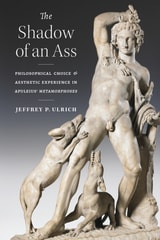
The Shadow of an Ass
Philosophical Choice and Aesthetic Experience in Apuleius' MetamorphosesJeffrey P. Ulrich
University of Michigan Press, 2024
Situating the novel in a long history of philosophical and literary conversations, Ulrich suggests that the Metamorphoses anticipates much of the philosophical burlesque we tend to associate with early modern fiction, from Don Quixote to Lewis Carroll.

The Shaky Game
Arthur Fine
University of Chicago Press, 1996
"What really led Einstein . . . to renounce the new quantum order? For those interested in this question, this book is compulsory reading."—Harvey R. Brown, American Journal of Physics
"Fine has successfully combined a historical account of Einstein's philosophical views on quantum mechanics and a discussion of some of the philosophical problems associated with the interpretation of quantum theory with a discussion of some of the contemporary questions concerning realism and antirealism. . . . Clear, thoughtful, [and] well-written."—Allan Franklin, Annals of Science
"Attempts, from Einstein's published works and unpublished correspondence, to piece together a coherent picture of 'Einstein realism.' Especially illuminating are the letters between Einstein and fellow realist Schrödinger, as the latter was composing his famous 'Schrödinger-Cat' paper."—Nick Herbert, New Scientist
"Beautifully clear. . . . Fine's analysis is penetrating, his own results original and important. . . . The book is a splendid combination of new ways to think about quantum mechanics, about realism, and about Einstein's views of both."—Nancy Cartwright, Isis

The Shan Rebellion
Siam’s Colonial Struggle to Secure LannaAndrew Walker
National University of Singapore Press, 2026
A gripping account of how the Shan rebellion influenced the colonial struggle between Siam, Britain, and France to expand their power in northern Thailand.
Moving beyond the familiar story of Siam fending off European colonialism, TheShan Rebellion reveals a new historical subject: Siam as colonizer. As European powers expanded their presence in Southeast Asia at the end of the nineteenth century, Siam launched its own colonial project to assert control over tributary states that lay outside the Siamese heartland. Most important was Lanna (now northern Thailand), a region where Siamese, British, and French colonial ambitions intersected. The outbreak of the Shan Rebellion in 1902 began with the violent dismantling of the Siamese colonial administration in Phrae, one of Lanna’s principal towns. As the rebels began moving towards other centers, they tested the limits of Siamese power in Lanna. With the British having valuable commercial interests to protect and the French itching for an opportunity to expand their reach, Siam’s colonial project faced a dangerous moment. Drawing on rich archival sources from Thailand, Burma, India, France, and England, this outstanding study provides the first detailed account of the rebellion and its impact on competitive colonialism in mainland Southeast Asia.
The Shape of Inca History
Narrative and Architecture in an Andean EmpireSusan A. Niles
University of Iowa Press, 1999
The Shape of Populism
Serbia before the Dissolution of YugoslaviaMarko Grdešic
University of Michigan Press, 2019

The Shape of Utopia
The Architecture of Radical Reform in Nineteenth-Century AmericaIrene Cheng
University of Minnesota Press, 2023
How nineteenth-century social reformers devised a new set of radical blueprints for society
In the middle of the nineteenth century, a utopian impulse flourished in the United States through the circulation of architectural and urban plans predicated on geometrically distinct designs. Though the majority of such plans remained unrealized, The Shape of Utopia emphasizes the enduring importance of these radical propositions and their ability to visualize alternatives to what was then a newly emerging capitalist nation.
Drawing diagrammatic plans for structures such as octagonal houses, a hexagonal anarchist city, and circular centers of equitable commerce, these various architectural utopians applied geometric forms to envision a more just and harmonious society. Highlighting the inherent political capacity of architecture, Irene Cheng showcases how these visionary planners used their blueprints as persuasive visual rhetoric that could mobilize others to share in their aspirations for a better world.
Offering an extensive and uniquely focused view of mid-nineteenth-century America’s rapidly changing cultural landscape, this book examines these utopian plans within the context of significant economic and technological transformation, encompassing movements such as phrenology, anarchism, and spiritualism. Engaging equally with architectural history, visual culture studies, and U.S. history, The Shape of Utopia documents a pivotal moment in American history when ordinary people ardently believed in the potential to reshape society.

The Shaping of American Liberalism
The Debates over Ratification, Nullification, and SlaveryDavid F. Ericson
University of Chicago Press, 1993
Focusing on three critical debates in American history—the debate between Anti-Federalists and Federalists over the ratification of the Constitution; the debate between the national republicans and the states-rights republicans over the nullification of the tariff; and the Lincoln-Douglas debates over slavery and pluralist democracy—Ericson shows that republicanism, rather than being opposed to liberalism, is in fact an offshoot of it. His descriptions of republicanism and pluralism represent the poles of an evolving tradition of liberal ideas in America: the former championing the claims of the public sphere, general welfare, and civic virtue; the latter protecting the rights of the individual to liberty, property, and privacy.
Republicanism and pluralism are therefore more properly understood as two sets of competing ideas that evolved from common roots. Ericson concludes that although republican themes persist in American politics, the profound transformations brought about by the Civil War made the ascendancy of pluralism virtually inevitable.
This highly original discussion of the relation between liberalism and republicanism—the central concern of much of the recent scholarship in American political thought—will be important reading for those interested in American politics, history, and culture.

The Shattered Mirror
Representations of Women in Mexican LiteratureBy María Elena de Valdés
University of Texas Press, 1998
Popular images of women in Mexico—conveyed through literature and, more recently, film and television—were long restricted to either the stereotypically submissive wife and mother or the demonized fallen woman. But new representations of women and their roles in Mexican society have shattered the ideological mirrors that reflected these images. This book explores this major change in the literary representation of women in Mexico.
María Elena de Valdés enters into a selective and hard-hitting examination of literary representation in its social context and a contestatory engagement of both the literary text and its place in the social reality of Mexico. Some of the topics she considers are Carlos Fuentes and the subversion of the social codes for women; the poetic ties between Sor Juana Inés de la Cruz and Octavio Paz; questions of female identity in the writings of Rosario Castellanos, Luisa Josefina Hernández, María Luisa Puga, and Elena Poniatowska; the Chicana writing of Sandra Cisneros; and the postmodern celebration—without reprobation—of being a woman in Laura Esquivel's Like Water for Chocolate.

The Shawnees and Their Neighbors, 1795-1870
Stephen Warren
University of Illinois Press, 2004
Until recently, historians have assumed that Central Algonquians derive from politically unified tribes, but by analyzing the crucial role that individuals, institutions, and policies played in shaping modern tribal governments, Warren reveals a messier, more complicated history of migration and conflict. Ultimately, Warren establishes that the form of the modern Shawnee "tribe" was coerced in accordance with the U.S. government's desire for an entity with whom to do business, rather than as a natural development of traditional Shawnee ways.
The Shenandoah
Julia Davis
West Virginia University Press, 2011

The Shiloh Campaign
Edited by Steven E. Woodworth
Southern Illinois University Press, 2009
Some 100,000 soldiers fought in the April 1862 battle of Shiloh, and nearly 20,000 men were killed or wounded; more Americans died on that Tennessee battlefield than had died in all the nation’s previous wars combined. In the first book in his new series, Steven E. Woodworth has brought together a group of superb historians to reassess this significant battleandprovide in-depth analyses of key aspects of the campaign and its aftermath.
The eight talented contributors dissect the campaign’s fundamental events, many of which have not received adequate attention before now. John R. Lundberg examines the role of Albert Sidney Johnston, the prized Confederate commander who recovered impressively after a less-than-stellar performance at forts Henry and Donelson only to die at Shiloh; Alexander Mendoza analyzes the crucial, and perhaps decisive, struggle to defend the Union’s left; Timothy B. Smith investigates the persistent legend that the Hornet’s Nest was the spot of the hottest fighting at Shiloh; Steven E. Woodworth follows Lew Wallace’s controversial march to the battlefield and shows why Ulysses S. Grant never forgave him; Gary D. Joiner provides the deepest analysis available of action by the Union gunboats; Grady McWhineydescribes P. G. T. Beauregard’s decision to stop the first day’s attack and takes issue with his claim of victory; and Charles D. Grear shows the battle’s impact on Confederate soldiers, many of whom did not consider the battle a defeat for their side. In the final chapter, Brooks D. Simpson analyzes how command relationships—specifically the interactions among Grant, Henry Halleck, William T. Sherman, and Abraham Lincoln—affected the campaign and debunks commonly held beliefs about Grant’s reactions to Shiloh’s aftermath.
The Shiloh Campaign will enhance readers’ understanding of a pivotal battle that helped unlock the western theater to Union conquest. It is sure to inspire further study of and debate about one of the American Civil War’s momentous campaigns.
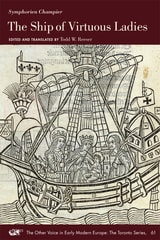
The Ship of Virtuous Ladies
Symphorien Champier
Iter Press, 2018

The Shipwreck of Their Hopes
The Battles for ChattanoogaPeter Cozzens
University of Illinois Press, 1994
Civil War enthusiasts will welcome this concluding volume of Peter Cozzens's highly praised trilogy on the Civil War in the West.
The battle around Chattanooga in the late fall of 1863 were among the most decisive of the Civil War, opening the Deep South to the Union and setting the stage for the Atlanta campaign and the March to the Sea. After Chattanooga, the principal Confederate army in the West fought without spirit or hope of victory. Cozzens's comprehensive account details movements of individual regiments, even as it reveals the larger impact of the campaign on the outcome of the war.
In The Shipwreck of Their Hopes, Cozzens draws on his acclaimed storytelling skills and exhaustive research efforts to fully chronicle one of the South's most humiliating defeats. As in his earlier books, he brings to life the officers and enlisted men who fought the war.
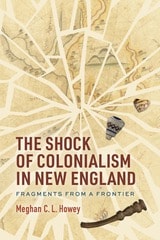
The Shock of Colonialism in New England
Fragments from a FrontierMeghan C. L. Howey
University of Alabama Press, 2025
Explores the untold impacts of colonialism in New England through diverse colonist lives, Indigenous encounters, and environmental legacies.
In The Shock of Colonialism in New England, archaeologist Meghan C. L. Howey uses excavations in the seventeenth-century colonial frontier of the Great Bay Estuary/P8bagok in today’s New Hampshire to trace the connection between European global colonialism and the planetary climate crises. Howey shows how this landscape holds forgotten stories of what it meant to live through the shock of colonialism.
These stories reveal an unexpected diversity and dynamism among English colonists, multifaceted encounters with Indigenous peoples, and lasting environmental damage from labor-intensive industries. Early Euro-American maps and stunning archaeological finds, such as a broken pickaxe embedded in a hearth, and a historical marker for the Oyster River “Massacre” of 1694 complicate our limited views of a shared past.
The reality of English colonialism in the dispossession of Indigenous lands and its wake is not commemorated. Howey’s work is a powerful corrective that traces the rise of intergenerational colonial wealth made possible by land commodified as property, the increased labor required to work newly opened land, the importation of indentured Scots and enslaved Africans to provide that labor, and the resulting degradation of the natural environment. Through Howey’s insights into the stories they tell, these fragments from a frontier can help contemporary readers better understand the past as they seek a more just and sustainable future.