1116 books match the query 'Africa' and 16 start with u
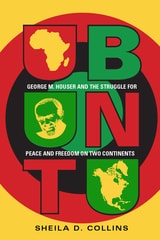
cover of Ubuntu: George M. Houser and the Struggle for Peace and Freedom on Two Continents

Ubuntu

George M. Houser and the Struggle for Peace and Freedom on Two Continents

Sheila D. Collins

Ohio University Press, 2020

This remarkable biography features a white American pacifist minister whose tireless work for justice and human rights helped reshape Black civil rights in the U.S. and Africa.

George M. Houser (1916–2015) was one of the most important civil rights and antiwar activists of the twentieth century. A conscientious objector during World War II, in 1942 Houser cofounded and led the Congress of Racial Equality (CORE), whose embrace of nonviolent protest strategies and tactics characterized the modern American Civil Rights Movement. Beginning in the 1950s, Houser played a critical role in pan-Africanist anticolonial movements, and his more than thirty-year dedication to the cause of human rights and self-determination helped prepare the ground for the toppling of the South African apartheid regime.

Throughout his life, Houser shunned publicity, preferring to let his actions speak his faith. Sheila Collins’s well-researched biography recounts the events that informed Houser’s life of activism—from his childhood experiences as the son of missionaries in the Philippines to his early grounding in the Social Gospel and the teachings of Mohandas Gandhi. In light of the corruption the U.S. and the world face today, Houser’s story of faith and decisive action for human rights and social justice is one for our time.

[more]
cover of Uganda Now: Between Decay and Development

Uganda Now

Between Decay and Development

Hölger Bernt Hansen

Ohio University Press, 1988

Can the revolutionary government of Yoweri Museveni’s National Resistance Movement put Uganda back on the road from decay to development?

These informed assessments put the present situation in context. The contributors assembled as Museveni’s guerrillas were launching their final bid for power. They have finalized their contributions in the light of the Museveni government’s initial period of power.

Contributions by Ugandan academics and politicians interlock with those by scholars from across the world who have a concern for Uganda. Historians examine the period of colonialism. There are political studies of the quarter century since independence. There are detailed analyses of the economic realities for the Ugandan government in the period of international debt. The central role of education in national development is given due prominence.

Ali A. Mazrui ends the book by asking ‘Is Africa Decaying?’ The editors have put the consideration of the case of Uganda’s recent history within the context of Africa’s development crisis. Uganda has presented in an aggravated form the crisis common to many other African countries: infrastructural breakdown, mounting foreign debt, military regimes and waves of refugees.
[more]
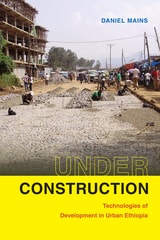
cover of Under Construction: Technologies of Development in Urban Ethiopia

Under Construction

Technologies of Development in Urban Ethiopia

Daniel Mains

Duke University Press, 2019
Over the past decade, Ethiopia has had one of the world's fastest growing economies, largely due to its investments in infrastructure, and it is through building dams, roads, and other infrastructure that the Ethiopian state seeks to become a middle-income country by 2025. Yet most urban Ethiopians struggle to meet their daily needs and actively oppose a ruling party that they associate with corruption and mismanagement. In Under Construction Daniel Mains explores the intersection of development and governance by examining the conflicts surrounding the construction of specific infrastructural technologies: asphalt and cobblestone roads, motorcycle taxis, and hydroelectric dams. These projects serve as sites for nation building and the means for the state to assert its legitimacy. The construction process—as well as Ethiopians' experience of living with the disruption of construction zones—reveals the tension and conflict between the promise of progress and the possibility of failure. Mains demonstrates how infrastructures as both ethnographic sites and as a means of theorizing such concepts as progress, development, and the state offer a valuable contrast to accounts of African abjection and decline.
[more]
cover of Under the Kapok Tree: Identity and Difference in Beng Thought

Under the Kapok Tree

Identity and Difference in Beng Thought

Alma Gottlieb

University of Chicago Press, 1996

In this companion volume to Parallel Worlds, Alma Gottlieb
explores ideology and social practices among the Beng people of Côte
d'Ivoire. Employing symbolic and postmodern perspectives, she highlights
the dynamically paired notions of identity and difference, symbolized by
the kapok tree planted at the center of every Beng village.

"This book merits a number of readings. . . . An experiment in
ethnography that future projects might well emulate." —Clarke K. Speed,
American Anthropologist

"[An] evocative, rich ethnography. . . . Gottlieb does anthropology a
real service." —Misty L. Bastian, American Ethnologist

"Richly detailed. . . . This book offers a nuanced descriptive analysis
which commands authority." —Elizabeth Tonkin, Man

"Exemplary. . . . Gottlieb's observations on identity and difference are
not confined to rituals or other special occasions; rather she shows
that these principles emerge with equal force during daily social life."
—Monni Adams, Journal of African Religion

"[An] excellent study." —John McCall, Journal of Folklore
Research
[more]
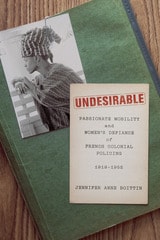
cover of Undesirable: Passionate Mobility and Women’s Defiance of French Colonial Policing, 1919–1952

Undesirable

Passionate Mobility and Women’s Defiance of French Colonial Policing, 1919–1952

Jennifer Anne Boittin

University of Chicago Press, 2022

Archival research into policing and surveillance of migrant women illuminates pressing contemporary issues.

Examining little-known policing archives in France, Senegal, and Cambodia, Jennifer Anne Boittin unearths the stories of hundreds of women labeled “undesirable” by the French colonial police and society in the early twentieth century. These “undesirables” were often women traveling alone, women who were poor or ill, women of color, or women whose intimate lives were deemed unruly. To refute the label and be able to move freely, they spoke out or wrote impassioned letters: some emphasized their “undesirable” qualities to suggest that they needed the care and protection of the state to support their movements, while others used the empire’s own laws around Frenchness and mobility to challenge state or societal interference. Tacking between advocacy and supplication, these women summoned intimate details to move beyond, contest, or confound surveillance efforts, bringing to life a practice that Boittin terms “passionate mobility.” In considering how ordinary women pursued autonomy, security, companionship, or simply a better existence in the face of surveillance and control, Undesirable illuminates pressing contemporary issues of migration and violence.
[more]
cover of Unfixed: Photography and Decolonial Imagination in West Africa

Unfixed

Photography and Decolonial Imagination in West Africa

Jennifer Bajorek

Duke University Press, 2020
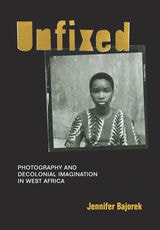
In Unfixed Jennifer Bajorek traces the relationship between photography and decolonial political imagination in Francophone west Africa in the years immediately leading up to and following independence from French colonial rule in 1960. Focusing on images created by photographers based in Senegal and Benin, Bajorek draws on formal analyses of images and ethnographic fieldwork with photographers to show how photography not only reflected but also actively contributed to social and political change. The proliferation of photographic imagery—through studio portraiture, bureaucratic ID cards, political reportage and photojournalism, magazines, and more—provided the means for west Africans to express their experiences, shape public and political discourse, and reimagine their world. In delineating how west Africans' embrace of photography was associated with and helped spur the democratization of political participation and the development of labor and liberation movements, Bajorek tells a new history of photography in west Africa—one that theorizes photography's capacity for doing decolonial work.
[more]
cover of Unhappy Valley, Book One: Conflict in Kenya & Africa

Unhappy Valley, Book One

Conflict in Kenya & Africa

Bruce Berman

Ohio University Press, 1992

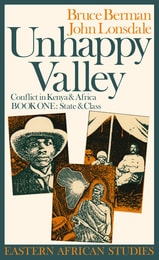
This long-awaited book is a considerable revision in the understanding of the history of colonial Kenya and, more widely, colonialism in Africa. There is a substantial amount of new work and this is interlocked with shared areas of concern that the authors have been exploring since 1976.

The authors investigate major themes. These include the conquest origins and subsequent development of the colonial state, the contradictory social forces that articulated African societies to European capitalism, and the creation of new political communities and changing meanings of ethnicity in Africa, in the context of social differentiation and class formation. There is substantial new work on the problems of Mau Mau and of wealth, poverty and civic virtue in Kikuyu political thought.

The authors make a fresh contribution to a deeper historical understanding of the development of contemporary Kenyan society and, in particular, of the British and Kukuyu origins of Mau Mau and the emergency of the 1950s.

They also highlight some of the shortcomings of ideas about development, explore the limitations of narrowly structuralist Marxist theory of the state, and reflect on the role of history in the future of Africa.

Book One on State and Class will be used by students of African history as well as of colonial Kenya; it is also concerned with the theory of history and of political science.
[more]
cover of Unhappy Valley, Book Two: Conflict in Kenya & Africa

Unhappy Valley, Book Two

Conflict in Kenya & Africa

Bruce Berman

Ohio University Press, 1992

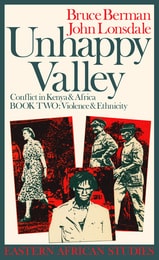
This long-awaited book is a considerable revision in the understanding of the history of colonial Kenya and, more widely, colonialism in Africa. There is a substantial amount of new work and this is interlocked with shared areas of concern that the authors have been exploring since 1976.

The authors investigate major themes. These include the conquest origins and subsequent development of the colonial state, the contradictory social forces that articulated African societies to European capitalism, and the creation of new political communities and changing meanings of ethnicity in Africa, in the context of social differentiation and class formation. There is substantial new work on the problems of Mau Mau and of wealth, poverty and civic virtue in Kikuyu political thought.

The authors make a fresh contribution to a deeper historical understanding of the development of contemporary Kenyan society and, in particular, of the British and Kukuyu origins of Mau Mau and the emergency of the 1950s.

They also highlight some of the shortcomings of ideas about development, explore the limitations of narrowly structuralist Marxist theory of the state, and reflect on the role of history in the future of Africa.

Book Two on Violence and Ethnicity gives new insights into popular consciousness, into revolutionary change and into the subtle realities of ethnicity; it will be of particular value to readers of Ngugi.
[more]
cover of Unhappy Valley: Clan, Class & State In Colonial Kenya

Unhappy Valley

Clan, Class & State In Colonial Kenya

Bruce Berman

Ohio University Press, 1991
[more]
cover of Unmasking the State: Making Guinea Modern

Unmasking the State

Making Guinea Modern

Mike McGovern

University of Chicago Press, 2012
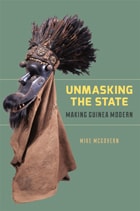
When the Republic of Guinea gained independence in 1958, one of the first policies of the new state was a village-to-village eradication of masks and other ritual objects it deemed “fetishes.” The Demystification Program, as it was called, was so urgent it even preceded the building of a national road system. In Unmasking the State, Mike McGovern attempts to understand why this program was so important to the emerging state and examines the complex role it had in creating a unified national identity. In doing so, he tells a dramatic story of cat and mouse where minority groups cling desperately to their important— and outlawed—customs.
 
Primarily focused on the communities in the country’s southeastern rainforest region—people known as Forestiers—the Demystification Program operated via a paradox. At the same time it banned rituals from Forestiers’ day-to-day lives, it appropriated them into a state-sponsored program of folklorization. McGovern points to an important purpose for this: by objectifying this polytheistic group’s rituals, the state created a viable counterexample against which the Muslim majority could define proper modernity. Describing the intertwined relationship between national and local identity making, McGovern showcases the coercive power and the unintended consequences involved when states attempt to engineer culture.
[more]
cover of Unpopular Sovereignty: Rhodesian Independence and African Decolonization

Unpopular Sovereignty

Rhodesian Independence and African Decolonization

Luise White

University of Chicago Press, 2015

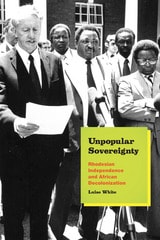
In 1965 the white minority government of Rhodesia (after 1980 Zimbabwe) issued a unilateral declaration of independence from Britain, rather than negotiate a transition to majority rule. In doing so, Rhodesia became the exception, if not anathema, to the policies and practices of the end of empire. In Unpopular Sovereignty, Luise White shows that the exception that was Rhodesian independence did not, in fact, make the state that different from new nations elsewhere in Africa: indeed, this history of Rhodesian political practices reveals some of the commonalities of mid-twentieth-century thinking about place and race and how much government should link the two.  

White locates Rhodesia’s independence in the era of decolonization in Africa, a time of great intellectual ferment in ideas about race, citizenship, and freedom. She shows that racists and reactionaries were just as concerned with questions of sovereignty and legitimacy as African nationalists were and took special care to design voter qualifications that could preserve their version of legal statecraft. Examining how the Rhodesian state managed its own governance and electoral politics, she casts an oblique and revealing light by which to rethink the narratives of decolonization.
[more]
cover of Unreasonable Histories: Nativism, Multiracial Lives, and the Genealogical Imagination in British Africa

Unreasonable Histories

Nativism, Multiracial Lives, and the Genealogical Imagination in British Africa

Christopher J. Lee

Duke University Press, 2015
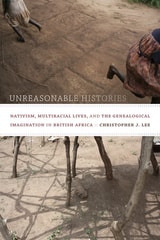
In Unreasonable Histories, Christopher J. Lee unsettles the parameters and content of African studies as currently understood. At the book's core are the experiences of multiracial Africans in British Central Africa—contemporary Malawi, Zimbabwe, and Zambia—from the 1910s to the 1960s. Drawing on a spectrum of evidence—including organizational documents, court records, personal letters, commission reports, popular periodicals, photographs, and oral testimony—Lee traces the emergence of Anglo-African, Euro-African, and Eurafrican subjectivities which constituted a grassroots Afro-Britishness that defied colonial categories of native and non-native. Discriminated against and often impoverished, these subaltern communities crafted a genealogical imagination that reconfigured kinship and racial descent to make political claims and generate affective meaning. But these critical histories equally confront a postcolonial reason that has occluded these experiences, highlighting uneven imperial legacies that still remain. Based on research in five countries, Unreasonable Histories ultimately revisits foundational questions in the field, to argue for the continent's diverse heritage and to redefine the meanings of being African in the past and present—and for the future.
[more]
cover of Unruly Ideas: A History of Kitawala in Congo

Unruly Ideas

A History of Kitawala in Congo

Nicole Eggers

Ohio University Press, 2023
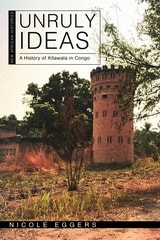
Unruly Ideas: A History of Kitawala in Congo recounts the multifaceted history of the Congolese religious movement Kitawala from its colonial beginnings in the 1920s through its continued practice in some of the most conflict-riven parts of the eastern Democratic Republic of Congo today. Drawing on a rich body of original oral, ethnographic, and archival research, Nicole Eggers uses Kitawala as a lens through which to address the complex relationship between politics, religion, healing, and violence in central African history. Kitawala, which has roots in the African Watchtower (Jehovah’s Witness) movement, has long been viewed both by scholars and by popular historians as a form of male-dominated, anticolonial insurgency. But just as Kitawalists were never exclusively male, their teachings and activities were never directed solely at the Belgian colonial state, and their yearnings for self-rule were never entirely about the secular realms of authority. A more comprehensive look at the oral and archival evidence reveals they were and are concerned with the morality of power more broadly: on state, communal, and individual levels. Moreover, Kitawalist doctrine is itself unruly, and its preachers, prophets, and practitioners have articulated innumerable interpretations—most quite different from Watchtower Christianity—across space and time. More than a case study of a particular religious movement, Unruly Ideas is a conceptual history of power that investigates how communities and individuals in the region have historically imagined power, sought to access it, wielded it, and policed the morality of its uses. By focusing on power and its intellectual and social history in Congo, Unruly Ideas creates an analytical space in which readers can understand the differing manifestations of Kitawala—from its overtly political and sometimes violent moments to those more aptly characterized as individual quests for spiritual and physical therapy—as varying themes in the same story: the pursuit of wellness in the context of malady. On a more practical level, the book raises important questions about the project of writing histories of places like eastern Congo: a region where the repercussions of decades of political neglect, upheaval, and violence force us to reconsider how we can think about and use oral and archival sources. Finally, the book investigates the embodied and gendered nature of field research and interrogates the intersubjective and reciprocal nature of knowledge production.
[more]
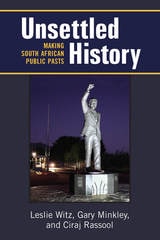
cover of Unsettled History: Making South African Public Pasts

Unsettled History

Making South African Public Pasts

Leslie Witz, Gary Minkley, and Ciraj Rassool

University of Michigan Press, 2017

Unsettled History examines South African society and the construction and presentation of its public pasts, from Nelson Mandela’s release from prison in 1990 to South Africa’s hosting of the 2010 FIFA World Cup ®. Conventionally represented as a time of rectifying the silences and distortions of settler history through inclusion and recovery, the focus here instead is on the shifts in processes and locations of historicizing and the unsettled state of categories of framing history in post-apartheid South Africa. This era saw fundamental transformations in the order of knowledge: from the academy to the public; from popular history to public history; from history-as-lesson to history-as-forum.

Leslie Witz, Gary Minkley, and Ciraj Rassool take the reader to sites of historical production in which complex ideas about pasts are invoked, and navigate a path toward understanding the agencies of image-making and memory production. This volume is the outcome of the authors’ intensive collaborative research and engagement over twenty-five years on questions including the production and performance of apartheid history; the cultural politics of social history; South Africa’s Truth and Reconciliation Commission and practices of orality; tourism as an arena of image-making and historical construction; museums as sites of heritage production for a new South Africa; photographs, archival meanings, and the construction of the social documentary; and the centenary commemorations of the South African War and the making of race. The authors not only witnessed many of these instances of history-making but were also participants in their constitution.

 
[more]
cover of Ups and Downs of Life in the Indies

Ups and Downs of Life in the Indies

P. A. Daum

University of Massachusetts Press, 1987
Written by one of the most realistic colonial authors of his time, his naturalistic novel presents a vivid portrait of colonial life on the island of Java in the late ninteenth-century. P.A. Daum (1850-98) was editor of popular newspaper in central Java. In 1883 he began to write novels under the pseudonym "Maurits" and serialized them in his paper. Over a ten year period he produced ten novels, all of them written in unadorned style and concerned with the vicissitudes of Dutch colonial life. His work is known for its direct style, sense of humor, and psychological portraiture. He is a perceptive observer with an eye for detail and a fine ear for the rhythms of speech in the East Indies.
[more]
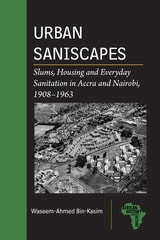
cover of Urban Saniscapes: Slums, Housing and Everyday Sanitation in  Accra and Nairobi, 1908–1963

Urban Saniscapes

Slums, Housing and Everyday Sanitation in Accra and Nairobi, 1908–1963

Waseem-Ahmed Bin-Kasim

Michigan State University Press, 2025

In this comparative study, Bin-Kasim examines environmental sanitation in the historical development of Accra and Nairobi, the capitals of the Gold Coast (Ghana) and Kenya. This book traces the approaches to sanitation during colonial rule and urban growth throughout the first half of the twentieth century and beyond. From the consolidation of the colonial regimes to the Great Depression, urbanization waves, and postwar development, sanitation was both a cause and a consequence of the built environment. Bin-Kasim characterizes this complex relationship between sanitation and urban growth over time as the 'saniscape.' The saniscape is the confluence of public health, planning interventions, and various urban constituencies, and includes an array of influences like colonial expertise and African industry, which shaped the two cities regardless of their power dynamics and land tenure. Attention to the saniscape validates how Africans called out colonial discrimination and inefficiencies to intervene and shape cities. This volume highlights the shared histories of Accra and Nairobi and upends conventional narratives that attach too much difference to non-settler and settler colonialism.
[more]