1563 books match the query 'African American & Black Studies' and 20 start with u
cover of Un-American: W.E.B. Du Bois and the Century of World Revolution

Un-American

W.E.B. Du Bois and the Century of World Revolution

Bill V Mullen

Temple University Press, 2015

Un-American is Bill Mullen’s revisionist account of renowned author and activist W.E.B. Du Bois’s political thought toward the end of his life, a period largely dismissed and neglected by scholars. He describes Du Bois’s support for what the Communist International called “world revolution” as the primary objective of this aged radical’s activism. Du Bois was a champion of the world’s laboring millions and critic of the Cold War, a man dedicated to animating global political revolution.

Mullen argues that Du Bois believed that the Cold War stalemate could create the conditions in which the world powers could achieve not only peace but workers’ democracy. Un-American shows Du Bois to be deeply engaged in international networks and personal relationships with revolutionaries in India, China, and Africa. Mullen explores how thinkers like Karl Marx, Jawaharlal Nehru, Mohandas Gandhi, and C.L.R. James helped him develop a theory of world revolution at a stage in his life when most commentators regard him as marginalized. This original political biography also challenges assessments of Du Bois as an American “race man.”
[more]
cover of Uncivil Rights: Teachers, Unions, and Race in the Battle for School Equity

Uncivil Rights

Teachers, Unions, and Race in the Battle for School Equity

Jonna Perrillo

University of Chicago Press, 2012
Almost fifty years after Brown v. Board of Education, a wealth of research shows that minority students continue to receive an unequal education. At the heart of this inequality is a complex and often conflicted relationship between teachers and civil rights activists, examined fully for the first time in Jonna Perrillo’s Uncivil Rights, which traces the tensions between the two groups in New York City from the Great Depression to the present.
While movements for teachers’ rights and civil rights were not always in conflict, Perrillo uncovers the ways they have become so, brought about both by teachers who have come to see civil rights efforts as detracting from or competing with their own goals and by civil rights activists whose aims have de-professionalized the role of the educator. Focusing in particular on unionized teachers, Perrillo finds a new vantage point from which to examine the relationship between school and community, showing how in this struggle, educators, activists, and especially our students have lost out. 
[more]
cover of Uncle Tom's Cabins: The Transnational History of America's Most Mutable Book

Uncle Tom's Cabins

The Transnational History of America's Most Mutable Book

Tracy C. Davis and Stefka Mihaylova, Editors

University of Michigan Press, 2018

As Harriet Beecher Stowe’s novel Uncle Tom’s Cabin traveled around the world, it was molded by the imaginations and needs of international audiences. For over 150 years it has been coopted for a dazzling array of causes far from what its author envisioned. This book tells thirteen variants of Uncle Tom’s journey, explicating the novel’s significance for Canadian abolitionists and the Liberian political elite that constituted the runaway characters’ landing points; nineteenth-century French theatergoers; liberal Cuban, Romanian, and Spanish intellectuals and social reformers; Dutch colonizers and Filipino nationalists in Southeast Asia; Eastern European Cold War communists; Muslim readers and spectators in the Middle East; Brazilian television audiences; and twentieth-century German holidaymakers.

Throughout these encounters, Stowe’s story of American slavery serves as a paradigm for understanding oppression, selectively and strategically refracting the African American slave onto other iconic victims and freedom fighters. The book brings together performance historians, literary critics, and media theorists to demonstrate how the myriad cultural and political effects of Stowe’s enduring story has transformed it into a global metanarrative with national, regional, and local specificity.
[more]
cover of Under a Bad Sign: Criminal Self-Representation in African American Popular Culture

Under a Bad Sign

Criminal Self-Representation in African American Popular Culture

Jonathan Munby

University of Chicago Press, 2011

What accounts for the persistence of the figure of the black criminal in popular culture created by African Americans? Unearthing the overlooked history of art that has often seemed at odds with the politics of civil rights and racial advancement, Under a Bad Sign explores the rationale behind this tradition of criminal self-representation from the Harlem Renaissance to contemporary gangsta culture.

In this lively exploration, Jonathan Munby takes a uniquely broad view, laying bare the way the criminal appears within and moves among literary, musical, and visual arts. Munby traces the legacy of badness in Rudolph Fisher and Chester Himes’s detective fiction and in Claude McKay, Julian Mayfield, and Donald Goines’s urban experience writing. Ranging from Peetie Wheatstraw’s gangster blues to gangsta rap, he also examines criminals in popular songs. Turning to the screen, the underworld films of Oscar Micheaux and Ralph Cooper, the 1970s blaxploitation cycle, and the 1990s hood movie come under his microscope as well. Ultimately, Munby concludes that this tradition has been a misunderstood aspect of African American civic life and that, rather than undermining black culture, it forms a rich and enduring response to being outcast in America.
[more]
cover of Under a Black Star: The Maroon Impulse in New Orleans

Under a Black Star

The Maroon Impulse in New Orleans

Amari Johnson

University of Minnesota Press, 2025

Uncovering the spirit of freedom and self-determination in New Orleans

In Under a Black Star, Amari Johnson explores what he defines as the “maroon impulse” among the BlackStar Community in the Algiers neighborhood of New Orleans. This community sought autonomy for Black people facing systemic marginalization through denied employment, insufficient education, and a housing crisis following Hurricane Katrina, establishing initiatives such as Kamali Academy, a homeschool collective, and BlackStar Books and Caffé, a bookstore and gathering place. Instead of appealing to the city, they built the community they desired by employing legacies of marronage: disengagement, flight, and reengagement.

An active participant in the physical and ideological development of these autonomous spaces, Johnson provides nuanced insights into the community’s work toward liberation and self-determination. Demonstrating that marronage is a cultural tradition throughout the African Diaspora, he focuses on the transtemporal maroon process to show how it is central to the pursuit of autonomy, community, and freedom.

From the swamps of southeastern Louisiana, across urban obstacles, and into BlackStar’s creative spaces, Johnson’s path leads him to ask: How did the New Orleans community mobilize the tradition of marronage to create autonomous spaces amid gentrification? What forms might the maroon impulse take in the twenty-first century? This dynamic ethnographic memoir ultimately illuminates marronage as a potent form of liberatory potential, offering strategies for similar communities across the country and around the world.
[more]
cover of Understanding and Teaching American Slavery

Understanding and Teaching American Slavery

Edited by Bethany Jay and Cynthia Lynn Lyerly, Foreword by Ira Berlin

University of Wisconsin Press, 2016

Perhaps no topic in U.S. history is as emotionally fraught as the nation’s centuries-long entanglement with slavery. How can teachers get students to understand the racist underpinnings of that institution—and to acknowledge its legacies in contemporary America? How can they overcome students’ shame, anger, guilt, or denial? How can they incorporate into the classroom important primary sources that may contain obsolete and racist terms, images, and ideas? This book, designed for college and high school teachers, is a critical resource for understanding and teaching this challenging topic in all its complexity.
            Opening with Ira Berlin’s reflections on ten elements that are essential to include in any course on this topic, Understanding and Teaching American Slavery offers practical advice for teaching specific content, utilizing sources, and getting students to think critically. Contributors address, among other topics, slavery and the nation’s founders, the diverse experiences of the enslaved, slavery’s role in the Civil War, and the relationship between slavery and the northern economy. Other chapters offer ideas for teaching through slave narratives, runaway ads, spirituals, films, and material culture. Taken together, the essays in the volume help instructors tackle problems, discover opportunities, and guide students in grappling with the ugliest truths of America’s past.
[more]
cover of Understanding and Teaching the Civil Rights Movement

Understanding and Teaching the Civil Rights Movement

Hasan Kwame Jeffries

University of Wisconsin Press, 2019

The civil rights movement transformed the United States in such fundamental ways that exploring it in the classroom can pose real challenges for instructors and students alike. Speaking to the critical pedagogical need to teach civil rights history accurately and effectively, this volume goes beyond the usual focus on iconic leaders of the 1950s and 1960s to examine the broadly configured origins, evolution, and outcomes of African Americans' struggle for freedom. Essays provide strategies for teaching famous and forgotten civil rights people and places, suggestions for using music and movies, frameworks for teaching self-defense and activism outside the South, a curriculum guide for examining the Black Panther Party, and more.
Books in the popular Harvey Goldberg Series provide high school and introductory college-level instructors with ample resources and strategies for better engaging students in critical, thought-provoking topics. By allowing for the implementation of a more nuanced curriculum, this is history instruction at its best. Understanding and Teaching the Civil Rights Movement will transform how the United States civil rights movement is taught.
[more]
cover of Underworld Work: Black Atlantic Religion Making in Jim Crow New Orleans

Underworld Work

Black Atlantic Religion Making in Jim Crow New Orleans

Ahmad Greene-Hayes

University of Chicago Press, 2025

A rethinking of African American religious history that focuses on the development and evolution of Africana spiritual traditions in Jim Crow New Orleans.
 
When Zora Neale Hurston traveled to New Orleans, she encountered a religious underworld, a beautiful anarchy of spiritual life. In Underworld Work, Ahmad Greene-Hayes follows Hurston on a journey through the rich tapestry of Black religious expression from emancipation through Jim Crow. He looks within and beyond the church to recover the diverse leadership of migrants, healers, dissidents, and queer people who transformed their marginalized homes, bars, and street corners into sacred space.  

Greene-Hayes shows how, while enclosed within an anti-black world, these outcasts embraced Africana esotericisms—ancestral veneration, faith healing, spiritualized sex work, and more—to conjure a connection to freer worlds past and yet to come. In recovering these spiritual innovations, Underworld Work celebrates the resilience and creativity of Africana religions.
[more]
cover of Unequal City: Race, Schools, and Perceptions of Injustice

Unequal City

Race, Schools, and Perceptions of Injustice

Carla Shedd is assistant professor of sociology and African American studies at Columbia University.

Russell Sage Foundation, 2015

Chicago has long struggled with racial residential segregation, high rates of poverty, and deepening class stratification, and it can be a challenging place for adolescents to grow up. Unequal City examines the ways in which Chicago’s most vulnerable residents navigate their neighborhoods, life opportunities, and encounters with the law. In this pioneering analysis of the intersection of race, place, and opportunity, sociologist and criminal justice expert Carla Shedd illuminates how schools either reinforce or ameliorate the social inequalities that shape the worlds of these adolescents.

Shedd draws from an array of data and in-depth interviews with Chicago youth to offer new insight into this understudied group. Focusing on four public high schools with differing student bodies, Shedd reveals how the predominantly low-income African American students at one school encounter obstacles their more affluent, white counterparts on the other side of the city do not face. Teens often travel long distances to attend school which, due to Chicago’s segregated and highly unequal neighborhoods, can involve crossing class, race, and gang lines. As Shedd explains, the disadvantaged teens who traverse these boundaries daily develop a keen “perception of injustice,” or the recognition that their economic and educational opportunities are restricted by their place in the social hierarchy.

Adolescents’ worldviews are also influenced by encounters with law enforcement while traveling to school and during school hours. Shedd tracks the rise of metal detectors, surveillance cameras, and pat-downs at certain Chicago schools. Along with police procedures like stop-and-frisk, these prison-like practices lead to distrust of authority and feelings of powerlessness among the adolescents who experience mistreatment either firsthand or vicariously. Shedd finds that the racial composition of the student body profoundly shapes students’ perceptions of injustice. The more diverse a school is, the more likely its students of color will recognize whether they are subject to discriminatory treatment. By contrast, African American and Hispanic youth whose schools and neighborhoods are both highly segregated and highly policed are less likely to understand their individual and group disadvantage due to their lack of exposure to youth of differing backgrounds.

[more]
cover of Unequal under Law: Race in the War on Drugs

Unequal under Law

Race in the War on Drugs

Doris Marie Provine

University of Chicago Press, 2007

Race is clearly a factor in government efforts to control dangerous drugs, but the precise ways that race affects drug laws remain difficult to pinpoint. Illuminating this elusive relationship, Unequal under Law lays out how decades of both manifest and latent racism helped shape a punitive U.S. drug policy whose onerous impact on racial minorities has been willfully ignored by Congress and the courts.

Doris Marie Provine’s engaging analysis traces the history of race in anti-drug efforts from the temperance movement of the early 1900s to the crack scare of the late twentieth century, showing how campaigns to criminalize drug use have always conjured images of feared minorities. Explaining how alarm over a threatening black drug trade fueled support in the 1980s for a mandatory minimum sentencing scheme of unprecedented severity, Provine contends that while our drug laws may no longer be racist by design, they remain racist in design. Moreover, their racial origins have long been ignored by every branch of government. This dangerous denial threatens our constitutional guarantee of equal protection of law and mutes a much-needed national discussion about institutionalized racism—a discussion that Unequal under Law promises to initiate.
[more]
cover of Uneven Encounters: Making Race and Nation in Brazil and the United States

Uneven Encounters

Making Race and Nation in Brazil and the United States

Micol Seigel

Duke University Press, 2009

In Uneven Encounters, Micol Seigel chronicles the exchange of popular culture between Brazil and the United States in the years between the World Wars, and demonstrates how that exchange affected ideas of race and nation in both countries. From Americans interpreting advertisements for Brazilian coffee or dancing the Brazilian maxixe, to Rio musicians embracing the “foreign” qualities of jazz, Seigel traces a lively, cultural back and forth. Along the way, she shows how race and nation for both elites and non-elites are constructed together, and driven by global cultural and intellectual currents as well as local, regional, and national ones.

Seigel explores the circulation of images of Brazilian coffee and of maxixe in the United States during the period just after the imperial expansions of the early twentieth century. Exoticist interpretations structured North Americans’ paradoxical sense of themselves as productive “consumer citizens.” Some people, however, could not simply assume the privileges of citizenship. In their struggles against racism, Afro-descended citizens living in Rio de Janeiro, São Paulo, New York, and Chicago encountered images and notions of each other, and found them useful. Seigel introduces readers to cosmopolitan Afro-Brazilians and African Americans who rarely traveled far from home but who nonetheless absorbed ideas from abroad. She suggests that studies comparing U.S. and Brazilian racial identities as two distinct constructions are misconceived. Racial formation transcends national borders; attempts to understand it must do the same.
[more]
cover of Universal Tonality: The Life and Music of William Parker

Universal Tonality

The Life and Music of William Parker

Cisco Bradley

Duke University Press, 2021
Since ascending onto the world stage in the 1990s as one of the premier bassists and composers of his generation, William Parker has perpetually toured around the world and released over forty albums as a leader. He is one of the most influential jazz artists alive today. In Universal Tonality historian and critic Cisco Bradley tells the story of Parker’s life and music. Drawing on interviews with Parker and his collaborators, Bradley traces Parker’s ancestral roots in West Africa via the Carolinas to his childhood in the South Bronx, and illustrates his rise from the 1970s jazz lofts and extended work with pianist Cecil Taylor to the present day. He outlines how Parker’s early influences—Ornette Coleman, John Coltrane, Albert Ayler, and writers of the Black Arts Movement—grounded Parker’s aesthetic and musical practice in a commitment to community and the struggle for justice and freedom. Throughout, Bradley foregrounds Parker’s understanding of music, the role of the artist, and the relationship between art, politics, and social transformation. Intimate and capacious, Universal Tonality is the definitive work on Parker’s life and music.
[more]
cover of Unjustly Dishonored: An African American Division in World War I

Unjustly Dishonored

An African American Division in World War I

Robert H. Ferrell

University of Missouri Press, 2026
For nearly one hundred years, the 92nd Division of the U.S. Army in World War I has been remembered as a military failure. The division should have been historically significant. It was the only African American division of the American Expeditionary Forces in France. Comprised of nearly twenty-eight thousand black soldiers, it fought in two sectors of the great battle of the Meuse-Argonne, the largest and most costly battle in all of U.S. history. Unfortunately, when part of the 368th Infantry Regiment collapsed in the battle’s first days, the entire division received a blow to its reputation from which it never recovered.      
 
In Unjustly Dishonored: An African American Division in World War I, Robert H. Ferrell challenges long-held assumptions and asserts that the 92nd, in fact, performed quite well militarily. His investigation was made possible by the recent recovery of a wealth of records by the National Archives. The retrieval of lost documents allowed access to hundreds of pages of interviews, mostly from the 92nd Division’s officers, that had never before been considered. In addition, the book uses the Army’s personal records from the Army War College, including the newly discovered report on the 92nd’s field artillery brigade by the enthusiastic commanding general.
 
In the first of its sectors, the Argonne, the 92nd took its objective. Its engineer regiment was a large success, and when its artillery brigade got into action, it so pleased its general that he could not praise it enough. In the attack of General John J. Pershing’s Second Army during the last days of the war, the 92nd captured the Bois Frehaut, the best performance of any division of the Second Army.
 
This book is the first full-length account of the actual accomplishments of the 92nd Division. By framing the military outfit’s reputation against cultural context, historical accounts, and social stigmas, the author proves that the 92nd Division did not fail and made a valuable contribution to history that should, and now finally can, be acknowledged. Unjustly Dishonored fills a void in the scholarship on African American military history and World War I studies.
[more]
cover of Unlearning the Hush: Oral Histories of Black Female Educators in Mississippi in the Civil Rights Era

Unlearning the Hush

Oral Histories of Black Female Educators in Mississippi in the Civil Rights Era

Marlee S. Bunch Foreword by Christopher M. Span

University of Illinois Press, 2025
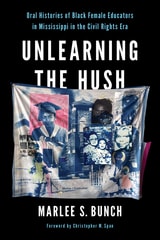
Despite significant challenges and historical opposition, Black female teachers stood at the forefront of advocating for and providing education to Black students. Their dedication not only improved opportunities for Black communities but also influenced changes in U.S. laws and societal expectations. Marlee S. Bunch draws on oral histories to illuminate the interior lives of Black female educators who taught before and after desegregation in Hattiesburg, Mississippi. In their own voices, these women detail the hurdles they faced guiding students through Jim Crow laws and Civil Rights–era desegregation. Bunch unearths the personal stories of teaching and activism during a historic time that included the Brown v. Board of Education decision and whites’ massive resistance to desegregation. The educators highlight the significance of the Black community and the role of Black homes in fostering student success and community cohesion. In addition, Bunch looks at the legacies of Black educators and the work still to be done. Visual artwork and poetry complement the text. Inspiring and immersive, Unlearning the Hush blends personal memory with Civil Rights history to document the pivotal role Black women played in education during a transformative and charged period in American history.
[more]
cover of Unsettling Sexuality: Queer Horizons in the Long Eighteenth Century

Unsettling Sexuality

Queer Horizons in the Long Eighteenth Century

Jeremy Chow

University of Delaware Press, 2025

This book is also freely available online as an open access digital edition on Manifold, here: https://openpub.udel.edu/projects/unsettling-sexuality.

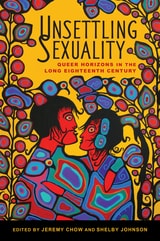
Unsettling Sexuality: Queer Horizons in the Long Eighteenth Century challenges the traditional ways that scholarship has approached sexuality, gender nonconformity, and sex (as well as its absence) in the long eighteenth century. Drawing from recent and emerging criticisms in Middle Eastern and Asian studies, Black studies, and Native American and Indigenous studies, the collected authors perform intersectional queer readings, reimagine queer historiographic methods, and spearhead new citational models that can invigorate the field. Contributors read with and against diverse European, transatlantic, and global archives to explore mutually informative frameworks of gender, sexuality, race, indigeneity, ability, and class. In charting multidirectional queer horizons, this collection locates new prospective desires and intimacies in the literature, culture, and media of the period to imagine new directions and simultaneously unsettle eighteenth-century studies.
[more]
cover of Unveiled Voices, Unvarnished Memories: The Cromwell Family in Slavery and Segregation, 1692-1972

Unveiled Voices, Unvarnished Memories

The Cromwell Family in Slavery and Segregation, 1692-1972

Adelaide M. Cromwell

University of Missouri Press, 2006
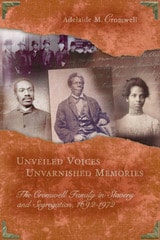
When an industrious slave named Willis Hodges Cromwell earned the money to obtain liberty for his wife—who then bought freedom for him and for their children—he set in motion a family saga that resounds today. His youngest son, John Wesley Cromwell, became an educator, lawyer, and newspaper publisher—and one of the most influential men of letters in the generation that bridged Frederick Douglass and W. E. B. Du Bois. Now, in Unveiled Voices, Unvarnished Memories, his granddaughter, Adelaide M. Cromwell, documents the journey of her family from the slave marts of Annapolis to achievements in a variety of learned professions.
John W. Cromwell began the family archives from which this book is drawn—letters and documents that provide an unprecedented view of how one black family thought, strived, and survived in American society from the seventeenth century to the twentieth. These papers reflect intimate thoughts about such topics as national and local leaders, moral behavior, color consciousness, and the challenges of everyday life in a racist society. They also convey a wealth of rich insights on the burdens that black parents’ demands for achievement placed on their children, the frequently bitter rivalries within the intellectual class of the African American community, and the negative impact on African American women of sexism in a world dominated by black men whose own hold on respect was tentative at best.
The voices gathered here give readers an inside look at the formation and networks of the African American elite, as John Cromwell forged friendships with such figures as journalist John E. Bruce and the Reverend Theophilus Gould Steward. Letters with those two faithfully depict the forces that shaped the worldview of the small but steadily expanding community of African American intellectuals who helped transform the nation’s attitudes and policies on race, and whose unguarded comments on a wide range of matters will be of particular interest to social historians. Additional correspondence between John and his son, John Jr., brings the family story into modern times.
Unveiled Voices, Unvarnished Memories is a rare look at the public and private world of individuals who refused to be circumscribed by racism and the ghetto while pursuing their own well-being. Its narrative depth breaks new ground in African American history and offers a unique primary source for that community.
[more]
cover of Uplift Cinema: The Emergence of African American Film and the Possibility of Black Modernity

Uplift Cinema

The Emergence of African American Film and the Possibility of Black Modernity

Allyson Nadia Field

Duke University Press, 2015
In Uplift Cinema, Allyson Nadia Field recovers the significant yet forgotten legacy of African American filmmaking in the 1910s. Like the racial uplift project, this cinema emphasized economic self-sufficiency, education, and respectability as the keys to African American progress. Field discusses films made at the Tuskegee and Hampton Institutes to promote education, as well as the controversial The New Era, which was an antiracist response to D. W. Griffith's The Birth of a Nation. She also shows how Black filmmakers in New York and Chicago engaged with uplift through the promotion of Black modernity. Uplift cinema developed not just as a response to onscreen racism, but constituted an original engagement with the new medium that has had a deep and lasting significance for African American cinema. Although none of these films survived, Field's examination of archival film ephemera presents a method for studying lost films that opens up new frontiers for exploring early film culture.
[more]
cover of Uprooting Racism and Racists in the United States

Uprooting Racism and Racists in the United States

James Boggs and Grace Lee Boggs

Disobedience Press, 2027

“Uprooting Racism and Racists in the United States” has become even more timely and instructive today than when James and Grace Lee Boggs first sounded the alarm in 1970. In this essay, the Boggses diagnose the “essential contradiction” of economic overdevelopment and political underdevelopment, tracing its path through key stages: how racism has been interwoven into U.S. economic development; a destructive national drive for economic growth at all costs; and how subsequent generations of Americans prioritize economics over principles—breeding a collective social irresponsibility that leaves us unable to act ethically in the face of pressing social challenges.


Today, the contradiction the Boggses identified has grown more entrenched—and its consequences more destructive. “Uprooting” helps explain why millions voted for Trump in 2024 despite his demonstrated corruption, why society fails to regulate the expansion of AI and data centers, why we are unable to forestall the climate changes that scientists have long warned against, why immigrants face racist vilification, and why the federal government is intent on erasing the centrality of race to the making of the country. Ultimately, “Uprooting” offers a crucial assessment of where this contradiction began, how it shapes the nation, and where we need to go.
[more]
cover of Urban Blues

Urban Blues

Charles Keil

University of Chicago Press, 1968

Charles Keil examines the expressive role of blues bands and performers and stresses the intense interaction between performer and audience. Profiling bluesmen Bobby Bland and B. B. King, Keil argues that they are symbols for the black community, embodying important attitudes and roles—success, strong egos, and close ties to the community. While writing Urban Blues in the mid-1960s, Keil optimistically saw this cultural expression as contributing to the rising tide of raised political consciousness in Afro-America. His new Afterword examines black music in the context of capitalism and black culture in the context of worldwide trends toward diversification.

"Enlightening. . . . [Keil] has given a provocative indication of the role of the blues singer as a focal point of ghetto community expression."—John S. Wilson, New York Times Book Review
"A terribly valuable book and a powerful one. . . . Keil is an original thinker and . . . has offered us a major breakthrough."—Studs Terkel, Chicago Tribune

"[Urban Blues] expresses authentic concern for people who are coming to realize that their past was . . . the source of meaningful cultural values."—Atlantic

"An achievement of the first magnitude. . . . He opens our eyes and introduces a world of amazingly complex musical happening."—Robert Farris Thompson, Ethnomusicology 

"[Keil's] vigorous, aggressive scholarship, lucid style and sparkling analysis stimulate the challenge. Valuable insights come from treating urban blues as artistic communication."—James A. Bonar, Boston Herald
 
[more]
cover of Urban Bush Women: Twenty Years of African American Dance Theater, Community Engagement, and Working It Out

Urban Bush Women

Twenty Years of African American Dance Theater, Community Engagement, and Working It Out

Nadine George-Graves

University of Wisconsin Press, 2010

Provocative, moving, powerful, explicit, strong, unapologetic. These are a few words that have been used to describe the groundbreaking Brooklyn-based dance troupe Urban Bush Women. Their unique aesthetic borrows from classical and contemporary dance techniques and theater characterization exercises, incorporates breath and vocalization, and employs space and movement to instill their performances with emotion and purpose. Urban Bush Women concerts are also deeply rooted in community activism, using socially conscious performances in places around the country—from the Kennedy Center, the Lincoln Center, and the Joyce, to community centers and school auditoriums—to inspire audience members to engage in neighborhood change and challenge stereotypes of gender, race, and class.
    Nadine George-Graves presents a comprehensive history of Urban Bush Women since their founding in 1984. She analyzes their complex work, drawing on interviews with current and former dancers and her own observation of and participation in Urban Bush Women rehearsals. This illustrated book captures the grace and power of the dancers in motion and provides an absorbing look at an innovative company that continues to raise the bar for socially conscious dance.
[more]