Results by title
1038 books match the query 'Antiquities' and 10 start with u
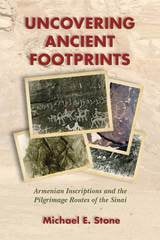
Uncovering Ancient Footprints
Armenian Inscriptions and the Pilgrimage Routes of the SinaiMichael E. Stone
SBL Press, 2017
Explore pilgrimage routes, epigraphy, and the history of writing with an expert guide
From the late 1970s through 1982, Michael E. Stone conducted a number of expeditions to the Sinai peninsula, searching for ancient inscriptions. In this book Stone describes his search, crowned by the discovery of the most ancient Armenian inscriptions known. Here Stone describes not only the inscriptions discovered along his journeys but also the Sinai, its past and present, its human inhabitants, its flora and fauna, and its history. Though once common, well-informed travel books to the Middle East with a broad academic interest and a specific focus have become rare. Stone’s diary of his expeditions in the Sinai fill this gap with vivid descriptions, poetry, and illustrations.
Features
- An account of five expeditions into the Sinai
- Thirteen poems written by Stone
- Twenty-six figures and five maps
Under the Canopy
The Archaelogy of Tropical Rain ForestsMercader, Julio
Rutgers University Press, 2002
Did our ancestors live in tropical forests? Although we see the rainforest as a bountiful environment teeming with life forms, most anthropologists and archaeologists have long viewed these areas as too harsh for human occupation during the pre-agricultural stages of hominid development.
Under the Canopy turns conventional wisdom on its head by providing a well-documented, geographically diverse overview of Stone Age sites in the wet tropics. New research indicates that, as humanity and its precursors increased their geographical and ecological ranges, rainforests were settled at a much earlier period than had previously been thought.
Featuring the work of leading scholars from Australia, Brazil, Canada, Colombia, France, Malaysia, Panama, Spain, and the United States, Under the Canopy creates a new niche in paleolithic studies: the archaeology of tropical rainforests. This book provides the first synthesis of archaeological research in early foraging sites across the rainforest zone, and indicates that tropical forests could harbor important clues to human evolution, origins of modern behavior, cultural diversity, and human impact on tropical ecosystems.
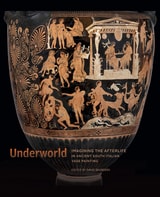
Underworld
Imagining the Afterlife in Ancient South Italian Vase PaintingDavid Saunders
J. Paul Getty Trust, The, 2022
What happens to us when we die? What might the afterlife look like? For the ancient Greeks, the dead lived on, overseen by Hades in the Underworld. We read of famous sinners, such as Sisyphus, forever rolling his rock, and the fierce guard dog Kerberos, who was captured by Herakles. For mere mortals, ritual and religion offered possibilities for ensuring a happy existence in the beyond, and some of the richest evidence for beliefs about death comes from southern Italy, where the local Italic peoples engaged with Greek beliefs. Monumental funerary vases that accompanied the deceased were decorated with consolatory scenes from myth, and around forty preserve elaborate depictions of Hades’s domain.
For the first time in over four decades, these compelling vase paintings are brought together in one volume, with detailed commentaries and ample illustrations. The catalogue is accompanied by a series of essays by leading experts in the field, which provides a framework for understanding these intriguing scenes and their contexts. Topics include attitudes toward the afterlife in Greek ritual and myth, inscriptions on leaves of gold that provided guidance for the deceased, funerary practices and religious beliefs in Apulia, and the importance accorded to Orpheus and Dionysos. Drawing from a variety of textual and archaeological sources, this volume is an essential source for anyone interested in religion and belief in the ancient Mediterranean.
Unmaking Waste
New Histories of Old ThingsSarah Newman
University of Chicago Press, 2023
Garbage is often assumed to be an inevitable part and problem of human existence. But when did people actually come to think of things as “trash”—as becoming worthless over time or through use, as having an end?
Unmaking Waste tackles these questions through a long-term, cross-cultural approach. Drawing on archaeological finds, historical documents, and ethnographic observations to examine Europe, the United States, and Central America from prehistory to the present, Sarah Newman traces how different ideas about waste took shape in different times and places. Newman examines what people consider to be “waste” and how they interact with it, as well as what happens when different perceptions of trash come into conflict. Conceptions of waste have shaped forms of reuse and renewal in ancient Mesoamerica, early modern ideas of civility and forced religious conversion in New Spain, and even the modern discipline of archaeology. Newman argues that centuries of assumptions imposed on other places, times, and peoples need to be rethought. This book is not only a broad reconsideration of waste; it is also a call for new forms of archaeology that do not take garbage for granted. Unmaking Waste reveals that waste is not—and never has been—an obvious or universal concept.
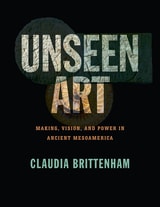
Unseen Art
Making, Vision, and Power in Ancient MesoamericaClaudia Brittenham
University of Texas Press, 2023
In Unseen Art, Claudia Brittenham unravels one of the most puzzling phenomena in Mesoamerican art history: why many of the objects that we view in museums today were once so difficult to see. She examines the importance that ancient Mesoamerican people assigned to the process of making and enlivening the things we now call art, as well as Mesoamerican understandings of sight as an especially godlike and elite power, in order to trace a gradual evolution in the uses of secrecy and concealment, from a communal practice that fostered social memory to a tool of imperial power.
Addressing some of the most charismatic of all Mesoamerican sculptures, such as Olmec buried offerings, Maya lintels, and carvings on the undersides of Aztec sculptures, Brittenham shows that the creation of unseen art has important implications both for understanding status in ancient Mesoamerica and for analyzing art in the present. Spanning nearly three thousand years of the Indigenous art of Mexico, Guatemala, Honduras, and Belize, Unseen Art connects the dots between vision, power, and inequality, providing a critical perspective on our own way of looking.
Unsettling Scripture
Iroquois and the Book of MormonThomas W Murphy
University of Utah Press, 2025
In Unsettling Scripture: Iroquois and the Book of Mormon, anthropologist Thomas W Murphy delves into the visions of Seneca prophet Handsome Lake, the epic narratives of the Iroquois Confederacy, and the origin story of the Book of Mormon, revealing surprising parallels between Indigenous and Mormon traditions.
Through ethnohistorical research and decolonizing methodologies, Murphy reexamines how both communities understand their origins, faith, and prophecy. From Handsome Lake’s revelations to Joseph Smith’s seer stone, from ancient sibling rivalries to the Great Peace, this book unsettles traditional narratives while opening new conversations on scripture, identity, and cultural exchange. Drawing from living Indigenous voices, Unsettling Scripture challenges readers to rethink sacred texts and the histories they tell.
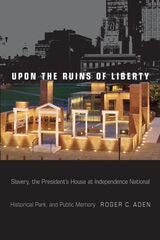
Upon the Ruins of Liberty
Slavery, the President's House at Independence National Historical Park, and Public MemoryRoger C. Aden
Temple University Press, 2014
In Upon the Ruins of Liberty, Roger Aden offers a compelling account that explores the development of this important historic site and how history, space, and public memory intersected with contemporary racial politics. Aden constructs this engrossing tale by drawing on archival material and interviews with principal figures in the controversy-including historian Ed Lawler, site activist Michael Coard, and site designer Emanuel Kelly.
Upon the Ruins of Liberty chronicles the politically-charged efforts to create a fitting tribute to the place where George Washington (and later, John Adams) shaped the presidency while denying freedom to the nine enslaved Africans in his household. From design to execution, the plans prompted advocates to embrace stories informed by race, and address difficulties that included how to handle the results of the site excavation. As such, this landmark project raised concerns and provided lessons about the role of public memory and how places are made to shape the nation's identity.
Urbanism and Empire in Roman Sicily
By Laura Pfuntner
University of Texas Press, 2019
Sicily has been the fulcrum of the Mediterranean throughout history. The island’s central geographical position and its status as ancient Rome’s first overseas province make it key to understanding the development of the Roman Empire. Yet Sicily’s crucial role in the empire has been largely overlooked by scholars of classical antiquity, apart from a small number of specialists in its archaeology and material culture.
Urbanism and Empire in Roman Sicily offers the first comprehensive English-language overview of the history and archaeology of Roman Sicily since R. J. A. Wilson’s Sicily under the Roman Empire (1990). Laura Pfuntner traces the development of cities and settlement networks in Sicily in order to understand the island’s political, economic, social, and cultural role in Rome’s evolving Mediterranean hegemony. She identifies and examines three main processes traceable in the archaeological record of settlement in Roman Sicily: urban disintegration, urban adaptation, and the development of alternatives to urban settlement. By expanding the scope of research on Roman Sicily beyond the bounds of the island itself, through comparative analysis of the settlement landscapes of Greece and southern Italy, and by utilizing exciting evidence from recent excavations and surveys, Pfuntner establishes a new empirical foundation for research on Roman Sicily and demonstrates the necessity of including Sicily in broader historical and archaeological studies of the Roman Empire.
Use-Wear Analysis of Flaked Stone Tools
Patrick C. Vaughan
University of Arizona Press, 1985
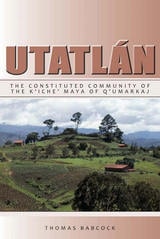
Utatlán
The Constituted Community of the K'iche' Maya of Q'umarkajThomas F. Babcock
University Press of Colorado, 2012
Most information available on Utatlán focuses on the ceremonial center and ignores the city of the commoners. Using the archaeological data, Utatlán attempts to determine the boundaries of the community and to characterize subdivisions within it. Evidence of indigenous nonelite houses, rich burials, and grave goods unlike those found in contemporary sites reveals information about the supporting residence zone. In addition, Babcock applies the concept of "constituted community," interpreting the archaeological data from a prehistoric context, and proposes a theoretical framework for interpreting prehistoric sites with respect to urbanism and political complexity.
Utatlán: The Constituted Community of the K'iche' Maya of Q'umarkaj will be of interest to students and scholars of Mesoamerican anthropology, archaeology, and ethnohistory.