Results by title
244 books match the query 'Arkansas' and 4 start with u
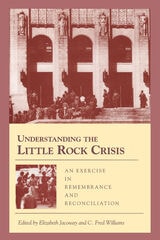
Understanding the Little Rock Crisis
An Exercise in Remembrance and ReconciliationElizabeth Jacoway
University of Arkansas Press, 1999
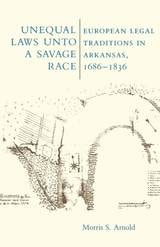
Unequal Laws Unto a Savage Race
European Legal Traditions in Arkansas, 1686-1836Morris Arnold
University of Arkansas Press, 1985
Partly because its colonial settlements were tiny, remote, and inconsequential, the early history of Arkansas has been almost entirely neglected. Even Arkansas Post, the principal eighteenth-century settlement, served mainly as a temporary place of residence for trappers and voyageurs. It was also an entrepot for travelers on the Mississippi—a place to be while on the way elsewhere. Only a very few inhabitants, true agricultural settlers, ever established themselves a or around the Post.
For most of the eighteenth century, Arkansas’s non-Indian population was less than one hundred, and never much exceeded five or six hundred. Its European residents of that era, mostly French, have left virtually no physical trace: the oldest buildings and the oldest marked graves in the state date from the 1820s. Drawing on original French and Spanish archival sources, Morris Arnold chronicles for the first time the legal institutions of colonial Arkansas, the attitude of its population towards European legal ideas as were current in Arkansas when Louisiana was transferred to the United States in 1803. Because he views the clash of legal traditions in the upper reaches of the Jefferson’s Louisiana as part of a more general cultural conflict, Arnold closely examines the social and economic characteristics of Arkansas’s early residents in order to explain why, following the American takeover, the common law was introduced into Arkansas with such relative ease.
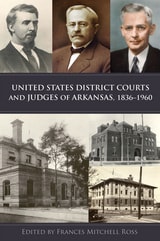
United States District Courts and Judges of Arkansas, 1836–1960
Frances Mitchell Ross
University of Arkansas Press, 2016
The book begins with statehood and continues with Congress’s decision to expand jurisdiction of the original 1836 District Court of Arkansas to include the vast Indian Territory to the west. The territory’s formidable size and rampant lawlessness brought in an overwhelming number of cases. The situation was only somewhat mitigated in 1851, when Congress split the state into eastern and western districts, which were still served by just one judge who travelled between the two courts.
A new judgeship for the Western District was created in 1871, and new seats for that court were established, but it wasn’t until 1896 that Congress finally ended all jurisdiction of Arkansas’s Western District Court over the Indian Territory.
Contributors to this collection include judges, practicing attorneys, academics, and thoughtful and informed family members who reveal how the judges made decisions on issues involving election laws, taxes, civil rights, railroads, liquor and prohibition, quack medicine, gangsters, bankruptcy, personal injury, the draft and Selective Service, school desegregation, prisons, and more. United States District Courts and Judges of Arkansas, 1836–1960 will be of value to anyone interested in Arkansas history—particularly Arkansas legal and judicial history as it relates to the local and national issues that came before these judges.
This project was supported in part by the United States District Court for the Eastern District of Arkansas and the United States District Court for the Western District of Arkansas.
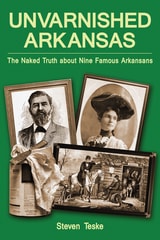
Unvarnished Arkansas
The Naked Truth about Nine Famous ArkansansSteven Teske
Butler Center for Arkansas Studies, 2012