Results by title
109 books match the query 'Astronomy' and 2 start with u

Uncommon Sense
Understanding Nature's Truths Across Time and CultureAnthony Aveni
University Press of Colorado, 2006
The divide between teaching “intelligent design” and evolution in U.S. schools has brought to the public eye a struggle that archaeoastronomer Anthony Aveni argues is as old as culture itself. All societies seek to understand the natural world, but their search is shaped by culturally distinct views and experiences. In Uncommon Sense, Aveni explores the common and conflicting ways that ancient and contemporary societies have searched for the literal truth about the natural world’s mysteries, from dinosaur bones to the Star of Bethlehem. Aveni demonstrates that a society’s approach to making sense of the natural world can serve as a working definition of its culture, so strongly does it resonate with fundamental values and assumptions.
In ten fascinating essays, Aveni examines topics that have absorbed scientists, religious figures, and ordinary citizens over the centuries. He traces the tug of war between astronomy and astrology, reveals the underpinnings of our notions of cartography and the representation of space and time, and much more.
Readers interested in science, history, and world cultures will revel in this celebration of different cultures’ common and uncommon questions and conclusions about the natural world.
[more]
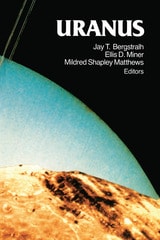
Uranus
Jay T. Bergstralh
University of Arizona Press, 1991
Uranus occupies a unique niche in the history of western thought; for while the planets from Mercury to Saturn had been known since pre-antiquity, Uranus was the first to be discovered, in 1781, through scientific investigation. Contemporary investigation of Uranus culminated in the Voyager 2 encounter in 1986. The results of that achievement, as well of concurrent research on the planet, are reviewed by 84 international authorities in this massive volume. Because Uranus' remoteness has prevented its being studied as intensively by earth-based observation as have other members of the solar system, most of what is known about the planet—its magnetic field and magnetosphere and satellites—were learned from the Voyager data, which is viewed here from a variety of perspectives. While the book is intended to serve as a comprehensive review, it also reports a substantial amount of original research results not previously published.
[more]