Results by title
239 books match the query 'Black people' and 4 start with u
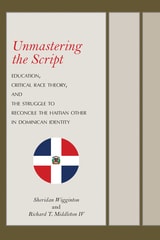
Unmastering the Script
Education, Critical Race Theory, and the Struggle to Reconcile the Haitian Other in Dominican IdentitySheridan Wigginton and Richard T. Middleton IV
University of Alabama Press, 2019
Unmastering the Script: Education, Critical Race Theory, and the Struggle to Reconcile the Haitian Other in Dominican Identity examines how school curriculum–based representations of Dominican identity navigate black racial identity, its relatedness to Haiti, and the culturally entrenched pejorative image of the Haitian Other in Dominican society. Wigginton and Middleton analyze how social science textbooks and historical biographies intended for young Dominicans reflect an increasing shift toward a clear and public inclusion of blackness in Dominican identity that serves to renegotiate the country’s long-standing antiblack racial master script.
The authors argue that although many of the attempts at this inclusion reflect a lessening of “black denial,” when considered as a whole, the materials often struggle to find a consistent and coherent narrative for the place of blackness within Dominican identity, particularly regarding the ways in which blackness continues to be meaningfully related to the otherness of Haitian racial identity. Unmastering the Script approaches the text materials as an example of “reconstructing” and “unburying” an African past, supporting the uneven, slow, and highly context-specific nature of the process.
This work engages with multiple disciplines including history, anthropology, education, and race studies, building on a new wave of Dominican scholarship that considers how contemporary perspectives of Dominican identity both accept the existence of an African past and seek to properly weigh its importance. The use of critical race theory as the framework facilitates unfolding the past political and legal agendas of governing elites in the Dominican Republic and also helps to unlock the nuance of an increasingly black-inclusive Dominican identity. In addition, this framework allows the unveiling of some of the socially damaging effects the Haitian Other master script can have on children, particularly those of Haitian ancestry, in the Dominican Republic.
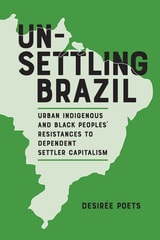
Unsettling Brazil
Urban Indigenous and Black Peoples' Resistances to Dependent Settler CapitalismDesirée Poets
University of Alabama Press, 0
Analyzes favela, quilombola, and indigenous communities’ responses to settler colonialism in urban Brazil. Based on ethnographic research and her experiences growing up in Brazil, the author tells the stories of communities in Rio de Janeiro, São Paulo, and Belo Horizonte
Unsettling Brazil offers a powerful account of five urban Indigenous and Black communities and movements in Brazil that illuminates their struggle for land, dignity, and their ways of life amid historic and ongoing settler colonialism, marked by militarization and dependent capitalist development. The in-depth case studies are the Indigenous movement Aldeia Maracanã and the quilombola community Sacopã in Rio, the Quilombo dos Luízes in Belo Horizonte, the Indigenous movement behind the Pindorama scholarship program in São Paulo, and the Complexo da Maré favela in Rio. For each, Poets vividly documents the intersectional and transnational structures of power that perpetuate the erasure, dispossession, and exploitation of nonwhite populations and the creative ways that Black and Indigenous communities have mobilized to unsettle these structures.
Drawing on the knowledge produced by Black and Indigenous organizers and thinkers, Poets argues for an interdisciplinary framework that prioritizes the voices and experiences of these communities. Addressing increasingly salient calls for decolonization, Poets ponders the paradoxical role of rights, citizenship, and the state in the fight for freedom and justice. Unsettling Brazil urges readers to confront the uncomfortable truths about the nation's history and stands in solidarity with those fighting to reclaim their heritage, identity, and land.
Unwelcome Shores
Black Refugees in AmericaBernadette Ludwig
Rutgers University Press, 2026
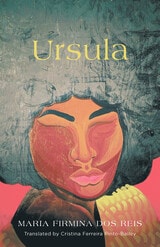
Ursula
Maria Firmina dos Reis, Translated by Cristina Ferreira Pinto-Bailey
Tagus Press, 2021