Results by title
71 books match the query 'Cancer' and 2 start with u
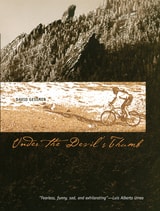
Under the Devil's Thumb
David Gessner
University of Arizona Press, 1999
David Gessner first moved to Colorado in the wake of a bout with cancer. In Under the Devil's Thumb, this young New Englander takes readers on a joyous quest to discover the mysteries of the western landscape and the landscape of the soul as well.
In the West Gessner began to rewrite his life. Under the Devil's Thumb is a story of rugged determination and sweat, as well as humor, adventure and hope. In and around his new hometown of Boulder, Colorado, Gessner hiked hard and ran alongside flooded creeks. He found that the West was a place of stories—stories that grow out of the ground, flow out of the dirt, work their way through one's limbs, and drive people to push their physical limits. Hiking up scree slopes toward the Devil's Thumb, a massive outcrop of orange rock that attracts climbers, hikers, and contemplaters, Gessner reflects on the illness he has so recently survived. He pushes his physical limits, hoping to outrun death, to outrun dread. He finds momentary transcendence in the joys and self-inflicted pain of mountain biking. "Nothing but the hardest ride has the power to flush out worry, mind clutter, and dread." In tranquil moments he seeks a chance to recover an animal self that is strong and powerful enough to conquer mountains, but also still and quiet enough to see things human beings ignore.
In the mountain West, Gessner finds what Wallace Stegner called "the geography of hope." He finds within himself an interior landscape that is healthy and strong. Combining memoir, nature writing, and travel writing, Under the Devil's Thumb is one man's journey deep into a place of healing.
[more]
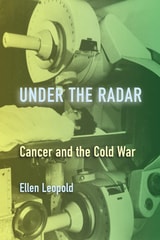
Under the Radar
Cancer and the Cold WarLeopold, Ellen
Rutgers University Press, 2008
At the end of the Second World War, a diagnosis of cancer was a death sentence. Sixty years later, it is considered a chronic disease rather than one that is invariably fatal. Although survival rates have improved, the very word continues to evoke a special terror and guilt, inspiring scientists and politicians to wage war against it.
In Under the Radar, Ellen Leopold shows how nearly every aspect of our understanding and discussion of cancer bears the imprint of its Cold War entanglement. The current biases toward individual rather than corporate responsibility for rising incidence rates, research that promotes treatment rather than prevention, and therapies that can be patented and marketed all reflect a largely hidden history shaped by the Cold War. Even the language we use to describe the disease, such as the guiding metaphor for treatment, "fight fire with fire," can be traced back to the middle of the twentieth century.
Writing in a lucid style, Leopold documents the military, governmental, industrial, and medical views of radiation and atomic energy to examine the postwar response to cancer through the prism of the Cold War. She explores the role of radiation in cancer therapies today, using case studies and mammogram screening, in particular, to highlight the surprising parallels. Taking into account a wide array of disciplines, this book challenges our understanding of cancer and how we approach its treatment.
- Examines the postwar response to cancer through the prism of the Cold War
- Goes beyond medical science to look at the influence of Cold War policies on the way we think about cancer today
- Links the experience of postwar cancer patients with the broader evolution of what have become cancer industries
- Traces the history of human-made radiation as a state-sponsored environmental toxin
[more]