Results by title
1566 books match the query 'Christianity' and 13 start with u
Uncharted Territory
The American Catholic Church at the United Nations, 1946-1972Joseph S. Rossi S.J.
Catholic University of America Press, 2006
Uneasy in Babylon
Southern Baptist Conservatives and American CultureBarry Hankins
University of Alabama Press, 2002
The definitive account of how conservative Southern Baptists came to dominate the nation's largest Protestant denomination
In 1979 a group of conservative members of the Southern Baptists Convention (SBC) initiated a campaign to reshape the denomination’s seminaries and organizations by installing new conservative leaders who made belief in the inerrancy of the Bible a condition of service. They succeeded. This book is a definitive account of that takeover.
Barry Hankins argues that the conservatives sought control of the SBC not or not only to secure the denomination's orthodoxy but to mobilize Southern Baptists for a war against secular culture. The best explanation of the beliefs and behavior of Southern Baptist conservatives, Hankins concludes, lies in their adoption of the culture war model of American society. Believing that "American culture has turned hostile to traditional forms of faith,” they sought to deploy the Southern Baptist Convention in a "full-scale culture war" against secularism in the United States. Hankins traces the roots of this movement to the ideas of such post-WWII northern evangelicals as Carl F. H. Henry and Francis Schaeffer. Henry and Schaeffer viewed America's secular culture as hostile to Christianity and called on evangelicals to develop a robust Christian opposition to secular culture. As the nation’s largest Protestant denomination, SBC positions on divisive cultural issues like abortion have remade the American political landscape, most notably in the reversal of Roe v. Wade.
Hankins also argues, however, that Southern Baptist conservatives sought more than orthodox adherence to Biblical inerrancy. They also sought an identity that was authentically Baptist and Southern. Hankin’s excellent and prescient work will fascinate readers interested in contemporary American religion, culture, and public policy, as well as in the American South.
Unequal Partners
In Search of Transnational Catholic SisterhoodCasey Ritchie Clevenger
University of Chicago Press, 2020
Taking us from Belgium and the United States to the Democratic Republic of the Congo, sociologist Casey Clevenger offers rare insight into how the sisters of this order work across national boundaries, shedding light on the complex relationships among individuals, social groups, and formal organizations. Throughout, Clevenger skillfully weaves the sisters’ own voices into her narrative, helping us understand how the order has remained whole over time. A thoughtful analysis of the ties that bind—and divide—the sisters, Unequal Partners is a rich look at transnationalism’s ongoing impact on Catholicism.
Unity in Christ and Country
American Presbyterians in the Revolutionary Era, 1758–1801William Harrison Taylor
University of Alabama Press, 2017
In Unity in Christ and Country: American Presbyterians in the Revolutionary Era, 1758–1801, William Harrison Taylor investigates the American Presbyterian Church’s pursuit of Christian unity and demonstrates how, through this effort, the church helped to shape the issues that gripped the American imagination, including evangelism, the conflict with Great Britain, slavery, nationalism, and sectionalism. When the colonial Presbyterian Church reunited in 1758, a nearly twenty-year schism was brought to an end. To aid in reconciling the factions, church leaders called for Presbyterians to work more closely with other Christian denominations. Their ultimate goal was to heal divisions, not just within their own faith but also within colonial North America as a whole.
Taylor contends that a self-imposed interdenominational transformation began in the American Presbyterian Church upon its reunion in 1758. However, this process was altered by the church’s experience during the American Revolution, which resulted in goals of Christian unity that had both spiritual and national objectives. Nonetheless, by the end of the century, even as the leaders in the Presbyterian Church strove for unity in Christ and country, fissures began to develop in the church that would one day divide it and further the sectional rift that would lead to the Civil War.
Taylor engages a variety of sources, including the published and unpublished works of both the Synods of New York and Philadelphia and the General Assembly of the Presbyterian Church in the United States, as well as numerous published and unpublished Presbyterian sermons, lectures, hymnals, poetry, and letters. Scholars of religious history, particularly those interested in the Reformed tradition, and specifically Presbyterianism, should find Unity in Christ and Country useful as a way to consider the importance of the theology’s intellectual and pragmatic implications for members of the faith.
Unity in Christ
Bishops, Synodality, and CommunionArchbishop Anthony Fisher, OP
Catholic University of America Press, 2023
Unlocking Divine Action
Michael J. Dodds
Catholic University of America Press, 2012
Unquiet Americans
U.S. Catholics, Moral Truth, and the Preservation of Civil LibertiesGerard V. Bradley
St. Augustine's Press, 2013
Before the Second Vatican Council, America’s Catholics operated largely as a coherent voting bloc, usually in connection with the Democratic Party. Their episcopal leaders generally spoke for Catholics in political matters; at least, where America’s bishops asserted themselves in public affairs there was little audible dissent from the faithful.
More than occasionally, the immigrant Church’s eagerness to demonstrate its patriotic bona fides furthered its tendency to speak with one voice about national matters, and in line with the broader societal consensus. And, notwithstanding the considerable conflict which Catholics encountered, and generated, in American political life, there was before the Council broad agreement in American culture about the centrality of Biblical morality to the success of Americans’ experiment with republican government.
In other words: before the Council, American Catholics’ relationship to the political common good was mediated, somewhat uncritical, and insulated from conflict (both within and without the Church) over such fundamental matters as protection of innocent life, marriage and family life, and (to a lesser extent) religious liberty.
This has all changed since the mid-1960s. For the first time in the Church’s pilgrimage on these shores, controversial questions about the basic moral requirements of the political common good are front and center for America’s Catholics. These questions require Catholics to confront matters which heretofore they either took for granted, read off from the background culture, or which they left to the bishops to handle. But the Council Fathers rightly recognized that Jesus calls upon a formed and informed laity to act as leaven in the public realm, to bring Gospel values to the temporal sphere. In this book of essays touching upon Catholic social doctrine, the truth about human equality and political liberty, and religious faith as it bears upon public life and the public engagement of lay Catholics, Gerard Bradley supplies indispensable aid to those seeking to answer Jesus’ call.
Unreconciled
From Racial Reconciliation to Racial Justice in Christian EvangelicalismAndrea Smith
Duke University Press, 2019
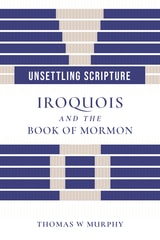
Unsettling Scripture
Iroquois and the Book of MormonThomas W Murphy
University of Utah Press, 2025
In Unsettling Scripture: Iroquois and the Book of Mormon, anthropologist Thomas W Murphy delves into the visions of Seneca prophet Handsome Lake, the epic narratives of the Iroquois Confederacy, and the origin story of the Book of Mormon, revealing surprising parallels between Indigenous and Mormon traditions.
Through ethnohistorical research and decolonizing methodologies, Murphy reexamines how both communities understand their origins, faith, and prophecy. From Handsome Lake’s revelations to Joseph Smith’s seer stone, from ancient sibling rivalries to the Great Peace, this book unsettles traditional narratives while opening new conversations on scripture, identity, and cultural exchange. Drawing from living Indigenous voices, Unsettling Scripture challenges readers to rethink sacred texts and the histories they tell.
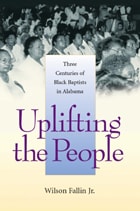
Uplifting the People
Three Centuries of Black Baptists in AlabamaWilson Fallin Jr.
University of Alabama Press, 2007
Three centuries of faith, leadership, and community building in Alabama's Black Baptist tradition.
Uplifting the People is a history of the Alabama Missionary Baptist State Convention—its origins, churches, associations, conventions, and leaders. Fallin demonstrates that a distinctive Afro-Baptist faith emerged as slaves in Alabama combined the African religious emphasis on spirit possession, soul-travel, and rebirth with the evangelical faith of Baptists. The denomination emphasizes a conversion experience that brings salvation, spiritual freedom, love, joy, and patience, and also stresses liberation from slavery and oppression and highlights the exodus experience. In examining the social and theological development of the Afro-Baptist faith over the course of three centuries, Uplifting the People demonstrates how black Baptists in Alabama used faith to cope with hostility and repression.
Fallin reveals that black Baptist churches were far more than places of worship. They functioned as self-help institutions within black communities and served as gathering places for social clubs, benevolent organizations, and political meetings. Church leaders did more than conduct services; they protested segregation and disfranchisement, founded and operated schools, and provided community leaders for the civil rights movement of the mid-20th century.
Through black churches, members built banking systems, insurance companies, and welfare structures. Since the gains of the civil rights era, black Baptists have worked to maintain the accomplishments of that struggle, church leaders continue to speak for social justice and the rights of the poor, and churches now house day care and Head Start programs. Uplifting the People also explores the role of women, the relations between black and white Baptists, and class formation within the black church.
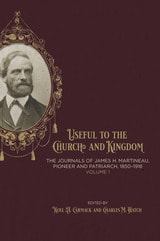
Useful to the Church and Kingdom
The Journals of James H. Martineau, Pioneer and Patriarch, 1850-1918, Volume: 1Noel A. Carmack
Signature Books, 2023
These journals document his exploration of virgin lands in southern Utah, his laying out of townsites and farmland in Cache Valley, his participation in canal building and water projects in Arizona, and his near-death experiences while surveying rough, mountainous areas. His work for the Union Pacific Railroad through Weber Canyon and across the Salt Lake Promontory and Humboldt Desert in 1868 is one of the very few complete records of its kind.
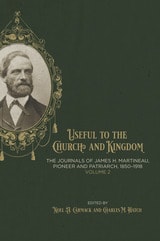
Useful to the Church and Kingdom
The Journals of James H. Martineau, Pioneer and Patriarch, 1850-1918, Volume: 2Noel A. Carmack
Signature Books, 2023
These journals document his exploration of virgin lands in southern Utah, his laying out of townsites and farmland in Cache Valley, his participation in canal building and water projects in Arizona, and his near-death experiences while surveying rough, mountainous areas. His work for the Union Pacific Railroad through Weber Canyon and across the Salt Lake Promontory and Humboldt Desert in 1868 is one of the very few complete records of its kind.
Utah Politics
The Elephant in the RoomRod Decker
Signature Books, 2019
Some themes reoccur: governors become popular by fighting federal oversight— signaling a lingering distrust that Washington could alter the Mormon way of life—and liberals use the court system to circumvent conservative legislatures who see public morality as a defining feature of government. Through this lens, issues both deceptively innocuous and deeply complex underscore Utah’s dance with religious freedom and civil liberty.