Results by title
303 books match the query 'Church history' and 2 start with u
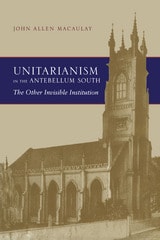
Unitarianism in the Antebellum South
The Other Invisible InstitutionJohn Allen Macaulay
University of Alabama Press, 2001
John Macaulay's model study of Unitarianism in the antebellum south reestablishes the denomination's position as an influential religious movement in the early history of the region. By looking at benevolent societies, lay meetings, professional and civic activity, ecumenical interchange, intellectual forums, business partnerships, literary correspondence, friendships, and other associations in which southern Unitarians were engaged with other southerners on a daily basis, Macaulay sees a much greater Unitarian presence than has been previously recognized. Instead of relying on a count of church steeples to gauge numbers, this volume blurs the lines between southern Unitarianism and orthodoxy by demonstrating how their theologies coexisted and intertwined.
Macaulay posits that just beneath the surface of organized religion in the South was an "invisible institution" not unlike Franklin Frazier's Black Church, a nebulous network of liberal faith that represented a sustained and continued strand of Enlightenment religious rationalism alongside and within an increasingly evangelical culture. He shows that there were in fact two invisible religious institutions in the antebellum South, one in the slave quarters and the other in the urban landscape of southern towns. Whereas slave preachers rediscovered in music and bodily movement and in themes of suffering a vibrant Christian community, Unitarians witnessed the simple spiritual truth that reason and belief are one unified whole.
In offering this fresh argument, Macaulay has chipped away at stereotypes of the mid-19th-century South as unreservedly "evangelical" and contributed greatly to historians' understanding of the diversity and complexity in southern religion.
[more]
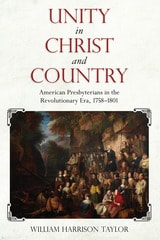
Unity in Christ and Country
American Presbyterians in the Revolutionary Era, 1758–1801William Harrison Taylor
University of Alabama Press, 2017
Examines the interdenominational pursuits of the American Presbyterian Church from 1758 to 1801
In Unity in Christ and Country: American Presbyterians in the Revolutionary Era, 1758–1801, William Harrison Taylor investigates the American Presbyterian Church’s pursuit of Christian unity and demonstrates how, through this effort, the church helped to shape the issues that gripped the American imagination, including evangelism, the conflict with Great Britain, slavery, nationalism, and sectionalism. When the colonial Presbyterian Church reunited in 1758, a nearly twenty-year schism was brought to an end. To aid in reconciling the factions, church leaders called for Presbyterians to work more closely with other Christian denominations. Their ultimate goal was to heal divisions, not just within their own faith but also within colonial North America as a whole.
Taylor contends that a self-imposed interdenominational transformation began in the American Presbyterian Church upon its reunion in 1758. However, this process was altered by the church’s experience during the American Revolution, which resulted in goals of Christian unity that had both spiritual and national objectives. Nonetheless, by the end of the century, even as the leaders in the Presbyterian Church strove for unity in Christ and country, fissures began to develop in the church that would one day divide it and further the sectional rift that would lead to the Civil War.
Taylor engages a variety of sources, including the published and unpublished works of both the Synods of New York and Philadelphia and the General Assembly of the Presbyterian Church in the United States, as well as numerous published and unpublished Presbyterian sermons, lectures, hymnals, poetry, and letters. Scholars of religious history, particularly those interested in the Reformed tradition, and specifically Presbyterianism, should find Unity in Christ and Country useful as a way to consider the importance of the theology’s intellectual and pragmatic implications for members of the faith.
[more]