Results by title
401 books match the query 'Civil War, 1861-1865' and 3 start with u
UNDER THE FLAG OF THE NATION
DIARIES AND LETTERS OF OWEN JOHNSTON HOPKINS, A YANKEE VOLUNTEER IN THE CIVIL WAROwen Johnston Hopkins
The Ohio State University Press, 1998
Owen Hopkins was a young man brought to maturity by the agony of war, but in spite of the horror of battle and the tedium of life in camp, he maintained a lively sense of humor and a constant devotion to the ideals for which he fought. The Civil War in these pages is a savage, vindictive conflict fought with canister, "minnie balls," grapeshot, the Enfield rifle, and the bayonet. Only seventeen when he enlisted in 1861, Hopkins was a foot soldier and a witness to the action that took place on the field of battle.
A vital part of Hopkins's life in the army was his correspondence with Julia Allison, who lived in his hometown of Bellefontaine. They began writing each other in 1863, and their friendship deepened into love. Each was a fervent patriot, and their shared devotion to their country was a significant fact of their relationship. They were married in 1865.
An epilogue tells what happened to Hopkins after June of 1865: his career, his family, and his death in 1902. Originally published in1961, this work is now available for the first time in paperback.
Union Heartland
The Midwestern Home Front during the Civil WarEdited by Ginette Aley and J. L. Anderson, with a foreword by William C. Davis
Southern Illinois University Press, 2013
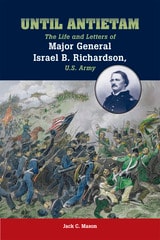
Until Antietam
The Life and Letters of Major General Israel B. Richardson, U.S. ArmyJack C. Mason
Southern Illinois University Press, 2009
While researching this book, Jack C. Mason made the kind of discovery that historians dream of. He found more than one hundred unpublished and unknown letters from Union general Israel B. Richardson to his family, written from his time as a West Point cadet until the day before his fatal wounding at the Battle of Antietam, the bloodiest day in American history. Using these freshly uncovered primary sources as well as extensive research in secondary materials, Mason has written the first-ever biography of Israel Bush Richardson.
Mason traces Richardson’s growth as a soldier through his experiences and the guidance of his superiors, and then as a leader whose style reflected the actions of the former commanders he respected. Though he was a disciplinarian, Richardson took a relaxed attitude toward military rules, earning him the affection of his men. Unfortunately, his military career was cut short just as high-ranking officials began to recognize his aggressive leadership. He was mortally wounded while leading his men at Antietam and died on November 3, 1862.
Until Antietam brings to life a talented and fearless Civil War infantry leader. Richardson’s story, placed within the context of nineteenth-century warfare, exemplifies how one soldier’s life influenced his commanders, his men, and the army as a whole.
Winner of the Army Historical Foundation 2009 Distinguished Book Award