Results by title
231 books match the query 'Colonies' and 7 start with u

Uncertain Dimensions
Western Overseas Empires in the Twentieth CenturyRaymond F. Betts
University of Minnesota Press, 1985
Uncertain Dimensions was first published in 1985. Minnesota Archive Editions uses digital technology to make long-unavailable books once again accessible, and are published unaltered from the original University of Minnesota Press editions.
World War I battered the Western imperial systems and destroyed one, that of Germany, but it did not sound the death knell of an empire. The "scramble" for overseas territory ha reached a virtual conclusion shortly before the war; afterwards, the main business of empire was to ensure a pax colonia: the often contradictory goals of a stable government and economic development. It is with the years between world wars—the brief age of administrative empire — that Raymond Betts is chiefly concerned in this book. An unsettled time, when individuals coped with empire of uncertain dimensions, the interwar years nonetheless left a material legacy—railroads, motor roads, public buildings — and an ideological one—the voices of protest that led to independence after World War II.
Preeminently a cultural history of the era rather than a political narrative, Uncertain Dimensions centers upon the regions we now call the Third World—Subsaharan Africa and Southeast Asia—and the major colonial powers, Great Britain and France. Betts has structured this book as a group of closely linked interpretive essays, each devoted to a specific aspect of the late colonial experience: World War I and the postwar mandates, colonial administration, the European economic imperative and "technology transfer," urbanization, anti-imperial protest, and decolonization. Throughout, he draws upon the work of novelists, poets, and theoreticians—Aime Cesaire, Claude McKay, Leopold Sedar Senghor, Frantz Fanon, and many others—and recognizes the deep irony at the heart of modern imperialism: that contact between Western and Third worlds was mostly confined to two minorities, the alien European and the socially uprooted African or Asian.
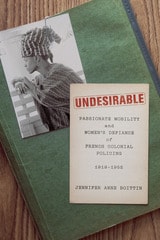
Undesirable
Passionate Mobility and Women’s Defiance of French Colonial Policing, 1919–1952Jennifer Anne Boittin
University of Chicago Press, 2022
Examining little-known policing archives in France, Senegal, and Cambodia, Jennifer Anne Boittin unearths the stories of hundreds of women labeled “undesirable” by the French colonial police and society in the early twentieth century. These “undesirables” were often women traveling alone, women who were poor or ill, women of color, or women whose intimate lives were deemed unruly. To refute the label and be able to move freely, they spoke out or wrote impassioned letters: some emphasized their “undesirable” qualities to suggest that they needed the care and protection of the state to support their movements, while others used the empire’s own laws around Frenchness and mobility to challenge state or societal interference. Tacking between advocacy and supplication, these women summoned intimate details to move beyond, contest, or confound surveillance efforts, bringing to life a practice that Boittin terms “passionate mobility.” In considering how ordinary women pursued autonomy, security, companionship, or simply a better existence in the face of surveillance and control, Undesirable illuminates pressing contemporary issues of migration and violence.
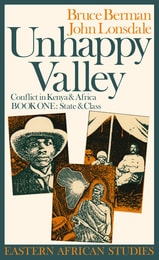
Unhappy Valley, Book One
Conflict in Kenya & AfricaBruce Berman
Ohio University Press, 1992
The authors investigate major themes. These include the conquest origins and subsequent development of the colonial state, the contradictory social forces that articulated African societies to European capitalism, and the creation of new political communities and changing meanings of ethnicity in Africa, in the context of social differentiation and class formation. There is substantial new work on the problems of Mau Mau and of wealth, poverty and civic virtue in Kikuyu political thought.
The authors make a fresh contribution to a deeper historical understanding of the development of contemporary Kenyan society and, in particular, of the British and Kukuyu origins of Mau Mau and the emergency of the 1950s.
They also highlight some of the shortcomings of ideas about development, explore the limitations of narrowly structuralist Marxist theory of the state, and reflect on the role of history in the future of Africa.
Book One on State and Class will be used by students of African history as well as of colonial Kenya; it is also concerned with the theory of history and of political science.
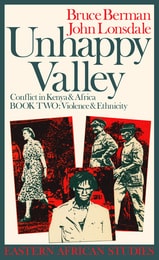
Unhappy Valley, Book Two
Conflict in Kenya & AfricaBruce Berman
Ohio University Press, 1992
The authors investigate major themes. These include the conquest origins and subsequent development of the colonial state, the contradictory social forces that articulated African societies to European capitalism, and the creation of new political communities and changing meanings of ethnicity in Africa, in the context of social differentiation and class formation. There is substantial new work on the problems of Mau Mau and of wealth, poverty and civic virtue in Kikuyu political thought.
The authors make a fresh contribution to a deeper historical understanding of the development of contemporary Kenyan society and, in particular, of the British and Kukuyu origins of Mau Mau and the emergency of the 1950s.
They also highlight some of the shortcomings of ideas about development, explore the limitations of narrowly structuralist Marxist theory of the state, and reflect on the role of history in the future of Africa.
Book Two on Violence and Ethnicity gives new insights into popular consciousness, into revolutionary change and into the subtle realities of ethnicity; it will be of particular value to readers of Ngugi.
Unhappy Valley
Clan, Class & State In Colonial KenyaBruce Berman
Ohio University Press, 1991
Unmaking Botany
Science and Vernacular Knowledge in the Colonial PhilippinesKathleen Cruz Gutierrez
Duke University Press, 2025
Unreasonable Histories
Nativism, Multiracial Lives, and the Genealogical Imagination in British AfricaChristopher J. Lee
Duke University Press, 2015