Results by title
264 books match the query 'Composition' and 5 start with u
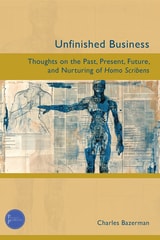
Unfinished Business
Thoughts on the Past, Present, Future, and Nurturing of Homo ScribensCharles Bazerman
University Press of Colorado, 2024
In Unfinished Business, Charles Bazerman considers long-standing puzzles in writing studies, from the most fundamental ideas about humans as writers and writing as constituting modern society to the most practical issues of curriculum and teaching. Together, the chapters provide a broad vision of the importance, role, consequences, and means of writing. The opening cluster of chapters places Homo sapiens’ capacity to write within the biological and cultural evolutionary arc. The second cluster of chapters focuses on how writing has extended and transformed our knowledge with major consequences for us as societies and individuals. The third cluster considers how we go about teaching this increasingly important skill that gives people voice in the literate world. The fourth reflects on the values and ethical concerns that pervade the practice and teaching of writing. In his final chapter, Bazerman speculates about where writing and writing instruction may go in the rapidly changing future.
[more]
Unlimited Players
The Intersections of Writing Center and Game StudiesHolly Ryan
Utah State University Press, 2021
Unlimited Players provides writing center scholars with new approaches to engaging with multimodality in the writing center through the lenses of games, play, and digital literacies. Considering how game scholarship can productively deepen existing writing center conversations regarding the role of creativity, play, and engagement, this book helps practitioners approach a variety of practices, such as starting new writing centers, engaging tutors and writers, developing tutor education programs, developing new ways to approach multimodal and digital compositions brought to the writing center, and engaging with ongoing scholarly conversations in the field.
The collection opens with theoretically driven chapters that approach writing center work through the lens of games and play. These chapters cover a range of topics, including considerations of identity, empathy, and power; productive language play during tutoring sessions; and writing center heuristics. The last section of the book includes games, written in the form of tabletop game directions, that directors can use for staff development or tutors can play with writers to help them develop their skills and practices.
No other text offers a theoretical and practical approach to theorizing and using games in the writing center. Unlimited Players provides a new perspective on the long-standing challenges facing writing center scholars and offers insight into the complex questions raised in issues of multimodality, emerging technologies, tutor education, identity construction, and many more. It will be significant to writing center directors and administrators and those who teach tutor training courses.
[more]
Unwell Writing Centers
Searching for Wellness in Neoliberal Educational Institutions and Beyondby Genie Nicole Giaim, foreword by Elizabeth Boquet
Utah State University Press, 2022
Unwell Writing Centers focuses on the inroads the wellness industry has made into higher education. Following graduate and undergraduate writing tutors during a particularly stressful period (2016–2019), Genie Nicole Giaimo examines how top-down and bottom-up wellness interventions are received and taken up by workers. Engaging sociocultural research on how workers react to and experience workplace conflict, Giaimo demonstrates the kinds of interventions welcomed by workers as well as those that fall flat, including the “easy” fixes to workplace issues that institutions provide in lieu of meaningful and community-based support.
The book is broken into sections based on journeying: searching for wellness, finding wellness, and imagining a “well” future that includes a sustainable model of writing center work. Each chapter begins with a personal narrative about wellness issues in writing centers, including the author’s experiences in and responses to local emergencies. She shares findings from a longitudinal assessment study on non-institutional interventions in writing centers and provides resources for administrators to create more ethical "well" writing centers. The book also includes an appendix of training documents, emergency planning documents, and several wellness-specific interventions developed from anti-racist, anti-neoliberal, and organizational theories.
Establishing the need for a field-specific response to the austerity-minded eruption of wellness-focused interventions in higher education, Unwell Writing Centers is a critical text for graduate students and new directors that can easily be applied in workplaces in and outside of higher education.
[more]
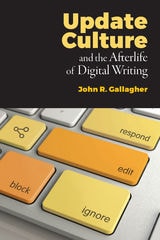
Update Culture and the Afterlife of Digital Writing
John R Gallagher
Utah State University Press, 2019
Update Culture and the Afterlife of Digital Writing explores “neglected circulatory writing processes” to better understand why and how digital writers compose, revise, and deliver arguments that undergo sometimes constant revision. John R. Gallagher also looks at how digital writers respond to comments, develop a brand, and evolve their arguments—all post-publication.
With the advent of easy-to-use websites, ordinary people have become internet writers, disseminating their texts to large audiences. Social media sites enable writers’ audiences to communicate back to the them, instantly and often. Even professional writers work within interfaces that place comments adjacent to their text, privileging the audience’s voice. Thus, writers face the prospect of attending to their writing after they deliver their initial arguments. Update Culture and the Afterlife of Digital Writing describes the conditions that encourage “published” texts to be revisited. It demonstrates—through forty case studies of Amazon reviewers, redditors, and established journalists—how writers consider the timing, attention, and management of their writing under these ever-evolving conditions.
Online culture, from social media to blog posts, requires a responsiveness to readers that is rarely duplicated in print and requires writers to consistently reread, edit, and update texts, a process often invisible to readers. This book takes questions of circulation online and shows, via interviews with both writers and participatory audience members, that writing studies must contend with writing’s afterlife. It will be of interest to researchers, scholars, and students of writing studies and the fields of rhetoric, communication, education, technical communication, digital writing, and social media, as well as all content creators interested in learning how to create more effective posts, comments, replies, and reviews.
[more]
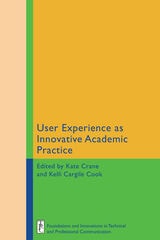
User Experience as Innovative Academic Practice
Kate Crane
University Press of Colorado, 2022
Situating itself in the Technical and Professional Communication discipline, this edited collection provides case studies from various points of instruction and curricular design to illustrate how a user experience (UX) methodology provides invaluable insight into understanding and including student-users. Drawing on research on student-users as they developed student-user profiles, journey maps, diary entries, course reflections, and affinity diagramming, among other sources, the authors of the chapters in this book argue that UX design is not only a worthy practice, but also a necessary one. Collectively, they argue that the UX design approach allows student-users to become co-creators of class material and academic products rather than the byproducts of such work. Together, the work in this collection offers an impetus of a new way of thinking about instruction and programs: designing courses and programs not only for students but with them.
[more]