Results by title
82 books match the query 'Conservatism' and 4 start with u

UNITED STATES EUROPEAN RIGHT
1945-1955DEBORAH KISATSKY
The Ohio State University Press, 2005

Under the Cover of Chaos
Trump and the Battle for the American RightLawrence Grossberg
Pluto Press, 2018
Lawrence Grossberg shows that the truth is bigger and more frightening. Locating Trumpism in the long struggle among traditional conservatism, the new right and the reactionary right, he suggests that the chaos is far more significant and strategic ... and dangerous. Taking the arguments of the reactionary right seriously, he projects a possible, nightmarish future: a cultural nationalism governed by a popular corporatocracy.
He lays bare how contemporary political struggles are being shaped by a changing national landscape of moods and feelings, marked by a growing absolutism of judgement and belief, and new forms of anxiety, alienation and narcissism.s—and lays out a possible nightmare future: a vision of a political system controlled by corporate interests, built on a deliberate dismantling of modern politics.
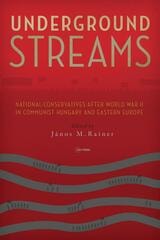
Underground Streams
National-Conservatives after World War II in Communist Hungary and Eastern EuropeJános M. Rainer
Central European University Press, 2023
The authors of this edited volume address the hidden attraction that existed between the extremes of left and right, and of internationalism and nationalism under the decades of communist dictatorship in Eastern Europe. One might suppose that under the suppressive regimes based on leftist ideology and internationalism their right-wing opponents would have been defeated and ultimately removed. These essays, on the other hand, recount the itinerary of survival and revival of "right-wing" thought and activities under communist dictatorship. Resistance and accommodation are explored in the various phases from the Stalinist era to the demise of the Soviet Bloc, with the continuity provided by tacit or concealed right-wing discourses receiving particular consideration. The Eastern European right, both in its conservative and fascist version, centered on nationalism, a legitimizing factor that increased with the downfall of the regimes, and the authors thus accord nationalism special attention.
Two documentary sources for these essays that stand out are files of the security services and the exceptionally rich Oral History Archive compiled by the 1956 Institute in Budapest, Hungary.
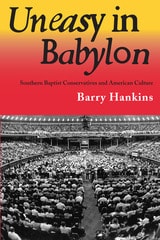
Uneasy in Babylon
Southern Baptist Conservatives and American CultureBarry Hankins
University of Alabama Press, 2002
The definitive account of how conservative Southern Baptists came to dominate the nation's largest Protestant denomination
In 1979 a group of conservative members of the Southern Baptists Convention (SBC) initiated a campaign to reshape the denomination’s seminaries and organizations by installing new conservative leaders who made belief in the inerrancy of the Bible a condition of service. They succeeded. This book is a definitive account of that takeover.
Barry Hankins argues that the conservatives sought control of the SBC not or not only to secure the denomination's orthodoxy but to mobilize Southern Baptists for a war against secular culture. The best explanation of the beliefs and behavior of Southern Baptist conservatives, Hankins concludes, lies in their adoption of the culture war model of American society. Believing that "American culture has turned hostile to traditional forms of faith,” they sought to deploy the Southern Baptist Convention in a "full-scale culture war" against secularism in the United States. Hankins traces the roots of this movement to the ideas of such post-WWII northern evangelicals as Carl F. H. Henry and Francis Schaeffer. Henry and Schaeffer viewed America's secular culture as hostile to Christianity and called on evangelicals to develop a robust Christian opposition to secular culture. As the nation’s largest Protestant denomination, SBC positions on divisive cultural issues like abortion have remade the American political landscape, most notably in the reversal of Roe v. Wade.
Hankins also argues, however, that Southern Baptist conservatives sought more than orthodox adherence to Biblical inerrancy. They also sought an identity that was authentically Baptist and Southern. Hankin’s excellent and prescient work will fascinate readers interested in contemporary American religion, culture, and public policy, as well as in the American South.