Results by title
476 books match the query 'Criticism' and 6 start with u
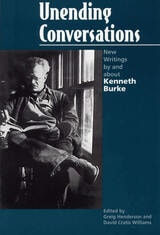
Unending Conversations
New Writings by and about Kenneth BurkeEdited by Greig Henderson and David Cratis Williams
Southern Illinois University Press, 2001
Previously unpublished writings by and about Kenneth Burke plus essays by such Burkean luminaries as Wayne C. Booth, William H. Rueckert, Robert Wess, Thomas Carmichael, and Michael Feehan make the publication of Unending Conversations a significant event in the field of Burke studies and in the wider field of literary criticism and theory.
Editors Greig Henderson and David Cratis Williams have divided their material into three parts: “Dialectics of Expression, Communication, and Transcendence,” “Criticism, Symbolicity, and Tropology,” and “Transcendence and the Theological Motive.”
In the first part, Williams’s textual introduction and Rueckert’s essay analyze the genesis and composition of Burke’s A Symbolic of Motives and Poetics, Dramatistically Considered. Henderson opens part two by showing how these two essays’ concerns with literary form hearken back to Burke’s first book of criticism, Counter-Statement.
Thomas Carmichael discusses Burke’s relationship to thinkers such as Paul de Man, Jacques Derrida, Stanley Fish, Fredric Jameson, Jean-François Lyotard, and Richard Rorty. Wess analyzes the relation between Burke’s dramatistic pentad of act, agent, scene, agency, and purpose and his four master tropes—metaphor, metonymy, synecdoche, and irony.
In the third part, Booth mines his unpublished correspondence with Burke to demonstrate that Burke is a coy theologian. Michael Feehan discusses Burke’s revelation in a 1983 interview that rather than rebounding from a naive kind of Marxism in Permanence and Change, he was rebounding from what he had “learned as a Christian Scientist.”
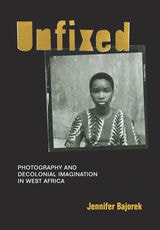
Unfixed
Photography and Decolonial Imagination in West AfricaJennifer Bajorek
Duke University Press, 2020

Universal Abandon
The Politics of PostmodernismAndrew Ross, Editor
University of Minnesota Press, 1989
Universal Abandon was first published in 1989. Minnesota Archive Editions uses digital technology to make long-unavailable books once again accessible, and are published unaltered from the original University of Minnesota Press editions.
In recent years, the debate about postmodernism has become a full-blown, global discussion about the nature and future of society: it has challenged and redefined the cultural and sexual politics of the last two decades, and is increasingly shaping tomorrow's agenda. Postmodernist culture is a medium in which we all live, no matter how unevenly its effects are felt across the jagged spectrum of color, gender, class, sexual, orientation, region, and nationality. But it is also a culture that proclaims its abandonment of the universalist foundations of Enlightenment thought in the West. At a time when interests can no longer be universalized, the question arises: Whose interests are served by this "universal abandon"?
Universal Abandon is the first volume in a new series entitled Cultural Politics, edited by the Social Text collective. This collection tackles a wider range of cultural and political issues than are usually addressed in the debates about postmodernism—color, ethnicity, and neocolonialism; feminism and sexual difference; popular culture and the question of everyday life—as well as some political and philosophical matters that have long been central to the Western tradition. Together, the contributors provide no consensus about the politics of postmodernism; they insist, rather, that "universal abandon?" remain a question and not an answer.
The contributors: Anders Stephanson, Chantal Mouffe, Stanley Aronowitz, Ernesto Laclau, Nancy Fraser, Linda Nicholson, Meaghan Morris, Paul Smith, Laura Kipnis, Lawrence Grossberg, Abigail Solomon-Godeau, George Yudice, Jacqueline Rose, and Hal Foster.
Andrew Ross teaches English at Princeton University and is the author of The Failure of Modernism.
Unseeing Empire
Photography, Representation, South Asian AmericaBakirathi Mani
Duke University Press, 2020
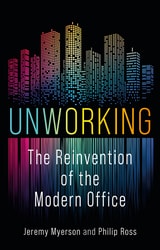
Unworking
The Reinvention of the Modern OfficeJeremy Myserson and Phillip Ross
Reaktion Books, 2022
Over the past one hundred years, the office has been integral to the development of modern society. It has shaped the architecture of our cities, the behavior of our organizations, and the everyday movements of millions of people. In 2020, however, the global pandemic brought our attendance in the office to an abrupt halt and triggered a complete reevaluation of the purpose of the workplace. This book offers a panoramic view of the office and explores what happens next. The authors advance a manifesto for “unworking”—unlearning old habits and rituals established for an outdated office and crafting and creating new ones fit for an age of digital technology, design innovation, and diverse workforces.
Urban Design
Alex Krieger
University of Minnesota Press, 2009
Highlights key issues in contemporary urban design through a discussion of its origins, current state, and future
Fifty years ago a landmark conference at Harvard University established urban design as a distinct architectural and planning practice. Today, with the world’s urban population surpassing three billion people, urban design has become more crucial than ever. Indeed, the concerns that initially brought leading architects and city planners together—including concerns over sprawl, pollution, and aging infrastructure—have only intensified over the past half century.
In Urban Design, Alex Krieger and William S. Saunders have assembled prominent figures in architecture, planning, and landscape design to look back on the evolution of the discipline of urban design; assess the current state of the field; and anticipate the challenges posed by the unprecedented rate of urbanization, particularly in the developing world, and how the profession will need to adapt in order to confront them. The volume opens with excerpts from transcripts of the 1956 Harvard conference followed by essays that contextualize and critique its assumptions and ambitions. Subsequent essays address such topics as the social conscience of urban design and stake out the competing sensibilities in the field, from New Urbanism to avant-garde. As humanity becomes an urban species to a degree that was unimaginable fifty years ago, this comprehensive volume seeks to encourage today’s designers to draw on the energy and messy vitality of cities in shaping tomorrow’s urban environments.Contributors: Jonathan Barnett, Denise Scott Brown, Joan Busquets, Kenneth Greenberg, John Kaliski, Timothy Love, Fumihiko Maki, Richard Marshall, Eric Mumford, Michelle Provoost, Peter G. Rowe, Edward W. Soja, Richard M. Sommer, Michael Sorkin, Emily Talen, Marilyn Jordan Taylor, Wouter Vanstiphout, Charles Waldheim.