Results by title
161 books match the query 'Cuba' and 3 start with u
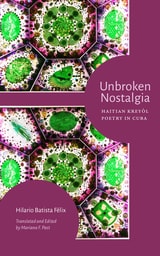
Unbroken Nostalgia
Haitian Kreyòl Poetry in CubaWritten by Hilario Batista Félix, edited and translated by Mariana F. Past
Amherst College Press, 2026
Unbroken Nostalgia: Haitian Kreyòl Poetry in Cuba is the first English translation and scholarly edition of the collection Nostalji san pwen ni vigil: pwezi kreyòl nan peyi Kiba (2016) by Hilario Batista Félix. A poet, journalist, and language activist, Batista (1955– ) embodies and expresses Cuba’s cultural and linguistic diversity as a descendant of Haitian migrant workers to Eastern Cuba during the mid-twentieth century; his poems bridge regions usually separated by language—the Spanish and Creolophone/Francophone Caribbean—and vividly depict the distinct heritage of Haitian Cubans and their shared dreams and challenges. A scholarly introduction by translator and editor Mariana F. Past provides biographical information about the author, situates his work within Haitian diasporic literature, and addresses patterns of Haitian migration to Cuba. Batista’s original poems appear alongside facing-page English translations with annotations that clarify historical figures and events, geographical features, and Haitian cultural and religious practices. Grounded in oral storytelling traditions, Unbroken Nostalgia brings to light the collective memory and complicated hybridity of the Haitian community in Cuba and upholds Haitian Kreyòl as a language of resistance.
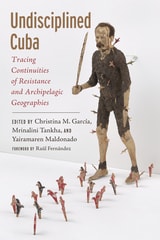
Undisciplined Cuba
Tracing Continuities of Resistance and Archipelagic GeographiesChristina M. García
Rutgers University Press, 2027
Undisciplined Cuba brings scholars of diverse disciplines and moves through multiple temporalities and geographies, allowing Cuba to emerge as a negotiated reality. Rather than rehearse narratives of exceptionalism and Cold War relationships that have detached the nation from its Antillean neighbors, this edited volume understands Cuba as deeply embedded in the Caribbean archipelago. Its chapters encompass feminist activism, public health, cinema for social justice, marine geopoetics, racial geographies, and literary corporealities. Drawing from an archipelagic framework and a decolonial practice of undisciplining, the anthology counters the tendency to treat landscapes, and cultural and political manifestations as artifacts of a national identity or evidence of a discrete geopolitical entity. Instead, Undisciplined Cuba attends to processes, to dynamic relations and continuities of resistance that defy periodization and institutional representation. The book offers a granular view of Cuba and an approach to Caribbean studies that imagines networks in excess of traditional categories of thought.
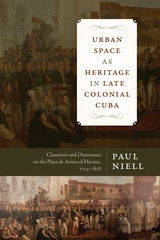
Urban Space as Heritage in Late Colonial Cuba
Classicism and Dissonance on the Plaza de Armas of Havana, 1754-1828By Paul Niell
University of Texas Press, 2015
According to national legend, Havana, Cuba, was founded under the shade of a ceiba tree whose branches sheltered the island’s first Catholic mass and meeting of the town council (cabildo) in 1519. The founding site was first memorialized in 1754 by the erection of a baroque monument in Havana’s central Plaza de Armas, which was reconfigured in 1828 by the addition of a neoclassical work, El Templete. Viewing the transformation of the Plaza de Armas from the new perspective of heritage studies, this book investigates how late colonial Cuban society narrated Havana’s founding to valorize Spanish imperial power and used the monuments to underpin a local sense of place and cultural authenticity, civic achievement, and social order.
Paul Niell analyzes how Cubans produced heritage at the site of the symbolic ceiba tree by endowing the collective urban space of the plaza with a cultural authority that used the past to validate various place identities in the present. Niell’s close examination of the extant forms of the 1754 and 1828 civic monuments, which include academic history paintings, neoclassical architecture, and idealized sculpture in tandem with period documents and printed texts, reveals a “dissonance of heritage”—in other words, a lack of agreement as to the works’ significance and use. He considers the implications of this dissonance with respect to a wide array of interests in late colonial Havana, showing how heritage as a dominant cultural discourse was used to manage and even disinherit certain sectors of the colonial population.