Results by title
74 books match the query 'Discourse analysis' and 2 start with u
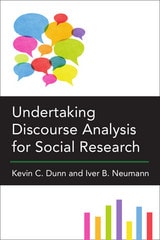
Undertaking Discourse Analysis for Social Research
Kevin C. Dunn and Iver B. Neumann
University of Michigan Press, 2016
Kevin C. Dunn and Iver B. Neumann offer a concise, accessible introduction to discourse analysis in the social sciences. A vital resource for students and scholars alike, Undertaking Discourse Analysis for Social Research combines a theoretical and conceptual review with a “how-to” guide for using the method. In the first part of the book, the authors discuss the development of discourse analysis as a research method and identify the main theoretical elements and epistemological assumptions that have led to its emergence as one of the primary qualitative methods of analysis in contemporary scholarship.
Then, drawing from a wide-range of examples of social science scholarship, Dunn and Neumann provide an indispensable guide to the variety of ways discourse analysis has been used. They delve into what is gained by using this approach and demonstrate how one actually applies it. They cover such important issues as research prerequisites, how one conceives of a research question, what “counts” as evidence, how one “reads” the data, and some common obstacles and pitfalls. The result is a clear and accessible manual for successfully implementing discourse analysis in social research.
[more]

Unfinished Business
Thoughts on the Past, Present, Future, and Nurturing of Homo ScribensCharles Bazerman
University Press of Colorado, 2024
In Unfinished Business, Charles Bazerman considers long-standing puzzles in writing studies, from the most fundamental ideas about humans as writers and writing as constituting modern society to the most practical issues of curriculum and teaching. Together, the chapters provide a broad vision of the importance, role, consequences, and means of writing. The opening cluster of chapters places Homo sapiens’ capacity to write within the biological and cultural evolutionary arc. The second cluster of chapters focuses on how writing has extended and transformed our knowledge with major consequences for us as societies and individuals. The third cluster considers how we go about teaching this increasingly important skill that gives people voice in the literate world. The fourth reflects on the values and ethical concerns that pervade the practice and teaching of writing. In his final chapter, Bazerman speculates about where writing and writing instruction may go in the rapidly changing future.
[more]