Results by title
230 books match the query 'Doctrines' and 4 start with u
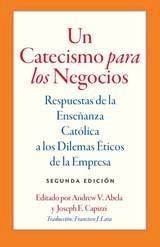
Un Catecismo para los Negocios
Andrew V. Abela
Catholic University of America Press, 2016
This second edition, translated into Spanish, streamlines some of the editing from the first addition, and more importantly, includes material from Pope Francis's encyclical, Laudato Si, and his apostolic exhortation, Evangelii Gaudium. A Catechism for Business presents the teachings of the Catholic Church as they relate to more than one hundred specific and challenging moral questions as they have been asked by business leaders. Andrew V. Abela and Joseph E. Capizzi have assembled the relevant quotations from recent Catholic social teaching as responses to these questions. Questions and answers are grouped together under major topics such as marketing, finance and investment. The book's easy-to-use question and answer approach invites quick reference for tough questions and serves as a basis for reflection and deeper study in the rich Catholic tradition of social doctrine.
[more]

Understanding Buddhism
Nolan Pliny Jacobson
Southern Illinois University Press, 1986
Jacobson presents Buddhism unencumbered by Western categories and concepts, free from the cognitive bias, from the concept-oriented, definition-minded preoccupations inherited from the ancient Greeks. It is an interpretation of the central ideas that have characterized all forms of Buddhism for 25 centuries.
[more]
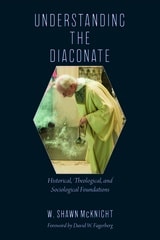
Understanding the Diaconate
Historical, Theological, and Sociological FoundationsW. Shawn McKnight
Catholic University of America Press, 2018
What is a deacon? More than fifty years since the restoration of the permanent diaconate by the Second Vatican Council, the office of deacon is still in need of greater specificity about its purpose and place within the mission and organizational structure of the Church. While the Church is more than a social reality, the Church nonetheless has a social reality. Our understanding of the diaconate therefore benefits from a theological discussion of the divine element of the Church and a sociological examination of the human element. Understanding the Diaconate adds the resources of sociology and anthropology to the theological sources of scripture, liturgy, patristic era texts, theologians, and magisterial teachings to conclude that the deacon can be understood as “social intermediary and symbol of communitas” who serves the participation of the laity in the life and mission of the Church. This research proposes the deacon as a servant of the bond of communion within the Church (facilitating the relationship between the bishop/priest and his people), and between the People of God and the individual in need. Thus authentic diaconal ministry includes a vast array of many concrete contexts of pastoral importance where one does more than simply serve at Mass.
[more]
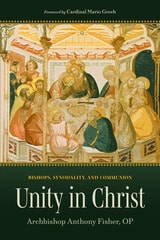
Unity in Christ
Bishops, Synodality, and CommunionArchbishop Anthony Fisher, OP
Catholic University of America Press, 2023
What does episcopal fraternity and communio look like? This central question is explored through the erudition and experience of Archbishop Anthony Fisher, Catholic Archbishop of Sydney, Australia. Unity in Christ, based upon a series of addresses given to the United States Conference of Catholic Bishops (USCCB) at their Special Assembly in 2022, delves into the themes associated with episcopal unity. By surveying the Christian tradition, beginning with the scriptures and then through various periods (Apostolic generation, patristic, scholastic, Vatican II, recent post Vatican II developments such as synodality) a coherent picture of episcopal togetherness is presented. What becomes clear is that unity among Christ’s disciples and their successors is not simply an ideal but rather a constitutive element of their office. They are called to love as Christ loved, expressed above all through genuine friendship with one another. The consequences of this fraternity and communio have implications in areas such as spirituality, preaching and fraternal correction, among others. This second feature, the implications of episcopal fraternity and communio, are explored through Archbishop Fisher’s twenty years of experience as a bishop of the Catholic Church. By providing concrete examples of lived episcopal fraternity and communio, Fisher offers a glimpse into both the challenges and fruits of living out Christ’s call that "they might all be one" (Jn 17:21).
[more]