Results by title
1038 books match the query 'Economic conditions' and 19 start with u

Uganda Now
Between Decay and DevelopmentHölger Bernt Hansen
Ohio University Press, 1988
Can the revolutionary government of Yoweri Museveni’s National Resistance Movement put Uganda back on the road from decay to development?
These informed assessments put the present situation in context. The contributors assembled as Museveni’s guerrillas were launching their final bid for power. They have finalized their contributions in the light of the Museveni government’s initial period of power.
Contributions by Ugandan academics and politicians interlock with those by scholars from across the world who have a concern for Uganda. Historians examine the period of colonialism. There are political studies of the quarter century since independence. There are detailed analyses of the economic realities for the Ugandan government in the period of international debt. The central role of education in national development is given due prominence.
Ali A. Mazrui ends the book by asking ‘Is Africa Decaying?’ The editors have put the consideration of the case of Uganda’s recent history within the context of Africa’s development crisis. Uganda has presented in an aggravated form the crisis common to many other African countries: infrastructural breakdown, mounting foreign debt, military regimes and waves of refugees.

Uncertain Honor
Modern Motherhood in an African CrisisJennifer Johnson-Hanks
University of Chicago Press, 2005
Combining insights from demography and cultural anthropology, Johnson-Hanks argues that Beti women delay motherhood as part of a broader attempt to assert a modern form of honor only recently made possible by formal education, Catholicism, and economic change. Through itinerant school careers and manipulations of marriage, educated Beti women now manage their status as mothers in order to coordinate major life events in the face of social and economic uncertainty.
Carefully researched and clearly written, Uncertain Honor offers an intimate look at the lives of African women trying to reconcile motherhood with new professional roles in a context of dramatic social change.
Uncertain Times
Kenneth Arrow and the Changing Economics of Health CarePeter J. Hammer, Deborah Haas-Wilson, Mark A. Peterson, and William M. Sage, eds.
Duke University Press, 2003
Coming from diverse backgrounds—economics, law, political science, and the health care industry itself—the contributors use Arrow’s article to address a range of present-day health-policy questions. They examine everything from health insurance and technological innovation to the roles of charity, nonprofit institutions, and self-regulation in addressing medical needs. The collection concludes with a new essay by Arrow, in which he reflects on the health care markets of the new millennium. At a time when medical costs continue to rise, the ranks of the uninsured grow, and uncertainty reigns even among those with health insurance, this volume looks back at a seminal work of scholarship to provide critical guidance for the years ahead.
Contributors
Linda H. Aiken
Kenneth J. Arrow
Gloria J. Bazzoli
M. Gregg Bloche
Lawrence Casalino
Michael Chernew
Richard A. Cooper
Victor R. Fuchs
Annetine C. Gelijns
Sherry A. Glied
Deborah Haas-Wilson
Mark A. Hall
Peter J. Hammer
Clark C. Havighurst
Peter D. Jacobson
Richard Kronick
Michael L. Millenson
Jack Needleman
Richard R. Nelson
Mark V. Pauly
Mark A. Peterson
Uwe E. Reinhardt
James C. Robinson
William M. Sage
J. B. Silvers
Frank A. Sloan
Joshua Graff Zivin
Underdeveloping the Amazon
Extraction, Unequal Exchange, and the Failure of the Modern StateStephen G. Bunker
University of Chicago Press, 1988

Understanding Contemporary Ireland
Edited by Brendan Bartley and Rob Kitchin
Pluto Press, 2006
The "Celtic Tiger" phenomenon has made Ireland the focus of much attention in recent years. Other countries have openly declared that they want to follow the Irish economic and social model. Yet there is no book that gives a comprehensive, spatially-informed analysis of the Irish experience. This book fills that gap.
Divided into four parts—planning and development, the economy, the political landscape, and population and social issues—the chapters provide an explanation of a particular aspect of Ireland and Irish life accompanied by illustrative material. In particular, the authors reveal how the transformations that have occurred are uneven and unequal in their effects across the country and highlight the challenges now facing Irish society and policy-makers.
Understanding Economic Recovery in the 1930s
Endogenous Propagation in the Great DepressionFrank G. Steindl
University of Michigan Press, 2003
Providing strong evidence for the role of the quantity of money in the revitalization, the author ultimately concludes that the seemingly robust monetary explanation of the recovery is deficient, as is any that relies principally on aggregate demand impulses. An accurate understanding of this phenomenon must account for the inherent tendency of the economy to revert to its long-run high employment trend.
Frank G. Steindl is Regents Professor of Economics and Ardmore Professor of Business Administration, Oklahoma State University.
Understanding Mainland Puerto Rican Pov
Susan Baker
Temple University Press, 2002
Uneven Tides
Rising Inequality in AmericaSheldon H. Danziger
Russell Sage Foundation, 1993
Unhappy Valley, Book One
Conflict in Kenya & AfricaBruce Berman
Ohio University Press, 1992
The authors investigate major themes. These include the conquest origins and subsequent development of the colonial state, the contradictory social forces that articulated African societies to European capitalism, and the creation of new political communities and changing meanings of ethnicity in Africa, in the context of social differentiation and class formation. There is substantial new work on the problems of Mau Mau and of wealth, poverty and civic virtue in Kikuyu political thought.
The authors make a fresh contribution to a deeper historical understanding of the development of contemporary Kenyan society and, in particular, of the British and Kukuyu origins of Mau Mau and the emergency of the 1950s.
They also highlight some of the shortcomings of ideas about development, explore the limitations of narrowly structuralist Marxist theory of the state, and reflect on the role of history in the future of Africa.
Book One on State and Class will be used by students of African history as well as of colonial Kenya; it is also concerned with the theory of history and of political science.
Unhappy Valley, Book Two
Conflict in Kenya & AfricaBruce Berman
Ohio University Press, 1992
The authors investigate major themes. These include the conquest origins and subsequent development of the colonial state, the contradictory social forces that articulated African societies to European capitalism, and the creation of new political communities and changing meanings of ethnicity in Africa, in the context of social differentiation and class formation. There is substantial new work on the problems of Mau Mau and of wealth, poverty and civic virtue in Kikuyu political thought.
The authors make a fresh contribution to a deeper historical understanding of the development of contemporary Kenyan society and, in particular, of the British and Kukuyu origins of Mau Mau and the emergency of the 1950s.
They also highlight some of the shortcomings of ideas about development, explore the limitations of narrowly structuralist Marxist theory of the state, and reflect on the role of history in the future of Africa.
Book Two on Violence and Ethnicity gives new insights into popular consciousness, into revolutionary change and into the subtle realities of ethnicity; it will be of particular value to readers of Ngugi.
Unhappy Valley
Clan, Class & State In Colonial KenyaBruce Berman
Ohio University Press, 1991

Unknown Tongues
Black Women's Political Activism in the Antebellum Era, 1830-1860Gayle T. Tate
Michigan State University Press, 2003
Unknown Tongues examines the social and economic factors of northern industrialization, social reform, and black nationalism, all of which undergirded black women’s political consciousness during the decades before the American Civil War. The linkages between black women’s roles in the “culture of resistance” in slave communities and their transformations in the urban market economy fueled the development of black women’s political consciousness. As community activists and then as abolitionists, black urban women organized and protested against slavery, racism, sexism, and its attendant ills. Driven by market forces of nascent capitalism, black women created broad- based protest responses to the white power structure. Unknown Tongues explores the material realities that underpinned black women’s political development as well as the transformative stages of their political consciousness and activity.
Unraveling the Garment Industry
Transnational Organizing and Women’s WorkEthel C. Brooks
University of Minnesota Press, 2007
Brooks analyzes a two-pronged problem in consumer boycott campaigns against labor abuse in the garment industry. First, how are we to understand the political necessities of local protest such as the right to unionize against the emphasis placed on consumer boycotts? Second, what and whose agency is privileged or obscured within the symbolic economies and the politics of information deployed by these campaigns? Tying both of these questions together is a commitment to seeing globalization as embedded in the everyday realities of the local.
Drawing attention to the race, class, and gender assumptions central to powerful consumer boycotts, Brooks reveals how these movements unintentionally reinforce the global economic forces they denounce.
Ethel C. Brooks is assistant professor of women’s and gender studies and sociology at Rutgers University.

Unsilencing Gaza
Reflections on ResistanceSara Roy
Pluto Press, 2021
Gaza, the centre of Palestinian nationalism and resistance to the occupation, is the linchpin of the Israeli-Palestinian conflict and the key to its resolution. Since 2005, Israel has deepened the isolation of the territory, severing it almost completely from its most vital connections to the West Bank, Israel and beyond, and has deliberately shattered its economy, transforming Palestinians from a people with political rights into a humanitarian problem.
Sara Roy unpacks this process, looking at US foreign policy towards the Palestinians, as well as analysing the trajectory of Israeli policy toward Gaza, which became a series of punitive approaches meant not only to contain the Hamas regime but weaken Gazan society.
Roy also reflects on Gaza's ruination from a Jewish perspective and discusses the connections between Gaza's history and her own as a child of Holocaust survivors. This book, a follow up from the renowned Failing Peace, comes from one of the world's most acclaimed writers on the region.
Urban Dwellings, Haitian Citizenships
Housing, Memory, and Daily Life in HaitiVincent Joos
Rutgers University Press, 2022
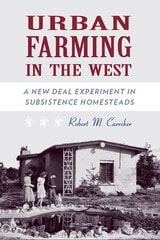
Urban Farming in the West
A New Deal Experiment in Subsistence HomesteadsRobert Carriker
University of Arizona Press, 2010
Robert Carriker examines for the first time the intricate histories of these subsistence homestead projects, which have long been buried in bureaucratic records and clouded by misunderstanding, showing that in many ways they were among the agency’s most successful efforts. He provides case studies of the projects, rescuing their obscure histories using archival documents and rare photographs. He also reveals the machinations of civic groups and private citizens across the West who jockeyed for access to the funds being allotted for New Deal community building.
By describing what took place on these western homesteads, Carriker shows that the DSH’s agenda was not as far-fetched as some have reported. The tendency to condemn the Division and its projects, he argues, has failed to appreciate the good that came from some of the individual homestead communities—particularly those in the Far West.
Although overshadowed by the larger undertakings of the New Deal, some of these western communities remain thriving neighborhoods—living legacies to FDR’s efforts that show how the country once chose to deal with economic hardship. Too often the DSH is noted for its failures; Carriker’s study shows that its western homesteads were instead qualified accomplishments.

Urban Leviathan
Mexico City in the Twentieth CenturyDiane E. Davis
Temple University Press, 1994
Why, Diane Davis asks, has Mexico City, once known as the city of palaces, turned into a sea of people, poverty, and pollution? Through historical analysis of Mexico City, Davis identifies political actors responsible for the uncontrolled industrialization of Mexico's economic and social center, its capital city. This narrative biography takes a perspective rarely found in studies of third-world urban development: Davis demonstrates how and why local politics can run counter to rational politics, yet become enmeshed, spawning ineffective policies that are detrimental to the city and the nation.
The competing social and economic demand of the working poor and middle classes and the desires of Mexico's ruling Partido Revolucionario Institutional (PRI) have led to gravely diminished services, exorbitant infrastructural expenditures, and counter-productive use of geographic space. Though Mexico City's urban transport system has evolved over the past seven decades from trolley to bus to METRO (subway), it fails to meet the needs of the population, despite its costliness, and is indicative of the city's disastrous and ill-directed overdevelopment. Examining the political forces behind the thwarted attempts to provide transportation in the downtown and sprawling outer residential areas, Davis analyzes the maneuverings of local and national politicians, foreign investors, middle classes, agency bureaucrats, and various factions of the PRI.
Looking to Mexico's future, Davis concludes that growing popular dissatisfaction and frequent urban protests demanding both democratic reform and administrative autonomy in the capital city suggest an unstable future for corporatist politics and the PRI's centralized one-party government.
Urban Life in Contemporary China
Martin King Whyte and William L. Parish
University of Chicago Press, 1984