Results by title
153 books match the query 'Egypt' and 3 start with u
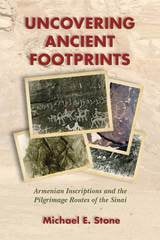
Uncovering Ancient Footprints
Armenian Inscriptions and the Pilgrimage Routes of the SinaiMichael E. Stone
SBL Press, 2017
Explore pilgrimage routes, epigraphy, and the history of writing with an expert guide
From the late 1970s through 1982, Michael E. Stone conducted a number of expeditions to the Sinai peninsula, searching for ancient inscriptions. In this book Stone describes his search, crowned by the discovery of the most ancient Armenian inscriptions known. Here Stone describes not only the inscriptions discovered along his journeys but also the Sinai, its past and present, its human inhabitants, its flora and fauna, and its history. Though once common, well-informed travel books to the Middle East with a broad academic interest and a specific focus have become rare. Stone’s diary of his expeditions in the Sinai fill this gap with vivid descriptions, poetry, and illustrations.
Features
- An account of five expeditions into the Sinai
- Thirteen poems written by Stone
- Twenty-six figures and five maps
Under Osman's Tree
The Ottoman Empire, Egypt, and Environmental HistoryAlan Mikhail
University of Chicago Press, 2017
The early modern Middle East was the world’s most crucial zone of connection and interaction. Accordingly, the Ottoman Empire’s many varied environments affected and were affected by global trade, climate, and disease. From down in the mud of Egypt’s canals to up in the treetops of Anatolia, Alan Mikhail tackles major aspects of the Middle East’s environmental history: natural resource management, climate, human and animal labor, energy, water control, disease, and politics. He also points to some of the ways in which the region’s dominant religious tradition, Islam, has understood and related to the natural world. Marrying environmental and Ottoman history, Under Osman’s Tree offers a bold new interpretation of the past five hundred years of Middle Eastern history.
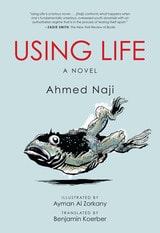
Using Life
By Ahmed Naji, Illustrations by Ayman Al Zorkany, Translated by Benjamin Koerber
University of Texas Press, 2017
Upon its initial release in Arabic in the fall of 2014, Using Life received acclaim in Egypt and the wider Arab world. But in 2016, Ahmed Naji was sentenced to two years in prison after a reader complained that an excerpt published in a literary journal harmed public morality. His imprisonment marks the first time in modern Egypt that an author has been jailed for a work of literature. Writers and literary organizations around the world rallied to support Naji, and he was released in December 2016. His original conviction was overturned in May 2017 but, at the time of printing, he is awaiting retrial and banned from leaving Egypt.
Set in modern-day Cairo, Using Life follows a young filmmaker, Bassam Bahgat, after a secret society hires him to create a series of documentary films about the urban planning and architecture of Cairo. The plot in which Bassam finds himself ensnared unfolds in the novel’s unique mix of text and black-and-white illustrations.
The Society of Urbanists, Bassam discovers, is responsible for centuries of world-wide conspiracies that have shaped political regimes, geographical boundaries, reigning ideologies, and religions. It is responsible for today’s Cairo, and for everywhere else, too. Yet its methods are subtle and indirect: it operates primarily through manipulating urban architecture, rather than brute force. As Bassam immerses himself in the Society and its shadowy figures, he finds Cairo on the brink of a planned apocalypse, designed to wipe out the whole city and rebuild anew.