Results by title
542 books match the query 'Emigration and immigration' and 13 start with u
Ukrainians in Michigan
Paul M. Hedeen
Michigan State University Press, 2023
Ulster and North America
Transatlantic Perspectives on the Scotch IrishH. Tyler Blethen
University of Alabama Press, 2001
The 11 essays in this volume, originally presented at meetings of the Ulster-American Heritage Symposium by scholars from Scotland, Ireland, Canada, and the United States, explore the nature of Scotch-Irish culture by examining values, traditions, demographics, and language. The essays also investigate the process of migration, which transmitted that culture to the New World, and the subsequent assimilation of Celtic ways into American culture.
The themes presented are wide-ranging and complex. First is the dynamic nature of Ulster society in the 17th and 18th centuries and the rapid changes occurring there, especially those affecting Presbyterianism and community cohesiveness. Also examined is the experience of migration, asking such questions as who migrated and when, what their expectations were, and how closely colonial reality matched those expectations. A third theme is the development of economic strategies and community-building both in Ulster and North America, making important contributions to the "new rural history" and explaining the success of the Scotch-Irish on the American frontier. Finally, the volume addresses ethnic identity and cultural diffusion, advancing the ongoing debate initiated by Forrest McDonald and Grady McWhiney and elaborated on by David Hackett Fischer. Ulster and North America illustrates the value of transatlantic dialog and of comparative studies for the understanding of ethnicity and migration history.
Unbordering Migration Studies in the Caribbean and Latin America
Patsy Lewis
Rutgers University Press, 2026
Unbordering Migration Studies in the Caribbean and Latin America brings together scholars and artists across regions, generations, disciplines, and modes of expression to decenter the US-Mexico border as both a site and a concept. Calling for renewed attention to the spaces, identities, and conflicts that remain understudied and excluded from our hemispheric knowledge of forced movement, the volume reveals a wider diversity of migratory realities and considers race, ethnicity, and class beyond the hegemonic formations that eclipse non-US histories. Through multidisciplinary and geographically expansive essays that draw from history, social anthropology, environmental studies, feminist studies, and lived experience, the volume examines diverse migratory flows from Chile and Argentina in the South to Georgia and New York in the North. Individually and collectively, the essays remap migratory movements other than through the most studied South-to-North trajectories and remove the US and US-based racial formations from the center of analysis. By tracking East-West flows, intraregional mobilities, and changing conceptions of racial identity, Unbordering Migration Studies in the Caribbean and Latin America complicates the concepts of forced mobility and border crossing by highlighting alternative liminalities in sites of transit, destination, and return. Demanding engagement with the submerged histories of racism and the production of ethnoracial categories beyond the Black/white binary, the collection brings into focus identities, sites, and forces that have not yet occupied the foreground of global migration study.
Uncharted Terrains
New Directions in Border Research Methodology, Ethics, and PracticeEdited by Anna Ochoa O’Leary, Colin M. Deeds, and Scott Whiteford
University of Arizona Press, 2013
Each chapter raises methodological and ethical questions relevant to conducting research in transnational contexts, which can frequently be unpredictable or even volatile. The volume addresses the central question of how can scholars work with vulnerable migrant populations along the perilous US–Mexico border and maintain ethical and methodological standards, while also providing useful knowledge to stakeholders? Not only may immigrants be afraid to provide information that could be incriminating, but researchers may also be reluctant to allow their findings to become the basis of harsher law enforcement, unjustly penalize the subjects of their research, and inhibit the formulation of humane and effective immigration policy based on scholarly research.
All of these concerns, which are perfectly legitimate from the social scientists’ point of view, can put researchers into conflict with legal authorities. Contributors acknowledge their quandaries and explain how they have dealt with them. They use specific topics—reproductive health issues and sexually transmitted diseases among immigrant women, a study of undocumented business owners, and the administration of the Mexican Household Survey in Phoenix, among others—to outline research methodology that will be useful for generations of border researchers.
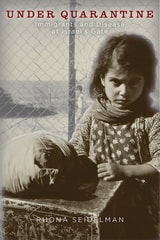
Under Quarantine
Immigrants and Disease at Israel’s GateRhona Seidelman
Rutgers University Press, 2020
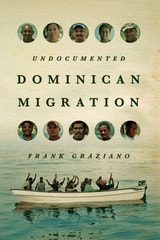
Undocumented Dominican Migration
By Frank Graziano
University of Texas Press, 2013
Undocumented Dominican Migration is the first comprehensive study of boat migration from the Dominican Republic to Puerto Rico. It brings together the interactive global, cultural, and personal factors that induce thousands of Dominicans to journey across the Mona Passage in attempts to escape chronic poverty. The book provides in-depth treatment of decision-making, experiences at sea, migrant smuggling operations, and U.S. border enforcement. It also explores several topics that are rare in migration studies. These include the psychology of migrant motivation, religious beliefs, corruption and impunity, procreation and parenting, compulsive recidivism after failed attempts, social values in relation to law, marriage fraud, and the use of false documents for air travel from Puerto Rico to the mainland United States.
Frank Graziano’s extensive fieldwork among migrants, smugglers, and federal agencies provides an authority and immediacy that brings the reader close to the migrants’ experiences. The exhaustive research and multidisciplinary approach, highly readable narrative, and focus on lesser-known emigrants make Undocumented Dominican Migration an essential addition to public and academic debates about migration.
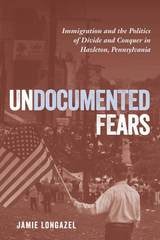
Undocumented Fears
Immigration and the Politics of Divide and Conquer in Hazleton, PennsylvaniaJamie Longazel
Temple University Press, 2016
The Illegal Immigration Relief Act (IIRA), passed in the small Rustbelt city of Hazleton, Pennsylvania in 2006, was a local ordinance that laid out penalties for renting to or hiring undocumented immigrants and declared English the city’s official language. The notorious IIRA gained national prominence and kicked off a parade of local and state-level legislative initiatives designed to crack down on undocumented immigrants.
In his cogent and timely book, UndocumentedFears, Jamie Longazel uses the debate around Hazleton’s controversial ordinance as a case study that reveals the mechanics of contemporary divide and conquer politics. He shows how neoliberal ideology, misconceptions about Latina/o immigrants, and nostalgic imagery of “Small Town, America” led to a racialized account of an undocumented immigrant “invasion,” masking the real story of a city beset by large-scale loss of manufacturing jobs.
Offering an up-close look at how the local debate unfolded in the city that set off this broader trend, Undocumented Fears makes an important connection between immigration politics and the perpetuation of racial and economic inequality.
Undocuments
John-Michael Rivera
University of Arizona Press, 2021
How do you document the undocumented? UNDOCUMENTS both poses and attempts to answer this complex question by remixing the forms and styles of the first encyclopedia of the New World, the Florentine Codex, in order to tell a modern story of Greater Mexico. Employing a broad range of writing genres and scholarly approaches, UNDOCUMENTS catalogs, recovers, and erases documents and images by and about peoples of Greater Mexico from roughly the first colonial moment. This brave and bracing volume organizes and documents ancient New World Mexican peoples from the Florentine Codex (1592) to our current technology-heavy age, wherein modern lawmakers and powerful global figures desire to classify, deport, and erase immigrants and their experiences.
While grappling with anxiety and the physical and mental health consequences of the way the United States treats immigrant bodies, John-Michael Rivera documents and scrutinizes what it means to seek opportunities in America. With a focus on the poetics of Latinx documentality itself, this book is concerned with the complicated and at times contradictory ways peoples of Greater Mexico have been documented and undocumented within systems of colonial knowledges, and how these peoples have been rendered as specters of the bureaucratic state. Rivera takes us through the painful, anxiety-ridden, and complex nature of what it means to be documented or undocumented, and the cruelty married to each of these states of being.
Unguarded Border
American Émigrés in Canada during the Vietnam WarDonald W. Maxwell
Rutgers University Press, 2023
Unguarded Border tells their stories and, in the process, describes a migrant experience that does not fit the usual paradigms. Rather than treating these American refugees as unwelcome foreigners, Canada embraced them, refusing to extradite draft resisters or military deserters and not even requiring passports for the border crossing. And instead of forming close-knit migrant communities, most of these émigrés sought to integrate themselves within Canadian society.
Historian Donald W. Maxwell explores how these Americans in exile forged cosmopolitan identities, coming to regard themselves as global citizens, a status complicated by the Canadian government’s attempts to claim them and the U.S. government’s eventual efforts to reclaim them. Unguarded Border offers a new perspective on a movement that permanently changed perceptions of compulsory military service, migration, and national identity.

Unsafe Haven
The United States, the IRA and Political PrisonersKaren McElrath
Pluto Press, 2000
Karen McElrath questions US government attempts to portray an impartial role in the Irish conflict, arguing that historical and contemporary evidence reveals otherwise. She shows that, far from being a neutral process, the success of bids for political asylum often depends on the relationship between the US and the government of the applicant’s country of origin. Drawing on exclusive interviews with Irish Republicans who have faced deportation or extradition from the United States, or who have been prosecuted in the US for politically-motivated offences, McElrath explores the links between deportation and extradition outcomes and foreign policy issues. The tools of exclusion are defined in their historical context, and the history of US extradition law is described, with particular focus on the treaties with Britain. McElrath also examines the offences for which Irish and Irish-American Republicans have been charged, discusses the various levels of support for Irish political prisoners in the US, and summarises the findings by international human rights organisations.
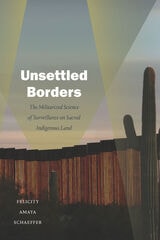
Unsettled Borders
The Militarized Science of Surveillance on Sacred Indigenous LandFelicity Amaya Schaeffer
Duke University Press, 2022
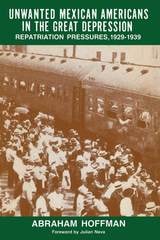
Unwanted Mexican Americans in the Great Depression
Repatriation Pressures, 1929–1939Abraham Hoffman; Foreword by Julian Nava
University of Arizona Press, 1973
Prior to 1931, many Mexican Americans left the United States voluntarily, prompted by homesickness, unemployment, and the Mexican government’s offer of free small land parcels. As the Great Depression deepened, repatriation pressures increased. Anglo groups lobbied for laws that excluded aliens from jobs and welfare benefits. Many businessmen, government officials, and social workers believed that removing Mexican Americans would open up jobs for U.S. citizens and alleviate some of the burden placed on relief agencies.
The Department of Labor’s federal deportation drive, launched in 1931, created an atmosphere of fear and tension in Mexican American communities. Immigration agents conducted surprise searches for people who had entered the country illegally, and Mexicans who had crossed the border before restrictive legislation was passed became prime targets of the deportation campaign.
Welfare agencies throughout the United States organized repatriation programs. The Los Angeles County Welfare Bureau, with the most extensive program, was responsible for the removal of more than thirteen thousand Mexican Americans. A few well-publicized deportations had frightened Mexicans who were unsure of their immigration status. Many chose repatriation over possible deportation.
Using much archival material and many previously unpublished government documents, Hoffman focuses on the repatriation experience in Los Angeles. The city’s large Mexican American population provides an excellent case study of the entire movement. He also surveys the process of Mexican repatriation throughout the entire United States.
Unwelcome Shores
Black Refugees in AmericaBernadette Ludwig
Rutgers University Press, 2026