Results by title
434 books match the query 'Ethics & Moral Philosophy' and 7 start with u
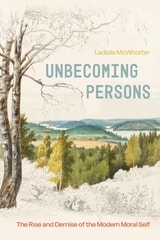
Unbecoming Persons
The Rise and Demise of the Modern Moral SelfLadelle McWhorter
University of Chicago Press, 2025
In the face of ecological crisis, economic injustice, and political violence, the moral demands of being a good person are almost too much to bear. In Unbecoming Persons, Ladelle McWhorter argues that this strain is by design. Our ideas about personhood, she shows, emerged to sustain centuries of colonialism, slavery, and environmental destruction. We must look elsewhere to find our way out.
This history raises a hard question: Should we be persons at all, or might we live a good life without the constraints of individualism or the illusion of autonomy? In seeking an answer, McWhorter pushes back on the notion of our own personhood—our obsession with identity, self-improvement, and salvation—in search of a better way to live together in this world. Although she finds no easy answers, McWhorter ultimately proposes a new ethics that rejects both self-interest and self-sacrifice and embraces perpetual dependence, community, and the Earth
Unchopping a Tree
Reconciliation in the Aftermath of Political ViolenceErnesto Verdeja
Temple University Press, 2009
Employing a normative theory of reconciliation that differs from prevailing approaches, Verdeja outlines a concept that emphasizes the importance of shared notions of moral respect and tolerance among adversaries in transitional societies. Drawing heavily from cases such as reconciliation efforts in Latin America and Africa—and interviews with people involved in such efforts—Verdeja debates how best to envision reconciliation while remaining realistic about the very significant practical obstacles such efforts face
Unchopping a Tree addresses the core concept of respect across four different social levels—political, institutional, civil society, and interpersonal—to explain the promise and challenges to securing reconciliation and broader social regeneration.
Uncountable
A Philosophical History of Number and Humanity from Antiquity to the PresentDavid Nirenberg and Ricardo L. Nirenberg
University of Chicago Press, 2021
Our knowledge of mathematics has structured much of what we think we know about ourselves as individuals and communities, shaping our psychologies, sociologies, and economies. In pursuit of a more predictable and more controllable cosmos, we have extended mathematical insights and methods to more and more aspects of the world. Today those powers are greater than ever, as computation is applied to virtually every aspect of human activity. Yet, in the process, are we losing sight of the human? When we apply mathematics so broadly, what do we gain and what do we lose, and at what risk to humanity?
These are the questions that David and Ricardo L. Nirenberg ask in Uncountable, a provocative account of how numerical relations became the cornerstone of human claims to knowledge, truth, and certainty. There is a limit to these number-based claims, they argue, which they set out to explore. The Nirenbergs, father and son, bring together their backgrounds in math, history, literature, religion, and philosophy, interweaving scientific experiments with readings of poems, setting crises in mathematics alongside world wars, and putting medieval Muslim and Buddhist philosophers in conversation with Einstein, Schrödinger, and other giants of modern physics. The result is a powerful lesson in what counts as knowledge and its deepest implications for how we live our lives.
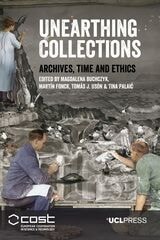
Unearthing Collections
Archives, Time and EthicsEdited by Magdalena Buchczyk, Martín Fonck, Tomás J. Usón, and Tina Palaic
University College London, 2025
Featuring insights from a range of scholars and collection practitioners, Unearthing Collections reconsiders the ethics of collections and archives through the lens of temporality. The volume explores the concept of “unearthing,” meaning the extractive process of uncovering the unknown, and advocates for processes of “re-earthing” to foster new ethical approaches among archivists and museum professionals in preserving and engaging with remnants of the past. It examines a diverse selection of case studies—from film and photography to medical history, geology, and contemporary art—to demonstrate how ethical challenges intersect across different types of collections and archives.
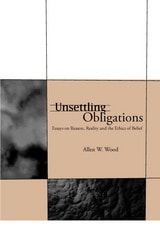
Unsettling Obligations
Essays on Reason, Reality and the Ethics of BeliefAllen W. Wood
CSLI, 2002
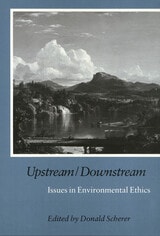
Upstream/Downstream
Issues in Environmental EthicsDonald Scherer
Temple University Press, 1993

Utility and Rights
R.G. Frey, Editor
University of Minnesota Press, 1984
Utility and Rights was first published in 1984. Minnesota Archive Editions uses digital technology to make long-unavailable books once again accessible, and are published unaltered from the original University of Minnesota Press editions.
At issue in the clash between utilitarianism and the theory of rights is a fundamental question about the theoretical underpinnings of moral and political philosophy. Is this structure to be utility-based—grounded in the general welfare—or is it to be based on individual moral and political rights, as critics of utilitarianism increasingly insist? The argument centers, in part, upon the fact that utilitarianism, with its emphasis upon outcomes and total utility in the world, seems to employ a value theory that offers no protection to persons and their vital interests.
The essays in this volume grapple with the main issues in this controversy. They share a common concern with the nature of rights and the ways in which various moral theories can accommodate them; some measure the degree to which utilitarianism can or cannot be modified to include rights. Eight of the eleven essays were written expressly for this book; all of the authors are deeply engaged in the debate over utility and rights, and their essays build upon and extend current thinking on the subject. R. G. Frey's lucid introduction will make the book appropriate for advanced students as well as for scholars in moral, political, and legal theory.
"One ubiquitous criticism of utilitarianism is that it cannot make sense of moral rights at all. This collection is the first that explicitly addresses these issues, and it marks a major step in the debate."–Dale Jamieson, University of Colorado
R. G. Frey is senior lecturer in philosophy at the University of Liverpool. He is the author of Interests and Rights and Rights, Killing, and Suffering.