Results by title
15 books match the query 'Mission'

From Mission to Madness
LAST SON OF THE MORMON PROPHETValeen Tippetts Avery
University of Illinois Press, 1998
"This is an astonishing accomplishment which not only tells the reader about a neglected historical figure, but about myriad neglected dimensions of both Mormon history and the history of religion in general." -- Jan Shipps, author of Mormonism: The Story of a New Religious Tradition
"This will stand alone as a biography of David H. Smith. . . . But it is also an insightful look at the times and environment from which the Smith family, and its ideas, emerged." -- Paul M. Edwards, author of Our Legacy of Faith: A Brief History of the Reorganized Church

Libraries, Mission, and Marketing
Linda Wallace
American Library Association, 2004
Libraries, Mission, and Marketing
Linda Wallace
American Library Association, 0
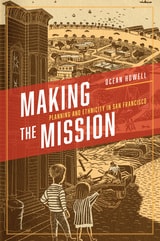
Making the Mission
Planning and Ethnicity in San FranciscoOcean Howell
University of Chicago Press, 2015
In Making the Mission, Ocean Howell tells the story of how residents of the Mission District organized to claim the right to plan their own neighborhood and how they mobilized a politics of place and ethnicity to create a strong, often racialized identity—a pattern that would repeat itself again and again throughout the twentieth century. Surveying the perspectives of formal and informal groups, city officials and district residents, local and federal agencies, Howell articulates how these actors worked with and against one another to establish the very ideas of the public and the public interest, as well as to negotiate and renegotiate what the neighborhood wanted. In the process, he shows that national narratives about how cities grow and change are fundamentally insufficient; everything is always shaped by local actors and concerns.

Man on a Mission
James Meredith and the Battle of Ole MissAram Goudsouzian
University of Arkansas Press, 2022
In 1962, James Meredith famously desegregated the University of Mississippi (a.k.a. Ole Miss). As the first Black American admitted to the school, he demonstrated great courage amidst the subsequent political clashes and tragic violence. After President Kennedy summoned federal troops to help maintain order, the South—and America at large—would never be the same.
Man on a Mission depicts Meredith’s relentless pursuit of justice, beginning with his childhood in rural Mississippi and culminating with the confrontation at Ole Miss. A blend of historical research and creative inspiration, this graphic history tells Meredith’s dramatic story in his own singular voice.
From the dawn of the modern civil rights movement, Meredith has offered a unique perspective on democracy, racial equality, and the meaning of America. Man on a Mission presents his captivating saga for a new generation in the era of Black Lives Matter.
Mission and Margin
A Practical Guide to University FinancesDaniel Diermeier and Brett C. Sweet
University of Chicago Press, 2025
An insider’s guide to university finances, for non-insiders.
The finances of higher education have never been more challenging. From two-year institutions to the Ivy Leagues, from department chairs to provosts, administrators face revenue shortfalls and financial insecurity. A fundamental understanding of financial management is more essential than ever for university leaders at every level—as is a true partnership between academic leaders and their CFOs.
In Margin and Mission, Daniel Diermeier and Brett Sweet distill the principles for successful financial management in higher education, based on their work together at Vanderbilt University. Their concise, practical guide develops the reader’s understanding step-by-logical-step with the help of real-world examples. Margin and Mission aims to give university leaders, from board members to department chairs, the knowledge to make sound economic decisions that preserve their institutions’ purpose—even in the face of uncertainty.

Mission in the Marianas
An Account of Father Diego Luis de Sanvitores and His Companions, 1669-1670Ward Barrett
University of Minnesota Press, 1975

Mission of Change in Southwest Alaska
Conversations with Father René Astruc and Paul Dixon on Their Work with Yup’ik PeopleEdited by Ann Fienup-Riordan
University of Alaska Press, 2012
Mission of Change is an oral history describing various types of change—political, social, cultural, and religious—as seen through the eyes of Father Astruc and Paul Dixon, non-Natives who dedicated their lives to working with the Yup’ik people. Their stories are framed by the an analytic history of regional changes, together with current anthropological theory on the nature of cultural change and the formation of cultural identity. The book presents a subtle and emotionally moving account of the region and the roles of two men, both of whom view issues from a Catholic perspective yet are closely attuned to and involved with changes in the Yup’ik community.

Mission of Sorrows
Jesuit Guevavi and the Pimas, 1691–1767John L. Kessell; Foreword by Ernest J. Burrus, S.J.
University of Arizona Press, 1970
For three-quarters of a century, from the first visit by the renowned Eusebio Francisco Kino in 1691 until the Jesuit Expulsion in 1767, the difficult process of replacing one culture with another—the heart of the Spanish mission system—went on at Guevavi. Yet all but the initial years presided over by Father Kino have been forgotten.
Drawing upon archival materials in Mexico, Spain, and the United States—including accounts by the missionaries themselves and the surviving pages of the Guevavi record books—Kessell brings to life those forgotten years and forgotten men who struggled to transform a native ranchería into an ordered mission community.
Of the eleven Black Robes who resided at Guevavi between 1701 and 1767, only a few are well known to history. Others—such as Joseph Garrucho, who presided more years at Guevavi than any other Padre; Alexandro Rapicani, son of a favorite of Sweden's Queen Christina; Custodio Zimeno, Guevavi's last Jesuit—have the details of their roles filled in here for the first time.
In this in-depth study of a single missionary center, Kessell describes in detail the daily round of the Padres in their activities as missionaries, educators, governors, and intercessors among the often-indifferent and occassionally hostile Pimas. He discusses the Pima uprising of 1751 and the events that led up to it, concluding that it actually continued sporadically for some ten years.
The growing ferocity of the Apache, the disastrous results of certain government policies—especially the removal of the Sobaípuri Indians from the San Pedro Valley—and the declining native population due to a combination of enforced culture change and epidemics of European diseases are also carefully explored.
The story of Guevavi is one of continuing adversity and triumph. It is the story, finally, of explusion for the Jesuits and, a few short years later, the end of Mission Guevavi at the hands of the Apaches.
In Mission of Sorrows Kessell has projected meticulous research into a highly readable narrative to produce an important contribution to the history of the Spanish Borderlands.

Mission on the Rhine
"Reeducation" and Denazification in American-Occupied GermanyJames F. Tent
University of Chicago Press, 1982
For this meticulously researched study, James F. Tent has drawn on a wealth of recently declassified documents and on numerous personal interviews with veterans of the Occupation. He brings to life not only the dilemmas American officials faced in balancing the need for a political purge against the need to rehabilitate a disrupted society but also the paradoxes involved in a democracy's attempt to impose its ideals on another people. His book chronicles the dedicated work of many Americans; it also illuminates America's Occupation experience as a whole.

Mission to Moscow
Edited by David Culbert; Tino T. Balio, Series Editor
University of Wisconsin Press, 1980
Mission to Moscow is a notorious classic among propaganda films produced in the United States. Never has another feature film been made with such explicit direction from the federal government, although the result failed to persuade every viewer.

Nearest East
American Millenialism and Mission to the Middle EastAuthored by Hans-Lukas Kieser
Temple University Press, 2012
Long before oil interests shaped American interaction with the Middle East, the U.S. had a strong influence on the late Ottoman and post-Ottoman region. Covering the period from approximately 1800 to the 1970s, Hans-Lukas Kieser’s compelling Nearest East tells the story of this intimate, identity-building relationship between the U.S. and the Near East.
Kieser chronicles how American missionaries worked to implement their belief in Biblical millennialism, enlightened modernity, and a modern Zion-Israel. Millennialism was part of an American identity that constituted itself religiously in the interaction with and the representation of the “cradle of Zion.” As such, "going Near East" was—at least to American evangelical Protestants—in some ways more important than colonizing the American West. However, many Ottoman Muslims felt threatened by the American missionaries perceiving their successful institutions as an estranging challenge from the outside.
Measuring the long twisted road from the missionary Zion-builders of the early 19th century to the privileged US-Israeli partnership in the late 20th century, Nearest East looks carefully on both sides of the relationship. Kieser uses a wide range of Ottoman, Turkish, French, German and other sources, unfamiliar to most Anglophone readers, to tell this story that will appeal to historians of all stripes.

Science on a Mission
How Military Funding Shaped What We Do and Don’t Know about the OceanNaomi Oreskes
University of Chicago Press, 2021
What difference does it make who pays for science?
Some might say none. If scientists seek to discover fundamental truths about the world, and they do so in an objective manner using well-established methods, then how could it matter who’s footing the bill? History, however, suggests otherwise. In science, as elsewhere, money is power. Tracing the recent history of oceanography, Naomi Oreskes discloses dramatic changes in American ocean science since the Cold War, uncovering how and why it changed. Much of it has to do with who pays.
After World War II, the US military turned to a new, uncharted theater of warfare: the deep sea. The earth sciences—particularly physical oceanography and marine geophysics—became essential to the US Navy, which poured unprecedented money and logistical support into their study. Science on a Mission brings to light how this influx of military funding was both enabling and constricting: it resulted in the creation of important domains of knowledge but also significant, lasting, and consequential domains of ignorance.
As Oreskes delves into the role of patronage in the history of science, what emerges is a vivid portrait of how naval oversight transformed what we know about the sea. It is a detailed, sweeping history that illuminates the ways funding shapes the subject, scope, and tenor of scientific work, and it raises profound questions about the purpose and character of American science. What difference does it make who pays? The short answer is: a lot.
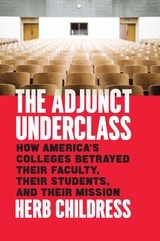
The Adjunct Underclass
How America’s Colleges Betrayed Their Faculty, Their Students, and Their MissionHerb Childress
University of Chicago Press, 2019
Welcome to the life of the mind in the gig economy. Over the past few decades, the job of college professor has been utterly transformed—for the worse. America’s colleges and universities were designed to serve students and create knowledge through the teaching, research, and stability that come with the longevity of tenured faculty, but higher education today is dominated by adjuncts. In 1975, only thirty percent of faculty held temporary or part-time positions. By 2011, as universities faced both a decrease in public support and ballooning administrative costs, that number topped fifty percent. Now, some surveys suggest that as many as seventy percent of American professors are working course-to-course, with few benefits, little to no security, and extremely low pay.
In The Adjunct Underclass, Herb Childress draws on his own firsthand experience and that of other adjuncts to tell the story of how higher education reached this sorry state. Pinpointing numerous forces within and beyond higher ed that have driven this shift, he shows us the damage wrought by contingency, not only on the adjunct faculty themselves, but also on students, the permanent faculty and administration, and the nation. How can we say that we value higher education when we treat educators like desperate day laborers?
Measured but passionate, rooted in facts but sure to shock, The Adjunct Underclass reveals the conflicting values, strangled resources, and competing goals that have fundamentally changed our idea of what college should be. This book is a call to arms for anyone who believes that strong colleges are vital to society.

The Saloon and the Mission
Addiction, Conversion, and the Politics of Redemption in American CultureEoin F. Cannon
University of Massachusetts Press, 2013
In this book Eoin Cannon illuminates the role that sobriety movements have played in placing notions of personal and societal redemption at the heart of modern American culture. He argues against the dominant scholarly perception that recovery narratives are private and apolitical, showing that in fact the genre's conventions turn private experience to public political purpose. His analysis ranges from neglected social reformer Helen Stuart Campbell's embrace of the "gospel rescue missions" of postbellum New York City to William James's use of recovery stories to consider the regenerative capabilities of the mind, to writers such as Upton Sinclair and Djuna Barnes, who used this narrative form in much different ways.
Cannon argues that rather than isolating recovery from these realms of wider application, the New Deal–era Alcoholics Anonymous refitted the "drunkard's conversion" as a model of selfhood for the liberal era, allowing for a spiritual redemption story that could accommodate a variety of identities and compulsions. He concludes by considering how contemporary recovery narratives represent both a crisis in liberal democracy and a potential for redemptive social progress.