Results by title
496 books match the query 'Ethnic identity' and 14 start with u
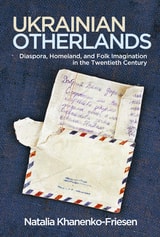
Ukrainian Otherlands
Diaspora, Homeland, and Folk Imagination in the Twentieth CenturyNatalia Khanenko-Friesen
University of Wisconsin Press, 2015
Ukrainian Otherlands is an innovative exploration of modern ethnic identity, focused on diaspora/homeland understandings of each other in Ukraine and in Ukrainian ethnic communities around the globe. Exploring a rich array of folk songs, poetry and stories, trans-Atlantic correspondence, family histories, and rituals of homecoming and hosting that developed in the Ukrainian diaspora and Ukraine during the twentieth century, Natalia Khanenko-Friesen asserts that many important aspects of modern ethnic identity form, develop, and reveal themselves not only through the diaspora's continued yearning for the homeland, but also in a homeland's deeply felt connection to its diaspora. Yet, she finds each group imagines the "otherland" and ethnic identity differently, leading to misunderstandings between Ukrainians and their ethnic-Ukrainian "brothers and sisters" abroad.
An innovative exploration of the persistence of vernacular culture in the modern world, Ukrainian Otherlands, amply informed by theory and fieldwork, will appeal to those interested in folklore, ethnic and diaspora studies, modernity, migration, folk psychology, history, and cultural anthropology.
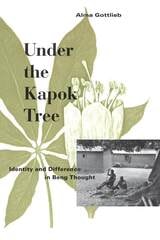
Under the Kapok Tree
Identity and Difference in Beng ThoughtAlma Gottlieb
University of Chicago Press, 1996
explores ideology and social practices among the Beng people of Côte
d'Ivoire. Employing symbolic and postmodern perspectives, she highlights
the dynamically paired notions of identity and difference, symbolized by
the kapok tree planted at the center of every Beng village.
"This book merits a number of readings. . . . An experiment in
ethnography that future projects might well emulate." —Clarke K. Speed,
American Anthropologist
"[An] evocative, rich ethnography. . . . Gottlieb does anthropology a
real service." —Misty L. Bastian, American Ethnologist
"Richly detailed. . . . This book offers a nuanced descriptive analysis
which commands authority." —Elizabeth Tonkin, Man
"Exemplary. . . . Gottlieb's observations on identity and difference are
not confined to rituals or other special occasions; rather she shows
that these principles emerge with equal force during daily social life."
—Monni Adams, Journal of African Religion
"[An] excellent study." —John McCall, Journal of Folklore
Research
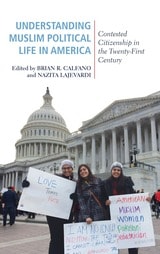
Understanding Muslim Political Life in America
Contested Citizenship in the Twenty-First CenturyBrian R. Calfano
Temple University Press, 2019
“Muslim Americans are at a political crossroads,” write editors Brian Calfano and Nazita Lajevardi. Whereas Muslims are now widely incorporated in American public life, there are increasing social and political pressures that disenfranchise them or prevent them from realizing the American Dream. Understanding Muslim Political Life in America brings clarity to the social, religious, and political dynamics that this diverse religious community faces.
In this timely volume, leading scholars cover a variety of topics assessing the Muslim American experience in the post-9/11 and pre-Trump era, including law enforcement; identity labels used in Muslim surveys; the role of gender relations; recognition; and how discrimination, tolerance, and politics impact American Muslims.
Understanding Muslim Political Life in America offers an update and reappraisal of what we know about Muslims in American political life. The editors and contributors also consider future directions and important methodological questions for research in Muslim American scholarship.
Contributors include Matt A. Barreto, Alejandro Beutel, Tony Carey, Youssef Chouhoud, Karam Dana, Oz Dincer, Rachel Gillum, Kerem Ozan Kalkan, Anwar Manje, Valerie Martinez-Ebers, Dani McLaughlan, Melissa R. Michelson, Yusuf Sarfati, Ahmet Tekelioglu, Marianne Marar Yacobian, and the editors.
Undocuments
John-Michael Rivera
University of Arizona Press, 2021
How do you document the undocumented? UNDOCUMENTS both poses and attempts to answer this complex question by remixing the forms and styles of the first encyclopedia of the New World, the Florentine Codex, in order to tell a modern story of Greater Mexico. Employing a broad range of writing genres and scholarly approaches, UNDOCUMENTS catalogs, recovers, and erases documents and images by and about peoples of Greater Mexico from roughly the first colonial moment. This brave and bracing volume organizes and documents ancient New World Mexican peoples from the Florentine Codex (1592) to our current technology-heavy age, wherein modern lawmakers and powerful global figures desire to classify, deport, and erase immigrants and their experiences.
While grappling with anxiety and the physical and mental health consequences of the way the United States treats immigrant bodies, John-Michael Rivera documents and scrutinizes what it means to seek opportunities in America. With a focus on the poetics of Latinx documentality itself, this book is concerned with the complicated and at times contradictory ways peoples of Greater Mexico have been documented and undocumented within systems of colonial knowledges, and how these peoples have been rendered as specters of the bureaucratic state. Rivera takes us through the painful, anxiety-ridden, and complex nature of what it means to be documented or undocumented, and the cruelty married to each of these states of being.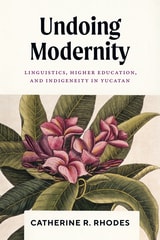
Undoing Modernity
Linguistics, Higher Education, and Indigeneity in YucatanCatherine R. Rhodes
University of Texas Press, 2025
An ethnography of the decolonization of Maya-ness.
On the Yucatan Peninsula today, undergraduates are inventing a new sense of being Maya by studying linguistics and culture in their own language: Maya. In this bold theoretical intervention informed by ethnographic research, Catherine Rhodes argues that these students are undoing the category of modernity itself. Created through colonization of the Americas, modernity is the counterpart to coloniality; the students, Rhodes suggests, are creating decoloniality’s companion: “demodernity.”
Disciplines like linguistics, anthropology, history, and archaeology invented “the Maya” as an essentialized ethnos in a colonial, modern mold. Undoing Modernity follows students and their teachers as they upset the seemingly stable ethnic definition of Maya, with its reliance on a firm dichotomy of Maya and modern. Maya linguistics does not prove that Maya is modern but instead rejects the Maya-ness that modernity built, while also fostering within the university an intellectual space in which students articulate identity on their own terms. An erudite and ultimately hopeful work of interdisciplinary scholarship that brings linguistic anthropology, Mesoamerican studies, and critical Indigenous studies into the conversation, Undoing Modernity dares to imagine the world on the other side of colonial/modern ideals of Indigeneity.
Universal Citizenship
Latina/o Studies at the Limits of IdentityBy R. Andrés Guzmán
University of Texas Press, 2019
Recently, many critics have questioned the idea of universal citizenship by pointing to the racial, class, and gendered exclusions on which the notion of universality rests. Rather than jettison the idea of universal citizenship, however, R. Andrés Guzmán builds on these critiques to reaffirm it especially within the fields of Latina/o and ethnic studies. Beyond conceptualizing citizenship as an outcome of recognition and admittance by the nation-state—in a negotiation for the right to have rights—he asserts that, insofar as universal citizenship entails a forceful entrance into the political from the latter’s foundational exclusions, it emerges at the limits of legality and illegality via a process that exceeds identitarian capture.
Drawing on Lacanian psychoanalysis and philosopher Alain Badiou’s notion of “generic politics,” Guzmán advances his argument through close analyses of various literary, cultural, and legal texts that foreground contention over the limits of political belonging. These include the French Revolution, responses to Arizona’s H.B. 2281, the 2006 immigrant rights protests in the United States, the writings of Oscar “Zeta” Acosta, Frantz Fanon’s account of Algeria’s anticolonial struggle, and more. In each case, Guzmán traces the advent of the “citizen” as a collective subject made up of anyone who seeks to radically transform the organizational coordinates of the place in which she or he lives.
Universities and Indian Country
Case Studies in Tribal-Driven ResearchEdited by Dennis K. Norman and Joseph P. Kalt
University of Arizona Press, 2015
Building on the Harvard Project on American Indian Economic Development’s experience with more than 120 nation-building projects over two decades, Universities and Indian Country posits that the tenets of nation building can provide a strategy for expanding and diversifying universities’ perspectives of knowledge in a multicultural world, while also producing results that are requested by and useful to Native communities.
This groundbreaking volume extends the dialogue begun by the Harvard project, providing another venue for the sharing of knowledge and information. The projects presented address a wide range of topics, including the regulation of genetic research, human resource development, tribal fund-raising, development of tribal museums, and freedom of the press in Indian Country.
Universities and Indian Country’s focus on the concerns and questions of Native communities themselves, provides insight not only into how projects came together, but also into what significance they have to the tribal partners. This compilation is a valuable resource for any student, professional, or community member concerned with issues of nation building and self-determination.
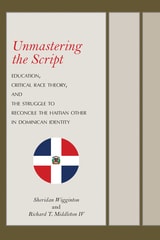
Unmastering the Script
Education, Critical Race Theory, and the Struggle to Reconcile the Haitian Other in Dominican IdentitySheridan Wigginton and Richard T. Middleton IV
University of Alabama Press, 2019
Unmastering the Script: Education, Critical Race Theory, and the Struggle to Reconcile the Haitian Other in Dominican Identity examines how school curriculum–based representations of Dominican identity navigate black racial identity, its relatedness to Haiti, and the culturally entrenched pejorative image of the Haitian Other in Dominican society. Wigginton and Middleton analyze how social science textbooks and historical biographies intended for young Dominicans reflect an increasing shift toward a clear and public inclusion of blackness in Dominican identity that serves to renegotiate the country’s long-standing antiblack racial master script.
The authors argue that although many of the attempts at this inclusion reflect a lessening of “black denial,” when considered as a whole, the materials often struggle to find a consistent and coherent narrative for the place of blackness within Dominican identity, particularly regarding the ways in which blackness continues to be meaningfully related to the otherness of Haitian racial identity. Unmastering the Script approaches the text materials as an example of “reconstructing” and “unburying” an African past, supporting the uneven, slow, and highly context-specific nature of the process.
This work engages with multiple disciplines including history, anthropology, education, and race studies, building on a new wave of Dominican scholarship that considers how contemporary perspectives of Dominican identity both accept the existence of an African past and seek to properly weigh its importance. The use of critical race theory as the framework facilitates unfolding the past political and legal agendas of governing elites in the Dominican Republic and also helps to unlock the nuance of an increasingly black-inclusive Dominican identity. In addition, this framework allows the unveiling of some of the socially damaging effects the Haitian Other master script can have on children, particularly those of Haitian ancestry, in the Dominican Republic.
Unseeing Empire
Photography, Representation, South Asian AmericaBakirathi Mani
Duke University Press, 2020
Unsettled Belonging
Educating Palestinian American Youth after 9/11Thea Renda Abu El-Haj
University of Chicago Press, 2015
Abu El-Haj explores the school as the primary site where young people from immigrant communities encounter the central discourses about what it means to be American. She illustrates the complex ways social identities are bound up with questions of belonging and citizenship, and she details the processes through which immigrant youth are racialized via everyday nationalistic practices. Finally, she raises a series of crucial questions about how we educate for active citizenship in contemporary times, when more and more people’s lives are shaped within transnational contexts. A compelling account of post-9/11 immigrant life, Unsettled Belonging is a steadfast look at the disjunctures of modern citizenship.
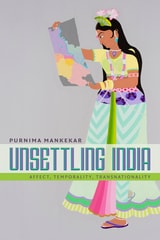
Unsettling India
Affect, Temporality, TransnationalityPurnima Mankekar
Duke University Press, 2015
Unsettling Scripture
Iroquois and the Book of MormonThomas W Murphy
University of Utah Press, 2025
In Unsettling Scripture: Iroquois and the Book of Mormon, anthropologist Thomas W Murphy delves into the visions of Seneca prophet Handsome Lake, the epic narratives of the Iroquois Confederacy, and the origin story of the Book of Mormon, revealing surprising parallels between Indigenous and Mormon traditions.
Through ethnohistorical research and decolonizing methodologies, Murphy reexamines how both communities understand their origins, faith, and prophecy. From Handsome Lake’s revelations to Joseph Smith’s seer stone, from ancient sibling rivalries to the Great Peace, this book unsettles traditional narratives while opening new conversations on scripture, identity, and cultural exchange. Drawing from living Indigenous voices, Unsettling Scripture challenges readers to rethink sacred texts and the histories they tell.
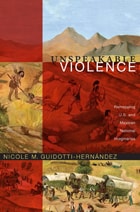
Unspeakable Violence
Remapping U.S. and Mexican National ImaginariesNicole M. Guidotti-Hernández
Duke University Press, 2011
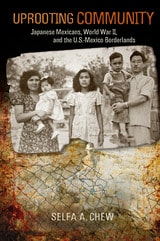
Uprooting Community
Japanese Mexicans, World War II, and the U.S.-Mexico BorderlandsSelfa A. Chew
University of Arizona Press, 2015
In Uprooting Community, Selfa A. Chew examines the lived experience of Japanese Mexicans in the U.S.-Mexico borderlands during World War II. Studying the collaboration of Latin American nation-states with the U.S. government, Chew illuminates the efforts to detain, deport, and confine Japanese residents and Japanese-descent citizens of Latin American countries during World War II. These narratives challenge the notion that Japanese Mexicans enjoyed the protection of the Mexican government during the war and refute the mistaken idea that Japanese immigrants and their descendants were not subjected to internment in Mexico during this period. Through her research, Chew provides evidence that, despite the principles of racial democracy espoused by the Mexican elite, Japanese Mexicans were in fact victims of racial prejudice bolstered by the political alliances between the United States and Mexico.
The treatment of the ethnic Japanese in Mexico was even harsher than what Japanese immigrants and their children in the United States endured during the war, according to Chew. She argues that the number of persons affected during World War II extended beyond the first-generation Japanese immigrants “handled” by the Mexican government during this period, noting instead that the entire multiethnic social fabric of the borderlands was reconfigured by the absence of Japanese Mexicans.