Results by title
95 books match the query 'Australia' and 15 start with a
A Constant Struggle
Deaf Education in New South Wales Since World War IINaomi Malone
Gallaudet University Press, 2019
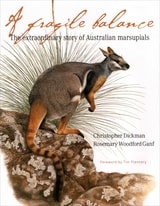
A Fragile Balance
The Extraordinary Story of Australian MarsupialsChristopher Dickman
University of Chicago Press, 2007
Marsupials are nearly synonymous with Australia. Although one of these enigmatic pouched mammals—the opossum—inhabits the United States and another 80 or so thrive in South America, some 220 species are confined to the Australasian region. In Australia, marsupials are the most diverse and dominant indigenous species, from the wallaby and the wombat to the kangaroo and koala.
The extraordinary story of these fascinating animals, A Fragile Balance provides the most up-to-date information on marsupials without losing sight of the unique set of circumstances that led them to prevalence Down Under. Covering all marsupial species in Australia, the book uses an evolutionary framework to interpret the marsupial’s biological traits. Each species account includes a basic biological description, a range map, and a measure of conservation status. The accounts are bounded by general chapters on biology, natural history, cultural history, and conservation. A Fragile Balance is the first book to emphasize interactions between and among marsupials, as well as between humans and marsupials.
Combining the expertise of renowned biologist Christopher Dickman with the artistic talents of illustrator Rosemary Woodford Ganf, A Fragile Balance will be a much celebrated reference for mammalogists worldwide, as well as for readers interested in Australian natural and cultural history.
A World of Fiction
Digital Collections and the Future of Literary HistoryKatherine Bode
University of Michigan Press, 2018

AIDS in Industrialized Democracies
Passions, Politics, and PoliciesBayer, Ronald
Rutgers University Press, 1992
In the ten years since the first cases of AIDS were reported, the disease has spread around the world. Every country has had to come up with policies suited to its own conditions, economy, culture, and institutions. The differences among their approaches are striking. This volume, the first international comprehensive comparison of responses to AIDS, is a unique guide to the world's most urgent public health crisis.
Sixteen leading experts in public health, social science, government, and public policy from USA, Canada, Germany, Australia, Spain, Britain, France, the Netherlands, Denmark, Sweden, and Japan candidly recount and analyze the responses of their own nations and comment on the lessons that can be drawn from each country's experience. For each country, they look critically at the tragic statistics of AIDS incidence; the circumstances of AIDS's first appearance; public health traditions of mandatory screening, contact tracing, and quarantine; attitudes toward drug abuse, homosexuality, sex education; publicity about AIDS; legal and customary protections of civil rights, minority groups, medical confidentiality; access to health care and insurance; and the interplay of formal and informal interest groups in shaping policy. The spectrum of AIDS policy ranges from severe "contain-and-control" programs to much more liberal plans based on education, cooperation, and inclusion.
No matter what policy a nation has constructed to deal with AIDS, the coming decade will test how well that policy conforms to democratic ideals. By scrutinizing the responses to AIDS so far, this book aims to give countries around the world a chance to learn from each others' mistakes and triumphs. It will be essential reading for all students and professionals in public health and public policy.
Aboriginal Adolescence
Burbank, Victoria Katherine
Rutgers University Press, 1999
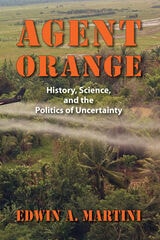
Agent Orange
History, Science, and the Politics of UncertaintyEdwin A. Martini
University of Massachusetts Press, 2012
Taking on what one former U.S. ambassador called “the last ghost of the Vietnam War,” this book examines the far-reaching impact of Agent Orange, the most infamous of the dioxin-contaminated herbicides used by American forces in Southeast Asia. Edwin A. Martini's aim is not simply to reconstruct the history of the “chemical war” but to investigate the ongoing controversy over the short- and long-term effects of weaponized defoliants on the environment of Vietnam, on the civilian population, and on the troops who fought on both sides.
Beginning in the early 1960s, when Agent Orange was first deployed in Vietnam, Martini follows the story across geographical and disciplinary boundaries, looking for answers to a host of still unresolved questions. What did chemical manufacturers and American policymakers know about the effects of dioxin on human beings, and when did they know it? How much do scientists and doctors know even today? Should the use of Agent Orange be considered a form of chemical warfare? What can, and should, be done for U.S. veterans, Vietnamese victims, and others around the world who believe they have medical problems caused by Agent Orange?
Martini draws on military records, government reports, scientific research, visits to contaminated sites, and interviews to disentangle conflicting claims and evaluate often ambiguous evidence. He shows that the impact of Agent Orange has been global in its reach affecting individuals and communities in New Zealand, Australia, Korea, and Canada as well as Vietnam and the United States. Yet for all the answers it provides, this book also reveals how much uncertainty—scientific, medical, legal, and political—continues to surround the legacy of Agent Orange.
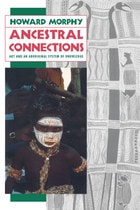
Ancestral Connections
Art and an Aboriginal System of KnowledgeHoward Morphy
University of Chicago Press, 1991
The rich symbolism of Yolngu art links the Yolngu directly with the "Dreaming," the time of world-creation that continues as the spiritual dimension of the present. Morphy shows how a complex dialectic of "inside" and "outside" interpretations of painting structures the system of knowledge in Yolngu society, and how European interest in this art has caused certain changes in the conditions of its production. The "inside" significance of the art, however, has not changed; it retains its dual ability to represent and to constitute relationships between things.
Ancestral Connections is a major contribution to the anthropology of art. A subtle commentary on the colonial encounter in northern Australia, the book demonstrates how the Yolngu have used their art—against all odds—as an instrument of cultural survival and as a component of the economic and political transformation of their society.
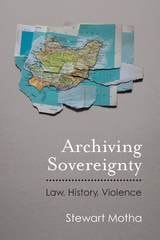
Archiving Sovereignty
Law, History, ViolenceStewart Motha
University of Michigan Press, 2018
Sovereignty is often cast as a limit-concept, constituent force, determining the boundary of law. Archiving Sovereignty reverses this to explain how judicial pronouncements inscribe and sustain extravagant claims to exceptionality and sovereign solitude. This wide-ranging, critical work distinguishes between myths that sustain neocolonial orders and fictions that generate new forms of political and ethical life.
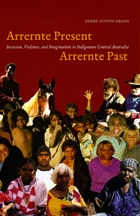
Arrernte Present, Arrernte Past
Invasion, Violence, and Imagination in Indigenous Central AustraliaDiane J. Austin-Broos
University of Chicago Press, 2008
Employing ethnographic and archival research, Diane Austin-Broos traces the history of the Arrernte as they have transitioned from a society of hunter-gatherers to members of the Hermannsburg Mission community to their present, marginalized position in the modern Australian economy. While she concludes that these wrenching structural shifts led to the violence that now marks Arrernte communities, she also brings to light the powerful acts of imagination that have sustained a continuing sense of Arrernte identity.
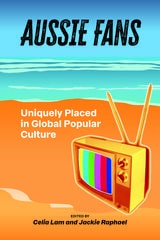
Aussie Fans
Uniquely Placed in Global Popular CultureCelia Lam and Jackie Raphael
University of Iowa Press, 2019
Australia holds a unique place in the global scheme of fandom. Much of the media consumed by Australian audiences originates from either the United States or the United Kingdom, yet several Australian productions have also attracted international fans in their own right. This first-ever academic study of Australian fandom explores the national popular culture scene through themes of localization and globalization.
The essays within reveal how Australian audiences often seek authentic imports and eagerly embrace different cultures, examining both Hollywood’s influence on Australian fandom and Australian fan reactions to non-Western content. By shining a spotlight on Australian fandom, this book not only provides an important case study for fan studies scholars, it also helps add nuance to a field whose current literature is predominantly U.S. and U.K. focused.Contributors: Kate Ames, Ahmet Atay, Jessica Carniel, Toija Cinque, Ian Dixon, Leigh Edmonds, Sharon Elkind, Jacqui Ewart, Lincoln Geraghty, Sarah Keith, Emerald L. King, Renee Middlemost
Australia, New Zealand, and the Pacific Islands since the First World War
Edited by William S. Livingston and Wm. Roger Louis
University of Texas Press, 1979
Three forces—dwindling British power, rising American influence, and nationalism in a variety of forms—have transformed Australia, New Zealand, and the adjacent islands since 1919. In this volume, some of the most distinguished scholars of the Pacific region assess these significant historical changes.
These essays deal with international relations, politics, changing social structures, and literature since World War I. The themes of the volume as a whole are social and humanistic; they concern the evolution of both a regional identity and separate national identities in the Southwest Pacific. The unique areal and thematic concentration of this book makes it essential reading for all those interested in the history, politics, and culture of the Pacific.
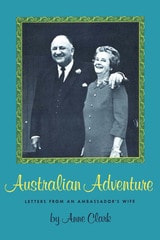
Australian Adventure
Letters from an Ambassador's WifeBy Anne Clark
University of Texas Press, 1969
From August 1965 to February 1968, during his period of service in Australia, Ambassador Edward Clark traveled in that country as no other American and probably few Australians ever have. His wife, Anne Clark, traveled with him, then wrote her observations and impressions to friends and family in the United States.
Her letters, published for the first time in this volume, reveal the isolations and involvements as well as the opportunities and the pleasures of embassy life. The etiquette of official functions at times posed problems, as in the Clarks' first black-tie dinner with the Acting Governor General, where Mrs. Clark was supposed to curtsy. "Some Ambassadors feel strongly that the representative of the President of the United States should never bend his knee (or rather his wife's) to any man. Mrs. Battle, wife of our predecessor ... put the question directly to President Kennedy. His answer to her was, 'Curtsy you must, but keep a stiff upper knee.'"
Soon, Anne Clark realized that the routine of appearances and entertainments was constant: "I do not know when I will make peace with the schedule. I am a slave to the little black book that is my calendar."
In addition to the intricacies of embassy life, the Clarks encountered much that was unfamiliar—new people, almost a new language, new flowers, new animals—even a sky with its new moon upside down. But their warm hospitality and genuine interest in things Australian attracted friends throughout the continent. Figures from the government, the church, the diplomatic circle, and everyday life, plus well-known guests from home, all become known to the reader in this perceptive account of official life from the inside.

Australian Film Theory and Criticism
Volume 1: Critical PositionsNoel King, Constantine Verevis, and Deane Williams
Intellect Books, 2013
Australian Film Theory and Criticism
Volume 2: InterviewsEdited by Noel King and Deane Williams
Intellect Books, 2014
Australian Voices
Writers and Their WorkBy Ray Willbanks
University of Texas Press, 1991
Contemporary Australian fiction is attracting a world audience, particularly in the United States, where a growing readership eagerly awaits new works. In Australian Voices, Ray Willbanks goes beyond the books to their authors, using sixteen interviews to reveal the state of fiction writing in Australia—what nags from the past, what engages the imagination for the future.
Willbanks engages the writers in lively discussions of their own work, as well as topics of collective interest such as the past, including convict times; the nature of the land; the treatment of Aborigines; national identity and national flaws; Australian-British antipathy; sexuality and feminism; drama and film; writing, publishing, and criticism in Australia; and the continuous and pervasive influence of the United States on Australia.
The interviews in Australian Voices are gossipy, often funny, and always informative, as Willbanks builds a structured conversation that reveals biography, personality, and significant insight into the works of each writer. They will be important for both scholars and the reading public.