Results by title
59 books match the query 'Ethnoarchaeology' and 2 start with u
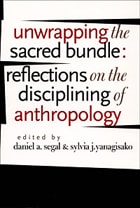
Unwrapping the Sacred Bundle
Reflections on the Disciplining of AnthropologyDaniel A. Segal and Sylvia J. Yanagisako, eds.
Duke University Press, 2005
The essayists consider the complex state of anthropology, its relation to other disciplines and the public sphere beyond academia, the significance of the convergence of linguistic and cultural anthropology, and whether or not anthropology is the best home for archaeology. While the contributors are not in full agreement with one another, they all critique “official” definitions of anthropology as having a fixed, four-field core. The editors are keenly aware that anthropology is too protean to be remade along the lines of any master plan, and this volume does not offer one. It does open discussions of anthropology’s institutional structure to all possible outcomes, including the refashioning of the discipline as it now exists.
Contributors. James Clifford, Ian Hodder, Rena Lederman, Daniel A. Segal, Michael Silverstein, Sylvia J. Yanagisako
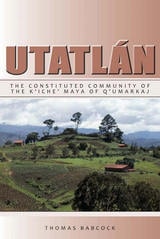
Utatlán
The Constituted Community of the K'iche' Maya of Q'umarkajThomas F. Babcock
University Press of Colorado, 2012
Most information available on Utatlán focuses on the ceremonial center and ignores the city of the commoners. Using the archaeological data, Utatlán attempts to determine the boundaries of the community and to characterize subdivisions within it. Evidence of indigenous nonelite houses, rich burials, and grave goods unlike those found in contemporary sites reveals information about the supporting residence zone. In addition, Babcock applies the concept of "constituted community," interpreting the archaeological data from a prehistoric context, and proposes a theoretical framework for interpreting prehistoric sites with respect to urbanism and political complexity.
Utatlán: The Constituted Community of the K'iche' Maya of Q'umarkaj will be of interest to students and scholars of Mesoamerican anthropology, archaeology, and ethnohistory.