Results by title
405 books match the query 'Human Geography' and 7 start with u
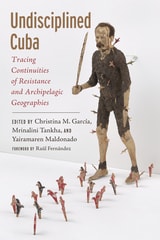
Undisciplined Cuba
Tracing Continuities of Resistance and Archipelagic GeographiesChristina M. García
Rutgers University Press, 2027
Undisciplined Cuba brings scholars of diverse disciplines and moves through multiple temporalities and geographies, allowing Cuba to emerge as a negotiated reality. Rather than rehearse narratives of exceptionalism and Cold War relationships that have detached the nation from its Antillean neighbors, this edited volume understands Cuba as deeply embedded in the Caribbean archipelago. Its chapters encompass feminist activism, public health, cinema for social justice, marine geopoetics, racial geographies, and literary corporealities. Drawing from an archipelagic framework and a decolonial practice of undisciplining, the anthology counters the tendency to treat landscapes, and cultural and political manifestations as artifacts of a national identity or evidence of a discrete geopolitical entity. Instead, Undisciplined Cuba attends to processes, to dynamic relations and continuities of resistance that defy periodization and institutional representation. The book offers a granular view of Cuba and an approach to Caribbean studies that imagines networks in excess of traditional categories of thought.
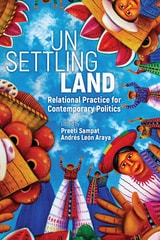
Unsettling Land
Relational Practice for Contemporary PoliticsPreeti Sampat
University Press of Colorado, 2026
Unsettling Land brings together anthropologists and geographers examining land relations across South Asia, the Americas, Northeast Africa, Eastern Europe, and Oceania to show how land’s forms, affordances, and meanings shift across diverse historical contexts and uses. Land is not a fixed, passive surface or static resource but a dynamic entity with agency that is shaped by social, historical, and material relations. As such, land is crucial to understanding contemporary political challenges around climate change, capitalism, and conflict.
Unsettling Land offers vital conceptual and methodological tools that challenge the familiar sociomaterial binaries centered on nature/culture, Indigenous/capitalist, and land/water dichotomies. Scholars make land sensible across its diverse relational forms and by placing it at the center of contemporary politics. Land’s relationalities manifest in animal sanctuaries, wetlands, plantations, forests, conflict zones, urban settlements, and in extractive, infrastructural, and national frontiers. They emerge as identities mobilized through historical, social, and institutional relations of power, and through relationships tied to financialization, assetization, rentierism, and extractivism.
Accessible and theoretically ambitious, Unsettling Land investigates new and old political projects based on questions of care, solidarity, identity, rights, and power across the world. It is essential reading for students and scholars of anthropology, geography, political ecology and economy, and environmental, development, Indigenous, urban, and agrarian studies, as well as readers interested in climate justice and the future of land politics worldwide.

Urban Housing Segregation of Minorities in Western Europe and the United States
Elizabeth Huttman, Juliet Saltman and Wim Blauw, eds.
Duke University Press, 1991
The collection begins with a review of the historical development of housing segregation in these countries, describing current housing conditions, concentration of housing in each country’s leading cities, minority populations and the housing they occupy—specifically public, nonprofit, and owner-occupied dwellings. When focusing on the United States, the contributors assess housing segregation, antisegregation measures, and institutional racism toward blacks in the Midwest and South, and toward Mexican-Americans throughout American cities. Chapters dealing with Western Europe include housing segregation of South Asian and West Indian immigrants in Britain, immigrants in Sweden, Turkish, and Yugoslav “guest workers” in West Germany, and Algerian and other Arab groups in France. The book concludes with discussions of public housing policies; suburban desegregation, resegregation, and integration maintenance programs; specific integration stabilization programs; and desegregation efforts in one specific place.
Contributors. Elizabeth Huttman, Michal Arend, Cihan Arin, Maurice Blanc, Wim Blauw, Ger Mik, Clyde McDaniels, Jürgen Friedrichs, Hannes Alpheis, John M. Goering, Len Gordon, Albert Mayer, Rosemary Helper, Barry V. Johnston, Terry Jones, Valerie Karn, Göran Lindberg, Anna Lisa Lindén, Deborah Phillips, Dennis Keating, Juliet Saltman, Alan Murie
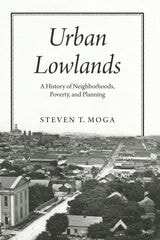
Urban Lowlands
A History of Neighborhoods, Poverty, and PlanningSteven T. Moga
University of Chicago Press, 2020
In Urban Lowlands, Steven T. Moga looks closely at the Harlem Flats in New York City, Black Bottom in Nashville, Swede Hollow in Saint Paul, and the Flats in Los Angeles, to interrogate the connections between a city’s actual landscape and the poverty and social problems that are often concentrated at its literal lowest points. Taking an interdisciplinary perspective on the history of US urban development from the nineteenth to the mid-twentieth century, Moga reveals patterns of inequitable land use, economic dispossession, and social discrimination against immigrants and minorities. In attending to the landscapes of neighborhoods typically considered slums, Moga shows how physical and policy-driven containment has shaped the lives of the urban poor, while wealth and access to resources have been historically concentrated in elevated areas—truly “the heights.” Moga’s innovative framework expands our understanding of how planning and economic segregation alike have molded the American city.
Urban Lowlands
A History of Neighborhoods, Poverty, and PlanningSteven T. Moga
University of Chicago Press, 2020
Interrogates the connections between a city’s physical landscape and the poverty and social problems that are often concentrated at its literal lowest points.
In Urban Lowlands, Steven T. Moga looks closely at the Harlem Flats in New York City, Black Bottom in Nashville, Swede Hollow in Saint Paul, and the Flats in Los Angeles, to interrogate the connections between a city’s actual landscape and the poverty and social problems that are often concentrated at its literal lowest points. Taking an interdisciplinary perspective on the history of US urban development from the nineteenth to the mid-twentieth century, Moga reveals patterns of inequitable land use, economic dispossession, and social discrimination against immigrants and minorities. In attending to the landscapes of neighborhoods typically considered slums, Moga shows how physical and policy-driven containment has shaped the lives of the urban poor, while wealth and access to resources have been historically concentrated in elevated areas—truly “the heights.” Moga’s innovative framework expands our understanding of how planning and economic segregation alike have molded the American city.
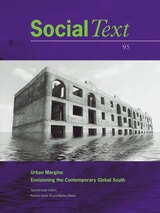
Urban Margins
Envisioning the Contemporary Global South, Volume 26Kamran Asdar Ali and Martina Rieker, eds.
Duke University Press, 0
“Urban Margins” explores the complex processes through which citizens produce and negotiate these marginalized landscapes and in turn are informed by them. Focusing on Douala in Cameroon and Dakar in Senegal, one essay discusses how the state’s failure to provide for its citizens has led many to turn to informal networks and affiliations—whether kin-based, local, translocal, gendered, religious, or secular—for survival. Rendering the urban landscape of these cities in terms of these networks and the ways that they shape a citizen’s interaction with the city, the essay considers the political possibilities for African cities where diverse multilingual and ethnic populations face the challenges, pitfalls, and compromises of coexistence. Examining how female migrant workers negotiate various spaces within the urban landscape of the free trade zone outside of Colombo, Sri Lanka, another essay details how the city represents a site of personal autonomy and political possibilities for both women and men. One contributor addresses the city of Ramallah in the embattled West Bank—the de facto Palestinian capital and the only cosmopolitan space within the occupied territories—to consider how the Palestinian urban middle class remains haunted by the “unmodern” within its own history and present. Another surveys changes in the cultural significance of roads, forts, and town walls in Bahla, Oman, in the aftermath of the country’s 1970 coup d’etat.
Contributors. Kamran Asdar Ali, Allen Feldman, Sandya Hewamanne, Mandana E. Limbert, Rosalind Morris, Martina Rieker, AbdouMaliq Simone, Lisa Taraki
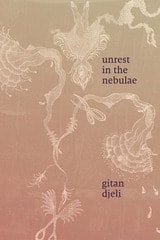
unrest in the nebulae
Gitan Djeli
Duke University Press, 2026