Results by title
732 books match the query 'Indigenous' and 10 start with u
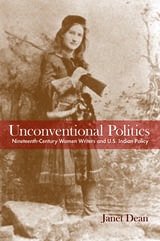
Unconventional Politics
Nineteenth-Century Women Writers and U.S. Indian PolicyJanet Dean
University of Massachusetts Press, 2016
Dean argues that in protesting U.S. Indian policy through popular genres, Wakefield, Sigourney, Callahan, and Eddleman also critiqued cultural protocols and stretched the contours of accepted modes of feminine discourse. Their acts of improvisation and reinvention tell a new story about the development of American women's writing and political expression.
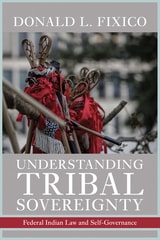
Understanding Tribal Sovereignty
Federal Indian Law and Self-GovernanceDonald L. Fixico
University of Arizona Press, 2026
What does tribal sovereignty really mean—and why does it matter today?
Accessibly written for the nonspecialist, acclaimed historian Donald L. Fixico unpacks the complex history and legal foundations of tribal sovereignty in the United States. From traditional Native governance to landmark treaties, federal laws, and court cases, Fixico guides readers through the evolution of tribal self-rule and its modern expressions—from tribal constitutions to license plates and casinos. Designed for students, educators, tribal members, and professionals alike, this book offers a clear, compelling introduction to one of the most important—and often misunderstood—concepts in American Indian affairs.
This book is a go-to source for understanding the federal Indian laws, treaties, and court cases simplified to explain tribal sovereignty.
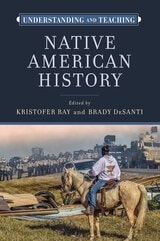
Understanding and Teaching Native American History
Edited by Kristofer Ray and Brady DeSanti
University of Wisconsin Press, 2023
Despite the availability of new scholarship, many teachers struggle with contextualizing Indigenous history and experience. Native peoples frequently find themselves relegated to historical descriptions, merely a foil to the European settlers who are the protagonists in the dominant North American narrative. This book offers a way forward, an alternative framing of the story that highlights the ongoing integral role of Native peoples via broad coverage in a variety of topics including the historical, political, and cultural.
With its scope and clarity of vision, suggestions for navigating sensitive topics, and a multitude of innovative approaches authored by contributors from multidisciplinary backgrounds, Understanding and Teaching Native American History will also find use in methods and other graduate courses. Nearly a decade in the conception and making, this is a groundbreaking source for both beginning and veteran instructors.
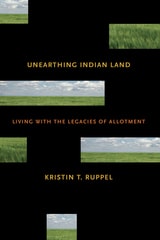
Unearthing Indian Land
Living with the Legacies of AllotmentKristin T. Ruppel
University of Arizona Press, 2008
Under the General Allotment Act of 1887, also known as the Dawes Act,individual Indians were issued title to land allotments while so-called “surplus”Indian lands were opened to non-Indian settlement. During the forty-seven years that the act remained in effect, American Indians lost an estimated 90 million acres of land—about two-thirds of the land they had held in 1887. Worse, the loss of control over the land left to them has remained an ongoing and insidious result.
Unearthing Indian Land traces the complex legacies of allotment, including numerous instructive examples of a policy gone wrong. Aside from the initial catastrophic land loss, the fractionated land ownership that resulted from the act’s provisions has disrupted native families and their descendants for more than a century. With each new generation, the owners of tribal lands grow in number and therefore own ever smaller interests in parcels of land. It is not uncommon now to find reservation allotments co-owned by hundreds of individuals.Coupled with the federal government’s troubled trusteeship of Indian assets,this means that Indian landowners have very little control over their own lands.
Illuminated by interviews with Native American landholders, this book is essential reading for anyone who is interested in what happened as a result of the federal government’s quasi-privatization of native lands.
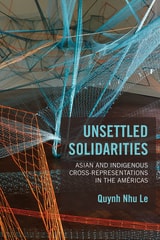
Unsettled Solidarities
Asian and Indigenous Cross-Representations in the AméricasQuynh Nhu Le
Temple University Press, 2019
Unsettled Solidarities examines contemporary Asian and Indigenous cross-representations within different settler states in the Américas. Quynh Nhu Le looks at literary works by both groups alongside public apologies, interviews, and hemispheric race theories to trace cross-community tensions and possibilities for solidarities amidst the uneven imposition of racialization and settler colonization.
Contrasting texts such as Maxine Hong Kingston’s China Men with Gerald Vizenor’s Hiroshima Bugi, and Karen Tei Yamashita’s Through the Arc of the Rain Forest with Leslie Marmon Silko’s Almanac of the Dead, among others, Le reveals how settler colonialism persists through the liberal ideological structuring or incorporation of critical and political resistance. She illuminates the tense collisions of Asian and Indigenous movements from the heroic/warrior traditions, reparations and redress, and transnational/cross-racial mobilization against global capital to mixed-race narratives.
Reading these tensions as formed through the unstable grammatical and emotional economies of liberalism, Le frames settler colonialism as a process that is invoked and yet ruptured by Asian and Indigenous peoples. In analyzing Asian/Indigenous crossings in the United States, Canada, Mexico, and Brazil, Unsettled Solidarities conveys the logics and instabilities that connect these settler empires.
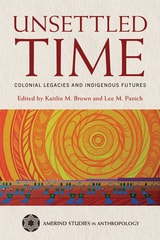
Unsettled Time
Colonial Legacies and Indigenous FuturesEdited by Kaitlin M. Brown and Lee M. Panich
University of Arizona Press, 2027
Time is at the core of how we think about colonialism in North America, with many seeing the first footfalls of newly arrived Europeans as indelibly marking the end of one era and the beginning of another. However, this understanding of time often serves to perpetuate outdated narratives about Indigenous people, normalizing colonial domination.
This volume unsettles conventional understandings of time in the study of Indigenous-colonial interactions in North America, acknowledging both the enduring nature of colonial legacies and the radical possibilities of Indigenous futures. The contributors largely approach this goal from the perspective of archaeology, with a particular concern for how we can effectively employ archaeological and related historical methods in collaboration with tribal nations and other descendant communities. The chapters engage with broader interdisciplinary questions about time, periodization, and temporality to build more nuanced and responsive understandings of Native-lived colonialism.
Contributors
Nathan Acebo
Kaitlin M. Brown
Wade Campbell
Emily Clark
Ruben Cu:k Ba’ak
Jacob Holland-Lulewicz
Nicholas V. Kessler
Nicholas C. Laluk
Koji Lau-Ozawa
Heather Law Pezzarossi
Lindsay Martel Montgomery
Lee M. Panich
Michelle M. Pigott
Robert W. Preucel
Christopher B. Rodning
Sarah Simeonoff
Unsettling Scripture
Iroquois and the Book of MormonThomas W Murphy
University of Utah Press, 2025
In Unsettling Scripture: Iroquois and the Book of Mormon, anthropologist Thomas W Murphy delves into the visions of Seneca prophet Handsome Lake, the epic narratives of the Iroquois Confederacy, and the origin story of the Book of Mormon, revealing surprising parallels between Indigenous and Mormon traditions.
Through ethnohistorical research and decolonizing methodologies, Murphy reexamines how both communities understand their origins, faith, and prophecy. From Handsome Lake’s revelations to Joseph Smith’s seer stone, from ancient sibling rivalries to the Great Peace, this book unsettles traditional narratives while opening new conversations on scripture, identity, and cultural exchange. Drawing from living Indigenous voices, Unsettling Scripture challenges readers to rethink sacred texts and the histories they tell.
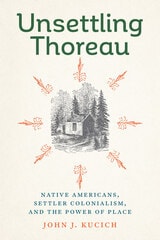
Unsettling Thoreau
Native Americans, Settler Colonialism, and the Power of PlaceJohn J. Kucich
University of Massachusetts Press, 2024
A CHOICE 2025 Outstanding Academic Title
Finalist for the 2025 New England Society Book Awards
Henry David Thoreau’s life-long fascination with Native Americans is widely known and a recurring topic of interest, and it is also a source of modern debate. This is a figure who both had a deep interest in Native American history and culture and was seen by many of his contemporaries, including Ralph Waldo Emerson and Nathaniel Hawthorne, as “more like an Indian” than his white neighbors. At the same time, Thoreau did little to protest the systematic dispossession of Indigenous people across the country in his lifetime. John J. Kucich charges into this contradiction, considering how Thoreau could demonstrate deep respect for Native American beliefs on one hand and remain largely silent about their genocide, actively happening throughout his life, on the other. Thoreau’s long study of Native peoples, as reflected in so much of his writing, allowed him to glimpse an Indigenous worldview, but it never fully freed him from the blind spots of settler colonialism.
Drawing on Indigenous studies and critiques of settler colonialism, as well as new materialist approaches that illustrate Thoreau’s radical reimagining of the relationship between humans and the natural world, Unsettling Thoreau explores the stakes of Thoreau’s effort to live mindfully and ethically in place when living alongside, or replacing marginalized peoples. By examining the whole scope of his writings, including the unpublished Indian Notebooks, and placing them alongside Native writers and communities in and beyond New England, this book gauges Thoreau’s effort to use Indigenous knowledge to reimagine a settler colonial world, without removing him from its trappings.

Up Against the Archive
Experiments in Writing British Empire History OtherwiseAntoinette Burton, editor
Duke University Press, 2027
Ute Indians of Utah, Colorado, and New Mexico
Virginia McConnell Simmons
University Press of Colorado, 2000