Results by title
358 books match the query 'Labor & Industrial Relations' and 9 start with u

Unfree Masters
Popular Music and the Politics of WorkMatt Stahl
Duke University Press, 2012
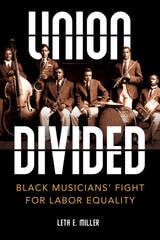
Union Divided
Black Musicians' Fight for Labor EqualityLeta E. Miller
University of Illinois Press, 2024
In the 1910s and 1920s, Black musicians organized more than fifty independent locals within the American Federation of Musicians (AFM) in an attempt to control audition criteria, set competitive wages, and secure a voice in national decision-making. Leta Miller follows the AFM’s history of Black locals, which competed directly with white locals in the same territories, from their origins and successes in the 1920s through Depression-era crises to the fraught process of dismantling segregated AFM organizations in the 1960s and 70s. Like any union, Black AFM locals sought to ensure employment and competitive wages for members with always-evolving solutions to problems. Miller’s account of these efforts includes the voices of the musicians themselves and interviews with former union members who took part in the difficult integration of Black and white locals. She also analyzes the fundamental question of how musicians benefitted from membership in a labor organization.
Broad in scope and rich in detail, Union Divided illuminates the complex working world of unionized Black musicians and the AFM’s journey to racial inclusion.
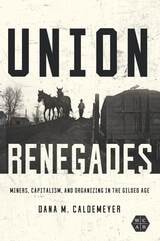
Union Renegades
Miners, Capitalism, and Organizing in the Gilded AgeDana M. Caldemeyer
University of Illinois Press, 2021
Nuanced and eye-opening, Union Renegades challenges popular notions of workers attitudes during the Gilded Age.
Union Representation Elections
Law and RealityJulius Getman
Russell Sage Foundation, 1976
Union Women
Forging Feminism In The United Steelworkers Of AmericaMary Margaret Fonow
University of Minnesota Press, 2002
How a feminist agenda took hold in a male-dominated union.
For more than a quarter century, steel mills in the United States and Canada have produced more than metal: they have produced a new kind of worker and union activist-"Women of Steel." In an era labeled postfeminist and postindustrial, women have created spaces in this quintessentially male-dominated workforce from which to mobilize for their rights as women and workers. In Union Women, Mary Margaret Fonow captures the stories of the women of the United Steelworkers. She focuses on a tenacious group who used their developing power in the union to challenge sex discrimination and to advocate for women’s rights, and applied their transnational resources to construct a feminist response to globalization and economic restructuring. In the process, they have transformed the organizations, resources, and networks of both the labor and women’s movements, and have in turn transformed themselves into feminists.
In Union Women Fonow uses statistical, archival, and ethnographic research methods to provide a broad historical account of women in the steel industry. Fonow’s sweeping approach allows her to examine several key issues in social movement, feminist, and political theory, and to show that insights from these fields shape each other. She explores how social movements are gendered, how working-class women develop a feminist consciousness, and how this process is informed by intersecting demands of race, class, and gender. As a comparative, cross-national study, Union Women also demonstrates how different political and social cultures affect women’s organizing and strategic decisions. Finally, Fonow emphasizes that economic restructuring and globalization pose immediate challenges for women as laborers and activists, and that, in order to survive, all unions must develop organizing and mobilization strategies informed by feminism and other social movements.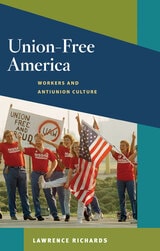
Union-Free America
Workers and Antiunion CultureLawrence Richards
University of Illinois Press, 2008
Union-Free America: Workers and Antiunion Culture confronts one of the most vexing questions with which labor activists and labor academics struggle: why is there so much opposition to organized labor in the United States? Scholars often point to powerful obstacles from employers or governmental policies, but Lawrence Richards offers a more complete picture of the causes for union decline in the postwar period by examining the attitudes of the workers themselves. Large numbers of American workers in the 1970s and 1980s told pollsters that they would vote against a union if an election were held at their place of employment, and Richards provides a provocative explanation for this hostility: a pervasive strain of antiunionism in American culture that has made many workers distrustful of organized labor.
Weighing the arguments of previous historians and sociologists, Richards posits that this underlying antiunion culture in America has been remarkably consistent over the course of half a century. Assessing organizing efforts among blue-collar, white-collar, and pink-collar workers, Richards examines the tactics and countertactics of company and union representatives who sought to either exploit or neutralize workers' popular negative stereotypes of organized labor's insidious control over workers' autonomy. The book considers a number of case studies of organizing drives throughout recent history, from the failed attempt by District 65 to organize clerical workers at New York University in 1970, to a similarly fruitless drive by the Textile Workers Union in 1980 at a textile factory in Charlottesville, Virginia. In both of these particular cases and in many more, antiunion culture has operated to hinder unions' efforts to organize the unorganized. By examining the manifestations and motivations of antiunion culture in the United States, Richards helps explain why so many American workers seem to vote against their own self-interest and declare themselves "Union Free and Proud."
Upheaval in the Quiet Zone
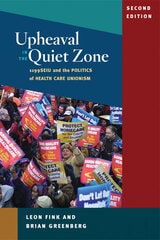
1199/SEIU and the Politics of Healthcare UnionismLeon Fink and Brian Greenberg
University of Illinois Press, 2008
Upon the Altar of Work
Child Labor and the Rise of a New American SectionalismBetsy Wood
University of Illinois Press, 2020
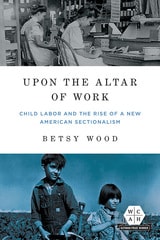
Betsy Wood examines the evolution of ideas about child labor and the on-the-ground politics of the issue against the backdrop of broad developments related to slavery and emancipation, industrial capitalism, moral and social reform, and American politics and religion. Wood explains how the decades-long battle over child labor created enduring political and ideological divisions within capitalist society that divided the gatekeepers of modernity from the cultural warriors who opposed them. Tracing the ideological origins and the politics of the child labor battle over the course of eighty years, this book tells the story of how child labor debates bequeathed an enduring legacy of sectionalist conflict to modern American capitalist society.

Uranium Matters
Central European Uranium in International Politics, 19001960Rainer Karlsch
Central European University Press, 2008