Results by title
171 books match the query 'Labor unions' and 9 start with u

Uncertain Times
Anthropological Approaches to Labor in a Neoliberal WorldE. Paul Durrenberger
University Press of Colorado, 2017
In this first-ever collection of labor anthropology from around the world, the contributors to Uncertain Times assert that traditional labor unions have been co-opted by neoliberal policies of corporate capital and have become service organizations rather than drivers of social movements. The current structure of labor unions facilitates corporations’ need for a stable labor force while reducing their power to prevent outsourcing, subcontracting, and other methods of undercutting worker security and union power. Through case studies from Switzerland, Israel, Argentina, Mexico, the United States, Greece, Sweden,Turkey, Brazil and Spain, the authors demonstrate that this process of neutering unions has been uneven across time and space. They also show that the potential exists for renewed union power based on more vociferous and creative collective action. These firsthand accounts—from activist anthropologists in the trenches as union members and staff, as well as academics analyzing policy, law, worker organizing, and community impact—illustrate the many approaches that workers around the world are taking to reclaim their rights in this ever-shifting labor landscape.
Uncertain Times is the first book to use this crucial comparative, ethnographic approach for understanding the new rules of the global labor struggle and the power workers have to change those rules. The volume will be of great interest to students and scholars of anthropology, sociology of work, and labor studies; labor union leadership; and others interested in developing innovative methods for organizing working people, fomenting class consciousness, and expanding social movements.
Contributors: Alpkan Birelma, Emma Braden, Maria Eugenia de la O, Christopher Kelley, Staffan Löfving, Gadi Nissim, Darcy Pan, Steven Payne, Alicia Reigada, Julia Soul, Manos Spyridakis, Christian Zlolniski
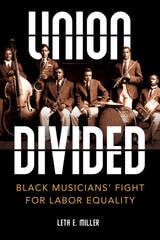
Union Divided
Black Musicians' Fight for Labor EqualityLeta E. Miller
University of Illinois Press, 2024
In the 1910s and 1920s, Black musicians organized more than fifty independent locals within the American Federation of Musicians (AFM) in an attempt to control audition criteria, set competitive wages, and secure a voice in national decision-making. Leta Miller follows the AFM’s history of Black locals, which competed directly with white locals in the same territories, from their origins and successes in the 1920s through Depression-era crises to the fraught process of dismantling segregated AFM organizations in the 1960s and 70s. Like any union, Black AFM locals sought to ensure employment and competitive wages for members with always-evolving solutions to problems. Miller’s account of these efforts includes the voices of the musicians themselves and interviews with former union members who took part in the difficult integration of Black and white locals. She also analyzes the fundamental question of how musicians benefitted from membership in a labor organization.
Broad in scope and rich in detail, Union Divided illuminates the complex working world of unionized Black musicians and the AFM’s journey to racial inclusion.
Union Power and American Democracy
The UAW and the Democratic Party, 1972-83Dudley W. Buffa
University of Michigan Press, 1984
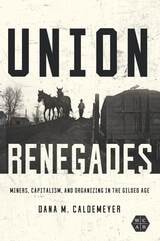
Union Renegades
Miners, Capitalism, and Organizing in the Gilded AgeDana M. Caldemeyer
University of Illinois Press, 2021
Nuanced and eye-opening, Union Renegades challenges popular notions of workers attitudes during the Gilded Age.
Union Representation Elections
Law and RealityJulius Getman
Russell Sage Foundation, 1976
Union by Law
Filipino American Labor Activists, Rights Radicalism, and Racial CapitalismMichael W. McCann with George I. Lovell
University of Chicago Press, 2020
Union by Law analyzes the broader social and legal history of Filipino American workers’ rights-based struggles, culminating in the devastating landmark Supreme Court ruling, Wards Cove Packing Co. v. Atonio (1989). Organized chronologically, the book begins with the US invasion of the Philippines and the imposition of colonial rule at the dawn of the twentieth century. The narrative then follows the migration of Filipino workers to the United States, where they mobilized for many decades within and against the injustices of American racial capitalist empire that the Wards Cove majority willfully ignored in rejecting their longstanding claims. This racial innocence in turn rationalized judicial reconstruction of official civil rights law in ways that significantly increased the obstacles for all workers seeking remedies for institutionalized racism and sexism. A reclamation of a long legacy of racial capitalist domination over Filipinos and other low-wage or unpaid migrant workers, Union by Law also tells a story of noble aspirational struggles for human rights over several generations and of the many ways that law was mobilized both to enforce and to challenge race, class, and gender hierarchy at work.
Union-Free America
Workers and Antiunion CultureLawrence Richards
University of Illinois Press, 2008
Union-Free America: Workers and Antiunion Culture confronts one of the most vexing questions with which labor activists and labor academics struggle: why is there so much opposition to organized labor in the United States? Scholars often point to powerful obstacles from employers or governmental policies, but Lawrence Richards offers a more complete picture of the causes for union decline in the postwar period by examining the attitudes of the workers themselves. Large numbers of American workers in the 1970s and 1980s told pollsters that they would vote against a union if an election were held at their place of employment, and Richards provides a provocative explanation for this hostility: a pervasive strain of antiunionism in American culture that has made many workers distrustful of organized labor.
Weighing the arguments of previous historians and sociologists, Richards posits that this underlying antiunion culture in America has been remarkably consistent over the course of half a century. Assessing organizing efforts among blue-collar, white-collar, and pink-collar workers, Richards examines the tactics and countertactics of company and union representatives who sought to either exploit or neutralize workers' popular negative stereotypes of organized labor's insidious control over workers' autonomy. The book considers a number of case studies of organizing drives throughout recent history, from the failed attempt by District 65 to organize clerical workers at New York University in 1970, to a similarly fruitless drive by the Textile Workers Union in 1980 at a textile factory in Charlottesville, Virginia. In both of these particular cases and in many more, antiunion culture has operated to hinder unions' efforts to organize the unorganized. By examining the manifestations and motivations of antiunion culture in the United States, Richards helps explain why so many American workers seem to vote against their own self-interest and declare themselves "Union Free and Proud."

Unionizing the Jungles
Labor and Community in the Twentieth-Century Meat-packing IndustryShelton Stromquist
University of Iowa Press, 1997
After Upton Sinclair's powerful novel appeared in 1906, “the jungle” became a compelling metaphor for life and work in the nation's meatpacking industry. Harsh living and working conditions from the killing floor to the hide cellar to the packingtowns, cycles of overwork and underemployment, and the ever-present crowds of new and unskilled laborers characterized an often-violent industry in which the appetite of workers for the protection of unions was exceeded only by the zeal of their employers to prevent workers from organizing. Unionizing the Jungles—which originated in a seminar at the University of Iowa sponsored by the Center for Recent United States History—brings together historians and anthropologists whose studies of various phases of the meatpacking industry, its unions, and its impact on communities in the twentieth century both raise and answer important questions.
The rise and decline of industrial unionism in the packinghouse industry is a unique story that casts into bold relief the conflicts between labor and capital and the tensions based on race and gender in a perpetually changing workforce. The essayists in Unionizing the Jungles discuss the structurally distinctive features of the packinghouse industry—such as the fact that violence and extreme antiunionism were central elements of its culture—the primary actors in the union-building process, the roots of the distinctive interracialism of the United Packinghouse Workers of America and the explosion of industrial unionism in the 1930s, and the community-based militant unionism of the Independent Union of All Workers. Central themes throughout these essays include the role of African American workers, the constant battle for racial equality, and the eruption of gender conflict in the 1950s. Structural and technological changes in the corporate economy, the increased mobility of capital, and a more hostile political economy all contributed to the difficulties the labor movement faced in the 1980s and beyond.
Focusing on the workplace and the community as arenas of conflict and accommodation, the new labor historians in these vigorous essays consider the historical and contemporary problems posed by the development of the packinghouse industry and its unions and reflect on the implications of this dramatic history for the larger story of the changing relations between labor and capital in mass production.
Upheaval in the Quiet Zone
1199/SEIU and the Politics of Healthcare UnionismLeon Fink and Brian Greenberg
University of Illinois Press, 2008