Results by title
622 books match the query 'Language Study' and 5 start with u

Unbroken Nostalgia
Haitian Kreyòl Poetry in CubaWritten by Hilario Batista Félix, edited and translated by Mariana F. Past
Amherst College Press, 2026
Unbroken Nostalgia: Haitian Kreyòl Poetry in Cuba is the first English translation and scholarly edition of the collection Nostalji san pwen ni vigil: pwezi kreyòl nan peyi Kiba (2016) by Hilario Batista Félix. A poet, journalist, and language activist, Batista (1955– ) embodies and expresses Cuba’s cultural and linguistic diversity as a descendant of Haitian migrant workers to Eastern Cuba during the mid-twentieth century; his poems bridge regions usually separated by language—the Spanish and Creolophone/Francophone Caribbean—and vividly depict the distinct heritage of Haitian Cubans and their shared dreams and challenges. A scholarly introduction by translator and editor Mariana F. Past provides biographical information about the author, situates his work within Haitian diasporic literature, and addresses patterns of Haitian migration to Cuba. Batista’s original poems appear alongside facing-page English translations with annotations that clarify historical figures and events, geographical features, and Haitian cultural and religious practices. Grounded in oral storytelling traditions, Unbroken Nostalgia brings to light the collective memory and complicated hybridity of the Haitian community in Cuba and upholds Haitian Kreyòl as a language of resistance.
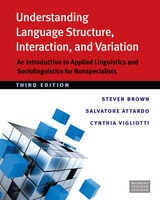
Understanding Language Structure, Interaction, and Variation, Third Ed.
An Introduction to Applied Linguistics and Sociolinguistics for NonspecialistsSteven Brown, Salvatore Attardo, and Cynthia Vigliotti
University of Michigan Press, 2014
Understanding Language Structure, Interaction, and Variation is an introduction to the study of language and applied linguistics for students who have had a minimum of exposure to the discipline of linguistics. Using clear, easy-to-understand explanations and examples, this text avoids the in-depth theoretical coverage found in texts written for those who specialize in linguistics or SLA. As a result, this book is perfect for students whose chosen fields require them to be acquainted with the ways language works--such as future teachers, psychologists, sociologists, and anthropologists--but who do not intend to become linguists. The text is also suitable for English or ESL/EFL teachers who need a reference volume about various aspects of language, particularly as it applies to teaching. Each chapter includes research projects and further readings.
The third edition of Understanding Language Structure, Interaction, and Variation features a new design and reorganization. All content has been significantly revised and updated. Each chapter also debunks a common language myth and now incorporates exercises that, for prior editions, appeared in a supplementary workbook. Extra practice for students is available online, as is additional materials for teachers. (There is no workbook for the third edition.)

Understanding Language Structure, Interaction, and Variation
An Introduction to Applied Linguistics and Sociolinguistics for NonspecialistsSalvatore Attardo and Steven Brown
University of Michigan Press, 2027
In the age of Artificial Intelligence hallucinations and slop, the need for a clear, accessible, uncluttered, and authoritative textbook is more important than ever. The fourth edition of Understanding Language Structure, Interaction, and Variation retains the informal and reader-friendly style of previous editions and has been substantively updated and rewritten to incorporate recent scholarship throughout. Language is important for a number of fields, including teaching, psychology, sociology, and anthropology. The wide coverage of language structure, sociolinguistics, language acquisition, and grammar makes this book suitable for pre-service teachers, undergraduates, and graduate students who need some exposure to linguistics, but do not need highly technical training in formal linguistics.
This extensively classroom-tested book is organized for use in a semester or can be customized for shorter terms by omitting chapters after the foundational core provided by chapters 1–3. The encyclopedic nature of the book, which includes a glossary and an index, make it appropriate for self-study and any reader who is interested in the study of language.
Readers of the fourth edition of Understanding Language Structure, Interaction, and Variation will find:
- Expanded coverage of Prosody, the phonetic alphabet, African American Language, neurodiversity and language, English as a world language, and English as a lingua franca;
- New content on biolinguistics, translanguaging, enregisterment, indexicality, the semiotic turn in sociolinguistics, code-meshing, complex dynamic systems theory, and personality theory in SLA;
- A thorough overview of the basics of English grammar.
Understanding the Courses We Teach
Local Perspectives on English Language TeachingJohn Murphy and Patricia Byrd, Editors
University of Michigan Press, 2001
Individual chapters are rich in descriptive details and resonate with the contributor-teachers' personal investment in teaching. John Murphy and Patricia Byrd have arranged these chapters in four thematic clusters, the first dealing with general purposes instruction, including workplace literacy, community-based ESL, and courses designed for rich recent immigrants; the second with the teaching of English as a foreign language; the third with university credit-bearing courses focused on the teaching of English for academic purposes; and the fourth with noncredit university-affiliated courses offered through intensive English programs.
The contributors represent a variety of educational settings and many different countries and include many of the most well-known researchers in the field.
.
Using a Genre-Based and Multimodal Approach to Teach Oral Academic Communication
Megan M. Siczek
University of Michigan Press, 2026
This book introduces a model course design and its guiding principles, then explicitly describes a variety of oral communication assignments that promote engaged learning, including steps in the instructional sequence, tips for teaching, and sample guidance to be shared with students. It emphasizes the importance of leveraging students’ cultural and linguistic strengths and global experiences to promote their agency as learners. The principles and practices described in this book are grounded in an English for Academic Purposes (EAP) context but are easily adaptable to other instructional settings and teaching modalities. Implementing a genre-based and multimodal approach helps build students’ rhetorical awareness, increases their communicative capacity, and enables them to participate actively in their academic discourse communities.