Results by title
642 books match the query 'Linguistics' and 9 start with u
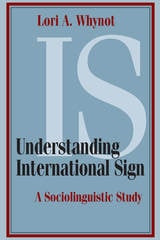
Understanding International Sign
A Sociolinguistic StudyLori A. Whynot
Gallaudet University Press, 2016
International Sign is regarded as a lingua franca that is employed by deaf people to communicate with other deaf people who do not share the same conventionalized local sign language. Contrary to widely-held belief, sign languages are not composed of a unified system of universal gestures—rather, they are distinctly different, and most are mutually unintelligible from one another. The phenomenon of IS has emerged through increased global interaction during recent decades, driven by a rise in the number of international conferences and events and by new technologies that allow for enhanced global communication. IS is gaining acceptance for providing communicative access to conference audience members who do not have knowledge of the designated conference languages, and it is being recruited for use due to the prohibitive expense of providing interpreting services in numerous different sign languages. However, it is not known how well audience members understand IS, and it may actually limit equal access to the interpreted information.
Whynot compares IS to native sign languages and analyzes the distribution of linguistic elements in the IS lexicon and their combined effect on comprehension. Her findings indicate that audiences with diverse sign languages understand much less of IS presentations than has been previously assumed. Whynot’s research has crucial implications for expository IS usage, training, and interpreting, and it sheds light on the strengths and weaknesses inherent in cross-linguistic, signed contact settings.
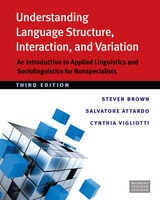
Understanding Language Structure, Interaction, and Variation, Third Ed.
An Introduction to Applied Linguistics and Sociolinguistics for NonspecialistsSteven Brown, Salvatore Attardo, and Cynthia Vigliotti
University of Michigan Press, 2014
Understanding Language Structure, Interaction, and Variation is an introduction to the study of language and applied linguistics for students who have had a minimum of exposure to the discipline of linguistics. Using clear, easy-to-understand explanations and examples, this text avoids the in-depth theoretical coverage found in texts written for those who specialize in linguistics or SLA. As a result, this book is perfect for students whose chosen fields require them to be acquainted with the ways language works--such as future teachers, psychologists, sociologists, and anthropologists--but who do not intend to become linguists. The text is also suitable for English or ESL/EFL teachers who need a reference volume about various aspects of language, particularly as it applies to teaching. Each chapter includes research projects and further readings.
The third edition of Understanding Language Structure, Interaction, and Variation features a new design and reorganization. All content has been significantly revised and updated. Each chapter also debunks a common language myth and now incorporates exercises that, for prior editions, appeared in a supplementary workbook. Extra practice for students is available online, as is additional materials for teachers. (There is no workbook for the third edition.)

Understanding Language Structure, Interaction, and Variation
An Introduction to Applied Linguistics and Sociolinguistics for NonspecialistsSalvatore Attardo and Steven Brown
University of Michigan Press, 2027
In the age of Artificial Intelligence hallucinations and slop, the need for a clear, accessible, uncluttered, and authoritative textbook is more important than ever. The fourth edition of Understanding Language Structure, Interaction, and Variation retains the informal and reader-friendly style of previous editions and has been substantively updated and rewritten to incorporate recent scholarship throughout. Language is important for a number of fields, including teaching, psychology, sociology, and anthropology. The wide coverage of language structure, sociolinguistics, language acquisition, and grammar makes this book suitable for pre-service teachers, undergraduates, and graduate students who need some exposure to linguistics, but do not need highly technical training in formal linguistics.
This extensively classroom-tested book is organized for use in a semester or can be customized for shorter terms by omitting chapters after the foundational core provided by chapters 1–3. The encyclopedic nature of the book, which includes a glossary and an index, make it appropriate for self-study and any reader who is interested in the study of language.
Readers of the fourth edition of Understanding Language Structure, Interaction, and Variation will find:
- Expanded coverage of Prosody, the phonetic alphabet, African American Language, neurodiversity and language, English as a world language, and English as a lingua franca;
- New content on biolinguistics, translanguaging, enregisterment, indexicality, the semiotic turn in sociolinguistics, code-meshing, complex dynamic systems theory, and personality theory in SLA;
- A thorough overview of the basics of English grammar.
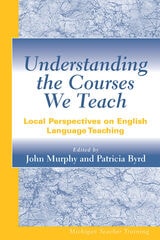
Understanding the Courses We Teach
Local Perspectives on English Language TeachingJohn Murphy and Patricia Byrd, Editors
University of Michigan Press, 2001
Individual chapters are rich in descriptive details and resonate with the contributor-teachers' personal investment in teaching. John Murphy and Patricia Byrd have arranged these chapters in four thematic clusters, the first dealing with general purposes instruction, including workplace literacy, community-based ESL, and courses designed for rich recent immigrants; the second with the teaching of English as a foreign language; the third with university credit-bearing courses focused on the teaching of English for academic purposes; and the fourth with noncredit university-affiliated courses offered through intensive English programs.
The contributors represent a variety of educational settings and many different countries and include many of the most well-known researchers in the field.
.
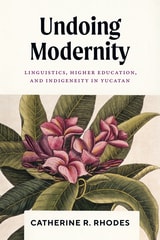
Undoing Modernity
Linguistics, Higher Education, and Indigeneity in YucatanCatherine R. Rhodes
University of Texas Press, 2025
An ethnography of the decolonization of Maya-ness.
On the Yucatan Peninsula today, undergraduates are inventing a new sense of being Maya by studying linguistics and culture in their own language: Maya. In this bold theoretical intervention informed by ethnographic research, Catherine Rhodes argues that these students are undoing the category of modernity itself. Created through colonization of the Americas, modernity is the counterpart to coloniality; the students, Rhodes suggests, are creating decoloniality’s companion: “demodernity.”
Disciplines like linguistics, anthropology, history, and archaeology invented “the Maya” as an essentialized ethnos in a colonial, modern mold. Undoing Modernity follows students and their teachers as they upset the seemingly stable ethnic definition of Maya, with its reliance on a firm dichotomy of Maya and modern. Maya linguistics does not prove that Maya is modern but instead rejects the Maya-ness that modernity built, while also fostering within the university an intellectual space in which students articulate identity on their own terms. An erudite and ultimately hopeful work of interdisciplinary scholarship that brings linguistic anthropology, Mesoamerican studies, and critical Indigenous studies into the conversation, Undoing Modernity dares to imagine the world on the other side of colonial/modern ideals of Indigeneity.

Universal Grammar and Narrative Form
David Herman
Duke University Press, 1995
Following an extensive historical overview of theories about universal grammar, Herman examines Joyce’s Ulysses, Kafka’s The Trial, and Woolf’s Between the Acts as case studies of modernist literary narratives that encode grammatical principles which were (re)fashioned in logic, linguistics, and philosophy during the same period. Herman then uses the interpretation of universal grammar developed via these modernist texts to explore later twentieth-century cultural phenomena. The problem of citation in the discourses of postmodernism, for example, is discussed with reference to syntactic theory. An analysis of Peter Greenaway’s The Cook, The Thief, His Wife, and Her Lover raises the question of cinematic meaning and draws on semantic theory. In each case, Herman shows how postmodern narratives encode ideas at work in current theories about the nature and function of language.
Outlining new directions for the study of language in literature, Universal Grammar and Narrative Form provides a wealth of information about key literary, linguistic, and philosophical trends in the twentieth century.

Universals
Studies in Indian Logic and LinguisticsFrits Staal
University of Chicago Press, 1988
Frits Staal is concerned with four basic questions: Are there universals of logic that transcend culture and time? Are there universals of language and linguistics? What is the nature of Indian logic? And what is the nature of Indian linguistics? By addressing these questions, Staal demonstrates that, contrary to the general assumption among Western philosophers, the classical philosophers of India were rationalists, attentive to arguments. They were in this respect unlike contemporary Western thinkers inspired by existentialism or hermeneutics, and like the ancient Chinese, Greeks, and many medieval European schoolmen, only—as Staal says—more so. Universals establishes that Asia's contributions are not only compatible with what has been produced in the West, but a necessary ingredient and an essential component of any future human science.
Usage Based Models of Language
Edited by Michael Barlow and Suzanne Kemmer
CSLI, 2000
Deviating from traditional methods, the contributions presented in this volume are among the first works to approach linguistic theory by developing and utilizing usage-based models. The contributing authors were among the principal leaders in their fields to leave behind rule-based linguistic representations in favor of constraint-based systems whose structural properties actually emerge from usage. The volume begins with an introductory chapter that defines contributors' interpretations of usage-based models and theories of language. The reason for the shift from formal linguistic theories to the gradual acceptance of usage-based models is also examined. Using methods such as Cognitive Grammar, the Lexical Network Model, Competition Model, Relational Network Theory, and Accessibility Theory, the selected works demonstrate how usage-based models evince far greater cognitive and neurological plausibility than algorithmic, generative models.

Utah English
David Ellingson Eddington
University of Utah Press, 2023
Is English in Utah truly unique? If so, what makes it different? Which stereotypes about how Utahns speak are completely off base and which are accurate? To answer these questions, linguist David Eddington surveyed more than 1,700 Utahns in an effort to better understand and systematize the peculiarities of English spoken in the Beehive State. This resulting book is a sophisticated data analysis that presents results in an accessible and often humorous fashion.
Utah is linguistically interesting for a variety of reasons. The massive numbers of immigrants who flocked there in the first years of European settlement, its relative isolation until completion of the transcontinental railroad, and its large Latter-day Saint population signaled greater linguistic commonality than is often the case in other western states. The book argues that religious affiliation, or lack thereof, might particularly play a role in the features that make up Utah English.
An accessible study of dialect in Utah, this book explores how social and geographic factors influence the pronunciations and regional expressions that characterize Utah English. Reflecting years of dealing with misconceptions about dialect both in and out of the classroom, Eddington covers vocabulary, individual words, syntax, vowels, and consonants, blending a serious and sometimes humorous approach to his research.