Results by title
8113 books match the query 'Literary Criticism' and 105 start with u
U.S. Orientalisms
Race, Nation, and Gender in Literature, 1790-1890Malini Johar Schueller
University of Michigan Press, 2001
This book begins with an examination of the literature of the "Barbary" Orient generated by the U.S. Algerian conflict in the late eighteenth century in the works of such writers as Royall Tyler, Susanna Rowson, and Washington Irving. It then moves on to the Near East Orientalist literature of the nineteenth century in light of Egyptology, theories of race, and the growth of missionary fervor in writers such as John DeForest, Maria Susanna Cummins, Herman Melville, Edgar Allan Poe, and Harriet Prescott Spofford. Finally, Schueller considers the Indic Orientalism of the period in the context of Indology, British colonialism, and the push for Asian trade in the United States, focusing particularly on Emerson and Whitman. U.S. Orientalisms demonstrates how these writers strove to create an Orientalism premised on the idea of civilization and empire moving West, from Asia, through Europe, and culminating in the New World.
Schueller draws on the work of Michel Foucault, Edward Said, Homi Bhabha, Rey Chow, and Judith Butler and compellingly demonstrates how a raced, compensatory "Orientalist" discourse of empire was both contested and evoked in the literary works of a wide variety of writers. The book will be of interest to readers in American history, postcolonial studies, gender studies, and literary theory.
Malini Johar Schueller is Associate Professor, Department of English, University of Florida. She is the author of The Politics of Voice: Liberalism and Social Criticism from Franklin to Kingston.

UMass Rising
The University of Massachusetts Amherst at 150Katharine Greider
University of Massachusetts Press, 2013
The principles that undergirded Mass Aggie's founding continue to form the basis for UMass Amherst's mission of preparing young people to make their way in life by stretching boundaries in all disciplines, from the physical and social sciences to the liberal arts. UMass Rising looks at the school over the course of its first 150 years and mines that history to reveal not only how these principles have been fostered, but also the whys and whos.
The engaging text is enhanced by features on all aspects of life at this unique university. The reader encounters a cavalcade of notable people, as well as many little-known anecdotes, from the humorous to the touching. All are anchored by a gathering of contemporary and archival images, some published here for the first time.
Distributed for the University of Massachusetts Amherst by University of Massachusetts Press.
UNNATURAL VOICES
EXTREME NARRATION IN MODERN AND CONTEMPOBrian Richardson
The Ohio State University Press, 2006
Ugly Productions
An Aesthetics of Greek DramaA. C. Duncan
University of Michigan Press, 2025
Through studies of the figures of Xerxes, Electra, Philoctetes, Ajax, Heracles, and other tragic figures, Ugly Productions offers detailed analyses of the various ways ugliness was produced in performance with each chapter serving as an in-depth guide for studying the aesthetics of these works. Duncan confronts the historical neglect of ugliness in critical discourses, calling for a revaluation of negative aesthetics and renewed interest in the uglier aspects of these canonical works of theater.
Ugly White People
Writing Whiteness in Contemporary AmericaStephanie Li
University of Minnesota Press, 2023
Whiteness revealed: an analysis of the destructive complacency of white self-consciousness
White Americans are confronting their whiteness more than ever before, with political and social shifts ushering in a newfound racial awareness. And with white people increasingly seeing themselves as distinctly racialized (not simply as American or human), white writers are exposing a self-awareness of white racialized behavior—from staunch antiracism to virulent forms of xenophobic nationalism. Ugly White People explores representations of whiteness from twenty-first-century white American authors, revealing white recognition of the ugly forms whiteness can take.
Stephanie Li argues that much of the twenty-first century has been defined by this rising consciousness of whiteness because of the imminent shift to a “majority minority” population and the growing diversification of America’s political, social, and cultural institutions. The result is literature that more directly grapples with whiteness as its own construct rather than a wrongly assumed norm. Li contextualizes a series of literary novels as collectively influenced by changes in racial and political attitudes. Turning to works by Dave Eggers, Sarah Smarsh, J. D. Vance, Claire Messud, Ben Lerner, and others, she traces the responses to white consciousness that breed shared manifestations of ugliness. The tension between acknowledging whiteness as an identity built on domination and the failure to remedy inequalities that have proliferated from this founding injustice is often the source of the ugly whiteness portrayed through these narratives.
The questions posed in Ugly White People about the nature and future of whiteness are vital to understanding contemporary race relations in America. From the election of Trump and the rise of white nationalism to Karen memes and the war against critical race theory to the pervasive pattern of behavior among largely liberal-leaning whites, Li elucidates truths about whiteness that challenge any hope of national unity and, most devastatingly, the basic humanity of others.
Retail e-book files for this title are screen-reader friendly.
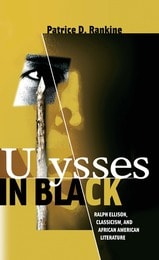
Ulysses in Black
Ralph Ellison, Classicism, and African American LiteraturePatrice D. Rankine
University of Wisconsin Press, 2008
In this groundbreaking work, Patrice D. Rankine asserts that the classics need not be a mark of Eurocentrism, as they have long been considered. Instead, the classical tradition can be part of a self-conscious, prideful approach to African American culture, esthetics, and identity. Ulysses in Black demonstrates that, similar to their white counterparts, African American authors have been students of classical languages, literature, and mythologies by such writers as Homer, Euripides, and Seneca.
Ulysses in Black closely analyzes classical themes (the nature of love and its relationship to the social, Dionysus in myth as a parallel to the black protagonist in the American scene, misplaced Ulyssean manhood) as seen in the works of such African American writers as Ralph Ellison, Toni Morrison, and Countee Cullen. Rankine finds that the merging of a black esthetic with the classics—contrary to expectations throughout American culture—has often been a radical addressing of concerns including violence against blacks, racism, and oppression. Ultimately, this unique study of black classicism becomes an exploration of America’s broader cultural integrity, one that is inclusive and historic.
Outstanding Academic Title, Choice Magazine
Ulysses
The Mechanics of MeaningDavid Hayman
University of Wisconsin Press, 1982
Un/Translatables
New Maps for Germanic LiteraturesEdited by Bethany Wiggin and Catriona MacLeod
Northwestern University Press, 2016
Unattainable Bride Russia
Gendering Nation, State, and Intelligentsia in Russian Intellectual CultureEllen Rutten
Northwestern University Press, 2010
Throughout the twentieth century and continuing today, personifications of Russia as a bride occur in a wide range of Russian texts and visual representations, from literature and political and philosophical treatises to cartoons and tattoos. Invariably, this metaphor functions in the context of a political gender allegory, which represents the relationships between Russia, the intelligentsia, and the Russian state, as a competition of two male suitors for the former’s love.
In Unattainable Bride Russia, Ellen Rutten focuses on the metaphorical role the intelligentsia plays as Russia’s rejected or ineffectual suitor. Rutten finds that this metaphor, which she covers from its prehistory in folklore to present-day pop culture references to Vladimir Putin, is still powerful, but has generated scarce scholarly consideration. Unattainable Bride Russia locates the cultural thread and places the political metaphor in a broad contemporary and social context, thus paying it the attention to which it is entitled as one of Russia’s modern cultural myths.
Unauthorized Voices
Essays on Poets and Poetry, 1987-2009Marilyn Hacker
University of Michigan Press, 2010
Praise for Marilyn Hacker:
"How piercing the duet we're offered between Marilyn Hacker and the reality principle. Reality saying, it’s impossible, something's always sacrificed: you can't be so merry and so raw; so learned and earthy; so gut-wrenching, so danceable at once. Can you? To which, steadily, the voice of Marilyn Hacker: Yes. Evidently; Evidently so."
---Eve Kosofsky Sedgwick, author of Epistemology of the Closet and Touching Feeling
"Hacker is one of our best singers---by turns elegiac and fierce, sweet and witty. With each new collection her voice grows richer, more resonant, sorrowing and lovely."
---Julia Alvarez, author of In the Time of the Butterflies and How the García Girls Lost Their Accents
"Marilyn Hacker joins a marvelous facility with poetic forms to a shockingly intense sensuality. Not unlike Baudelaire, you might say, and indeed like him, she shares a taste for excess, drink, Paris, women, crowds. 'Enivrez-vous!' Baudelaire ordered his readers, and Marilyn Hacker has taken his advice seriously."
---Edmund White, author of Hotel de Dream, City Boy, and Le Flâneur
"Everything is thrilling and true, fast and witty, deep and wise; her vitality is the pulse of life itself."
---Derek Mahon, author of Harbour Lights and An Autumn Wind
A volume in the Poets on Poetry series, which collects critical works by contemporary poets, gathering together the articles, interviews, and book reviews by which they have articulated the poetics of a new generation.
For over twenty years, award-winning poet, translator, and editor Marilyn Hacker has been writing incisive criticism and reviews of contemporary poetry, with particular attention to the work of feminist poets, poets of color, and any poets whose work she judged worthy of more attention from the American (and sometimes British) reading public.
Unauthorized Voices is Hacker’s first collection of critical prose, bringing together her essays on American, British, Irish, and French poets. It includes pieces on Adrienne Rich, Hayden Carruth, Elizabeth Bishop, Tony Harrison, Marilyn Nelson, and June Jordan; on French and Francophone poets including Vénus Khoury-Ghata and Guy Goffette; on poetry and politics; and on the contemporary sonnet, all affirming Hacker as a lively, unabashedly opinionated American critical voice.
Marilyn Hacker is the author of twelve books of poems, most recently Names and Essays on Departure, and of ten collections of poetry translated from the French, including Marie Étienne's King of a Hundred Horsemen, recipient of the 2009 PEN Award for Poetry in Translation. She has been the recipient of the Lenore Marshall Poetry Prize, two Lambda Literary Awards, and the National Book Award for her own poetry and is a Chancellor of the Academy of American Poets.
Unbecoming Americans
Writing Race and Nation from the Shadows of Citizenship, 1945-1960Keith, Joseph
Rutgers University Press, 2013
During the Cold War, Ellis Island no longer served as the largest port of entry for immigrants, but as a prison for holding aliens the state wished to deport. The government criminalized those it considered un-assimilable (from left-wing intellectuals and black radicals to racialized migrant laborers) through the denial, annulment, and curtailment of citizenship and its rights. The island, ceasing to represent the iconic ideal of immigrant America, came to symbolize its very limits.
Unbecoming Americans sets out to recover the shadow narratives of un-American writers forged out of the racial and political limits of citizenship. In this collection of Afro-Caribbean, Filipino, and African American writers—C.L.R. James, Carlos Bulosan, Claudia Jones, and Richard Wright—Joseph Keith examines how they used their exclusion from the nation, a condition he terms “alienage,” as a standpoint from which to imagine alternative global solidarities and to interrogate the contradictions of the United States as a country, a republic, and an empire at the dawn of the "American Century.”
Building on scholarship linking the forms of the novel to those of the nation, the book explores how these writers employed alternative aesthetic forms, including memoir, cultural criticism, and travel narrative, to contest prevailing notions of race, nation, and citizenship. Ultimately they produced a vital counter-discourse of freedom in opposition to the new formations of empire emerging in the years after World War II, forms that continue to shape our world today.
Unbecoming Language
Anti-Identitarian French Feminist FictionsAnnabel L. Kim
The Ohio State University Press, 2018
Kim’s close readings ultimately enliven the current conversation in French studies by serving as a provocation to return to reading literary texts deeply and closely, without subordinating literature to a pre-existing ideological framework—to let literature speak, to let it theorize. Tracking the influence of these writers on each other, Kim provides a new, original French feminist poetics and demonstrates that Sarraute, Wittig, and Garréta’s work allows for a hollowing out of difference from within, allowing writers and readers to unbecome—to break free of identity and exist as subjectivities without subjecthood. In looking at these writers together, Kim provides a defense of literature as liberatory— capable of effecting personal and political change—and gives readers an experience of literature’s revolutionary possibilities.
Unbecoming Language
Anti-Identitarian French Feminist FictionsAnnabel L. Kim
The Ohio State University Press, 2018
Kim’s close readings ultimately enliven the current conversation in French studies by serving as a provocation to return to reading literary texts deeply and closely, without subordinating literature to a pre-existing ideological framework—to let literature speak, to let it theorize. Tracking the influence of these writers on each other, Kim provides a new, original French feminist poetics and demonstrates that Sarraute, Wittig, and Garréta’s work allows for a hollowing out of difference from within, allowing writers and readers to unbecome—to break free of identity and exist as subjectivities without subjecthood. In looking at these writers together, Kim provides a defense of literature as liberatory— capable of effecting personal and political change—and gives readers an experience of literature’s revolutionary possibilities.
Unbought and Unbossed
Transgressive Black Women, Sexuality, and RepresentationTrimiko Melancon
Temple University Press, 2014
Drawing from black feminist and critical race theories, historical discourses on gender and sexuality, and literary criticism, Melancon explores the variety and complexity of black female identity. She illuminates how authors including Ann Allen Shockley, Alice Walker, and Gayl Jones engage issues of desire, intimacy, and independence to shed light on a more complex black identity, one ungoverned by rigid politics over-determined by race, gender and sexuality.
Unbridled
Studying Religion in PerformanceWilliam Robert
University of Chicago Press, 2022
In Unbridled, William Robert uses Equus, Peter Shaffer’s enigmatic play about a boy passionately devoted to horses, to think differently about religion. For several years, Robert has used Equus to introduce students to the study of religion, provoking them to conceive of religion in unfamiliar, even uncomfortable ways. In Unbridled, he is inviting readers to do the same.
A play like Equus tangles together text, performance, practice, embodiment, and reception. Studying a play involves us in playing different roles, as ourselves and others, and those roles, as well as the imaginative work they require, are critical to the study of religion. By approaching Equus with the reader, turning the play around and upside-down, Unbridled transforms standard approaches to the study of religion, engaging with themes including ritual, sacrifice, worship, power, desire, violence, and sexuality, as well as thinkers including Judith Butler, Sigmund Freud, Karl Marx, Friedrich Nietzsche, and Jonathan Z. Smith. As Unbridled shows, the way themes and theories play out in Equus challenges us to reimagine the study of religion through open questions, contrasting perspectives, and alternative modes of interpretation and appreciation.
Uncanny Encounters
Literature, Psychoanalysis, and the End of AlterityJohn Zilcosky
Northwestern University Press, 2015
Winner of the Friedrich Wilhelm Bessel Research Award
Recipient, 2022 Guggenheim Fellowship
Around 1900, when the last blank spaces on their maps were filled, Europeans traveled to far-flung places hoping to find the spectacularly foreign. They discovered instead what Freud called, several years later, the uncannily familiar: disturbing reflections of themselves—either actual Europeans or Westernized natives. This experience was most extreme for German travelers, who arrived in the contact zones late, on the heels of other European colonialists, and it resulted not in understanding or tolerance but in an increased propensity for violence and destruction. The quest for a “virginal,” exotic existence proved to be ruined at its source, mirroring back to the travelers demonic parodies of their own worst aspects. In this strikingly original book, John Zilcosky demonstrates how these popular “uncanny” encounters influenced Freud’s—and the literary modernists’—use of the term, and how these encounters remain at the heart of our cross-cultural anxieties today.
Uncanny Fidelity
Recognizing Shakespeare in Twenty-First-Century Film and TelevisionJames Newlin
University of Alabama Press, 2024
How the study of Shakespeare’s legacy, specifically in film and television, can radically challenge what we consider to be authentically Shakespearean
In the field of adaptation studies today, the idea of reading an adapted text as “faithful” or “unfaithful” to its original source strikes many scholars as too simplistic, too conservative, and too moralizing. In Uncanny Fidelity: Recognizing Shakespeare in Twenty-First Century Film and Television, James Newlin challenges these critical orthodoxies. Instead, recognizing how a film or television series closely recalls Shakespeare’s drama encourages an interrogation of what we consider to be “Shakespeare” in the first place.
Drawing upon Sigmund Freud’s model of the uncanny—the sudden sensation of peculiar, discomforting familiarity—this book focuses on films and television series that were not marketed as adaptations of Shakespeare. Yet these works unexpectedly invoke lost, even troubling aspects of Shakespeare’s original playtexts, their performance history, or their reception. Broadening the scope of fidelity readings beyond familiar concerns like plot and language, Newlin demonstrates how the study of Shakespeare’s afterlife can clarify both the historical context of his drama and its relevance for the current political moment. Engaging contemporary debates in literary and psychoanalytic theory, this book features provocative close readings of The Tempest, Othello, and The Winter’s Tale alongside recent films and television series, from art-house movies such as The Master and Manchester by the Sea to the cult favorites Brigsby Bear and Vice Principals. These works conjure widely overlooked qualities of Shakespeare’s drama by recalling the casting practices or the generic contexts of the early modern stage or by making a meaningful intervention in the plays’ critical reception. Closely examining these surprisingly faithful adaptations of Shakespeare’s drama helps us to articulate the original experience of the early modern stage and better consider its resonance in the present.
This book will benefit students and scholars of Shakespeare on film and psychoanalytic theory. Yet Uncanny Fidelity will also be of interest to scholars of performance history, source studies, and early modern discourses of race and gender—as well as anyone interested in the unexpected connections between canonical literature and contemporary culture. By examining adaptation as an instance of uncanny return, Newlin demonstrates how the study of Shakespeare’s afterlife can radically challenge what we consider to be authentically Shakespearean.
Uncanny Rest
For AntiphilosophyAlberto Moreiras
Duke University Press, 2022
Uncanny Subjects
Aging in Contemporary NarrativeAmelia DeFalco
The Ohio State University Press, 2009
In the United States anti-aging is a multibillion-dollar industry, and efforts to combat signs of aging have never been stronger, or more lucrative. Although there are many sociological studies of aging and culture, there are few studies that examine the ways cultural texts construct multiple narratives of aging that intersect and sometimes conflict with existing social theories of aging. In Uncanny Subjects, Amelia DeFalco incorporates methodologies and theories derived from the humanities in her investigation into contemporary representations of aging.
Both aging and narrative are a function of time, of change, of one event happening after another. Subjects understand their lives through narrative trajectories—not necessarily as they are living moment to moment, but in the sort of reflection that many argue becomes more prevalent with age. As a result, narrative fiction provides compelling representations of the strange—indeed uncanny—familiarity of the aging self.
DeFalco examines a range of contemporary fiction and film by authors and directors such as John Banville, John Cassavetes, and Alice Munro. As these texts suggest, old age involves a growing awareness of the otherness within, an awareness that reveals identity as multiple, shifting, and contradictory—in short, uncanny. Drawing together theories of the uncanny with research on aging and temporality, DeFalco argues that aging is a category of difference integral to a contemporary understanding of identity and alterity.
Uncensored
Samizdat Novels and the Quest for Autonomy in Soviet DissidenceAnn Komaromi
Northwestern University Press, 2015
Uncertainty and Plenitude
Five Contemporary PoetsPeter Stitt
University of Iowa Press, 1997
Stitt's interest in these five poets is intellectual and aesthetic. As he states, “I chose these particular writers because their work continues to interest me deeply, both intellectually and formally, even after years of familiarity.” He uses his understanding of the philosophical implications inherent in modern physics, as they apply to both content and form, as the basis for his close analysis.
Stitt attends to the poets' writerly strategies so that we may discover in their poetry where “surface form” intersects and complements meaning and thus becomes, in John Berryman's terms, “deep form.” He explains what these poets say and how they say it and what relationships lie between. He also shows how humor plays a part in some of their work.
Uncivil Unions
The Metaphysics of Marriage in German Idealism and RomanticismAdrian Daub
University of Chicago Press, 2012
“What a strange invention marriage is!” wrote Kierkegaard. “Is it the expression of that inexplicable erotic sentiment, that concordant elective affinity of souls, or is it a duty or a partnership . . . or is it a little of all that?”
Like Kierkegaard a few decades later, many of Germany’s most influential thinkers at the turn of the eighteenth century wondered about the nature of marriage but rejected the easy answers provided by biology and theology. In Uncivil Unions, Adrian Daub presents a truly interdisciplinary look at the story of a generation of philosophers, poets, and intellectuals who turned away from theology, reason, common sense, and empirical observation to provide a purely metaphysical justification of marriage.
Through close readings of philosophers like Fichte and Schlegel, and novelists like Sophie Mereau and Jean Paul, Daub charts the development of this new concept of marriage with an insightful blend of philosophy, cultural studies, and theory. The author delves deeply into the lives and work of the romantic and idealist poets and thinkers whose beliefs about marriage continue to shape ideas about gender, marriage, and sex to the present day.
Uncivil Wars
Elena Garro, Octavio Paz, and the Battle for Cultural MemoryBy Sandra Messinger Cypess
University of Texas Press, 2012
The first English-language book to place the works of Elena Garro (1916–1998) and Octavio Paz (1914–1998) in dialogue with each other, Uncivil Wars evokes the lives of two celebrated literary figures who wrote about many of the same experiences and contributed to the formation of Mexican national identity but were judged quite differently, primarily because of gender.
While Paz’s privileged, prize-winning legacy has endured worldwide, Garro’s literary gifts garnered no international prizes and received less attention in Latin American literary circles. Restoring a dual perspective on these two dynamic writers and their world, Uncivil Wars chronicles a collective memory of wars that shaped Mexico, and in turn shaped Garro and Paz, from the Conquest period to the Mexican Revolution; the Spanish Civil War, which the couple witnessed while traveling abroad; and the student massacre at Tlatelolco Plaza in 1968, which brought about social and political changes and further tensions in the battle of the sexes. The cultural contexts of machismo and ethnicity provide an equally rich ground for Sandra Cypess’s exploration of the tandem between the writers’ personal lives and their literary production. Uncivil Wars illuminates the complexities of Mexican society as seen through a tense marriage of two talented, often oppositional writers. The result is an alternative interpretation of the myths and realities that have shaped Mexican identity, and its literary soul, well into the twenty-first century.
Uncle Tom's Cabins
The Transnational History of America's Most Mutable BookTracy C. Davis and Stefka Mihaylova, Editors
University of Michigan Press, 2018
Throughout these encounters, Stowe’s story of American slavery serves as a paradigm for understanding oppression, selectively and strategically refracting the African American slave onto other iconic victims and freedom fighters. The book brings together performance historians, literary critics, and media theorists to demonstrate how the myriad cultural and political effects of Stowe’s enduring story has transformed it into a global metanarrative with national, regional, and local specificity.
Uncollected Early Prose of Katherine Anne Porter
Edited by Ruth Moore Alvarez and Thomas F. Walsh
University of Texas Press, 1993
This volume brings together twenty-nine pieces dating from before 1932, none of which appeared in Porter's collected works and many of which are published here for the first time. Both fiction and essays are covered. All these pieces belong to Porter's apprenticeship as a creative writer. Thus, they offer new insights into her artistic development and her relationship with Mexico, a place that, as she later said, "influenced everything I did afterward."
Uncomfortable Situations
Emotion between Science and the HumanitiesDaniel M. Gross
University of Chicago Press, 2017
Science and the humanities typically offer two different paradigms for thinking about emotion—the first rooted in brain and biology, the second in a social world. With rhetoric as a field guide, Uncomfortable Situations establishes common ground between these two paradigms, focusing on a theory of situated emotion. Daniel M. Gross anchors the argument in Charles Darwin, whose work on emotion has been misunderstood across the disciplines as it has been shoehorned into the perceived science-humanities divide. Then Gross turns to sentimental literature as the single best domain for studying emotional situations. There’s lost composure (Sterne), bearing up (Equiano), environmental hostility (Radcliffe), and feeling mixed (Austen). Rounding out the book, an epilogue written with ecological neuroscientist Stephanie Preston provides a different kind of cross-disciplinary collaboration. Uncomfortable Situations is a conciliatory work across science and the humanities—a groundbreaking model for future studies.
Uncommon Women
Gender and Representation in Nineteenth-Century U.S. Women's WritingLaura Laffrado
The Ohio State University Press, 2009
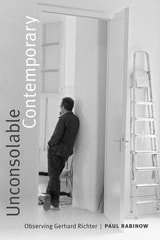
Unconsolable Contemporary
Observing Gerhard RichterPaul Rabinow
Duke University Press, 2017
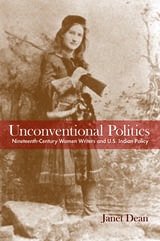
Unconventional Politics
Nineteenth-Century Women Writers and U.S. Indian PolicyJanet Dean
University of Massachusetts Press, 2016
Dean argues that in protesting U.S. Indian policy through popular genres, Wakefield, Sigourney, Callahan, and Eddleman also critiqued cultural protocols and stretched the contours of accepted modes of feminine discourse. Their acts of improvisation and reinvention tell a new story about the development of American women's writing and political expression.

Uncovering Heian Japan
An Archaeology of Sensation and InscriptionThomas LaMarre
Duke University Press, 2000
Combining a pathbreaking visual analysis of the calligraphy with which this poetry was transcribed, a more traditional textual analysis, and a review of the politics of the period, LaMarre presents a dramatically new view of Heian poetry and culture. He challenges the assumption of a cohesive “national imagination,” seeing instead an early Japan that is ethnically diverse, territorially porous, and indifferent to linguistic boundaries. Working through the problems posed by institutionalized notions of nationalism, nativism, and modernism, LaMarre rethinks the theories of scholars such as Suzuki Hideo, Yoshimoto Takaaki, and Komatsu Shigemi, in conjunction with theorists such as Derrida, Karatani, Foucault, and Deleuze. Contesting the notion that speech is central to the formation of community, Uncovering Heian Japan focuses instead on the potential centrality of the more figural operations of poetic practice.
Specialists in Japanese history and culture as well as scholars working in other areas of cultural criticism will find that this book enriches their understanding of an early Japan that has exerted so much influence on later concepts of what it means to be Japanese.

Undead Ends
Stories of ApocalypseS. Trimble
Rutgers University Press, 2019

Under Review
Further Writings on Writers, 1946-1990Anthony Powell
University of Chicago Press, 1994
"Powell is one of the great novelists of our time, much more interested in other people than in his own views and ideas. The result is that his extraordinary richness of act and detail also embodies a far more arresting and penetrating quantity of critical judgements on books, authors, fashions, developments, than are to be found in the theoretical pronouncement of modern academic criticism."—John Bayley, The Sunday Times
"These delightful reviews could be said to amount to a latter-day Brief Lives."—David Plante, Times Literary Supplement
Under Western Eyes
India from Milton to MacaulayBalachandra Rajan
Duke University Press, 1999
Rajan begins with the Portuguese poet Camões, whose poem celebrating Vasco da Gama’s passage to India becomes, according to its eighteenth-century English translator, the epic of those who would possess India. He closely examines Milton’s treatment of the Orient and Dryden’s Aureng-Zebe, the first English literary work on an Indian subject. Texts by Shelley, Southey, Mill, and Macaulay, among others, come under careful scrutiny, as does Hegel’s significant impact on English imperial discourse. Comparing the initial English representation of its actions in India (as a matter of commerce, not conquest) and its contemporaneous treatment of Ireland, Rajan exposes contradictions that shed new light on the English construction of a subaltern India.
Under a Bad Sign
Criminal Self-Representation in African American Popular CultureJonathan Munby
University of Chicago Press, 2011
What accounts for the persistence of the figure of the black criminal in popular culture created by African Americans? Unearthing the overlooked history of art that has often seemed at odds with the politics of civil rights and racial advancement, Under a Bad Sign explores the rationale behind this tradition of criminal self-representation from the Harlem Renaissance to contemporary gangsta culture.
In this lively exploration, Jonathan Munby takes a uniquely broad view, laying bare the way the criminal appears within and moves among literary, musical, and visual arts. Munby traces the legacy of badness in Rudolph Fisher and Chester Himes’s detective fiction and in Claude McKay, Julian Mayfield, and Donald Goines’s urban experience writing. Ranging from Peetie Wheatstraw’s gangster blues to gangsta rap, he also examines criminals in popular songs. Turning to the screen, the underworld films of Oscar Micheaux and Ralph Cooper, the 1970s blaxploitation cycle, and the 1990s hood movie come under his microscope as well. Ultimately, Munby concludes that this tradition has been a misunderstood aspect of African American civic life and that, rather than undermining black culture, it forms a rich and enduring response to being outcast in America.
Under the Sky of My Africa
Alexander Pushkin and BlacknessCatherine Nepomnyashchy
Northwestern University Press, 2006
Roughly in the year 1705, a young African boy, acquired from the seraglio of the Turkish sultan, was transported to Russia as a gift to Peter the Great. This child, later known as Abram Petrovich Gannibal, was to become Peter's godson and to live to a ripe old age, having attained the rank of general and the status of Russian nobility. More important, he was to become the great-grandfather of Russia's greatest national poet, Alexander Pushkin. It is the contention of the editors of this book, borne out by the essays in the collection, that Pushkin's African ancestry has played the role of a "wild card" of sorts as a formative element in Russian cultural mythology; and that the ways in which Gannibal's legacy has been included in or excluded from Pushkin's biography over the last two hundred years can serve as a shifting marker of Russia's self-definition.
The first single volume in English on this rich topic, Under the Sky of My Africa addresses the wide variety of interests implicated in the question of Pushkin's blackness-race studies, politics, American studies, music, mythopoetic criticism, mainstream Pushkin studies. In essays that are by turns biographical, iconographical, cultural, and sociological in focus, the authors-representing a broad range of disciplines and perspectives-take us from the complex attitudes toward race in Russia during Pushkin's era to the surge of racism in late Soviet and post-Soviet contemporary Russia. In sum, Under the Sky of My Africa provides a wealth of basic material on the subject as well as a series of provocative readings and interpretations that will influence future considerations of Pushkin and race in Russian culture.
Under the Western Sky
Essays on the Fiction and Music of Willy VlautinNeil Campbell
University of Nevada Press, 2018
Brutally honest, raw, gritty, down to earth, compassionate and affecting, Willy Vlautin’s writing evokes a power in not only theme, but in methodology. Vlautin’s novels, The Motel Life, Northline, Lean on Pete and The Free (2006-2014) chart the dispossessed lives of young people struggling to survive in difficult economic times and in regions of the U.S. West and Pacific Northwest traditionally viewed as affluent and abundant. Yet as his work shows, are actually highly stratified and deprived.
Likewise, Vlauntin’s songs, penned as lead singer of the Americana band Richmond Fontaine chart a related territory of blue-collar landscapes of the American West and Northwest with a strong emphasis on narrative and affective soundscapes evocative of the similar worlds defined in his novels.
Featuring an interview with Vlautin himself, this edited collection aims to develop the first serious, critical consideration of the important novels and songs of Willy Vlautin by exploring relations between region, music, and writing through the lens of critical regionality and other interdisciplinary, cultural, and theoretical methodologies. In so doing, it will situate his work within its regional frame of the American New West, and particularly the city of Reno, Nevada and the Pacific Northwest, whilst showing how he addresses wider cultural and global issues such as economic change, immigration shifts, gender inequality, and the loss of traditional mythic identities.
The essays take different positions in relation to considerations of both novels and music, looking for links and relations across genres, always mindful of their specificity. Under the Western Sky shows how although apparently rooted in place, Vlautin’s work traces diverse lines of contemporary cultural enquiry, engaging in an effective and troubling examination of regional haunting.

Underdogs
Social Deviance and Queer TheoryHeather Love
University of Chicago Press, 2021
The sociology of “social deviants” flourished in the United States at midcentury, studying the lives of outsiders such as homosexuals, Jews, disabled people, drug addicts, and political radicals. But in the following decades, many of these downcast figures would become the architects of new social movements, activists in revolt against institutions, the state, and social constraint. As queer theory gained prominence as a subfield of the humanities in the late 1980s, it seemed to inherit these radical, activist impulses—challenging not only gender and sexual norms, but also the nature of society itself.
With Underdogs, Heather Love shows that queer theorists inherited as much from sociologists as they did from activists. Through theoretical and archival work, Love traces the connection between midcentury studies of deviance and the antinormative, antiessentialist field of queer theory. While sociologists saw deviance as an inevitable fact of social life, queer theorists embraced it as a rallying cry. A robust interdisciplinary history of the field, Underdogs stages a reencounter with the practices and communities that underwrite radical queer thought.
Underground Modernity
Urban Poetics in East-Central Europe, Pre- and Post-1989Alfrun Kliems
Central European University Press, 2021
The literary scholar Alfrun Kliems explores the aesthetic strategies of Eastern European underground literature, art, film and music in the decades before and after the fall of communism, ranging from the ‘father’ of Prague Underground, Egon Bondy, to the neo-Dada Club of Polish Losers in Berlin.
The works she considers are "underground" in the sense that they were produced illegally, or were received as subversive after the regimes had fallen. Her study challenges common notions of ‘Underground’ as an umbrella term for nonconformism. Rather, it depicts it as a sociopoetic reflection of modernity, intimately linked to urban settings, with tropes and aesthetic procedures related to Surrealism, Dadaism, Expressionism, and, above all, pop and counterculture.
The author discusses these commonalities and distinctions in Czech, Polish, Slovak, Ukrainian, Russian, and German authors, musicians, and filmmakers. She identifies intertextual relations across languages and generations, and situates her findings in a transatlantic context (including the Beat Generation, Susan Sontag, Neil Young) and the historical framework of Romanticism and modernity (including Baudelaire and Brecht).
Despite this wide brief, the book never loses sight of its core message: Underground is no arbitrary expression of discontent, but rather the result of a fundamental conflict at the socio-philosophical roots of modernity.
Underground Movements
Modern Culture on the New York City SubwaySunny Stalter-Pace
University of Massachusetts Press, 2013
Writers and artists took up questions that originated in the sphere of urban planning to explore how underground movement changed the ways people understand the city. Modern poets envisioned the subway as a space of literary innovation; playwrights and fiction writers used it to gauge the consequences of migration and immigration; and essayists found that it underscored the fragile relationship between urban development and memory. Even today, the symbolic associations forged by these early texts continue to influence understanding of the cultural significance of the subway and the city it connects.

Understanding "Les Fleurs du Mal"
Critical ReadingsWilliam J. Thompson
Vanderbilt University Press, 1997
Surprisingly, there are few book-length studies available that approach the poems in Charles Baudelaire's collection on an individual basis. Understanding "Les Fleurs du Mal" fills this gap by providing students and serious readers with clear, scholarly "explications" to many of the most widely read of Baudelaire's poems.
Understanding Chekhov
A Critical Study Of Chekhov'S Prose And DramaDonald Rayfield
University of Wisconsin Press, 1999
Understanding Nationalism
On Narrative, Cognitive Science, and IdentityPatrick Colm Hogan
The Ohio State University Press, 2009
Understanding Tolstoy
Andrew D. Kaufman
The Ohio State University Press, 2010
Understanding Tolstoy recreates Tolstoy’s lifelong artistic and spiritual journey, taking readers to the core of the writer’s world through nuanced close readings of his major novels and novellas. Andrew D. Kaufman’s broad and accessible analysis of Tolstoy’s work speaks to the ways in which Tolstoy, despite living in a manner far removed from the experiences of most modern-day Americans, is still applicable and contemporary.
From a reconstruction of Olenin’s search for truth in The Cossacks to an illuminating analysis of Hadji-Murat’s tragic last stand, Understanding Tolstoy brings to life the fascinating parallels between Tolstoy’s personal quest and his characters’ journeys. Whether writing about the ballrooms and battlefields of War and Peace or the spectrum of sexual and spiritual attachments in Anna Karenina, Tolstoy emerges as a vital, searching artist who continually grows and surprises us, yet is driven by a single, unchanging belief in universal human truths.
Understanding Tolstoy is a treasure trove of critical and philosophical insights that will appeal to Tolstoy aficionados of all kinds, from advanced scholars to undergraduate students. The book offers an eminently readable guide to those entering Tolstoy’s world for the first time or the tenth, and it invites them to grapple alongside the writer and his characters with the most urgent existential questions of our time, and all times.
Understanding the Medieval Meditative Ascent
Augustine, Anselm, Boethius and DanteRobert McMahon
Catholic University of America Press, 2006
Underworlds of Memory
W. G. Sebald's Epic Journeys through the PastAlan Itkin
Northwestern University Press, 2017
Scholars often read Sebald’s work as a project of cultural memory that aims to reevaluate Europe's past in the wake of the traumatic and complex events of the twentieth century. Sebald’s characters seek out the traces of Europe’s destructive history in strange places. They linger in disused train stations, pause before works of art, and return to childhood homes that turn out to be more foreign than any place they have visited. Underworlds of Memory demonstrates that these strange encounters with the past are based on central tropes of classical epic: the journey to the underworld, the encounter with a work of art, and the return to the homeland.
Sebald thus follows in the footsteps of German Jewish authors, including Peter Weiss, Siegfried Kracauer, and Jean Améry, who use these same epic tropes to reconsider the cultural memory of the Holocaust. Underworlds of Memory reads Sebald's works together with the works of these German Jewish authors and the classical epics of Homer and Virgil in order to describe and trace the origins of the unique intervention into cultural memory they embody.
Undocuments
John-Michael Rivera
University of Arizona Press, 2021
How do you document the undocumented? UNDOCUMENTS both poses and attempts to answer this complex question by remixing the forms and styles of the first encyclopedia of the New World, the Florentine Codex, in order to tell a modern story of Greater Mexico. Employing a broad range of writing genres and scholarly approaches, UNDOCUMENTS catalogs, recovers, and erases documents and images by and about peoples of Greater Mexico from roughly the first colonial moment. This brave and bracing volume organizes and documents ancient New World Mexican peoples from the Florentine Codex (1592) to our current technology-heavy age, wherein modern lawmakers and powerful global figures desire to classify, deport, and erase immigrants and their experiences.
While grappling with anxiety and the physical and mental health consequences of the way the United States treats immigrant bodies, John-Michael Rivera documents and scrutinizes what it means to seek opportunities in America. With a focus on the poetics of Latinx documentality itself, this book is concerned with the complicated and at times contradictory ways peoples of Greater Mexico have been documented and undocumented within systems of colonial knowledges, and how these peoples have been rendered as specters of the bureaucratic state. Rivera takes us through the painful, anxiety-ridden, and complex nature of what it means to be documented or undocumented, and the cruelty married to each of these states of being.
Une collecte d’images
Walter Benjamin à la Bibliothèque nationaleSteffen Haug
Diaphanes, 2022
Au fil de ses recherches, Benjamin se rend à l’évidence : il faudra que son Livre des passages soit enrichi par des images. Une « documentation visuelle » se constitue bientôt, écrit-il, glanée pour l’essentiel dans les recueils du Cabinet des estampes de la Bibliothèque nationale où il travaille pendant son exil parisien. Une centaine de notes témoignent de cette collecte et conservent, enfermée dans leurs plis, la mention d’une ou de plusieurs images qui sont restées pour la plupart inconnues jusqu’ici.
Steffen Haug a voulu retrouver cette réserve enfouie. Gravures et dessins de presse, tracts, réclames, affiches et photographies, de Meryon et Grandville à Daumier, en passant par l’infinie cohorte anonyme et le tout-venant de la production visuelle à grand tirage du XIXe siècle : la moisson rapportée ici est surprenante. Elle invite à lire ou relire les Passages en faisant à l’image toute la place qu’elle occupe dans la pensée du dernier Benjamin, à l’heure où s’élaborent, sous la menace de temps assombris, son essai « L’œuvre d’art à l’époque de sa reproductibilité technique », le projet de livre sur Baudelaire ou ses « Thèses sur le concept d’histoire ».
Uneasy Allies
Working for Labor Reform in Nineteenth-Century BostonDavid A. Zonderman
University of Massachusetts Press, 2011
In addition to analyzing what motivated these workers and reformers to create cross-class organizations, David Zonderman examines the internal tactical debates and external political pressures that fractured them, even as new alliances were formed, and shows how these influences changed over time. He describes what workers and reformers learned about politics and social change within these complex and volatile alliances, and speculates as to whether those lessons have relevance for activists and reformers today.
What emerges from this investigation is a narrative of progress and decline that spans nearly three-quarters of a century, as an ever-shifting constellation of associations debated the meaning of labor reform and the best strategy to secure justice for workers. But the quest for ideological consistency and organizational coherence was not easily achieved. By century's end, not only did Boston look dramatically different from its antebellum ancestor, but its labor reform alliances had lost some of their earlier openhearted optimism and stubborn resilience.
Uneasy Sensations
Smollett and the BodyAileen Douglas
University of Chicago Press, 1995
Aileen Douglas draws on feminist and other new theoretical perspectives to reassess Smollett's entire body of fiction as well as his classic Travels through France and Italy. Like many writers of his time, Douglas argues, Smollett was interested in the body and in how accurately it reflects internal disposition. But Smollett's special contribution to the eighteenth-century novel is his emphasis on sentience, or the sensations of the physical body. Looking at such works as The Adventures of Roderick Random, The Expedition of Humphry Clinker, The Adventures of Peregrine Pickle, and The History and Adventures of an Atom, Douglas explores the ways Smollett uses representations of sentience—especially torment and pain—in his critique of the social and political order.
Trained in medicine, Smollett was especially alert to the ways in which the discourses of medicine, philosophy, and law construct (as we would put it now) the body as an object of knowledge, and yet his work always returns to the importance of the physical world of the body and its feelings. Smollett reminds us, as Douglas aptly puts it, that "if you prick a socially constructed body, it still bleeds."
Uneven Developments
The Ideological Work of Gender in Mid-Victorian EnglandMary Poovey
University of Chicago Press, 1988
Asserting that the organization of sexual difference is a social, not natural, phenomenon, Poovey shows how representations of gender took the form of a binary opposition in mid-Victorian culture. She then reveals the role of this opposition in various discourses and institutions—medical, legal, moral, and literary. The resulting oppositions, partly because they depended on the subordination of one term to another, were always unstable. Poovey contends that this instability helps explain why various institutional versions of binary logic developed unevenly. This unevenness, in turn, helped to account for the emergence in the 1850s of a genuine oppositional voice: the voice of an organized, politicized feminist movement.
Drawing on a wide range of sources—parliamentary debates, novels, medical lectures, feminist analyses of work, middle-class periodicals on demesticity—Poovey examines various controversies that provide glimpses of the ways in which representations of gender were simultaneously constructed, deployed, and contested. These include debates about the use of chloroform in childbirth, the first divorce law, the professional status of writers, the plight of governesses, and the nature of the nursing corps. Uneven Developments is a contribution to the feminist analysis of culture and ideology that challenges the isolation of literary texts from other kinds of writing and the isolation of women's issues from economic and political histories.