Results by title
328 books match the query 'Literature and society' and 7 start with u

Uncle Tom's Cabin and the Reading Revolution
Hochman Barbara
University of Massachusetts Press, 2011
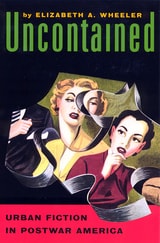
Uncontained
Urban Fiction in Postwar AmericaWheeler, Elizabeth A.
Rutgers University Press, 2001
In the postwar era, American urban fiction is dominated by the imagery of containment. Across the fictional landscape, the city is divided into segregated zones, marked by the threat of inevitable violence, and set off from the safety of equally contained suburbs. Mean and dangerous, the city can only be navigated by a solitary expert, alienated and male. In Uncontained, Elizabeth A. Wheeler offers a critique of this familiar story-evident in the noir. narratives of James M. Cain and in work by Ellison, Roth, Salinger, Percy, Capote, and others —and challenges its link to the postwar city.
Discussing film, short stories, and novels from a cross-section of American cities, Wheeler integrates these stories of containment into a shared pattern and reads them across a broad spectrum of famous and forgotten works by men and women of various ethnic and literary traditions to reveal a larger vision of postwar America. Knowing that containment is never the entire story, that diversity or trauma always shows itself, she shows how the uncontained has shaped the historical moment. Aware that liberating counterstories do get told, she places them in dialogue with those of the alienated man, the war veteran, Beat hipster, noir detective, and ironic suburbanite — in historical context — and revives the idea of urban space as a place of openness, thereby challenging a literary containment of racial difference, gender, and sexuality. By reading Paule Marshall in tandem with Philip Roth, Wheeler explores the relationships between adjacent neighborhoods and reconnects separate literary and geographic areas. By bringing Ann Bannon's lesbian pulp fiction, Hubert Selby's cult novels, or the work of John Okada, Hisaye Yamamoto, Chester Himes, Gwendolyn Brooks's, Jo Sinclair, and many others to bear on more canonical texts, she offers a more complete understanding of this period of American fiction — one that points toward a city that is open and inclusive.
Uncontained suggests that while decline, division, and decay form a major part of the story of mid-century urban America, the postwar city also represents much of what is best about American life. Rather than reproducing the containment of culture, Wheeler places together the wildly disparate to show how we move beyond containment.
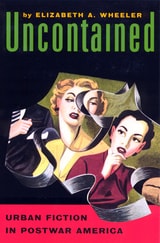
Uncontained
Urban Fiction in Postwar AmericaWheeler, Elizabeth A.
Rutgers University Press, 2001
In the postwar era, American urban fiction is dominated by the imagery of containment. Across the fictional landscape, the city is divided into segregated zones, marked by the threat of inevitable violence, and set off from the safety of equally contained suburbs. Mean and dangerous, the city can only be navigated by a solitary expert, alienated and male. In Uncontained, Elizabeth A. Wheeler offers a critique of this familiar story-evident in the noir. narratives of James M. Cain and in work by Ellison, Roth, Salinger, Percy, Capote, and others —and challenges its link to the postwar city.
Discussing film, short stories, and novels from a cross-section of American cities, Wheeler integrates these stories of containment into a shared pattern and reads them across a broad spectrum of famous and forgotten works by men and women of various ethnic and literary traditions to reveal a larger vision of postwar America. Knowing that containment is never the entire story, that diversity or trauma always shows itself, she shows how the uncontained has shaped the historical moment. Aware that liberating counterstories do get told, she places them in dialogue with those of the alienated man, the war veteran, Beat hipster, noir detective, and ironic suburbanite — in historical context — and revives the idea of urban space as a place of openness, thereby challenging a literary containment of racial difference, gender, and sexuality. By reading Paule Marshall in tandem with Philip Roth, Wheeler explores the relationships between adjacent neighborhoods and reconnects separate literary and geographic areas. By bringing Ann Bannon's lesbian pulp fiction, Hubert Selby's cult novels, or the work of John Okada, Hisaye Yamamoto, Chester Himes, Gwendolyn Brooks's, Jo Sinclair, and many others to bear on more canonical texts, she offers a more complete understanding of this period of American fiction — one that points toward a city that is open and inclusive.
Uncontained suggests that while decline, division, and decay form a major part of the story of mid-century urban America, the postwar city also represents much of what is best about American life. Rather than reproducing the containment of culture, Wheeler places together the wildly disparate to show how we move beyond containment.
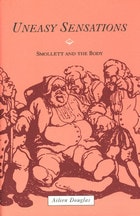
Uneasy Sensations
Smollett and the BodyAileen Douglas
University of Chicago Press, 1995
Aileen Douglas draws on feminist and other new theoretical perspectives to reassess Smollett's entire body of fiction as well as his classic Travels through France and Italy. Like many writers of his time, Douglas argues, Smollett was interested in the body and in how accurately it reflects internal disposition. But Smollett's special contribution to the eighteenth-century novel is his emphasis on sentience, or the sensations of the physical body. Looking at such works as The Adventures of Roderick Random, The Expedition of Humphry Clinker, The Adventures of Peregrine Pickle, and The History and Adventures of an Atom, Douglas explores the ways Smollett uses representations of sentience—especially torment and pain—in his critique of the social and political order.
Trained in medicine, Smollett was especially alert to the ways in which the discourses of medicine, philosophy, and law construct (as we would put it now) the body as an object of knowledge, and yet his work always returns to the importance of the physical world of the body and its feelings. Smollett reminds us, as Douglas aptly puts it, that "if you prick a socially constructed body, it still bleeds."
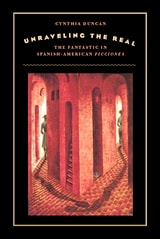
Unraveling the Real
The Fantastic in Spanish-American FiccionesAuthored by Cynthia Duncan
Temple University Press, 2010
In literary and cinematic fictions, the fantastic blurs the lines between reality and fantasy. Lacking a consensus on definition, critics often describe the fantastic as supernatural, or similar to, but quite different from fantasy, science fiction, and magical realism.
In Unraveling the Real Cynthia Duncan provides a new theoretical framework for discussing how the fantastic explores both metaphysical and socially relevant themes in Spanish American fictions. Duncan deftly shows how authors and artists have used this literary genre to convey marginalized voices as well as critique colonialism, racism, sexism, and classism. Selecting examples from the works of such noted writers as Jorge Luis Borges, Julio Cortázar, and Carlos Fuentes, among others, she shows how capacious the concept is, and why it eludes standard definition.
Challenging the notion that the fantastic is escapist in nature, Unraveling the Real shows how the fantastic has been politically engaged throughout the twentieth century, often questioning what is real or unreal. Presenting a mirror image of reality, the fantastic does not promoting a utopian parallel universe but rather challenges the way we think about the world around us and the cultural legacy of colonialism.
Urban Chroniclers in Modern Latin America
The Shared Intimacy of Everyday LifeBy Viviane Mahieux
University of Texas Press, 2011
An unstructured genre that blends high aesthetic standards with nonfiction commentary, the journalistic crónica, or chronicle, has played a vital role in Latin American urban life since the nineteenth century. Drawing on extensive archival research, Viviane Mahieux delivers new testimony on how chroniclers engaged with modernity in Mexico City, Buenos Aires, and São Paulo during the 1920s and 1930s, a time when avant-garde movements transformed writers' and readers' conceptions of literature. Urban Chroniclers in Modern Latin America: The Shared Intimacy of Everyday Life examines the work of extraordinary raconteurs Salvador Novo, Cube Bonifant, Roberto Arlt, Alfonsina Storni, and Mário de Andrade, restoring the original newspaper contexts in which their articles first emerged.
Each of these writers guided their readers through a constantly changing cityscape and advised them on matters of cultural taste, using their ties to journalism and their participation in urban practice to share accessible wisdom and establish their role as intellectual arbiters. The intimate ties they developed with their audience fostered a permeable concept of literature that would pave the way for overtly politically engaged chroniclers of the 1960s and 1970s. Providing comparative analysis as well as reflection on the evolution of this important genre, Urban Chroniclers in Modern Latin America is the first systematic study of the Latin American writers who forged a new reading public in the early twentieth century.
Urban Underworlds
A Geography of Twentieth-Century American Literature and CultureHeise, Thomas
Rutgers University Press, 2010
The quarantining of minority cultures helped to promote white, middle-class privilege. Following a diverse array of literary figures who differ with the assessment of the underworld as the space of the monstrous Other, Heise contends that it is a place where besieged and neglected communities are actively trying to take possession of their own neighborhoods.