Results by title
534 books match the query 'Making' and 4 start with u
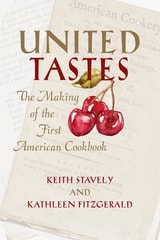
United Tastes
The Making of the First American CookbookKeith Stavely
University of Massachusetts Press, 2017
Winner of the 2017 Bruce Fraser Award from the Association for the Study of Connecticut History
The Library of Congress has designated American Cookery (1796) by Amelia Simmons one of the eighty-eight “Books That Shaped America.” Its recognition as “the first American cookbook” has attracted an enthusiastic modern audience of historians, food journalists, and general readers, yet until now American Cookery has not received the sustained scholarly attention it deserves. Keith Stavely and Kathleen Fitzgerald's United Tastes fills this gap by providing a detailed examination of the social circumstances and culinary tradition that produced this American classic.
Situating American Cookery within the post-Revolutionary effort to develop a distinct national identity, Stavely and Fitzgerald demonstrate the book's significance in cultural as well as culinary terms. Ultimately the separation between these categories dissolves as the authors show that the formation of “taste,” in matters of food as well as other material expressions, was essential to building a consensus on what it was to be American. United Tastes explores multiple histories—of food, cookbooks, printing, material and literary culture, and region—to illuminate the meaning and affirm the importance of America's first cookbook.
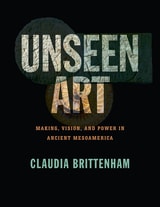
Unseen Art
Making, Vision, and Power in Ancient MesoamericaClaudia Brittenham
University of Texas Press, 2023
In Unseen Art, Claudia Brittenham unravels one of the most puzzling phenomena in Mesoamerican art history: why many of the objects that we view in museums today were once so difficult to see. She examines the importance that ancient Mesoamerican people assigned to the process of making and enlivening the things we now call art, as well as Mesoamerican understandings of sight as an especially godlike and elite power, in order to trace a gradual evolution in the uses of secrecy and concealment, from a communal practice that fostered social memory to a tool of imperial power.
Addressing some of the most charismatic of all Mesoamerican sculptures, such as Olmec buried offerings, Maya lintels, and carvings on the undersides of Aztec sculptures, Brittenham shows that the creation of unseen art has important implications both for understanding status in ancient Mesoamerica and for analyzing art in the present. Spanning nearly three thousand years of the Indigenous art of Mexico, Guatemala, Honduras, and Belize, Unseen Art connects the dots between vision, power, and inequality, providing a critical perspective on our own way of looking.
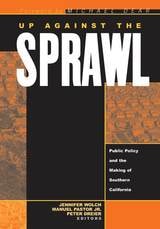
Up Against The Sprawl
Public Policy And The Making Of Southern CaliforniaJennifer Wolch
University of Minnesota Press, 2004
Los Angeles's experience in managing urban growth and change
America's first truly twenty-first-century metropolis, Los Angeles is often depicted as diverse, fragmented, polarized, and ungovernable, a city without a unifying geographic center or civic culture. The sprawling evolution of the city and its infamous problems—traffic, pollution, growing inequality—are usually attributed to a Wild West version of capitalism—the triumph of an unregulated free market over comprehensive urban planning. But market choices and lack of planning did not set the terrain of Southern California: Los Angeles has been profoundly shaped by a wide range of local, state, and federal public policies and programs.
Up Against the Sprawl details how governmental policies and public agencies have dictated many aspects of the region’s growth: infrastructure, transportation, housing, immigration, finances, civic and regional administration, the environment. The authors also argue that since public policy set the landscape, it can help forge the future. They explore countermovements by progressive activists to use innovative policies—from smart growth initiatives to the actions of living wage advocates—for greater social, economic, and environmental justice. This book is a major contribution to our understanding of past and present urban processes and policy, and highlights practical lessons for urban and regional policy makers and activists in Los Angeles and beyond.Contributors: Carolyn B. Aldana, California State U, San Bernadino; Carol S. Armstrong; Michael Dear, U of Southern California; Gary Dymski, U of California Riverside; Steven P. Erie, USC; Gregory Freeman; William Fulton; Elizabeth Gearin, USC; Genevieve Giuliano, USC; Pascale Joassart-Marcelli, U of Massachusetts, Boston; Enrico A. Marcelli; Myra A. Marks, Loyola Marymount U; Juliet Musso, USC; Stephanie Pincetl, USC; Laura Pulido; Christine M. Ryan; John P. Wilson.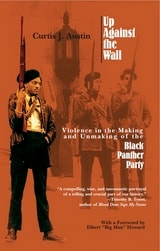
Up Against the Wall
Violence in the Making and Unmaking of the Black Panther PartyCurtis J. Austin
University of Arkansas Press, 2008