Results by title
204 books match the query 'Massachusetts' and 3 start with u

Under Construction
Making Homeland Security at the Local LevelKerry B. Fosher
University of Chicago Press, 2008
In the aftermath of the 9/11 terrorist attacks, security became the paramount concern of virtually everyone involved in governing the United States. While the public’s most enduring memories of that time involved the actions of the Bush administration or Congress, the day-to-day reality of homeland security was worked out at the local level. Kerry B. Fosher, having begun an anthropological study of counterterrorism in Boston a few months prior to the attacks, thus found herself in a unique position to observe the formation of an immensely important area of government practice.
Under Construction goes behind the headlines and beyond official policy to describe the human activities, emotions, relationships, and decisions that shaped the way most Americans experienced homeland security. Fosher’s two years of fieldwork focused on how responders and planners actually worked, illuminating the unofficial strategies that allowed them to resolve conflicts and get things done in the absence of a functioning bureaucracy. Given her unprecedented access, Fosher’s account is an exceptional opportunity to see how seemingly monolithic institutions are constructed, maintained, and potentially transformed by a community of people.
[more]
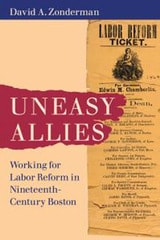
Uneasy Allies
Working for Labor Reform in Nineteenth-Century BostonDavid A. Zonderman
University of Massachusetts Press, 2011
Throughout the nineteenth century, working-class activists and middle-class reformers in Boston strived to build alliances in the campaign for labor reform. Though some of these organizations have been familiar to historians for more than a century, this is the first study to trace these cross-class groups from their origins in the early 1830s to the dawn of the Progressive Era.
In addition to analyzing what motivated these workers and reformers to create cross-class organizations, David Zonderman examines the internal tactical debates and external political pressures that fractured them, even as new alliances were formed, and shows how these influences changed over time. He describes what workers and reformers learned about politics and social change within these complex and volatile alliances, and speculates as to whether those lessons have relevance for activists and reformers today.
What emerges from this investigation is a narrative of progress and decline that spans nearly three-quarters of a century, as an ever-shifting constellation of associations debated the meaning of labor reform and the best strategy to secure justice for workers. But the quest for ideological consistency and organizational coherence was not easily achieved. By century's end, not only did Boston look dramatically different from its antebellum ancestor, but its labor reform alliances had lost some of their earlier openhearted optimism and stubborn resilience.
[more]
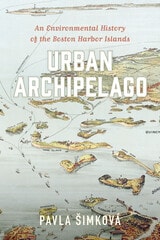
Urban Archipelago
An Environmental History of the Boston Harbor IslandsPavla Šimková
University of Massachusetts Press, 2021
The Boston Harbor Islands have been called Boston's "hidden shores." While some are ragged rocks teeming with coastal wildlife, such as oystercatchers and harbor seals, others resemble manicured parks or have the appearance of wooded hills rising gently out of the water. Largely ignored by historians and previously home to prisons, asylums, and sewage treatment plants, this surprisingly diverse ensemble of islands has existed quietly on the urban fringe over the last four centuries. Even their latest incarnation as a national park and recreational hub has emphasized their separation from, rather than their connection to, the city.
In this book, Pavla Šimková reinterprets the Boston Harbor Islands as an urban archipelago, arguing that they have been an integral part of Boston since colonial days, transformed by the city's changing values and catering to its current needs. Drawing on archival sources, historic maps and photographs, and diaries from island residents, this absorbing study attests that the harbor islands' story is central to understanding the ways in which Boston has both shaped and been shaped by its environment over time.
In this book, Pavla Šimková reinterprets the Boston Harbor Islands as an urban archipelago, arguing that they have been an integral part of Boston since colonial days, transformed by the city's changing values and catering to its current needs. Drawing on archival sources, historic maps and photographs, and diaries from island residents, this absorbing study attests that the harbor islands' story is central to understanding the ways in which Boston has both shaped and been shaped by its environment over time.
[more]