Results by title
3785 books match the query 'Poetry' and 41 start with u
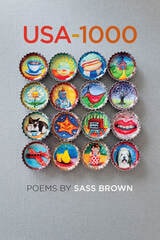
USA-1000
Sass Brown
Southern Illinois University Press, 2016
Sass Brown’s darkly funny debut collection of poems explores both the isolation and the absurdity of twenty-something apartment living. The world Brown creates in USA-1000 overflows with infomercials, classic Hollywood films, billboard messages, strip clubs, and fortune-tellers, illuminating our complex relationship with consumerism. In the absence of personal intimacy, everyday objects take on unexpected importance: the clothing of a would-be couple mingles in a washing machine; a father watches pornography in a hotel room with his wife and daughter; a woman searches a shopping mall to put on hold items she’ll never buy; a broken hair dryer prompts a complaint letter to the Better Business Bureau. Brown’s dazzling poems probe the disappointment of domestic reality in the face of America’s glossy facade, abundance and emptiness hand in hand. Ultimately, the book finds beauty in the deliciously artificial and resurrects “the missing world” with words and memory.
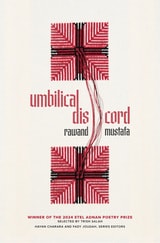
Umbilical Discord
Rawand Mustafa
University of Arkansas Press, 2024
At its core, Rawand Mustafa’s Umbilical Discord is an impossible attempt. Ambitious in scope, it strives to trace the billion-branched reach of the Palestinian context within a fixed yet flowing form—columnar, helical, intertwining, tense, intense. Incorporating testimonies by elder Palestinian women who survived the Nakba, or Palestinian Catastrophe of 1948, Mustafa re-presents the ongoing shockwaves from this historical upheaval by interlacing witnesses’ stories with related recollections from her own family history. The overlapping accounts from Palestinian women that Mustafa has painstakingly translated or gathered from family members recall moments of supreme perseverance in the face of unimaginable violence, separation, and loss, while weaving together past and present, collective and individual, Arabic and English, memory and imagination, homeland and host country. As Trish Salah observes in the foreword for Umbilical Discord, “these are poems of yearning and of being, both in spite of and fractured by an impossible history. [. . .] Mustafa offers resistant traces of the geographies and names dis/re-membered in [. . .] efforts to erase the material architecture and cultural memory of Arab life in Palestine. What must be traversed in order to come to tell a history? As Mustafa writes in ‘dis cord,’ her opening poem, [. . .] ‘I attempt / my story / on a lost / foundation.’ ”
Unauthorized Voices
Essays on Poets and Poetry, 1987-2009Marilyn Hacker
University of Michigan Press, 2010
Praise for Marilyn Hacker:
"How piercing the duet we're offered between Marilyn Hacker and the reality principle. Reality saying, it’s impossible, something's always sacrificed: you can't be so merry and so raw; so learned and earthy; so gut-wrenching, so danceable at once. Can you? To which, steadily, the voice of Marilyn Hacker: Yes. Evidently; Evidently so."
---Eve Kosofsky Sedgwick, author of Epistemology of the Closet and Touching Feeling
"Hacker is one of our best singers---by turns elegiac and fierce, sweet and witty. With each new collection her voice grows richer, more resonant, sorrowing and lovely."
---Julia Alvarez, author of In the Time of the Butterflies and How the García Girls Lost Their Accents
"Marilyn Hacker joins a marvelous facility with poetic forms to a shockingly intense sensuality. Not unlike Baudelaire, you might say, and indeed like him, she shares a taste for excess, drink, Paris, women, crowds. 'Enivrez-vous!' Baudelaire ordered his readers, and Marilyn Hacker has taken his advice seriously."
---Edmund White, author of Hotel de Dream, City Boy, and Le Flâneur
"Everything is thrilling and true, fast and witty, deep and wise; her vitality is the pulse of life itself."
---Derek Mahon, author of Harbour Lights and An Autumn Wind
A volume in the Poets on Poetry series, which collects critical works by contemporary poets, gathering together the articles, interviews, and book reviews by which they have articulated the poetics of a new generation.
For over twenty years, award-winning poet, translator, and editor Marilyn Hacker has been writing incisive criticism and reviews of contemporary poetry, with particular attention to the work of feminist poets, poets of color, and any poets whose work she judged worthy of more attention from the American (and sometimes British) reading public.
Unauthorized Voices is Hacker’s first collection of critical prose, bringing together her essays on American, British, Irish, and French poets. It includes pieces on Adrienne Rich, Hayden Carruth, Elizabeth Bishop, Tony Harrison, Marilyn Nelson, and June Jordan; on French and Francophone poets including Vénus Khoury-Ghata and Guy Goffette; on poetry and politics; and on the contemporary sonnet, all affirming Hacker as a lively, unabashedly opinionated American critical voice.
Marilyn Hacker is the author of twelve books of poems, most recently Names and Essays on Departure, and of ten collections of poetry translated from the French, including Marie Étienne's King of a Hundred Horsemen, recipient of the 2009 PEN Award for Poetry in Translation. She has been the recipient of the Lenore Marshall Poetry Prize, two Lambda Literary Awards, and the National Book Award for her own poetry and is a Chancellor of the Academy of American Poets.
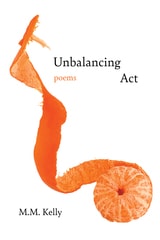
Unbalancing Act
M.M. Kelly
Four Way Books, 2026
Unbalancing Act is a haunting collection of poems about the particular physics of loving and losing—about the way grief, desire, memory, and awe can tip a life off its axis, and right it again. The speaker moves through fire and water, childhood, intimacy and abandonment, always with one eye on the natural world: bears, whales, rivers, storms, animals sleeping in impossible ways. The poems are lyric but narrative-driven, often darkly funny, and fascinated—bordering on obsessed—with the strange facts and small surrealities that make ordinary life feel mythic.
At its heart, the book is about imbalance as a kind of truth: the way trauma warps time, the way love can feel like weather, the way the body keeps trying to survive even when the mind wants to disappear. It's a collection for readers who like their beauty a little feral—poems that are tender but not precious, intelligent but not academic, and emotionally sharp without ever losing their sense of wonder.
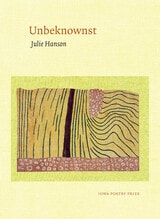
Unbeknownst
Julie Hanson
University of Iowa Press, 2011
Julie Hanson’s award-winning collection, Unbeknownst, gives us plainspoken poems of unstoppable candor. They are astonished and sobered by the incoming data; they are funny; they are psychologically accurate and beautifully made. Hanson’s is a mind interested in human responsibility—to ourselves and to each other—and unhappy about the disappointments that are bound to transpire (“We’ve been like gods, our powers wasted”). These poems are lonely with spiritual longing and wise with remorse for all that cannot last.
“The Kindergartners” begins, “All their lives they’ve waited for / the yellow bus to come for them,” then moves directly to the present reality: “Now it’s February and the mat / is wet.” Settings and events are local and familiar, never more exotic than a yoga session at the Y, one of several instances where the body is central to the report and to the net result (“I slip in and fold / behind the wheel into the driver’s seat like a thin young thing: / My organs are surely glistening. This car was made for me.“). These poems are intimate revelations, thinking as they go, including the reader in the progress of their thoughts.
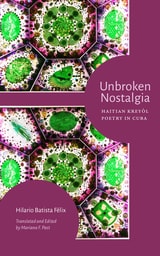
Unbroken Nostalgia
Haitian Kreyòl Poetry in CubaWritten by Hilario Batista Félix, edited and translated by Mariana F. Past
Amherst College Press, 2026
Unbroken Nostalgia: Haitian Kreyòl Poetry in Cuba is the first English translation and scholarly edition of the collection Nostalji san pwen ni vigil: pwezi kreyòl nan peyi Kiba (2016) by Hilario Batista Félix. A poet, journalist, and language activist, Batista (1955– ) embodies and expresses Cuba’s cultural and linguistic diversity as a descendant of Haitian migrant workers to Eastern Cuba during the mid-twentieth century; his poems bridge regions usually separated by language—the Spanish and Creolophone/Francophone Caribbean—and vividly depict the distinct heritage of Haitian Cubans and their shared dreams and challenges. A scholarly introduction by translator and editor Mariana F. Past provides biographical information about the author, situates his work within Haitian diasporic literature, and addresses patterns of Haitian migration to Cuba. Batista’s original poems appear alongside facing-page English translations with annotations that clarify historical figures and events, geographical features, and Haitian cultural and religious practices. Grounded in oral storytelling traditions, Unbroken Nostalgia brings to light the collective memory and complicated hybridity of the Haitian community in Cuba and upholds Haitian Kreyòl as a language of resistance.
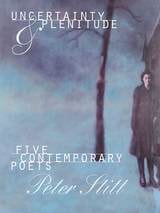
Uncertainty and Plenitude
Five Contemporary PoetsPeter Stitt
University of Iowa Press, 1997
Stitt's interest in these five poets is intellectual and aesthetic. As he states, “I chose these particular writers because their work continues to interest me deeply, both intellectually and formally, even after years of familiarity.” He uses his understanding of the philosophical implications inherent in modern physics, as they apply to both content and form, as the basis for his close analysis.
Stitt attends to the poets' writerly strategies so that we may discover in their poetry where “surface form” intersects and complements meaning and thus becomes, in John Berryman's terms, “deep form.” He explains what these poets say and how they say it and what relationships lie between. He also shows how humor plays a part in some of their work.
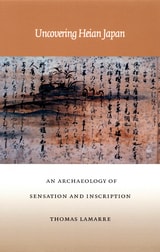
Uncovering Heian Japan
An Archaeology of Sensation and InscriptionThomas LaMarre
Duke University Press, 2000
Combining a pathbreaking visual analysis of the calligraphy with which this poetry was transcribed, a more traditional textual analysis, and a review of the politics of the period, LaMarre presents a dramatically new view of Heian poetry and culture. He challenges the assumption of a cohesive “national imagination,” seeing instead an early Japan that is ethnically diverse, territorially porous, and indifferent to linguistic boundaries. Working through the problems posed by institutionalized notions of nationalism, nativism, and modernism, LaMarre rethinks the theories of scholars such as Suzuki Hideo, Yoshimoto Takaaki, and Komatsu Shigemi, in conjunction with theorists such as Derrida, Karatani, Foucault, and Deleuze. Contesting the notion that speech is central to the formation of community, Uncovering Heian Japan focuses instead on the potential centrality of the more figural operations of poetic practice.
Specialists in Japanese history and culture as well as scholars working in other areas of cultural criticism will find that this book enriches their understanding of an early Japan that has exerted so much influence on later concepts of what it means to be Japanese.

Under Briggflatts
A History of Poetry in Great Britain, 1960-1988Donald Davie
University of Chicago Press, 1989
Under Briggflatts is organized in three large chapters, one devoted to each decade. In the 1960s, Davie pays particular attention to the work of Austin Clarke, Hugh MacDiarmid, Norman McCaig, Keith Douglas, Edwin Muir, Basil Bunting (the gurus whose prose writings helped catalyze the traumatic events of 1968), Elaine Feinstein, Sylvia Townsend Warner, Philip Larkin, Charles Tomlinson, Thomas Kinsella, and Ted Hughes. The second chapter follows these figures into the new decade and explores the work of (among others) Thom Gunn, C. H. Sisson, R. S. Thomas, John Betjeman, and such themes as women's poetry, translation, poetic theory, and the later impact of T. S. Eliot and of Edward Thomas. Perhaps the most controversial chapter is the third, in which David—without abandoning the poets already introduced—assesses Geoffrey Hill, Tony Harrison, and Seamus Heaney, and looks too at the recovery of Ivor Gurney's poems, at Ted Hughes as Laureate, the posthumous work of Sylvia Townsend Warner, the burgeoning Hardy industry, and the critical writings of Kenneth Cox.
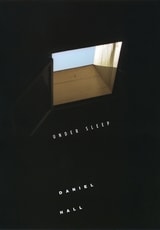
Under Sleep
Daniel Hall
University of Chicago Press, 2007
Then
You looked up vaguely
or you didn’t—even the memory
is dying. Then you whole body
breathed out, and the argument ended.
Heaven surfaced about you
like a glass tabletop, hard
and cold. Whatever you do
don’t turn me into poetry. Sorry:
I am done crying about it
but I am not done crying.
An extended meditation on how death affects those left behind, Under Sleep is a skillfully understated, beautifully rendered elegy for the poet’s partner. Formally inventive and technically sophisticated, Daniel Hall attends to the power of death to haunt every perception. The poet’s voice registers as though he were walking on the bottom of the ocean, in a state of mind somewhere “under sleep,” in a kind of waking dream. In Hall’s hands, isolated moments of perception bloom into truly touching love elegies.
The poems in Under Sleep were written over a period of ten years and, as a result, are densely interconnected, with lines and entire stanzas transplanted between different poems. Using styles ranging from free verse to sonnets, Sapphics, and rhymed haikus, Hall populates the book with literary and historical figures—Baudelaire, Pound, and Casanova—in poems set in China, the Middle East, Death Valley, and Italy. Throughout, the poetry is propelled by tension as the speaker struggles with his own better judgment—and against his lover’s wishes—to turn the loss of the beloved into art.
Praise for Daniel Hall
“Daniel Hall’s work reminds us that a poet’s sharp-sightedness, the whole business of ‘getting things right,’ is a matter of far more than accuracy. It’s a matter of—inescapably—thanksgiving.”—Brad Leithauser, New York Review of Books
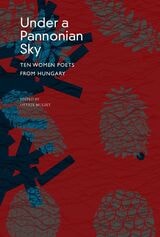
Under a Pannonian Sky
Ten Women Poets from HungaryEdited by Ottilie Mulzet
Seagull Books, 2025
Under a Pannonian Sky is a landmark anthology that brings the voices of ten extraordinary Hungarian women poets to English readers. Edited by award-winning translator Ottilie Mulzet, this collection spans generations, offering a rare glimpse into the rich and complex world of Hungarian poetry. The anthology features renowned poets like Ágnes Nemes Nagy and Zsuzsa Rakovszky, whose works have been celebrated internationally, alongside voices such as Gizella Hervay and Magda Székely, who are introduced in-depth to English readers for the first time. Through original and lyrical language, these poets chronicle the traumas of World War II, the Hungarian Holocaust, and the societal upheavals of the 1989 regime change, exploring themes of identity and resilience. Their poems reflect deeply personal confrontations with their roles as citizens, daughters, mothers, and witnesses to turbulent and often disorienting historical epochs.
Under a Pannonian Sky is an essential collection for readers seeking to discover the richness of Hungarian poetry and its profound engagement with the personal and political landscapes of the twentieth century and beyond.
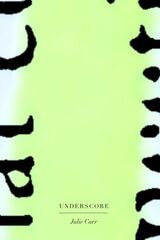
Underscore
Julie Carr
Omnidawn, 2024
Julie Carr’s most intimate book to date, Underscore, is dedicated to two of Carr’s foundational teachers, the dancer Nancy Stark Smith and the poet Jean Valentine, both of whom died in 2020. Elegiac and tender—at times erotic at other times bitter—these poems remain deeply invested in human relationships amid a life whose backdrop is human suffering.
Reaching toward the “ghost companions in the thicket” and to the beloveds who still “pulse with activity,” Underscore’s sonically intricate poems express a longing for dynamic forces of intra-action, a sense of expanded encounter, and what Stark Smith called “overlapping kinespheres.”
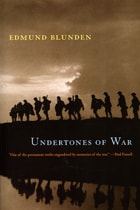
Undertones of War
Edmund Blunden
University of Chicago Press, 2007
In Undertones of War, one of the finest autobiographies to come out of World War I, the acclaimed poet Edmund Blunden records his devastating experiences in combat. After enlisting at the age of twenty, he took part in the disastrous battles at the Somme, Ypres, and Passchendaele, describing them as “murder, not only to the troops but to their singing faiths and hopes.”
All the horrors of trench warfare, all the absurdity and feeble attempts to make sense of the fighting, all the strangeness of observing war as a writer—of being simultaneously soldier and poet—pervade Blunden’s memoir. In steely-eyed prose as richly allusive as any poetry, he tells of the endurance and despair found among the men of his battalion, including the harrowing acts of bravery that won him the Military Cross.
Now back in print for American readers, the volume includes a selection of Blunden’s war poems that unflinchingly juxtapose death in the trenches with the beauty of Flanders’s fields. Undertones of War deserves a place on anyone’s bookshelf between Siegfried Sassoon’s poetry and Robert Graves’s Goodbye to All That.
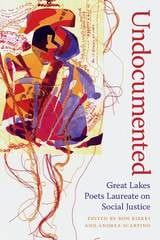
Undocumented
Great Lakes Poets Laureate on Social JusticeRonald Riekki
Michigan State University Press, 2019
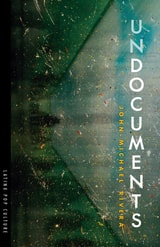
Undocuments
John-Michael Rivera
University of Arizona Press, 2021
How do you document the undocumented? UNDOCUMENTS both poses and attempts to answer this complex question by remixing the forms and styles of the first encyclopedia of the New World, the Florentine Codex, in order to tell a modern story of Greater Mexico. Employing a broad range of writing genres and scholarly approaches, UNDOCUMENTS catalogs, recovers, and erases documents and images by and about peoples of Greater Mexico from roughly the first colonial moment. This brave and bracing volume organizes and documents ancient New World Mexican peoples from the Florentine Codex (1592) to our current technology-heavy age, wherein modern lawmakers and powerful global figures desire to classify, deport, and erase immigrants and their experiences.
While grappling with anxiety and the physical and mental health consequences of the way the United States treats immigrant bodies, John-Michael Rivera documents and scrutinizes what it means to seek opportunities in America. With a focus on the poetics of Latinx documentality itself, this book is concerned with the complicated and at times contradictory ways peoples of Greater Mexico have been documented and undocumented within systems of colonial knowledges, and how these peoples have been rendered as specters of the bureaucratic state. Rivera takes us through the painful, anxiety-ridden, and complex nature of what it means to be documented or undocumented, and the cruelty married to each of these states of being.
Undress, She Said
Doug Anderson
Four Way Books, 2022
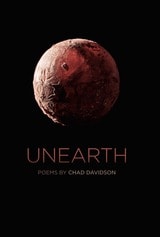
Unearth
Chad Davidson
Southern Illinois University Press, 2020
“What if the end were as colorless as real / estate?” the speaker asks in Unearth. Poet Chad Davidson’s latest collection takes a hard look at our world as it collapses under numerous trials and tribulations. Fashioned mostly of elegiac poems, Unearth charts the way in which personal grief ripples out to meet and mirror larger systems of loss. The first section deals with local traumas and bereavements—the loss of pets, the disintegration of a friends’ marriage. These tragedies combine with more ominous, larger breakdowns in the second section until, in the final section, grief roils over into historical wickedness, institutionalized violence, and state-sanctioned wrath. Ultimately, “Even the mouth / of a volcano, from far away, / is beautiful.”
The poetry itself offers us vessels into which we can pour out our despair. To understand the failing earth, Davidson’s speaker cajoles us to see the pain at its roots. From the opening poem—a reluctant elegy for a mother—to the final eschatological survey, an ode to maddening violence and destruction on a global scale, this collection imagines a world in which private and public terrors feed on each other, ultimately growing to a fever pitch. An act of resistance, this collection gives voice to our deep-seated emotional pain and offers us constructive ways to deal with it.
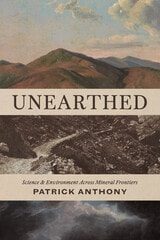
Unearthed
Science and Environment Across Mineral FrontiersPatrick Anthony
University of Chicago Press, 2026
Unearthed depicts a pivotal moment during the nineteenth century: As European and settler schemes to govern ever larger territories intensified, the earth and atmospheric sciences were also becoming more global in scope, assembling models of the planet while making use of militarized or highly industrialized systems. These efforts were informed by the physique du monde, or global physics, of Alexander von Humboldt (1769–1859), a program of vast data collection that spanned four hemispheres that aimed to determine general, scientific laws about the planet and its environments.
Using Humboldt’s itineraries as a frame, Unearthed traces an information order that linked far-flung industrial sites and frontier stations, from Prussian provinces to the Spanish and Russian empires. Humboldt intersected with Saxon miners, Mexican cartographers, and Siberian surveyors, among other itinerant Germans who mobilized the labor and resources of widespread mining operations for global surveys of earth and air. Interweaving the histories of capital and climate, Patrick Anthony takes readers from mines to mountains to show how the sciences of Humboldt’s circuits both measured and made modern natures. These sciences of the mineral frontier, he argues, ultimately laid the groundwork for carbon-intensive economics and a logic of unending extraction. Wide-ranging and ambitious, Unearthed will interest scholars working in the history of science, global history, and the environmental humanities.
Unfathoming
Andrea Cohen
Four Way Books, 2017
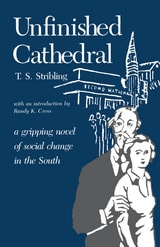
Unfinished Cathedral
Thomas S. Stribling
University of Alabama Press, 1986
The third volume of T.S. Stribling’s Southern trilogy and was originally published in 1934
The trilogy, Stribling’s greatest literary achievement, is set in and around Florence, Alabama, and spans six decades of social, economic, and political change from the Civil War and Reconstruction to the 1920s. In each of the novels Stribling brings together the various social classes of the period, revealing their interdependency. The Forge is the story of the South during the period of the Civil War and Reconstruction, while The Store chronicles the changing social and economic landscape of the post-Reconstruction period and the rise to power of the mercantile class in the reconstructed South. In Unfinished Cathedral, Stribling continues the story of the dramatic transformation in the social structure of the South. The 1920s saw the control of society shift from the wealthy landowners and merchants to the rising middle class. This period also saw significant changes in the status of Southern women and blacks, and economically, a surge of prosperity was evident that was brought on by the land boom and the resulting influx of Northern dollars.
The University of Alabama Press reissued the first two novels in T.S. Stribling’s trilogy, The Forge and The Store, in 1985.
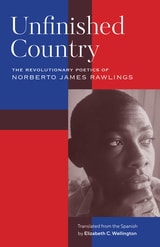
Unfinished Country
The Revolutionary Poetics of Norberto James RawlingsNorberto James Rawlings; Translated from the Spanish by Elizabeth C. Wellington
Vanderbilt University Press, 2026
The story of Afro-Caribbean poet Norberto James Rawlings is one of migration, loss, adaptation, and reinvention that goes back for generations. Most well-known for “The Immigrants,” a poem about a Black minority community of Anglophone sugar plantation workers, James Rawlings’s poetry has been performed, monumentalized, and celebrated in the Dominican Republic and beyond. Over time his work transcended the acclaim of his most famous poem, offering expansive reflections on the world outside the island of his birth, expressed with an expatriate’s longing. Bringing this selection of James Rawlings’s work into English for the first time, this volume will expand the entry points into one of the most important Caribbean writers yet to punctuate the mainstream.
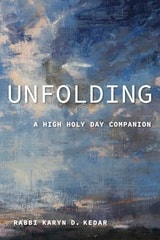
Unfolding
A High Holy Day CompanionRabbi Karyn D. Kedar
Central Conference of American Rabbis, 2025
Unfolding: A High Holy Day Companion invites readers into a contemplative spiritual exploration of the holiest months of the Jewish year. With a poet’s heart and a seeker’s soul, Rabbi Karyn D. Kedar leads us on an introspective journey through sacred moments, from the solemnity of Tishah B’Av to the self-reflection of Yom Kippur. With each chapter, the reader is invited to linger on themes of beauty, memory, repentance, and forgiveness. Woven with Biblical, Rabbinic, and liturgical texts, Unfolding is a journey into the inner landscape where our deepest questions reside. Whether you follow the calendar’s rhythm or allow passages to find you serendipitously, these pages are a spiritual companion, offering meditations on a voyage of self-reflection, purpose, meaning, and love.
Featured on Kirkus Reviews' Best Indie Books of 2025.
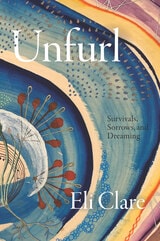
Unfurl
Survivals, Sorrows, and DreamingEli Clare
Duke University Press, 2025
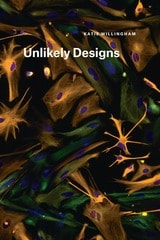
Unlikely Designs
Katie Willingham
University of Chicago Press, 2017
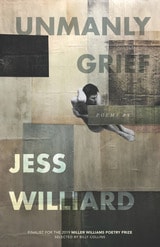
Unmanly Grief
PoemsJess Williard
University of Arkansas Press, 2019
Finalist, 2019 Miller Williams Poetry Prize
“Poems that lead us to striking insights and strange destinations.”
—Billy Collins
The men who recur as characters throughout Jess Williard’s Unmanly Grief perform their masculinity in a variety of ways: boxing, theater, brotherhood, labor, and familial and romantic love. Marked by a sharp nostalgia, Williard’s poems move from Wisconsin to New York City and back, tracing the geographic movement of the speaker and his family: a teenage sister who disappears and returns, changed irrevocably; an older brother dismantled in adulthood; an ever-sacrificing father. Woven through the musculature of this varied and exciting collection, music appears as readily in dexterous formal verse as in lean, scrappy storytelling. What results is a crooning celebration of struggle and tenderness in this world, “where to be small and furious is enough.”
Finalist, 2020 Milt Kessler Poetry Book Award from the Binghamton Center for Writers
Unnatural Ecopoetics
Unlikely Spaces in Contemporary PoetrySarah Nolan
University of Nevada Press, 2017
By approaching environments in a new way, Nolan closes this gap and recognizes how contemporary poets employ self-reflexive commentary and formal experimentation in order to create new natural/cultural environments on the page. She proposes a radical new direction for ecopoetics and deploys it in relation to four major American poets. Working from literal to textual spaces through the contemporary poetry of A.R. Ammons’s Garbage, Lyn Hejinian’s My Life, Susan Howe’s The Midnight, and Kenneth Goldsmith’s Seven American Deaths and Disasters, the book presents applications of unnatural ecopoetics in poetic environments, ones that do not engage with traditional ideas of nature and would otherwise remain outside the scope of ecocritical and ecopoetic studies.
Nolan proposes a new practical approach for reading poetic language. Ecocriticism is a very fluid and evolving discipline, and Nolan’s pioneering new book pushes the boundaries of second-wave ecopoetics—the fundamental issue being what is nature/natural, and how does poetic language, particularly self-conscious contemporary poetic agency, contribute to and complicate that question.
Unoriginal Genius
Poetry by Other Means in the New CenturyMarjorie Perloff
University of Chicago Press, 2010
What is the place of individual genius in a global world of hyper-information— a world in which, as Walter Benjamin predicted more than seventy years ago, everyone is potentially an author? For poets in such a climate, "originality" begins to take a back seat to what can be done with other people’s words—framing, citing, recycling, and otherwise mediating available words and sentences, and sometimes entire texts. Marjorie Perloff here explores this intriguing development in contemporary poetry: the embrace of "unoriginal" writing. Paradoxically, she argues, such citational and often constraint-based poetry is more accessible and, in a sense, "personal" than was the hermetic poetry of the 1980s and 90s.
Perloff traces this poetics of "unoriginal genius" from its paradigmatic work, Benjamin’s encyclopedic Arcades Project, a book largely made up of citations. She discusses the processes of choice, framing, and reconfiguration in the work of Brazilian Concretism and Oulipo, both movements now understood as precursors of such hybrid citational texts as Charles Bernstein’s opera libretto Shadowtime and Susan Howe’s documentary lyric sequence The Midnight. Perloff also finds that the new syncretism extends to language: for example, to the French-Norwegian Caroline Bergvall writing in English and the Japanese Yoko Tawada, in German. Unoriginal Genius concludes with a discussion of Kenneth Goldsmith’s conceptualist book Traffic—a seemingly "pure’" radio transcript of one holiday weekend’s worth of traffic reports. In these instances and many others, Perloff shows us "poetry by other means" of great ingenuity, wit, and complexity.

Unpeopled Eden
Rigoberto González
Four Way Books, 2013
Unsettled Accounts
PoemsWill Wells
Ohio University Press, 2010
To take the mess of life and make meaning from it is what all poets seek to do. For Will Wells, recipient of the thirteenth annual Hollis Summers Poetry Prize, this includes reaching across centuries and continents, into the minds and hearts of disparate individuals—Albert Einstein, Andrea Yates, the traveler from Porlock, Dante, or Holocaust survivors, including his own grandmother—to extract the personal value embedded there for him.
By turns funny, shocking, gentle, and musing, the poems of Unsettled Accounts reflect Will Wells’s constant attention to his environment and to his past—and to our environment and our past—and his persistent effort to keep them real and whole by turning them into art.
Ping-Pong with the Nazis
Bored couriers have kicked off boots and set
their pipes aside, a Dutch interior.
The slapped ball clacks over the table
like a telegraphic code, then trickles
like faint hope across the marble floor.
How quickly he bends to retrieve it
and puts it back in play, the Jewish boy
living with false papers in a villa
owned by his mother’s Gentile friends, and now
commandeered by retreating Germans
as divisional headquarters. The young
blond soldiers, deferential to a social
better, muss his blond locks like the kid
brothers back in the fatherland, like big
brothers steeped in genial menace.
He begs another game, so they relent.
As the ball resumes its chatter across
the no-man’s-land strung with a net,
he calculates the risk that each shot brings.
And so do they. He holds his pee and serves.
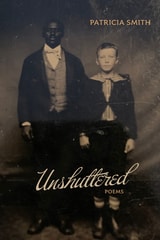
Unshuttered
PoemsPatricia Smith
Northwestern University Press, 2023
National Book Award winner Patricia Smith presents a portrait of Black America in the nineteenth century
Over the course of two decades, Patricia Smith has amassed a collection of rare nineteenth-century photographs of Black men, women, and children who, in these pages, regard us from the staggering distance of time.
Unshuttered is a vessel for the voices of their incendiary and critical era. Smith’s searing stanzas and revelatory language imbue the subjects of the photos with dynamism and revived urgency while she explores how her own past of triumphs and losses is linked inextricably to their long-ago lives:
We ache for fiction etched in black and white. Our eyes never touch. These tragic grays and bustles, mourners’
hats plopped high upon our tamed but tangled crowns, strain to disguise what yearning does with us.
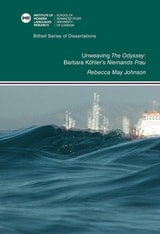
Unweaving The Odyssey
Barbara Köhler’s Niemands FrauRebecca May Johnson
University of London Press, 2019
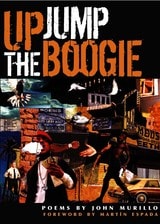
Up Jump the Boogie
John Murillo
Four Way Books, 2020
"The feel of now lives in John Murillo's UP JUMP THE BOOGIE, but it's tempered by bows to the tradition of soulful music and oral poetry. The lived dimensions embodied in this collection say that here's an earned street knowledge and a measured intellectual inquiry that dare to live side by side, in one unique voice. The pages of UP JUMP THE BOOGIE breathe and sing; the tributes and cultural nods are heartfelt, and in these honest poems no one gets off the hook."—Yusef Komunyakaa
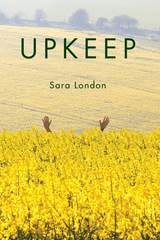
Upkeep
Sara London
Four Way Books, 2019
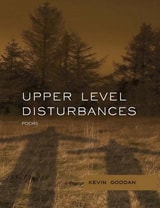
Upper Level Disturbances
Kevin Goodan
University Press of Colorado, 2012
Published by the Center for Literary Publishing at Colorado State University
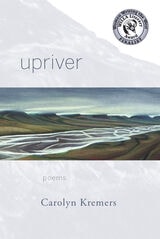
Upriver
Carolyn Kremers
University of Alaska Press, 2013
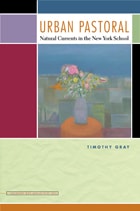
Urban Pastoral
Natural Currents in the New York SchoolTimothy Gray
University of Iowa Press, 2010
Were the urbane, avant-garde poets of the New York School secretly nature lovers like Edward Abbey, Wendell Berry, and Annie Dillard? In Urban Pastoral, Timothy Gray urges us to reconsider our long-held appraisals of Frank O’Hara, John Ashbery, Barbara Guest, and their peers as celebrants of cosmopolitan culture and to think of their more pastoral impulses. As Gray argues, flowers are more beautiful in the New York School’s garden of verse because no one expects them to bloom there.
Along with the poets whose careers he chronicles, Gray shows us that startlingly new approaches to New York City art and literature emerge when natural and artificial elements collide kaleidoscopically, as when O’Hara likens blinking stars to a hairnet, when painter Jane Freilicher places a jar of irises in her studio window to mirror purple plumes rising from Consolidated Edison smokestacks, or when poet Kathleen Norris equates rooftop water towers with grain silos as she plans her escape route to the Great Plains.
The New York School poets and their coterie have become a staple of poetics, literary criticism and biography, cultural studies, and art criticism, but Urban Pastoral is the first study of the original New York School poets to offer sustained discussion of the pastoral and natural imagery within the work of these renowned “city poets” and also consider poets from the second generation of the New York School—Diane di Prima, Jim Carroll, and Kathleen Norris.
Moving beyond the traditional boundaries of literary criticism to embrace the creative spirit of New York poets and artists, Gray’s accessible, lively, and blithely experimental book will shape future discussions of contemporary urban literature and literary nature writing, offering new evidence of avant-garde poetry’s role within those realms.
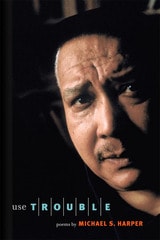
Use Trouble
Michael Harper
University of Illinois Press, 2008

u&i
Cassandra Smith
Omnidawn, 2015
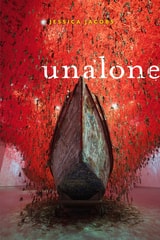
unalone
Jessica Jacobs
Four Way Books, 2024
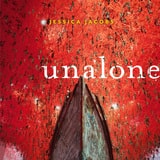
Deeply personal and yet universal in its truths, unalone draws on the Book of Genesis as a living document whose stories, wisdom, and ethical knots can engage us more fully with our own lives — whatever your religious tradition or spiritual beliefs. In this stunning and ambitious book, Jacobs reminds us that all poetry serves as a kind of prayer – a recognition of beauty, a spoken bid for connection, a yearning toward an understanding that might better guide us through our days. When you “dive / from the twin heights of your eyes,” “that tiny pool below” isn’t God. “Well, not exactly,” Jacobs comforts us. “It’s you. One breath deeper than you’ve / ever been, one breath closer to the heeded, heedful world.”
unalone
Jessica Jacobs
Four Way Books, 2024
Deeply personal and yet universal in its truths, unalone draws on the Book of Genesis as a living document whose stories, wisdom, and ethical knots can engage us more fully with our own lives — whatever your religious tradition or spiritual beliefs. In this stunning and ambitious book, Jacobs reminds us that all poetry serves as a kind of prayer – a recognition of beauty, a spoken bid for connection, a yearning toward an understanding that might better guide us through our days. When you “dive / from the twin heights of your eyes,” “that tiny pool below” isn’t God. “Well, not exactly,” Jacobs comforts us. “It’s you. One breath deeper than you’ve / ever been, one breath closer to the heeded, heedful world.”
unrest in the nebulae
Gitan Djeli
Duke University Press, 2026