Results by title
1066 books match the query 'Political' and 9 start with u
Ugly Freedoms
Elisabeth R. Anker
Duke University Press, 2022
Unbecoming Persons
The Rise and Demise of the Modern Moral SelfLadelle McWhorter
University of Chicago Press, 2025
In the face of ecological crisis, economic injustice, and political violence, the moral demands of being a good person are almost too much to bear. In Unbecoming Persons, Ladelle McWhorter argues that this strain is by design. Our ideas about personhood, she shows, emerged to sustain centuries of colonialism, slavery, and environmental destruction. We must look elsewhere to find our way out.
This history raises a hard question: Should we be persons at all, or might we live a good life without the constraints of individualism or the illusion of autonomy? In seeking an answer, McWhorter pushes back on the notion of our own personhood—our obsession with identity, self-improvement, and salvation—in search of a better way to live together in this world. Although she finds no easy answers, McWhorter ultimately proposes a new ethics that rejects both self-interest and self-sacrifice and embraces perpetual dependence, community, and the Earth
Unburied Bodies
Subversive Corpses and the Authority of the DeadJames R. Martel
Amherst College Press, 2018

Uncovering the Constitution's Moral Design
Paul R. DeHart
University of Missouri Press, 2007
In critiquing previous attempts at describing and evaluating the Constitution’s normative framework, DeHart demonstrates that the Constitution’s moral framework corresponds largely to classical moral theory. Using the method of Inference to the Best Explanation to ascertain our Constitution’s moral meaning, he challenges the logical coherency of modern moral philosophy, normative positivism, and other theories that the Constitution has been argued to embody, offering instead an innovative methodology that can be applied to uncovering the normative framework of other constitutions as well.
Undead Labor
Capitalism's Zombie WorkerDavid Bering-Porter
University of Minnesota Press, 2026
How the zombie represents capitalism’s fantasy of limitless labor
Much more than just an enduring figure of horror entertainment, the zombie is a uniquely modern symbol representing capitalism’s most brutal demands on human life. Examining the push to extract surplus value from human bodies in ways that exceed their natural limits, David Bering-Porter shows how this notion of the undead is both integral to and symptomatic of capitalism’s endless cycle of growth and consumption.
Bering-Porter demonstrates how the zombie has long been deeply intertwined with issues of race and exploitation, from its origins in the slave plantations of colonial Haiti to its traces in the continuing evolution of artificial intelligence systems, serving as capitalism’s ideal worker: one that never rests, never stops, and never dies. Featuring close readings of Marx alongside films such as I Walked with a Zombie, The Blob, and Night of the Living Dead, the book traces the concept of undead labor as it manifests across various historical epochs, providing insight into the manifold ways that capitalism has sought to transform living beings into instruments of limitless production.
As he weaves together critical race studies with an analysis of popular culture and media, Bering-Porter interrogates racialized capitalism and its fantasy of labor beyond all limits. By highlighting how the zombie is borne of the same ideology that has given rise to contemporary burnout culture and environmental collapse, Undead Labor uncovers the capitalist system’s relentless death drive with the hope that it finally may be put to rest.
Retail e-book files for this title are screen-reader friendly.
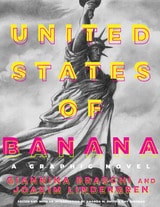
United States of Banana
A Graphic NovelGiannina Braschi and Joakim LindengrenEdited and with an introduction by Amanda M. Smith and Amy Sheeran
The Ohio State University Press, 2021

Universal Abandon
The Politics of PostmodernismAndrew Ross, Editor
University of Minnesota Press, 1989
Universal Abandon was first published in 1989. Minnesota Archive Editions uses digital technology to make long-unavailable books once again accessible, and are published unaltered from the original University of Minnesota Press editions.
In recent years, the debate about postmodernism has become a full-blown, global discussion about the nature and future of society: it has challenged and redefined the cultural and sexual politics of the last two decades, and is increasingly shaping tomorrow's agenda. Postmodernist culture is a medium in which we all live, no matter how unevenly its effects are felt across the jagged spectrum of color, gender, class, sexual, orientation, region, and nationality. But it is also a culture that proclaims its abandonment of the universalist foundations of Enlightenment thought in the West. At a time when interests can no longer be universalized, the question arises: Whose interests are served by this "universal abandon"?
Universal Abandon is the first volume in a new series entitled Cultural Politics, edited by the Social Text collective. This collection tackles a wider range of cultural and political issues than are usually addressed in the debates about postmodernism—color, ethnicity, and neocolonialism; feminism and sexual difference; popular culture and the question of everyday life—as well as some political and philosophical matters that have long been central to the Western tradition. Together, the contributors provide no consensus about the politics of postmodernism; they insist, rather, that "universal abandon?" remain a question and not an answer.
The contributors: Anders Stephanson, Chantal Mouffe, Stanley Aronowitz, Ernesto Laclau, Nancy Fraser, Linda Nicholson, Meaghan Morris, Paul Smith, Laura Kipnis, Lawrence Grossberg, Abigail Solomon-Godeau, George Yudice, Jacqueline Rose, and Hal Foster.
Andrew Ross teaches English at Princeton University and is the author of The Failure of Modernism.

Up the Capitol Steps
A Woman's March to the GovernorshipBarbara Roberts
Oregon State University Press, 2011

Utopian Horizons
Ideology, Politics, LiteratureZsolt Cziganyik
Central European University Press, 2017