Results by title
336 books match the query 'Political Economy' and 2 start with u

Understanding ALBA
Progress, Problems, and Prospects of Alternative Regionalism in Latin America and the CaribbeanEdited by Asa K. Cusack
University of London Press, 2018
This collection analyses the impact and influence of the Bolivarian Alliance for the Peoples of Our America (ALBA), whose vision of alternative regionalism has spearheaded Latin America and the Caribbean’s collective challenge to neoliberal globalisation in the twenty-first century. The volume’s comprehensive coverage incorporates insights from the domestic level in Nicaragua, the Anglophone Caribbean, and especially Venezuela, while also exploring ALBA’s key regional economic and social-policy initiatives and its place in the wider international relations of Latin American and the Caribbean. Moving beyond normative debates about the project’s desirability and descriptive accounts of its initiatives, this volume provides critical analyses that consider equally ALBA’s progress, problems, and prospects. In tackling many of the key questions about the past and future of ALBA it reveals a frequently misunderstood organisation whose impacts have been significant but whose failings also jeopardise the project’s long-term sustainability. This timely volume helps us to understand the dynamics shaping the region at a time when its global relevance has never been greater.
[more]
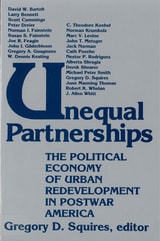
Unequal Partnerships
The Political Economy of Urban Redevelopment in Postwar AmericaEdited by Gregory Squires
Rutgers University Press, 1989
Unequal Partnerships explores urban development in American cities since World War II. Gregory D. Squires and other contributors examine what has long been a highly inequitable and destructive process of urban development. They look at the political and social assumptions and interests shaping redevelopment, the social and economic costs of development for the vast majority of urban residents, and alternative approaches emerging.The book begins with an overview of the ideological forces that have shaped urban economic development in the United States from the urban renewal days of the 1950s and 1960s through the celebration of public-private partnerships in the 1980s. Subsequent chapters examine specific cities in light of the consequences of development initiatives. These cities include those in declining rustbelt regions that are struggling with the consequences of deindustrialization (Boston, New York, Philadelphia, Pittsburgh, Cleveland, Detroit, Chicago, and Milwaukee), as well as growing cities in the sunbelt (Louisville, New Orleans, Houston, and Sacramento). The book concludes with a discussion of promising policy alternatives.
[more]