Results by title
1148 books match the query 'Political Ideologies' and 13 start with u
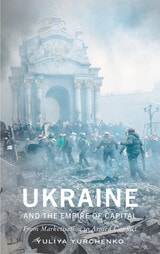
Ukraine and the Empire of Capital
From Marketisation to Armed ConflictYuliya Yurchenko
Pluto Press, 2017
Providing distinctive and unexplored reflections on the origins of the conflict, Yurchenko unpacks the four central myths that underlie Ukraine's post-Soviet reality: the myth of transition, the myth of democracy, the myth of two Ukraines, and the myth of 'the other'. In doing so, she sheds light on the current intensification of class rivalries in Ukraine, the kleptocracy, resource wars and analyses existing and potential dangers of the rightwing shift in Ukraine's polity, stressing a historic opportunity for change.
Critiquing the concept of Ukraine as ‘transition space’, she provides a sweeping analysis which includes the wider neoliberal restructuring of global political economy since the 1970s, with particular focus on Ukraine's relations with the US, the EU and Russia. This is a book for those wanting to understand the current conflict as a dangerous product of neoliberalism, of the empire of capital.

Unbeatable
The Brutally Honest Case for Free MarketsBryan Caplan
University of Chicago Press, 2027
From economist and New York Times bestselling author Bryan Caplan, a provocative and powerful argument for ending the age of big government and embracing free markets as the best tool to foster prosperity for all.
“Markets do the good things that sound bad; governments do the bad things that sound good.” So begins the audacious argument from New York Times bestselling author Bryan Caplan in his essential treatise on modern economies, Unbeatable. Caplan’s case is not merely ideological: he shows compellingly that markets—by lowering prices, giving consumers what they want, and weighing risks—deliver the raw materials for human prosperity that history tells us are unbeatable by other means. Their more popular alternative, governments, focus on addressing crowd-pleasing complaints, incurring high costs and delivering dubious benefits. With this historical foundation, Caplan makes the case for unabashed support of free markets and fervent opposition to government intervention.
Unbeatable imagines a world where markets are allowed in all the places where we think we don’t want them—schools, immigration, social care, and housing policy—and sketches the positive social and economic transformations that would follow from privatization. These include the miracle effects of giving people money instead of Medicare and Social Security; the ability of open borders to solve demographic and labor problems; and the universal benefits of less regulation. In prose that is uncoded and uncommonly honest, Caplan explains how our aversion to markets emerged from our shared wish to avoid wrestling with tradeoffs—the social desirability bias that leads us to favor bad things that sound good over good things that sound bad. Markets, it turns out, can save us from those disappointments, especially compared to the alternatives. Unlike many free-market economists, Caplan freely concedes the ugly downsides of the policies he favors—but argues that the policies should be evaluated on their overall performance rather than their emotional appeal.
Unbeatable is the maximalist, politically unbeholden case for markets as tools for human flourishing. For readers with open hearts, it offers nothing short of an antidote to our economic discontents.

Uncivil Agreement
How Politics Became Our IdentityLilliana Mason
University of Chicago Press, 2018
Political polarization in America is at an all-time high, and the conflict has moved beyond disagreements about matters of policy. For the first time in more than twenty years, research has shown that members of both parties hold strongly unfavorable views of their opponents. This is polarization rooted in social identity, and it is growing. The campaign and election of Donald Trump laid bare this fact of the American electorate, its successful rhetoric of “us versus them” tapping into a powerful current of anger and resentment.
With Uncivil Agreement, Lilliana Mason looks at the growing social gulf across racial, religious, and cultural lines, which have recently come to divide neatly between the two major political parties. She argues that group identifications have changed the way we think and feel about ourselves and our opponents. Even when Democrats and Republicans can agree on policy outcomes, they tend to view one other with distrust and to work for party victory over all else. Although the polarizing effects of social divisions have simplified our electoral choices and increased political engagement, they have not been a force that is, on balance, helpful for American democracy. Bringing together theory from political science and social psychology, Uncivil Agreement clearly describes this increasingly “social” type of polarization in American politics and will add much to our understanding of contemporary politics.
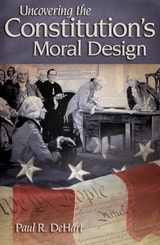
Uncovering the Constitution's Moral Design
Paul R. DeHart
University of Missouri Press, 2007
In critiquing previous attempts at describing and evaluating the Constitution’s normative framework, DeHart demonstrates that the Constitution’s moral framework corresponds largely to classical moral theory. Using the method of Inference to the Best Explanation to ascertain our Constitution’s moral meaning, he challenges the logical coherency of modern moral philosophy, normative positivism, and other theories that the Constitution has been argued to embody, offering instead an innovative methodology that can be applied to uncovering the normative framework of other constitutions as well.
Undead Labor
Capitalism's Zombie WorkerDavid Bering-Porter
University of Minnesota Press, 2026
How the zombie represents capitalism’s fantasy of limitless labor
Much more than just an enduring figure of horror entertainment, the zombie is a uniquely modern symbol representing capitalism’s most brutal demands on human life. Examining the push to extract surplus value from human bodies in ways that exceed their natural limits, David Bering-Porter shows how this notion of the undead is both integral to and symptomatic of capitalism’s endless cycle of growth and consumption.
Bering-Porter demonstrates how the zombie has long been deeply intertwined with issues of race and exploitation, from its origins in the slave plantations of colonial Haiti to its traces in the continuing evolution of artificial intelligence systems, serving as capitalism’s ideal worker: one that never rests, never stops, and never dies. Featuring close readings of Marx alongside films such as I Walked with a Zombie, The Blob, and Night of the Living Dead, the book traces the concept of undead labor as it manifests across various historical epochs, providing insight into the manifold ways that capitalism has sought to transform living beings into instruments of limitless production.
As he weaves together critical race studies with an analysis of popular culture and media, Bering-Porter interrogates racialized capitalism and its fantasy of labor beyond all limits. By highlighting how the zombie is borne of the same ideology that has given rise to contemporary burnout culture and environmental collapse, Undead Labor uncovers the capitalist system’s relentless death drive with the hope that it finally may be put to rest.
Retail e-book files for this title are screen-reader friendly.
Under the Cover of Chaos
Trump and the Battle for the American RightLawrence Grossberg
Pluto Press, 2018
Lawrence Grossberg shows that the truth is bigger and more frightening. Locating Trumpism in the long struggle among traditional conservatism, the new right and the reactionary right, he suggests that the chaos is far more significant and strategic ... and dangerous. Taking the arguments of the reactionary right seriously, he projects a possible, nightmarish future: a cultural nationalism governed by a popular corporatocracy.
He lays bare how contemporary political struggles are being shaped by a changing national landscape of moods and feelings, marked by a growing absolutism of judgement and belief, and new forms of anxiety, alienation and narcissism.s—and lays out a possible nightmare future: a vision of a political system controlled by corporate interests, built on a deliberate dismantling of modern politics.

Under the Radar
Tracking Western Radio Listeners in the Soviet UnionR. Eugene Parta
Central European University Press, 2022
Western democracy is currently under attack by a resurgent Russia, weaponizing new technologies and social media. How to respond? During the Cold War, the West fought off similar Soviet propaganda assaults with shortwave radio broadcasts. Founded in 1949, the US-funded Radio Free Europe/Radio Liberty broadcast uncensored information to the Soviet republics in their own languages. About one-third of Soviet urban adults listened to Western radio. The broadcasts played a key role in ending the Cold War and eroding the communist empire.
R. Eugene Parta was for many years the director of Soviet Area Audience Research at RFE/RL, charged among others with gathering listener feedback. In this book he relates a remarkable Cold War operation to assess the impact of Western radio broadcasts on Soviet listeners by using a novel survey research approach. Given the impossibility of interviewing Soviet citizens in their own country, it pioneered audacious interview methods in order to fly under the radar and talk to Soviets traveling abroad, ultimately creating a database of 51,000 interviews which offered unparalleled insights into the media habits and mindset of the Soviet public. By recounting how the “impossible” mission was carried out, Under the Radar also shows how the lessons of the past can help counter the threat from a once and current adversary.
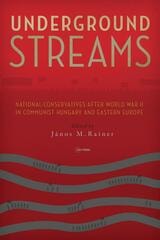
Underground Streams
National-Conservatives after World War II in Communist Hungary and Eastern EuropeJános M. Rainer
Central European University Press, 2023
The authors of this edited volume address the hidden attraction that existed between the extremes of left and right, and of internationalism and nationalism under the decades of communist dictatorship in Eastern Europe. One might suppose that under the suppressive regimes based on leftist ideology and internationalism their right-wing opponents would have been defeated and ultimately removed. These essays, on the other hand, recount the itinerary of survival and revival of "right-wing" thought and activities under communist dictatorship. Resistance and accommodation are explored in the various phases from the Stalinist era to the demise of the Soviet Bloc, with the continuity provided by tacit or concealed right-wing discourses receiving particular consideration. The Eastern European right, both in its conservative and fascist version, centered on nationalism, a legitimizing factor that increased with the downfall of the regimes, and the authors thus accord nationalism special attention.
Two documentary sources for these essays that stand out are files of the security services and the exceptionally rich Oral History Archive compiled by the 1956 Institute in Budapest, Hungary.
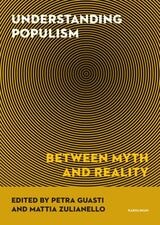
Understanding Populism
Between Myth and RealityEdited by Petra Guasti and Mattia Zulianello
Karolinum Press, 2026
A concise and analytically rigorous guide to one of the most contested concepts in contemporary politics.
Understanding Populism is driven by a clear objective: to advance understanding of populism by systematically dismantling the myths that continue to dominate public discourse and, at times, academic debate. The book approaches populism as a coherent yet flexible set of ideas that can be analyzed through careful conceptual clarification and comparison.
The book opens with an unconventional introduction structured as a dialogue that directly addresses common misunderstandings and establishes the volume’s analytical orientation. The core of the book consists of 101 short chapters organized into six thematic sections, each devoted to critically examining a central myth about populism. Each section concludes with a synthetic reflection highlighting key insights.

Unfinished Socialism
Pictures from the Kádár EraAndrás Gero
Central European University Press, 1999
This extraordinary book provides a snapshot of socialism throughout the Kádár regime in Hungary (1956-1989) and captures the essence of the world behind the ‘iron curtain’ in a stunning, and often stark, collection of photographs.
Unfinished Socialism is a visually stunning anthropological study containing 450 photographs, many previously unpublished, which portray life in Hungary from every angle: from the May Day March to pop music and from the homeless to sport.
With an introduction that will help the reader understand and appreciate the true meaning of the photographs, this political, social and cultural study of the Kádár years transports the reader back to a time of great significance in Hungary’s long and turbulent history.
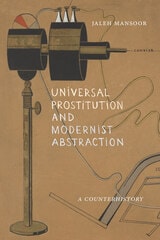
Universal Prostitution and Modernist Abstraction
A CounterhistoryJaleh Mansoor
Duke University Press, 2025

Uprooting Racism and Racists in the United States
James Boggs and Grace Lee Boggs
Disobedience Press, 2027
“Uprooting Racism and Racists in the United States” has become even more timely and instructive today than when James and Grace Lee Boggs first sounded the alarm in 1970. In this essay, the Boggses diagnose the “essential contradiction” of economic overdevelopment and political underdevelopment, tracing its path through key stages: how racism has been interwoven into U.S. economic development; a destructive national drive for economic growth at all costs; and how subsequent generations of Americans prioritize economics over principles—breeding a collective social irresponsibility that leaves us unable to act ethically in the face of pressing social challenges.
Today, the contradiction the Boggses identified has grown more entrenched—and its consequences more destructive. “Uprooting” helps explain why millions voted for Trump in 2024 despite his demonstrated corruption, why society fails to regulate the expansion of AI and data centers, why we are unable to forestall the climate changes that scientists have long warned against, why immigrants face racist vilification, and why the federal government is intent on erasing the centrality of race to the making of the country. Ultimately, “Uprooting” offers a crucial assessment of where this contradiction began, how it shapes the nation, and where we need to go.

Uranium Matters
Central European Uranium in International Politics, 19001960Rainer Karlsch
Central European University Press, 2008